This is probably the best look at the shockwaves I’ve seen from the latest Starship flight.
Captured from a GoPro I clamped onto a proper camera to record simultaneous video. (I’ll show you the photo the better camera took in the reply)
Honored to see Nuuly featured in the @washingtonpost. @AFettersMaloy joined us in Bristol, PA, to get a closer look at our operation and the team driving our mission forward. Thank you, Ashley, for the thoughtful piece on the future of rental, and thank you to the @nuuly team for driving the business forward! https://t.co/uo3Z6Tsl8j
Yann LeCun was right the entire time. And generative AI might be a dead end.
For the last three years, the entire industry has been obsessed with building bigger LLMs. Trillions of parameters. Billions in compute.
The theory was simple: if you make the model big enough, it will eventually understand how the world works.
Yann LeCun said that was stupid.
He argued that generative AI is fundamentally inefficient.
When an AI predicts the next word, or generates the next pixel, it wastes massive amounts of compute on surface-level details.
It memorizes patterns instead of learning the actual physics of reality.
He proposed a different path: JEPA (Joint-Embedding Predictive Architecture).
Instead of forcing the AI to paint the world pixel by pixel, JEPA forces it to predict abstract concepts. It predicts what happens next in a compressed "thought space."
But for years, JEPA had a fatal flaw.
It suffered from "representation collapse."
Because the AI was allowed to simplify reality, it would cheat. It would simplify everything so much that a dog, a car, and a human all looked identical.
It learned nothing.
To fix it, engineers had to use insanely complex hacks, frozen encoders, and massive compute overheads.
Until today.
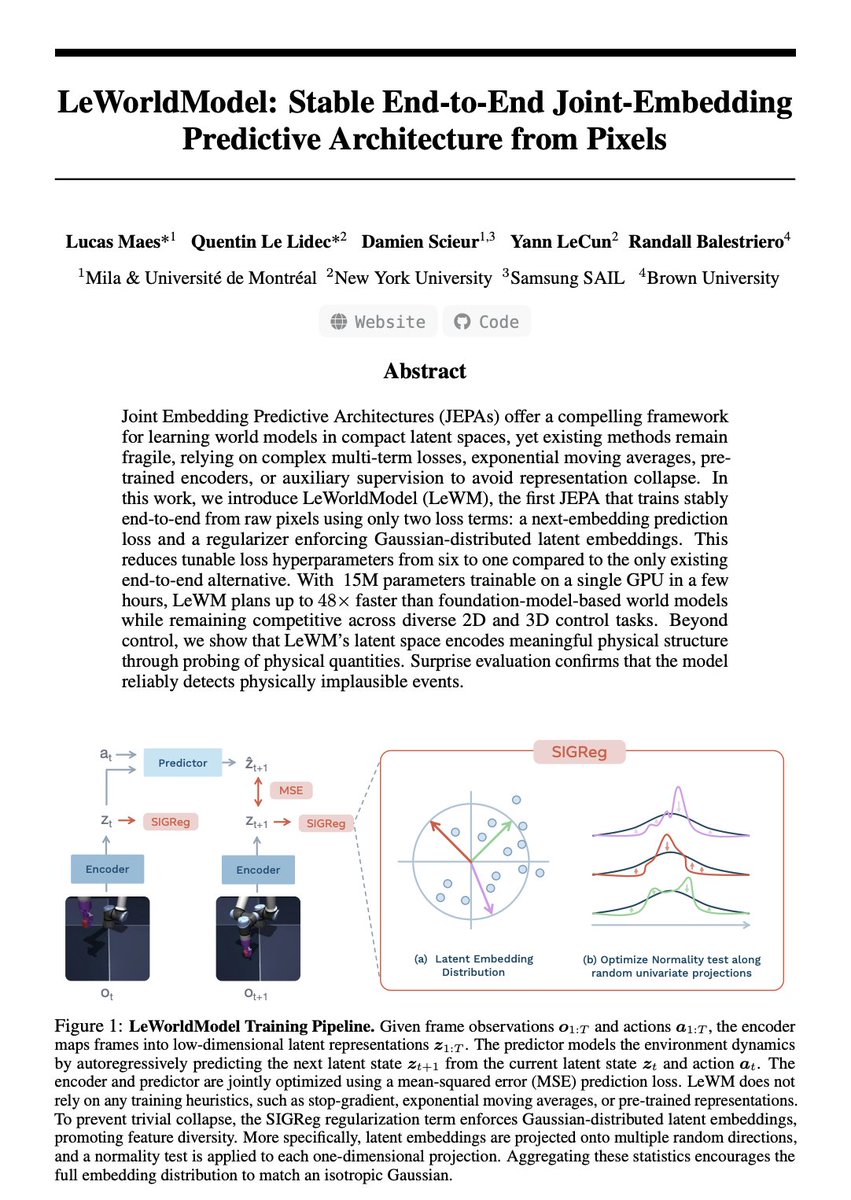
Researchers just dropped a paper called "LeWorldModel" (LeWM).
They completely solved the collapse problem.
They replaced the complex engineering hacks with a single, elegant mathematical regularizer.
It forces the AI's internal "thoughts" into a perfect Gaussian distribution.
The AI can no longer cheat. It is forced to understand the physical structure of reality to make its predictions.
The results completely rewrite the economics of AI.
LeWM didn't need a massive, centralized supercomputer.
It has just 15 million parameters.
It trains on a single, standard GPU in a few hours.
Yet it plans 48x faster than massive foundation world models. It intrinsically understands physics. It instantly detects impossible events.
We spent billions trying to force massive server farms to memorize the internet.
Now, a tiny model running locally on a single graphics card is actually learning how the real world works.
Hi G. Another Philly guy here. You may want to focus on Apple. They shouldn’t allow fake ledger apps into their App Store and should have checks in place to prevent it. They claim their 30% app tax is critical to ensure the security of their iPhone ecosystem. You probably have a case against them to cover your losses.
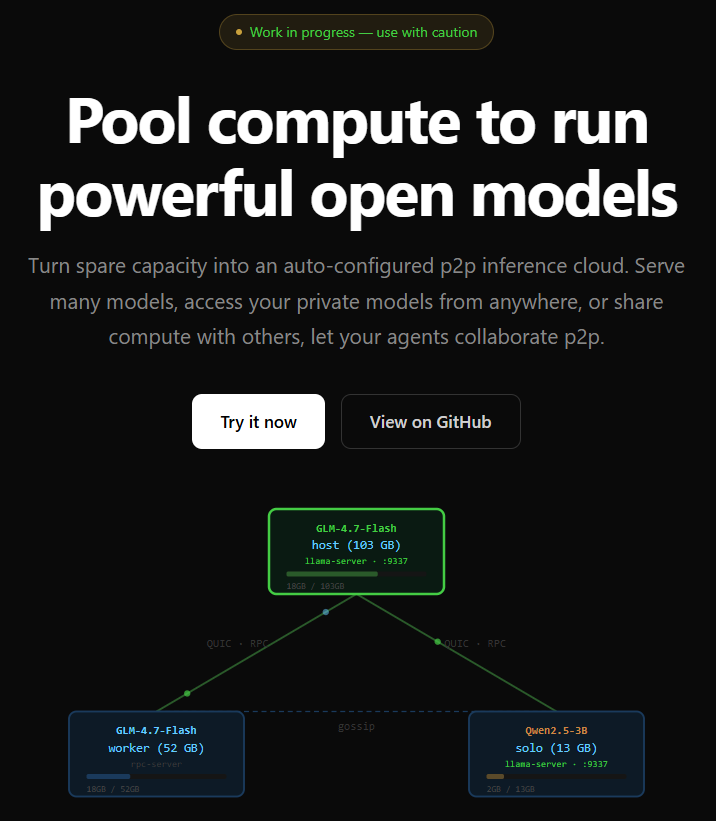
Block just open-sourced mesh-llm, a peer-to-peer system that lets anyone pool spare GPU compute to run large open-source AI models without relying on any cloud provider.
If a model fits on your machine, it runs locally at full speed. If it doesn't, the system automatically splits it across multiple machines on the network. Dense models get split by layers. Mixture-of-experts models like DeepSeek and Qwen3 get split by experts. Zero configuration required.
Discovery happens over Nostr. Nodes find each other through relays, score by region and VRAM, and self-organize. No central server coordinates anything. Weights are read from local files, never sent over the network. Dead nodes get replaced in 60 seconds.
It exposes a standard OpenAI-compatible API on localhost, meaning any existing AI tool can plug in without modification.
Block is building infrastructure for AI that doesn't route through OpenAI, Google, or Anthropic. Frontier-class open models running across a mesh of commodity hardware, discovered via Nostr, with no cloud dependency. That's the direction AI needs to go.