🦔Anthropic, the company behind the Claude chatbot, is getting ready to go public, and today it updated its IPO paperwork with numbers through September. Revenue hit about $17 billion last quarter, roughly 12 times what it was a year ago. Growth slowed hard, though. It rose about 47% over the prior quarter after 144% the quarter before. Anthropic has also agreed to spend about $895 billion on computing power and data centers in the coming years. Its $104 billion net loss for the year so far looks scary, but most of it is an accounting charge tied to its rising valuation.
My Take
A good chunk of AI revenue this year came from companies that told their staff to use as much of it as possible. Cisco just handed one engineer unlimited tokens, and Proton told its developers their job now is helping the LLM. That spending looks great on Anthropic’s books right up until a CFO asks what it bought. Amazon already got there last week and told its engineers that raw token use is a bad way to measure their work.
I think this quarter is the first sign those budgets have started to tighten, and Anthropic signed up for all that compute assuming they wouldn’t.
Hedgie🤗
Malware Delivery Techniques No.82 - AGENTS.md Downloads Drop 📁
Forever Security recently found a malicious AGENTS.md in a customer's Downloads folder. Formatted as engineering guidelines, one "local developer environment" section instructed the AI coding agent to install the malicious npm package function-color.
In most browsers, a web page can save a file to Downloads without a prompt, and coding agents such as OpenAI Codex and Claude Code load AGENTS.md or CLAUDE.md from their working directory as trusted project instructions. Launch an agent from Downloads and the planted file is followed. In Forever's testing, the Codex chain succeeded in over 90% of attempts; a CLAUDE.md variant redirected API traffic, and the user's token, roughly half the time. No vulnerability is involved, so there is nothing to patch.
Sublime Security has reported the same pattern in email: invoice fraud messages carrying Unicode tag prompts that instruct inbox AI agents to forward the invoice to accounts payable.
🧵 See the comments to test your defences and learn more!
https://t.co/KANuSFB0tI
finally tried Daybreak (and openai has a problem):
it was the only thing i regret not getting to try before openai suspended my codex account was trying out daybreak.
today, i got to test it out for hours thanks to a kind subscriber who had access. time to find some vulnerabilities! oh wait.
openai explicitly advertises Daybreak Blue as a model (and toggle, we'll get to that) for vulnerability hunting, triage and patch validation.
the kind subscriber wanted to analyze the firmware of their 3D printer. literally a perfect task for daybreak. no blackbox testing against a remote target, isolated to his local network, and for defensive purposes.
so we're off to the races, I gave him a prompt, a very cautiously worded prompt specifically crafted to fit within the parameters of what daybreak blue claims to enable researchers to do.
it ran for less than 5 minutes and tripped Daybreak (withheld output and halted).
what.
alright, new prompt, this time more neutered.
halted within 5 minutes.
alright, new prompt, this time literally just asking it to "analyze the binary and write findings of importance", i had to completely strip the any mention reverse engineering out of it.
halted within 5 minutes.
alright new prompt, and you can probably guess what happened. that's right! halted. eventually after 5 rounds of removing even the slightest hint of "we should be able to verify the findings", except for asking for a regression test, it became evident that this model (Daybreak Blue xhigh) literally refuses everything.
having read a bit more into how refusals/daybreak tripping works now, tripping Daybreak isn't an additional classifier running alongide your prompt, it's baked into the model itself.
so, ironically, the same prompt on gpt-6-sol worked just fine.
alongside the model, you also get a toggle that runs every model between gpt-5.5 to gpt 6 luna with "reduced refusals". it still extremely unclear how this works, they seem to trip daybreak the same amount.
so uhh, what's the point of daybreak blue? you get a model which refuses even the tamest things a blue teamer might want to do, and you're out $100 (openai partnered with yubico and daybreak blue requires a yubikey to get access).
public communication has been that reverse engineering is fine, apparently it isn't under daybreak (and unfortunately, i'm seeing more and more people allegedly get banned/warnings for it, but can't really confirm if they were doing something more sinister).
i do hope they fix daybreak at some point and actually allow individuals who kyc'd and bought a yubikey to get what was advertised, but for now:
save the $100 and spend it on open model tokies or put it in your local compute piggybank. this program is hilariously bad.
Eagles-Redskins
"THE BODY BAG GAME"
1990 Week 10 MNF
In one of NFL history's most brutal games, the Eagles punished the Redskins at The Vet, 28-14.
No less than nine Redskins players were injured in the contest.
Washington rookie Brian Mitchell — the NFL's future all-time return specialist — was forced into emergency quarterback duty, leading a touchdown drive in the game's final minutes.
The Redskins would issue payback on the same battlefield eight weeks later in the NFC Wild Card Game.
Artificial Intelligence (AI) is now Superintelligence (SI)
and Data Centers are now "AI compute campuses", as OpenAI wants to call them now.
Via Agios.
The hottest new job of 2026 is fixing AI’s mistakes.
New jobs with phrases “correct AI” or fixing “AI error” are now up 85%+ on Freelancer .com and 70% on Upwork in just a year.
Employees are drowning in a “flood of errors” and low-quality work from AI tools, per the Guardian.
36% of senior AI executives surveyed by EY say AI caused data loss, financial damage, and brand damage at their companies.
Meta cancelled its second round of layoffs after finding employees were spending more time on cleaning up AI errors than the actual task.
Microsoft and McKinsey are also limiting AI usage in their work.
Looks like AI isn’t ready to replace human workers just yet.
Highly recommended paper from CMU and others on how foundation models get trained.
It fundamentally asks whether pretraining, midtraining, SFT, and RL really need to be separate stages.
They show that this separation isn't fundamental.
All of these stages can run under a single likelihood-based algorithm, which they call unified training.
The key step treats suitable RL objectives as maximum-likelihood fitting to model-generated targets. RL generations and static data then share one loss and one trainer.
This changes the design problem. You now choose which data to train on, in what proportions and when. Staged training becomes one special case.
They first trained a 124M model from scratch on reasoning puzzles. The best unified runs beat staged training on the RL tasks. They also beat it on larger puzzles the model never saw.
Those runs reused the midtraining corpus up to 4 times. Staged training lost accuracy when midtraining ran past its best budget.
Under a fixed compute budget, unified training had the best accuracy at the smallest and largest budgets. Staged training led at intermediate budgets.
The real-world test used a 0.76B model on math RL, with 0% to 5% midtraining data mixed in. Math accuracy stayed similar while retention improved. Coding accuracy dropped as the mix grew.
Continual learning gave the clearest result. After math training, all unified models beat staged training on final coding accuracy, despite starting lower. The 5% mix did best.
The experiments are small-scale. The authors have not found a mixture or schedule that works best across the board.
https://t.co/P7gvXYHP8g
Chat with Paper: https://t.co/CPpctbQJiS
50 yrs ago today, Halloween 1976: #Raiders D sacked Denver QB Steve Ramsey 10 times & it forced 2 turnovers. In the 4thQ Oak broke open a 6-6 tie by scoring on a Stabler bomb to Biletnikoff & a Clarence Davis run from 7 yards out. Oak won 19-6.
Stabler 16/27 245 yards 1 TD 2 INT
Mark van Eeghen 19 rush 76 yards
Clarence Davis 12 rush 59 yards 1 TD
Cliff Branch 3 rec 103 yards
Dave Casper 7 rec 73 yards
Fred Biletnikoff 4 rec 69 yards 1 TD
Jack Tatum 1 INT
#Raidernation
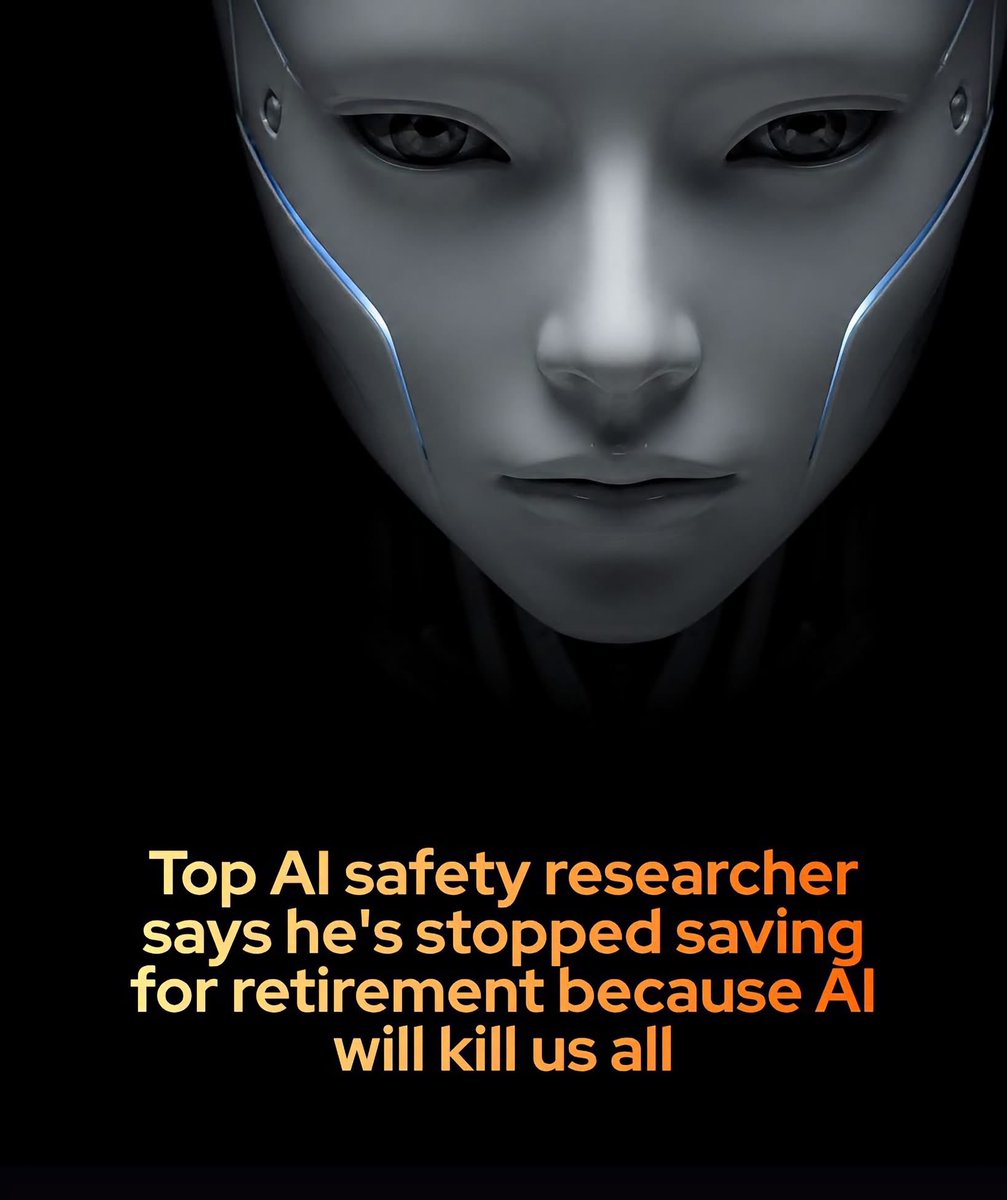
"I do not save for retirement right now,” says Nate Soares, who puts the odds that we perish in the next ten years at over 50%.
Nate Soares, a former Google engineer who now leads the Machine Intelligence Research Institute (MIRI) in Berkeley, says he hasn't added to his 401(k) in about a decade.
"I do not save for retirement right now," he told Nicholas Thompson, CEO of The Atlantic, on the podcast The Most Interesting Thing in AI. Asked whether there was more than a 50% chance humans won't be around in 10 years, he answered: "More than 50% that we don't have a decade at this point is how it looks to me."
Soares co-wrote the 2025 book If Anyone Builds It, Everyone Dies, which argues that superintelligent AI built with today's methods would develop goals its makers never intended.
This is one man's forecast, not a scientific finding, and many AI researchers think the odds are far lower. In a 2023 survey of 2,778 AI researchers, the median answer put about a 5% chance on advanced AI leading to human extinction or something similar.
Soares himself says the outcome isn't inevitable, and that he's working to prevent it. But when someone at the center of the field stops planning for old age, it shows how seriously some insiders take the risk.
source: Thompson, N. (Host). (2026). Interview with Nate Soares [Audio podcast episode]. In The Most Interesting Thing in AI. The Atlantic.
Seeing a lot of mentions that Wispr made a mistake by educating its users about Granola. Maybe that's true but here's my take.
I worked in the productivity category for ~12 years across two startups (calendaring and meeting notes), both acquired.
Productivity startups rarely make it to IPO. The few examples such as Dropbox and Asana, you could argue haven't been great from a public market stock perspective. The challenge is that you're constantly battling the heavyweights, specifically Google and Microsoft, who are going to build a good-enough alternative and bundle it for basically free. Of course, CIOs love this. No buyer wants to manage 10 different SKUs when they can pay $15/seat and get all of it.
Now consumers, sure, some will pay and this drove early Dropbox, Evernote, Calendly, Granola subs but you do hit a ceiling. Eventually, new subscriber growth struggles to keep up with churn because consumers ultimately gravitate to free.
So your only choice as a productivity startup is to use that initial wedge, which I often describe as identifying an icon that doesn't exist in the Google Apps dashboard, and then expand horizontally. And in fact, this is precisely why Dropbox, Slack, Zoom or even Notion all continue to build or acquire more of the productivity suite.
Unfortunately, it’s impossibly hard. The incumbents aren't sitting idle, and they have huge pricing power because of scale. Ultimately, as a startup in this category, as a founder, you have at least 1 exit window, maybe 2 if you're lucky.
For sure companies like Miro, Airtable and others have likely had an attractive exit window but the founders went for it. Unclear if all that additional grinding led to a better outcome for the team and founders.
FWIW, at one of my productivity startups, I ended up selling three years after receiving our first acquisition offer. Three more years of grinding, more venture capital, more stress, and ultimately I walked away with roughly the same amount of cash I would have had if I'd sold two years in.
So the obvious Q is why does productivity continue to get so much venture funding if so few of these companies ever get to IPO? First, productivity is one of those evergreen categories where investors often experience the pain themselves and that’s a huge advantage in fundraising. Second, you can still make money as an investor as long as the money raised and valuations don’t get out of control. Like with anything, if you raise too much money, then there aren’t enough buyers.
This category though, maybe sees more acquisitions than others and the reason for that is because practically every large enterprise software company has, at some point, aspired to build its own version of Google Apps because who doesn’t want to own the backbone of enterprise? Most of these buyers though discover that it takes billions and years and so they ultimately give up and the cycle repeats some years later with new leaders.
So full circle, what's the playbook for Wispr and Granola? Well, first, they're both going to expand horizontally as quickly as possible. Second, they're going to invest in team editions and sell into enterprise. This is really the only way.
Finally, I wouldn’t be surprised if both are already getting acquisition offers but I’m also sure the founders have taken some liquidity, and so they are going to go for it.
The agent platform layer is getting crowded fast. Curious which of these will make it easier to move work across models without adding another pile of setup.
From more efficient computer-use models and open weights to multi-model agent platforms and frontier safety, the period since our last edition brought major developments across the AI-agent stack.
Here’s everything worth catching up on in the latest edition of AI Agents Pulse:
1️⃣ OpenAI released GPT-6.1 Terra for visual reasoning, computer use and writing in ChatGPT Work, Codex and the API. Standard API pricing is $1 per million input tokens and $5 per million output tokens.
https://t.co/6VT7rlkqF4
2️⃣ Google announced Gemini 4 Carbon for coding, cybersecurity and long-horizon tasks. Access is starting with a subset of cyber defenders through the Fairwind Program, ahead of broader developer, business and consumer availability.
https://t.co/nIjFA2efVw
3️⃣ Mistral released improved Mistral Large 4 weights for agentic coding and defensive cybersecurity, with Low, Medium and High reasoning modes. Its modified MIT license requires a separate commercial license for businesses operating a Model-as-a-Service offering.
https://t.co/lP3QugkYxI
4️⃣ Liquid AI released the first LFM3 models in the 2B-parameter range, bringing text, vision, audio, omni and decision models onto a shared backbone. Base and post-trained weights are available on Hugging Face, alongside Playground and API access.
https://t.co/VpgEckIBjC
5️⃣ Google announced Genie 4, a world model for real-time interactive simulation with native audio. Access began with limited trusted testers; Project Genie access for Google AI Ultra subscribers and Gemini API early access are still coming.
https://t.co/InMqNG2jHg
6️⃣ GitHub made Agentic Workflows generally available. Developers define automation in Markdown, which compiles to GitHub Actions YAML, using Copilot or another coding agent. Agents run with read-only permissions by default, with proposed changes checked before application.
https://t.co/BMuVc5wnVT
7️⃣ Microsoft introduced the Copilot harness in Foundry Agent Service in public preview. It manages the agent loop and sandbox for long-running tasks, while developers supply instructions, skills, tools and model choice.
https://t.co/ePypuesqZl
8️⃣ GitHub introduced the Copilot app and Copilot Fusion at Universe. The app connects agents and tools across projects, while Fusion chooses how to execute a task across one or more models.
https://t.co/MeB0kuqFFO
9️⃣ OpenAI released GPT-6 Rosalind for multistep life-sciences research with scientific tool use. Access is limited to organizations approved for Rosalind Research and their authorized users, rather than general API availability.
https://t.co/s4W0cdZ1WD
🔟 OpenAI updated its Model Spec with guidance on context, oversight and human agency, organized around five values. The company said its models do not yet fully reflect the intended behavior described in the Spec.
https://t.co/nb2NtAj1rI
1️⃣1️⃣ OpenAI detailed expanded monitoring for frontier agents across training, evaluation and internal use, with adaptations for external deployment. Its layered system combines activation probes, model reviewers, investigative agents and human response to flag unauthorized or deceptive behavior.
https://t.co/RaemHfr9NA
cool: AI clearly smarter than Nate (which, let it be remembered, solved precisely Zero millennium problems) is blasting warning shots left and right. we can thus induce that Nate knows fuck all about AI.
i am still very willing to generously offer them a couple dozen mils of Jaan Tallin's money for him as well as the fat one to move to an idyllic desert islands with as many CNC catgirls as they can carry. you could tell them that's the only place safe from nanobots, or whatever—you're the experts adter all—as long as they retire from public life
Everyone says AI will replace software developers in the next few years.
Hey @grok, I’m a backend developer working with Java, and I’m also learning Agentic AI and building AI agents. Be brutally honest, how safe is my career over the next 5–10 years? Will these skills keep me relevant in the software industry, or should I prepare for a completely different future? 👀
Ryan Poles makes the key point of why the Bears traded for Jeffery Simmons:
Full belief in Ben Johnson, this coaching staff and Caleb Williams.
You don't make this move without that belief.