@mikecoops85 Agree but I think everyone thought the same when Hinsh went and Maynard came in. I’m not sure about this at all but I think the owners have probably earned the right to make big calls given they’ve got most of them right before.
@LiamRawcliffe1@LSissoYCFC I’m going to guess based on nothing other than how these things normally go that it’s because he wanted more control over recruitment, and the club didn’t want to give him it
EXC: Andy Burnham will accelerate a plan to give some income tax receipts to mayors.
Treasury officials are working up a plan to present to Burnham’s Chancellor next week, after access talks on his priorities.
Money is most likely to be given to the seven “established” mayors, including in London, Manchester, Liverpool and the West Mids. Six of the seven are held by Labour (Manchester is vacant).
Under the plans, mayors would retain a proportion of income tax receipts and invest it in local growth schemes. They would then receive more money to invest if the schemes work.
Burnham will argue that in other Western countries with high levels of fiscal devolution, wages are higher. OECD data shows this trend in Germany, the US and Switzerland.
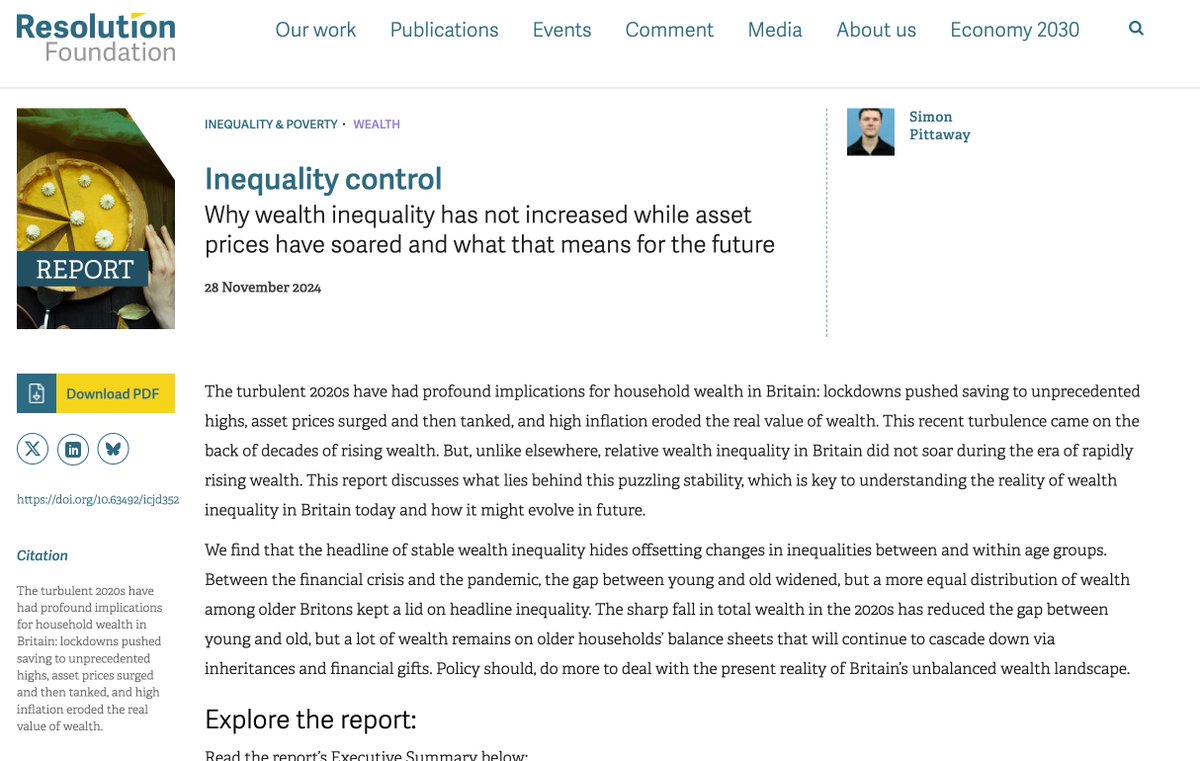
I am *not* an expert in equality. But I sense it's all much more nuanced than Stevenson's videos suggest. I worry a lot about the inability of young people to buy houses. That's very little to do with billionaires.
This is excellent: https://t.co/zmE6m0Glkp
Clear and cogent - the Equality Act needs urgent reform. How on earth can a tribunal judge decide if a job is 'of equal value' compared to a completely different job better than a market can?
In the case of Next, in 2024 an employment tribunal decided that its shop workers must be paid the same rate as warehouse staff.
This is despite the very same tribunal revealing that in 2021 the company offered 25,000 retail workers the chance to transfer to better paid Warehouse roles. Just seven took up the offer, and of those three quit within the year.
The judge still determined the jobs as 'of equal value', meaning they must be paid the same.
1 - 🏴 England are the first team ever to beat 🇲🇽 Mexico at the Estadio Azteca in the FIFA World Cup - they were unbeaten in 10 games there before today.
Altitude?
I'm enjoying the cold wave of embarrassed fear that has swept the British political commentariat since Burnham's Reddit AMA. Everyone knows he is going to be a total disaster the moment he lands in office, but nobody on the left can break cover to attack him.
I think Andy Burnham should champion the idea of 'municipal socialism': having utilities owned by local governments, primarily combined authorities, rather than the national monopoly that nationalisation usually entails. This may already be what he is planning, but he hasn't really said so yet.
Nationalised monopoly fails for many reasons:
- It creates entities that are too big to fail, so they can waste large amounts of money while being subsidised from public funds.
- It gives people no comparison point to see if a certain industry is being well-run, so bad outcomes end up being treated like bad weather.
- It prevents the public companies themselves from learning from other companies, because they only have other countries to learn from where circumstances might be very different.
- It creates very weak political feedback mechanisms, because your vote on whether the trains are being run well is bundled with your vote on, eg, tax policy and foreign policy.
- It engenders short-termism, because voters are less forward looking than private investors, so there is more scope to take long-term degradation of service for short-term benefits. (This is happening with TfL's fare freeze right now.)
Municipal ownership does not solve all these problems, but it can maintain more accountability and some of the elements of competition that national monopoly does not have.
There is more room for experimentation and learning because different municipalities try different policies, and can copy the successes from each other. The Oyster Card and contactless card payments were a good example of this by TfL. Manchester's bus privatisation scheme was scrapped in part by looking at the success of London's approach to buses, where delivery is outsourced to multiple private companies but services are designed by a single authority and provided under one brand.
The 'too big to fail' problem is smaller, because municipal governments can face a harder budget constraint than national government, though bailouts undermine this. Those that want to subsidise services have to draw on a narrower tax base. In fact, well-run services can raise revenues for local governments, as many locally-owned tramways did in the 19th and early 20th Centuries. Local authorities are more accountable for failures and get more credit for successes than national governments would be.
Internationally, successful examples of public ownership of utilities are often owned by municipalities. This is true in much of the United States, where water is mostly municipally owned rather than private, and in France, where most public services are owned by local governments, who then offer contracts to companies to handle the actual delivery. The Bee network and London buses operate on the same basis.
Historically in Britain, trams, electricity and gas were all mostly run by small local companies and local governments before the 1940s–70s. Municipally-owned gas networks were highly profitable for Birmingham under Joseph Chamberlain. There were still nearly 200 different water boards across England by 1970!
We use 'nationalisation' as a byword for 'public ownership', but there is little reason for most of these things to be nationalised monopolies. Much of the drive towards nationalised monopoly in the 20th Century was inspired by a mistaken belief that economies of scale would drive the biggest improvements in productivity, inspired by the apparent success of the USSR and large conglomerates in Germany and the USA. It is clear today that experimentation via trial and error is extremely valuable, and losing it is one of the big costs of monopoly.
'Municipalisation' would, for example, mean overhauling the Great British Railways policy which by default puts commuter lines in Surrey into the same administration that runs the West Midlands Cross-City Line, the East Coast Main Line, and commuter networks in Manchester, Leeds and Liverpool. There are some provisions for lines going into municipal control, but the default is to stop the next Mayor of Greater Manchester from running the region's commuter trains and London from absorbing more lines into the Overground.
Public ownership has many flaws, but some of them are avoidable by looking beyond the 1940s and 1970s for how to do it. 'Municipal socialism' allows for much greater learning and feedback loops, and would hugely strengthen devolution by making local government responsible for things that directly matter to their electorates rather than having them run by a single inert national monopoly.
Voters often say they want a normal bloke as PM. But in reality they emphatically don't. To be an effective PM you have to live and breathe politics. You have to relish the job and the argument.
You can't be the kind of person who would rather watch Sky Sports than debate welfare reform.
We discussed this on Chopper's Political Podcast w/@christopherhope@forster_k
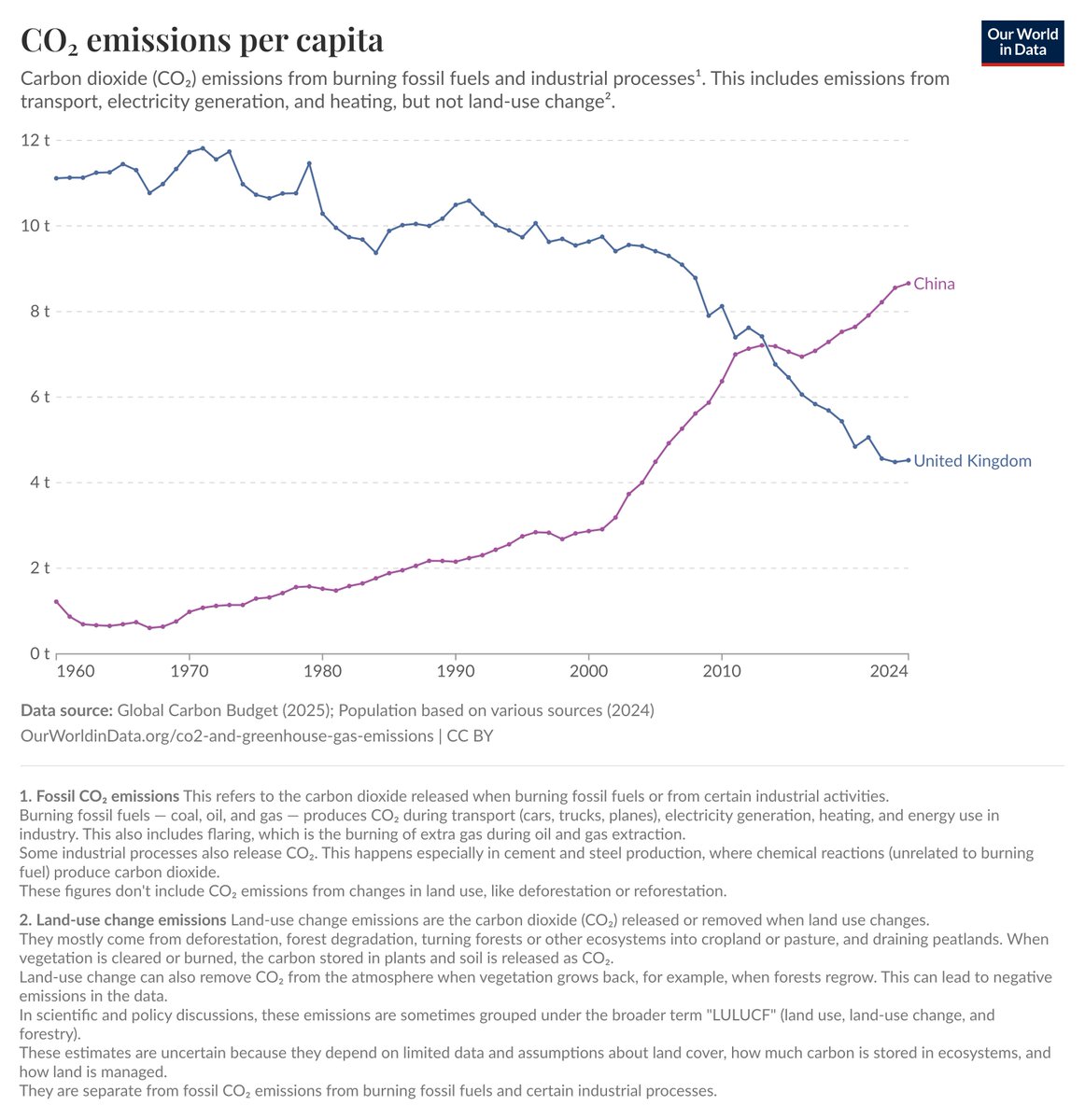
This is characteristically excellent from @jburnmurdoch. The arguments for degrowth were never strong. But the strongest – environmental damage from growth – turns out to be false.
For developed countries, growth is associated with decarbonisation: households switch to EVs & heat pumps, grids use more efficient, green technologies, and less gets wasted.
Full piece in the FT: https://t.co/2yQvrrF7go
Reminder: Hinkley Point C (7% of Britain's electricity needs) is at risk of delay due to Natural England's view that the £700m on fish mitigations isn't enough.
https://t.co/xnH9jma4xV
the mental thing is: British electricity demand is highest in winter. We have spare capacity in summer PLUS that's when solar panels work best. So air conditioning should be fairly easy to accommodate given current supply! We should ENCOURAGE it!
THE FIVE TESTS
For weeks I've argued that this party, and this country, needs a proper debate about where we go next. Not a reshuffle. Not a few degrees of course correction. The big, difficult, honest choices we've spent thirty years avoiding.
A few people have asked me what that debate should actually be about. Fair enough. I spent 24 years in the Marines and two in government, and I resigned because I couldn't win the argument I believed in from the inside. So let me make it here, plainly.
This isn't a manifesto, but a set of five tests. Anyone asking to lead our country should be able to look down this list and say yes to all five.
1️⃣ The Frontline Test
Do we give the people on the frontline the kit they need to do the job, and stand by them when the job is done?
I joined the Marines at 18. I've buried friends. So I do take this one personally.
I sat in government and watched us write a defence plan for a world that no longer exists, discussed in rooms I was kept out of. A 100k drone is now sinking warships that cost a billion. That is the reality of the wars being fought right now.
Passing this means 3% of GDP as the floor, not the ceiling. Buying for the next war, not the last. And fixing the Legacy Act so blokes in their seventies aren't back in the dock for what they were cleared of decades ago.
2️⃣ The Next-Generation Test
Are we handing the next generation a better deal than the one we inherited, or a worse one?
I'm a lad from a tough part of Aberdeen. My mum raised five of us through some bleak years. The only reason I got out was because I was given an opportunity. That cannot be said for young people today.
Nearly a million young people, around one in eight, are now outside work, education or training. That isn't their failure. It's ours.
Fixing this means a NEETs and youth unemployment target with a date, the youth guarantee delivered not just announced. Restoring the link between work and a decent life for the under 30s, on housing, wages and opportunity. Skills and apprenticeship numbers that beat the last government, not just match it.
Talent is everywhere in this country. Opportunity isn't. Fix that and you fix half of everything else...
3️⃣ The Trillion-Pound Test
Is the plan to add a trillion pounds to what Britain earns, or to manage the decline more politely?
Here's the lesson I learned from Ukraine and in government, and it never changes. We invent things. Other countries build them. Other countries decide. We're brilliant at the first mile and absent for the next ninety nine.
So set a target and be judged on it. A trillion pounds added to our GDP within a decade. Yes, it's ambitious. We should be ambitious!
Getting there means backing the high tech inventors just as much as the high street traders. Your local coffee shop shouldn't be paying more tax per cappuccino than Starbucks does. So why on earth do they?
It means an industrial strategy worth the name. Things to make and things to sell, in Barrow, in Derby, in every region. Our industrial base is national security, so we should fund it like it.
And it means building the chips and the compute here, not inventing the breakthrough and watching someone else scale it. Data is the new gunpowder.
4️⃣ The 10% Test
Can we make the country work 10% better, instead of only ever asking for 10% more?
I saw this from the inside. We patch the symptom this year, but the bill grows next year, and we end up paying for failure at the most expensive end of every system.
A 10% improvement in outcomes across a handful of our biggest problems, ill health, reoffending, wasted potential, would free up somewhere between £40 and £60 billion a year. We're already paying those costs. We just pay them too late, when they're at their worst.
Passing this means investing early instead of paying far more later, and having the honesty to admit that not every pound we spend today delivers an immediate return.
5️⃣ The Lights-On Test
Does our energy policy keep the lights on, the bills down and factories open, or do we keep chasing a target and hope the rest sorts itself out?
For years we've treated net zero as the only goal, and everything else, your bill, our industry, whether the grid even stays up, as a problem for later. That’s the wrong way around.
Make energy security the goal. Power that people, businesses, and industry can afford, and a grid that stays on when someone tries to switch it off. Do that and net zero follows. Chase the target on its own, and you end up with neither.
Passing this means a serious baseload, nuclear and the North Sea, built in time to matter. Strong countries have cheap, secure energy. Weak countries don't.
None of this is complicated. It's the oldest deal there is. You serve the country, the country stands by you. In uniform, in a hospital, in a classroom, on a building site. Right now that deal is broken, and everyone keeping our country going can feel it.
That broken deal is the real reason for the frustration out there. It's why trust has drained out of politics. And it's why our party that won a landslide is, halfway through the term, already arguing about who leads it.
But changing the person at the top fixes nothing if we don't fix the deal underneath. Swap one leader for another and leave the deal broken, and we'll be right back here in eighteen months, asking the same question all over again.
So I'm not interested in who gets what job. I'm interested in whether we've got the courage to pass these tests.
We've been promised a debate. This is my opening offer to it. And if that debate ever becomes a contest, it should be fought on this ground, not on personalities.
I know where I stand.
How should Andy Burnham pick his Chancellor?
At @BritishProgress we polled several bond traders and investors to ask how markets might respond. Here's what we learned:
1⃣The Chancellor has two jobs. They need to be good at both.
Truss & Kwarteng thought they could get away with unfunded tax cuts as long as they were pro-growth. They were wrong.
Reeves has won the trust of bond markets with her fiscal rules, but growth is still lacking.
The Chancellor is responsible for balancing the budget & for growth. Andy's pick must be good at both.
2⃣Markets can see through hollow commitments
In Opposition, Labour tried to reassure businesses that it had moved on from Corbynism. Talking loudly about growth was sufficient. But in Government, you need to back this up with genuine, detailed policy. Markets are more interested in the fine print than newspaper headlines.
3⃣Reform is hard, so pick your battles.
The OBR can feel like an annoyance, but attempts to remove or radically reshape it are likely to be received badly by bond markets.
A new Chancellor should focus on tax reform: particularly cliff edges which penalise working; stamp duty, which should be replaced with a proportional property tax; and greater fiscal devolution.
4⃣Levers for growth are often outside the Treasury
The Treasury is nominally in charge of economic growth, but many of the most powerful levers for growth actually sit in other departments.
In our annual growth survey of economists and policy researchers, respondents rated planning reform, environmental regulations and energy as some of the highest priority areas for growth.
5⃣Not everything requires a fight
Andy is a coalition-building politician, and there are genuine win-wins out there. Densifying urban centres can boost growth without having to fight over greenfield land. Cheaper electricity is better for climate and for household bills.
We have a lot of catch-up growth to do. A new Chancellor has an opportunity to make a real difference.
Read the full piece here: https://t.co/oSTHBA1X0s