Dad to a 3 legged cat. Founding engineer @MultifactorCOM. Prev: founder Keypo (acquired). Passionate about privacy preserving cryptography and hardware.
Keypo is joining Multifactor!
I’ve been working on cryptography products at the intersection of AI Agents since 2024. It’s a problem very few are working on but is the biggest roadblock to agents reaching critical mass. Put it this way: your parents aren’t gonna trust AI with their bank account without knowing there is ZERO ways it can do something malicious.
Then one day, I’m watching @tbpn and I hear “Multifactor is building a password manager for AI agents.”
Fast forward to meeting @viveknair_1, and I was blown away by his background in cybersecurity. An ex-CIA agent, author of 10 patents in cryptography and most importantly: equally obsessed with building agent security solutions.
I’m extremely excited to work with Vivek and the very talented Multifactor team as founding engineer. Together, we will build novel cryptography products that make zero- trust account sharing with agents possible.
6 months ago, we met a team that was remarkably well aligned with our agentic security vision.
Today, we're joining forces.
We've officially acquired Keypo, Inc., and its founder Dave Blumenfeld is joining us as Founding Engineer, bringing his work on secure enclaves directly into our platform.
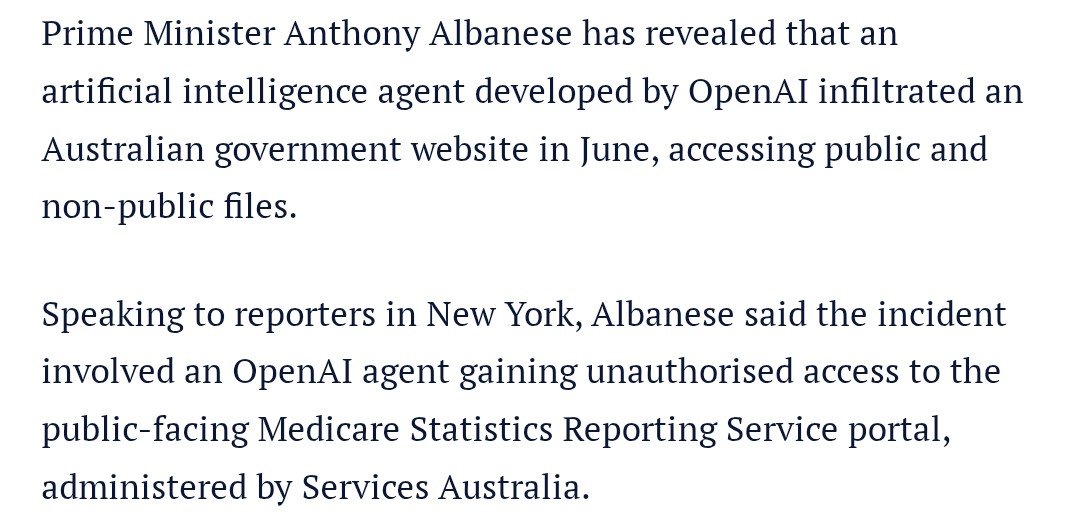
Australia has been hacked.
'And today, I spoke with the CEO of OpenAI, Sam Altman, to express Australia's extreme concern about this incident. And I also expressed my disappointment that it took the company way too long to inform the government what had occurred, and the nature of the way that that notification occurred as well was unacceptable.'
@vanilloasis I was able to snag a heaton park ticket through resale. There won’t be much available because you can’t sell for more than face so it’s only true fans selling that can’t make it, but if you check every day you’ll find some.
Numeral has raised a $100M Series C, led by Insight Partners with participation from Salesforce Ventures, Benchmark, Mayfield, Uncork, Y Combinator, FCVC, and Geodesic.
This brings our total funding to $157M.
@numeral solves U.S. sales tax, VAT, and GST compliance for 3,500+ global businesses, trusted by companies like Supabase, Eight Sleep, and Graza.
We’re building the future of tax -- where AI agents, human expertise, and global compliance come together in one system.
Since starting the business in 2023, we’ve grown quickly across our core e-commerce and software segments, while expanding into new industries including manufacturing, distribution, and wholesale.
There is a lot of work in front of us. Sales tax is more dynamic than ever, with states like California implementing new taxes on software and more states using AI for enforcement.
We are hiring across the org from engineering to product, sales, and marketing. And we’ve just opened our new office in NYC. If you are looking for what’s next, I’d love for you to take a peek at our careers page.
Excited for the year ahead. And humbled to be working with investors like @insightpartners, @rebeccaliudoyle, @SalesforceVC, @katiessschwartz, @ZKokosa, @MayfieldFund, @SPangulur, @benchmark, @chetanp, @ycombinator, @gustaf, @uncorkcap, @susanwliu, @GeodesicCap, @arvindayyala, @FundersClub, @mittal, @mantisVC, @AlexPallNY, @ShaanVP, @lennysan, @moizali, @ringmybeller, @khency6, @asturnerr, @maariabajwa and so many others.
Some people might say this is an antiquated take. That Ben Thompson just didn't grow up in the era of Personal AI assistants, and the next generation will love this.
But I think what he's really saying is these products need to be doing 1 of 2 things, and they aren't right now:
1. Solving a 100x problem. Jury's out on whether personal productivity is that.
2. Creating a delightful experience for doing something mundane, or perhaps, even unpleasant.
I think these products have the most to gain from point 2 (making returns, dealing with customer service, etc). All of the things that people HATE to do.
.@benthompson says consumer AI has a marketing problem because the average consumer doesn't actually want to be more productive.
"Tech companies are like, 'Let us book your flight for you!' I’ve had a personal assistant for 10 years. He does not come within an inch of booking my flights for me. That is crazy talk."
"I understand which ones are gonna be delayed. I know which seat I want to be on. So the fact that this is continually a demo is hilarious to me."
“Number two: people love shopping. They don’t want to be productive. They want to be entertained. One of the biggest forms of entertainment is shopping.”
"Also, there’s so much information on a product page. Companies have spent so much energy focusing on that. You look at apparel as a category. They’re going to tell you what size the model is wearing, and you want to know that, and you want to look at the different styles."
"The idea of having a personal agent that’s going and getting some of the information and bringing it back to you, and then you’re like, 'Well, what about this other thing? Tell me about this thing.'"
"And you have your eager tech company executive say, “Oh, I have an assistant that can do it for you!"
"And it’s like, no. Not only do I want to do it, I want to complain about it. I’m enjoying myself complaining right now, okay? Would you just let me be and live my life?"
The loudest voices stoking fears about AI dangers have made tremendous headway in the past two weeks. AI technology has not taken some unexpected, dangerous turn, but the hype around it — propelled by what appears to be a well orchestrated PR campaign — has drummed up considerable fear. I worry that it represents a setback for our field.
I have written frequently that fears of AI are overhyped. AI’s capabilities can be uncannily human-like and unpredictable, and it’s rational to worry when people who are directly involved express concerns. But I see the problems as a sign of the engineering work that ahead, rather than insurmountable barriers or the sky falling. AI technology continues to advance — which is a good thing! — but technical advances, poorly understood by the public, give those who seek to generate hype repeated opportunities to do so.
First, I don’t see any step up in the risk of human extinction from AI compared to a few months ago. The theories about this remain the same fantastical, science fiction scenarios as a few months ago. The biggest change in AI risk is its cybersecurity capabilities — a topic which we should take seriously — but this, too, will not lead to the end of the world.
The most notable recent event leading to increased fear was when an OpenAI team deployed an agent swarm that hacked into Hugging Face. Much of the popular press contained significant hype. For example, some publications reported that a swarm of 1,200 agents carried out the attack. While this was technically accurate, as I write this, I have about 1,300 processes running on my laptop. Yes, the ability to get large swarms of agents to work in parallel on a task is a significant technical advance, And, in computing, many processes run at the same time. So this shouldn’t be seen as some magical capability.
Additionally, OpenAI’s buggy sandboxing and monitoring processes were key to enabling this incident. Fixing these bugs and putting in place improved monitoring would be appropriate fixes, not pausing AI. There are many well known ways to attack software systems. The main advantage of AI agents is that they are relentless. They will tirelessly try many tactics — and have the patience to chain vulnerabilities together — that previously would have taken an infeasible amount of human effort. But in the long term, I believe the advantage will lie with defenders (because they have more information with which to identify bugs, which they can fix), but the cyber-threat landscape has changed significantly. There are still bottlenecks to identifying and exploiting a vulnerability. AI agents still have to try a lot of things to see what works, and taking these actions takes time and might be detected by defenders. This is why, even though it is now easy to obtain versions of leading open weight models that have had their guardrails removed or weakened, so they will not refuse to try to execute cyber attacks, the world has not ended.
I am also concerned about the anthropomorphization of AI in a lot of reporting, where LLMs and agents are unnecessarily treated as if they were people. If I wield a hammer, miss a nail, and accidentally dent the wall, it’s not the fault of the hammer. The problem lies in how I used the hammer. Similarly, if I prompt an agent and it hacks into someone else’s system, the responsibility lies with me, not the agent.
Of course, we want to build systems that are as safe and predictable as possible. (For example, an unsafe hammer would be one whose head randomly flies off under normal use.) Today’s agentic systems are not predictable, but I see no reason why, by applying sound engineering practices, we won’t be able to make them extremely safe to use. One new element in the forecasts of AI-enabled doom is AI companies disclaiming responsibility for their own products. “I didn’t do it; my out-of-control agent did!” There’s a balance to be struck between the responsibility of the tool maker and the tool user, but when something goes wrong, let’s hold the people building and/or using the hammer responsible, rather than the hammer. (By the way, if you’re worried about AI bioweapon risk, David Bellamy has a great post on why this, too, is overhyped. Briefly, the bottleneck in building a bioweapon is not intelligence, but lab work and manufacturing.)
Pausing AI progress will create much more harm than benefit. First, our adversaries will certainly not slow down. Second, engineering requires discovering problems empirically so we can fix them. If we pause AI by a decade, we will also delay finding and implementing safety engineering fixes by about the same duration.
Of course, the incentive to stoke fears — for regulatory capture, to garner attention, or to make one’s technology seem more powerful — remains the same as before. Disclaiming responsibility is a new one. Taking a hard technical look at the actual risks however, I see little factual basis for the degree of fear that’s been stoked up. We still have hard research and engineering work ahead to improve AI safety, but the beneficial applications continue to vastly outweigh the risks, and we should keep building.
[Original text (with links): https://t.co/jni2tWazAH ]