"That's the deal. That's open source. I give you a gift of code, you accept the terms of the license. There cannot be a second set of shadow obligations that might suddenly apply, if you strike it rich using the software. Then the license is meaningless." https://t.co/2em0wkIC7H
@nathanbarry@carlhendy A small suggestion - you're blocking Google from crawling parameters with your robots.txt file, but the previous domain has ~40,000 links to URLs that include params (e.g. ?lmref). I'd recommend letting Google crawl those URLs so it can pass the value to the new domain
🧵 I can't believe I am about to write this but... the Bing index is crucial in the future of SEO. Why? It's not about Bing the search engine. Bing's index now also powers ChatGPT (and thus, soon Apple's Siri), Meta AI, LinkedIn AI and Microsoft Copilot.
@GergelyOrosz I get the hesitation because maybe there’s a concern it’ll be the new “copy/paste from StackOverflow without knowing how it works”. But AI is helpful for lots of things - spotting code smells, naming classes, finding the “right” way to do something. A shame to not have that
A 5 minute task that might recapture some decent links: check robots.txt and see if you're blocking any parameters. Check Ahrefs to see if you have any links with those params. If you do - those links won't be passing value. Consider unblocking that param, and canonical instead.
Whoa, this is a big change. Google just confirmed with @sengineland that continuous scroll will revert back to pagination on desktop, along with mobile soon.
Is it due to AI overviews? Declining ad clicks? We may never know... More info via @rustybrick: https://t.co/nmye11lA9G
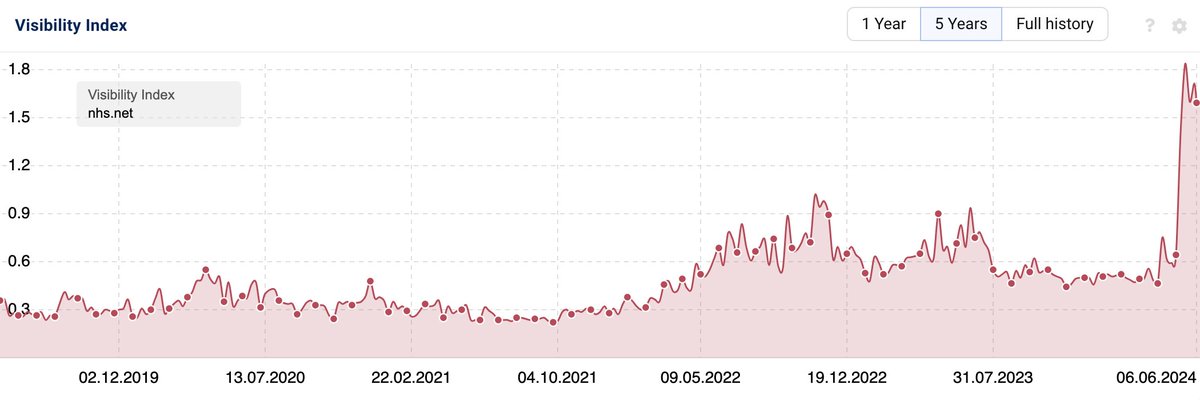
It's an intranet that isn't intended for the general public. But the NHS employs 1.7 million people, so it's a heavily used intranet. Makes me think that this is to do with click data being a stronger signal. Thanks for highlighting these spikes @lilyraynyc
The spikes here are absolutely wild - I'm pretty sure something fairly big rolled out around May 11th. My colleague Robin has spent some time digging into some unusual patterns: https://t.co/Doxxuznxv7
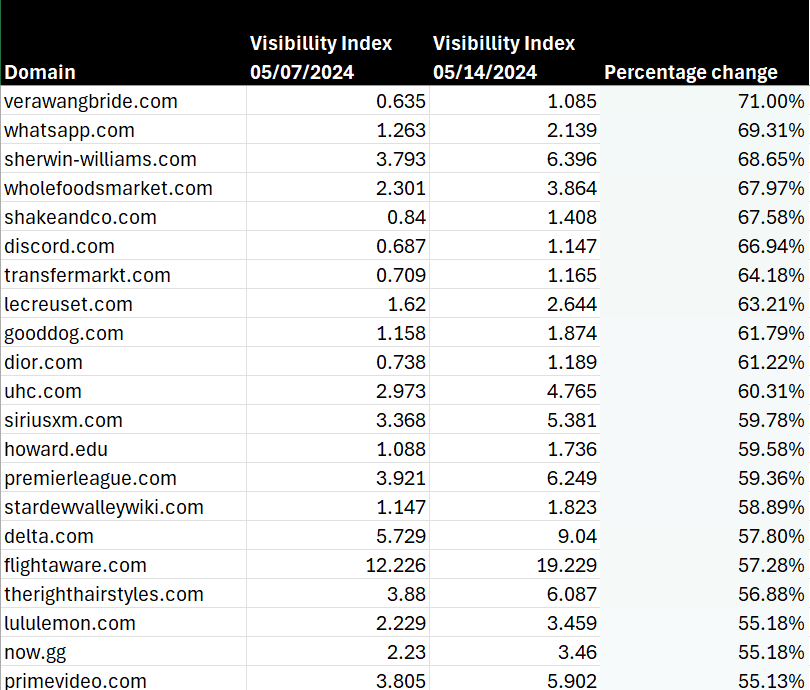
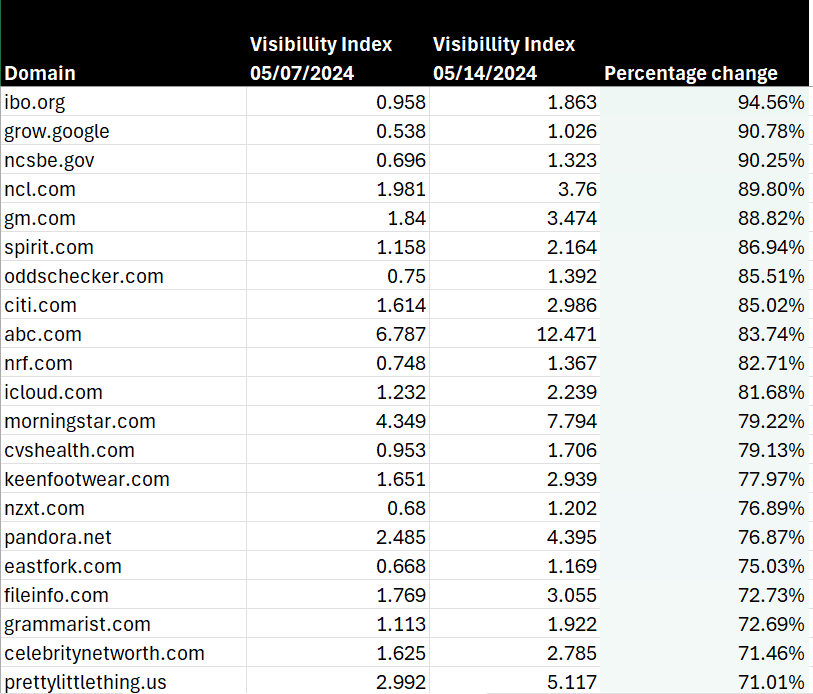
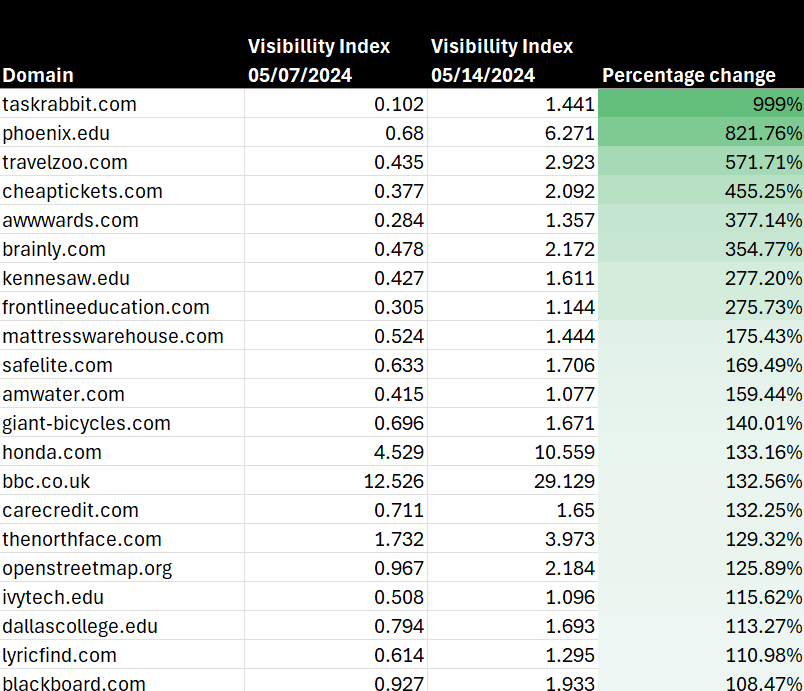
There's an interesting trend happening in the SERPs right now.
A seemingly random group of popular brands are seeing enormous surges in SEO visibility according to @sistrix
(I confirmed many of these using @ahrefs too)
I don't have time right now to figure out what's happening here, but I'm sharing the domains in case someone else wants to dig in.
My working theory based on looking at a small sample: these brand names are earning top positions not only for various brand keywords (which seems obvious), but many non-brand keywords that may have been previously held by third party blogs, review sites etc.
I think these companies' blogs and service pages are often moving into top positions. See 4th screenshot - https://t.co/RjCvjBAp6g came out of nowhere to earn the #1 spot for "online degrees" (8.2k MSV)
If anyone finds anything interesting, please share!
In particular, there's an example where https://t.co/6rQ5fQfv1P saw a huge spike. Important to note that https://t.co/6rQ5fQfv1P isn't the public-facing NHS site - it's their intranet, and it's seen page 1 rankings for queries like "email" and "join teams"
We all need to do a shout out to @iPullRank and @randfish on the 14K Google Ranking Features analysis and output. Good work to Mike (Mic) for working the weekend and great work on Rand for being one to share data a decade before being proven right.
I can verify a few things now...
1. Mueller had conversations with me via telephone while I was at Tribune. He was very, very adamant about Tribune being very picky about time stamps and those time stamps being precisely accurate everywhere.
2. Gary has had 1-on-1 conversations with me that highlight the concern that disavowed links are real and have a nasty implication that most don't consider. The secondary and tertiary links that get cut off when you disavow. He also said that disavows don't happen for 'weeks'.
3. All new content does EXPONENTIALLY better when you TIGHTLY combine it with a marketing blitz to your best users. You will find success stronger than links if you can get very positive user signals to your latest content.
4. Link to your most important pages from your homepage. Make sure you keep it there long enough for Google to re-index your homepage and see the links.
5. Use title attributes on your navigation and other internal links to help match anchor text better to the landing pages. Shoes under the Men's nav may not look good as "Mens Shoes" again, but it is so much better. If you can't get buy-in, use a title attribute to do it.
6. Title tag length has never matter for relevancy. Be SUPER relevant in a title tag and if that means it goes long, so what. But...careful on the impact of the CTR from the SERPS.
7. Content has to be tighter to the domain than ever before. It's a spam signal if you get too far outside your 'core content'. I got a phone call or email from Matt Cutts himself when the ChiTrib decided to launch 'belly rings' (literally) on the website. Matt specifically told me that it will be radical harm to the entire domain if we do not remove the content. We did, within 24 hours. No clue what would've happened. But...we got the call/email.
8. Google loves to hide behind the lack of precision in interviews and word choices used. That gives them a LOT of wiggle room in their responses. They are masterful at making you believe one thing, staying accurate in their responses and still leading you astray. Many examples have to do with domain rating. We need better interviewers that are cautious (meticulously cautious) about what words are being used in the questions and returned in the responses. So far, I have only found Eric Enge (@stonetemple) to be good at this.
9. Google can always spin out of things. This document is easy to label 'out of date' and it can be made 'out of date' but simply making a new edit to a single word and making it the 'live version' or 'updated version'. The personalities at @googlesearchc are such that they would find this fun, funny, etc.
10. Do your own research. Follow the data. Follow your gut.