How much do disruptions to U.S.-bound shipping routes matter for the U.S. economy? A lot, and far more than conventional trade models suggest.
To make this point, I just circulated a new paper, “Shipping to America,” with my dear coauthors Xiwen Bai, @YiliangLi_, @RicardoVMarto, and Francesco Zanetti:
https://t.co/fJN0kfm5R5
Using satellite vessel-tracking data, we build route-level measures of potential and effective capacity for all U.S.-bound container ships from 2016 to 2025. In recent supply disruptions, utilization losses ran 20 to 40 percentage points, and they began months before port congestion became visible. That is a lot.
We then embed these measures in a general equilibrium model in which shipping firms reallocate a common fleet across routes, price above marginal cost, and ignore the congestion they create, while importers shift their sourcing in response to route profitability.
The key result is that the reallocation triggered by a disruption has first-order welfare effects, so a route’s Domar weight is not a sufficient statistic for its welfare cost. Here we depart from conventional models, where some form of Hulten’s theorem holds and the welfare costs of supply disruptions are often small.
But what I find most interesting is that the model lets us measure the economic value of military operations that keep sea lanes open. The 2023–2024 Red Sea attacks cost 0.35% of US output. Combining data on the cost of the U.S. Navy’s protection of Red Sea shipping with the model, we estimate that the Navy’s intervention delivered benefits of 0.04–0.08% of US output at a fiscal cost of 0.02%. While the Navy did not fully reopen the Red Sea, it cut the losses by a tenth to a quarter. The operation paid for itself two to four times over.
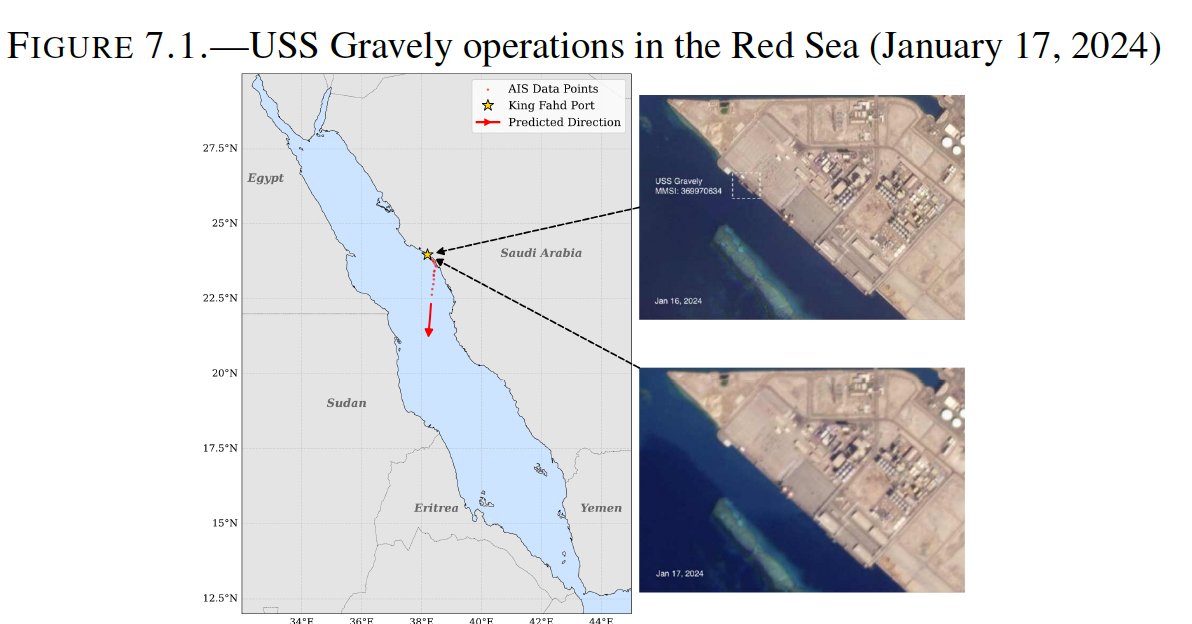
The figure shows how we can track these operations: it plots the movements of the Arleigh Burke-class guided-missile destroyer USS Gravely (DDG 107) from AIS data. Because U.S. Navy ships usually switch off AIS during active operations, the data are sparse and cluster around the ship’s departures for operations and its returns to port.
The punchline is clear: freedom of navigation is of the utmost strategic importance for the U.S. It has been so for every thalassocracy: Athens, Carthage, Venice, the Dutch Republic, Britain, and now the U.S. Let us not forget it.
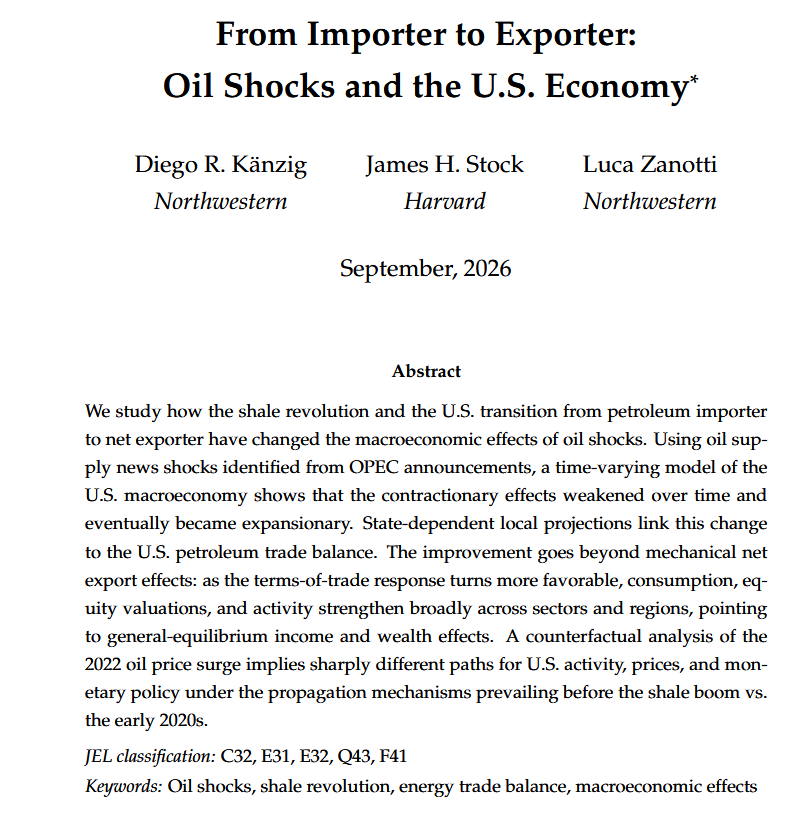
Very excited to share our new paper with Jim Stock and @LucaZanotti8:
“From Importer to Exporter: Oil Shocks and the U.S. Economy”
I’ll present it today at the Fall 2026 BPEA conference @BrookingsEcon.
Paper: https://t.co/o2c0TAbjK5
Livestream: https://t.co/7zoVNxmsCC
Thread below👇
If you'e never read The Falling Man, you should do so. I post this on September 11th every year, and I find time to read it on this day every year. Still, in my eyes, the greatest piece of journalism I have ever read. https://t.co/gZgwzRoSgX
Very valuable!
"Government bond-backed repo markets: between resilience and vulnerability" by Ayelen Banegas, Lucas Devigne, Mulalo Mamburu, Kleopatra Nikolaou, Anna Samarina, and Fabio Tamburrini.
"This paper synthesizes the literature on vulnerabilities in government bond-backed repo markets, focusing on the features that contribute to both the fragility and stability of these markets. The literature shows that the same features that enable efficient liquidity provision, including short-term funding, dealer intermediation, extensive collateral reuse, and low haircuts, can also create channels for rapid transmission of stress. The review documents tight linkages between repo and government bond markets, highlighting how repos are key to the build-up of leverage and can propagate stress across funding, cash, and derivatives markets, particularly through dealers and nonbank financial intermediaries such as investment firms, hedge funds, and money market funds. Evidence from recent stress episodes illustrates how these vulnerabilities materialize in practice. The review also examines post-crisis regulatory reforms and central bank interventions, identifying how these measures have enhanced market resilience while also creating trade-offs for market dynamics, with implications for liquidity and collateral availability."
https://t.co/lPOaXvnpqa
Sometimes, when I want to lift my spirits, as this week after brooding about the state of much of academia, I want to read a great paper I have already read dozens of times. Those are the papers that inspired me as a younger scholar and that, even today, make me slightly jealous.
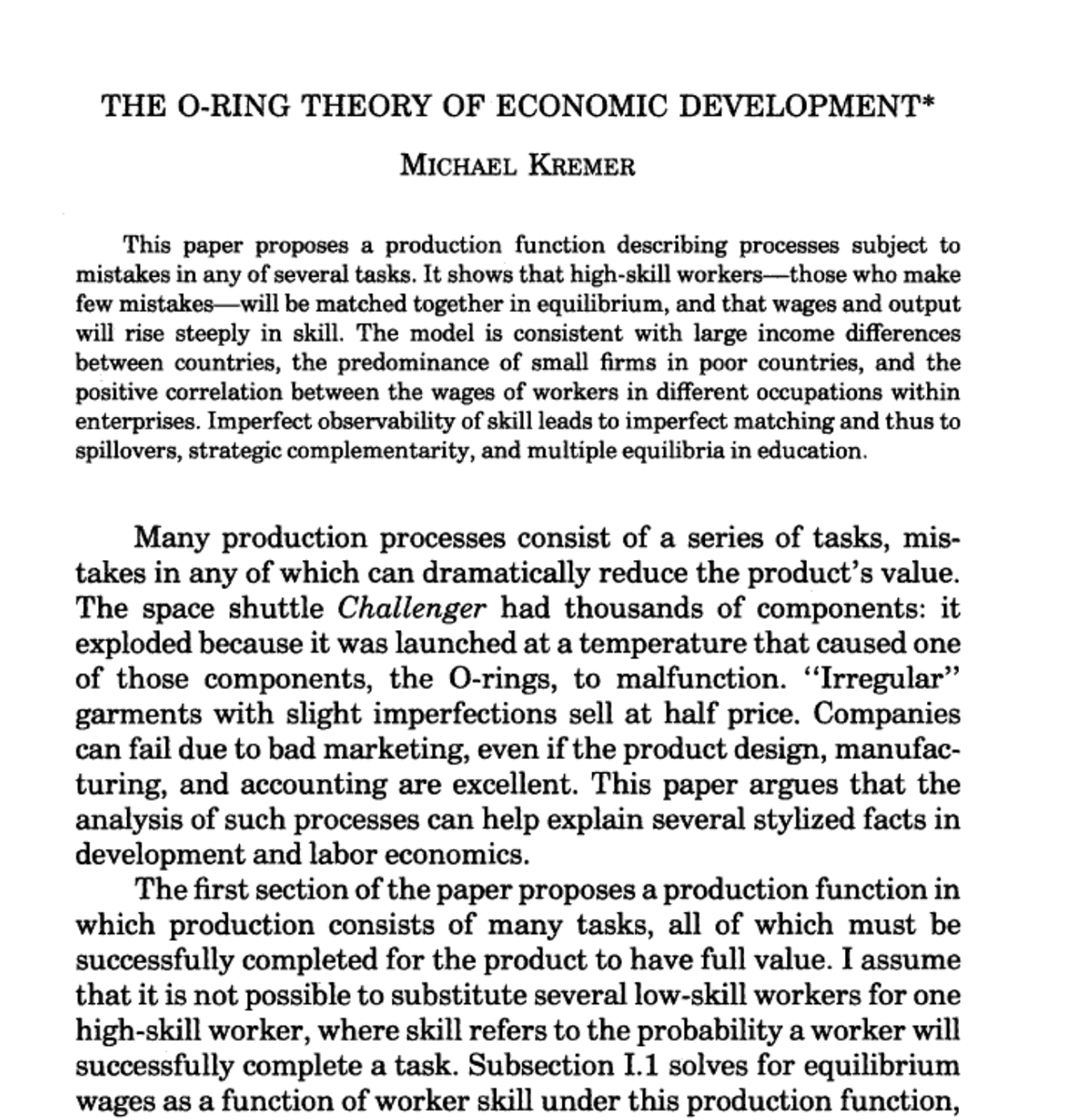
One of my favorite go-tos is “The O-Ring Theory of Economic Development,” by the inimitable Michael Kremer, at UChicago Econ.
The idea is that producing output requires many tasks, and failure in just one of them drastically lowers the value of the final output. My favorite examples are the British cars of the 1950s and early 1960s. Think of the Jaguars or the Austin-Healeys. Was anything ever more gorgeous than an XK120 in British Racing Green? And yet, that Moss gearbox with no synchro on first! Go for a Porsche 356 if you have the money, because the Jaguar will eventually break your heart.
But the paper is gorgeous because Kremer takes this simple observation and builds a whole theory of differences in output across countries around it. He lets the quality of each task multiply rather than add up, as in standard models. A good worker is worth more next to other good workers, so the best end up working with the best and wages fan out. And a small difference in the chance of a mistake, compounded over dozens of tasks, becomes a huge difference in output per worker across countries, plus a large set of predictions about the distribution of firms, wage correlations, matching, and more.
Here, back in 2014:
https://t.co/XexEUaKVNq
I used that model to think about some of Spain’s economic problems (an automatic translator will give you a very good English version).
It is such a wonderful and deft piece of economic craftsmanship. Read it. I just did.
What happens when you roll out custom generative AI to half a country's judges?
New paper on Pakistan's courts with @ProfSultanEcon and @gochristoph.
In line with https://t.co/7yUFGTsTut -- we provide early empirical evidence on the impacts of transformative generative AI.
We couldn’t find a usable set of boundaries for 10,000+ global cities, so we (@devdatalab) developed our own and made them open for research.
We were kind of shocked this didn’t exist already. A thread 1/
Highly relevant!
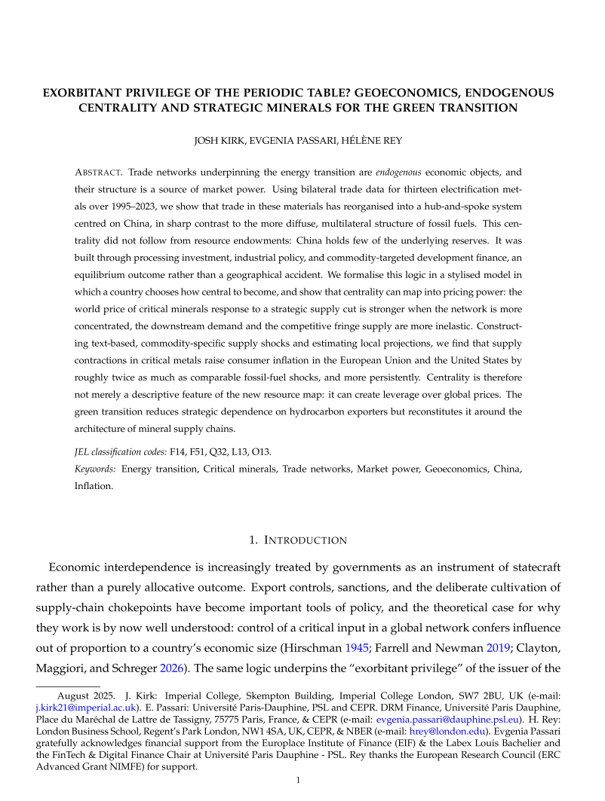
"Exorbitant Privilege of the Periodic Table? Geoeconomics, Endogenous Centrality and Strategic Minerals for the Green Transition" by Josh Kirk, Evgenia Passari, and Hélène Rey.
"Trade networks underpinning the energy transition are endogenous economic objects, and their structure is a source of market power. Using bilateral trade data for thirteen electrification metals over 1995–2023, we show that trade in these materials has reorganised into a hub-and-spoke system centred on China, in sharp contrast to the diffuse, multilateral structure of fossil fuels. This centrality did not follow from resource endowments: China holds few of the underlying reserves. It was built through processing investment, industrial policy, and commodity-targeted development finance—an equilibrium outcome rather than a geographical accident. We formalise this in a stylised model in which a country chooses how central to become, and show that centrality maps into pricing power: the world price response to a strategic supply cut is stronger when the network is more concentrated and downstream demand and fringe supply are more inelastic. Constructing text-based, commodity-specific supply shocks and estimating local projections, we find that supply contractions in critical metals raise US and EU consumer prices by roughly twice as much as comparable fossil-fuel shocks, and more persistently. Centrality is therefore not merely descriptive: it creates leverage over global prices. The green transition reduces strategic dependence on hydrocarbon exporters but reconstitutes it around mineral supply chains."
https://t.co/M99CDDLE0T
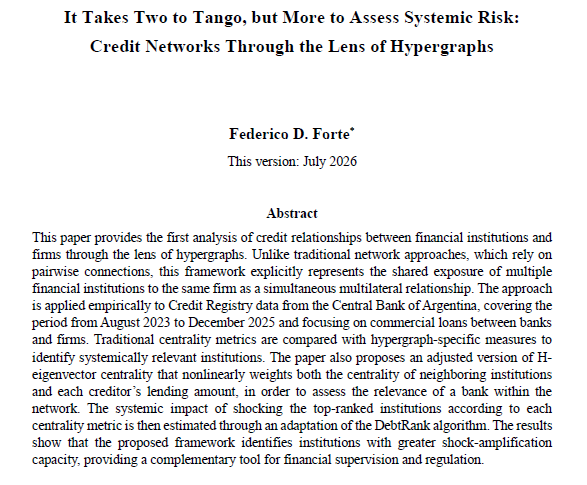
Nuevo working paper! ⚠️🚨:
Redes de crédito a través de la lente de los hipergrafos
Creo que es de las cosas más complicadas que he hecho en mi vida. Está publicado en la web de @BBVAResearch (https://t.co/C5no8mvSKM)
Les cuento un poco de qué trata (abro hilo abajo): propongo usar hipergrafos para analizar el riesgo sistémico en las redes de créditos comerciales, y aplico empíricamente este enfoque sobre los préstamos a empresas en Argentina entre 2023 y 2025, usando al Central de Deudores del BCRA... pero ¿qué son? ¿y para qué?
I've read a few things about how "agent-based models" (I'm not a fan of the term tbh) are difficult to understand, have too many parameters, etc etc.
Pretty good timing because we updated a preprint this week (with D Martin, D Panja and JP Bouchaud) which essentially consists
I gave @AnthropicAI's new Fable 5 my hardest challenge: explain the Riemann Hypothesis — math's most famous unsolved problem — to anyone. Two prompts later: a full interactive site + this video, scored with music composed from the zeta zeros themselves 🤯🎵 https://t.co/OfX7I1IVCZ
I'm delighted that this short survey, a labor of love, is forthcoming in Notices of the AMS later this month.
I'll post a few threads over the next few weeks.
Today: why do eigenvectors keep showing up in models of networks and influence?!
1/
Tommaso Porzio and co-authors (Colonnelli, Cruz, Pereira-López, Zhao) have a new important paper on African startup financing that lands exactly where founders, GPs, and policy operators on the continent have been pointing for the better part of a decade.
Headline result: capital to African startups flows disproportionately to white, foreign-educated founders, primarily from foreign investors in rich countries, with strong homophily around common language and colonial linkages. And, from a survey experiment with IFC, African entrepreneurs don't actually care about the source of capital. What they want is equity from investors with local experience, and they don't want to give up control. They place near-zero value on the "non-financial support" foreign investors tout.
Because the result is consistent with what the African startup community has been saying out loud, referees will dissect the methodology in due course. I'll jump straight to what it means if you're building, funding, or regulating in this ecosystem.
For African innovators:
1. The pattern you've flagged anecdotally is now documented at scale. The homophily on language and colonial linkages is not in your head.
2. Your revealed preference, equity from locally experienced investors, and retaining control, needs no second-guessing. Optimize your cap table accordingly: a smaller check from a local fund with operational fluency often dominates a larger one from a foreign syndicate that will dilute your governance.
3. Non-financial support is priced at near-zero in the paper's elicitation. Use that in negotiation. Mentorship decks and platform value are not free options against your equity.
For policymakers:
4. The diagnosis is a missing local equity market; supply side, not founder quality. Build it. That means pension fund mandates that permit alternative assets, a regulatory perimeter that distinguishes VC from public-market intermediation, and tax treatment of carry that doesn't punish domiciled funds.
5. Stop indexing success on "$X billion raised by African startups." That metric is largely a foreign-influence variable. The right KPI is the share of capital intermediated by locally domiciled, locally managed GPs. UEMOA, EAC and AfCFTA harmonization on fund vehicles would move this faster than any single jurisdiction acting alone. Coordinate!
For DFIs:
6. Deploying more LP capital alongside the same foreign VC syndicates reinforces the homophily channel. The marginal dollar should crowd in local fund managers (first-loss tranches, anchor LP commitments, GP seeding), not match foreign GPs on standard terms.
7. The "non-financial support" finding should reset expectations on technical assistance programs (at least for startups). Founders are telling you that they value cash on equitable terms more than your advisory hours. Redirect that budget toward de-risking local fund formation.
8. The control-retention result has concrete design implications: revenue-based financing pilots, dilution through IPOs after proven success of the family business (cf. Dangote) and contract designs that don't reflexively replicate Silicon Valley defaults in markets where they don't fit.
I met with a lot of operators at the Africa CEO Forum last week who discussed building domestic institutional capital, shared-equity vehicles for cross-border African champions, and how DFIs should govern their relationships with local fund managers. I hope these insights are useful as research and practice continue to refine the playbook.
Great paper, Tommaso et al.
A few comments on this chart:
1/ People unfamiliar with economic history don’t realize how enormously transformative the transportation & communication revolution of the 19th century was
2/ it’ll be a high bar for AI to be that transformative because…
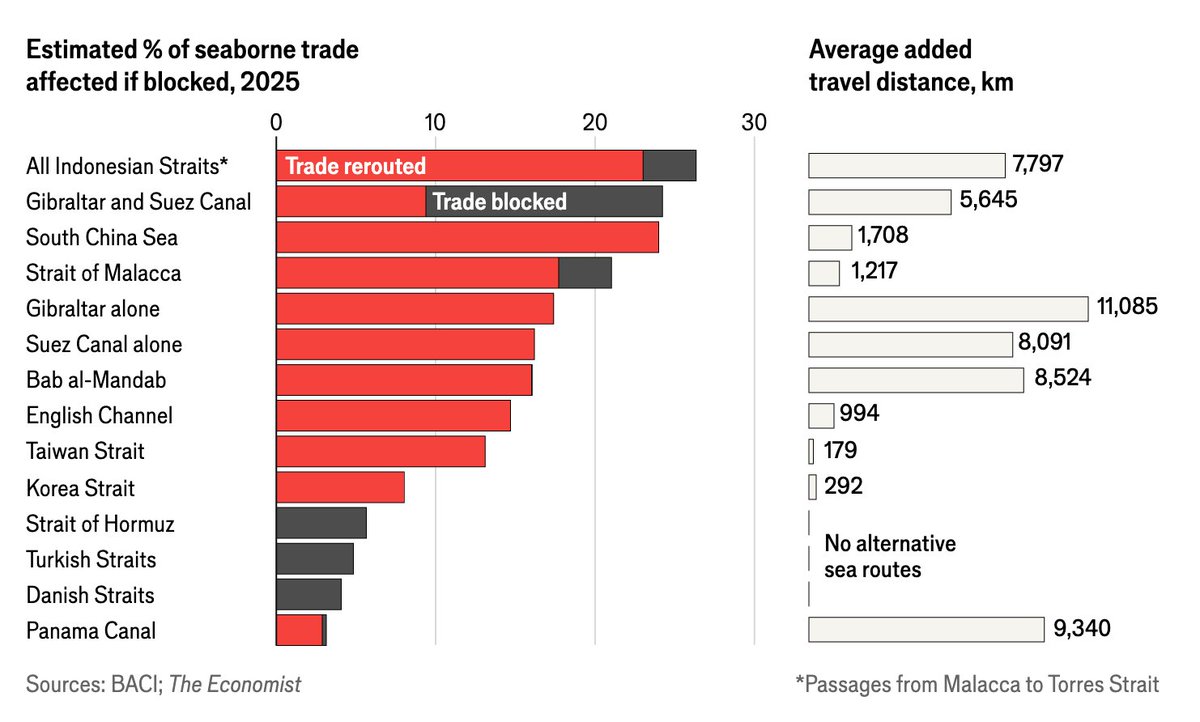
Terrific modelling by @TheEconomist. Key points:
- "Hormuz is exceptional in one sense: no other single disruption has the potential to outright block (rather than reroute) so much trade."
- Little impact on US; Asia and Europe will suffer worse economic consequences.
Iran is demanding sovereign control over the Strait of Hormuz. If it succeeds in imposing this logic, it will undermine the very foundation of international maritime law. The Strait of Hormuz is an international strait governed by the regime of transit passage: passage cannot be arbitrarily prevented or made selective. If Iran succeeds, it will open a Pandora's box: other states will also decide they can act the same way.
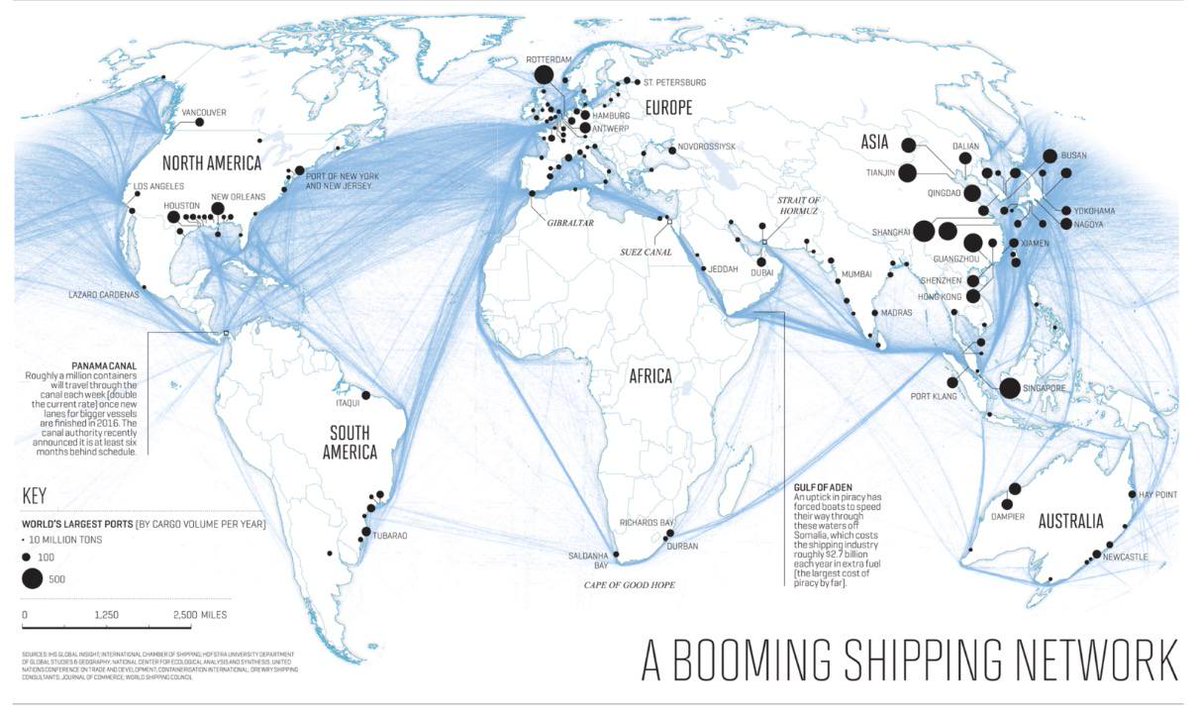
Let's look at other straits that are critically important for the global economy:
◾️ The Straits of Malacca and Singapore are the next most dangerous example. The Strait of Malacca is the world's busiest oil chokepoint, as well as one of the main corridors for common trade; studies estimate that about 20% of global maritime trade passes through the Strait of Malacca, amounting to approximately $2.4-2.5 trillion annually. In theory, Indonesia, Malaysia, and Singapore could all seek to exert tighter control here. If even one of these countries were to impose a system of permits, selective inspections, or political restrictions, global trade would suffer.
◾️ Bab-el-Mandeb is another example of how control over a narrow strait can quickly become a tool of war. In 2023, approximately 9.2 million barrels per day passed through it, but following the escalation, flows dropped to about 4.0-4.2 million barrels per day in 2024-2025. Formally, Yemen, Djibouti, and Eritrea may attempt to strengthen their control here, and effectively, armed non-state actors may also be involved. The threat is clear: whoever controls this chokepoint can sever the maritime link between Europe and Asia via the Red Sea and the Suez Canal.
◾️ The Bosphorus and the Dardanelles are a separate case, as they are already subject to a specific regime under the Montreux Convention, and Türkiye has broader authority over military vessels. But that is precisely why this example is important. In the first half of 2025, approximately 3.7 million barrels per day of oil and petroleum products passed through the Turkish Straits, not counting grain and other Black Sea exports. The danger here lies elsewhere: the existing legal exception could become a justification for new exceptions in other straits.
◾️ The Danish straits are a critical exit route from the Baltic Sea. In the first half of 2025, approximately 4.9 million barrels of oil and petroleum products passed through them daily. Formally, Denmark could impose stricter controls here, and in a broader regional sense, so could the states that control the approaches to the Baltic Sea. If Europe ever adopts a policy of selective access through such a strait, it would mean that even within the Euro-Atlantic space, freedom of navigation is no longer considered absolute. This would be a critical moment for maritime law.
◾️ The Taiwan Strait is perhaps the most dangerous case in the long term. According to CSIS estimates, approximately $2.45 trillion worth of goods passed through it in 2022, accounting for more than one-fifth of global maritime trade. There is only one potential contender for political control here - China. If Beijing manages to impose a system where passage depends not on international rules but on Chinese jurisdiction, it will be a turning point. Then, not only regional security would be at risk, but also the very principle that major trade routes cannot be controlled by a single state through political decision. And since the Taiwan Strait is also linked to the risk of a major war between the US and China, maritime law here directly confronts the risk of global escalation.
◾️ Arctic shipping routes demonstrate that this logic now extends beyond traditional straits. Russia regards the Northern Sea Route as a "historic national transport corridor" and demands compliance with the navigation rules established by Moscow; in 2024, the Northern Sea Route Administration issued 1,312 permits for 975 vessels. Canada, for its part, considers the Northwest Passage to be part of its internal waters, while the United States and other states disagree with this approach. Here, the risk is particularly significant for the future: if Arctic routes begin to be established as a licensed passage under the control of coastal states, this will provide yet another strong argument for those who wish to establish their own control in other areas.
So, control over sea lanes is becoming a new weapon. If Iran breaks this barrier in the Strait of Hormuz, other states will also begin competing for control of the seas. The next conflict may arise not only over territory, but over the right to determine who has access to global trade, energy, and naval traffic. This is the real danger: the Strait of Hormuz could lay the groundwork for many future wars.
In this new piece, my Tashkent-based colleague Shakhlo Kamaladinova examines the spillover effects of the Iran war for the landlocked economies of Central Asia. Drawing on recent data and statements from senior Uzbek and Kazakh officials, she highlights the significant impact that disruptions to maritime trade and air freight will have on Central Asian supply chains. Link here: https://t.co/XwWXbwoGGk
Highly relevant!
"The Cost of Closing the Strait of Hormuz: Energy Bottlenecks and Global Food Security" by Julian Hinz, Hendrik Mahlkow, Robin Sogalla, and Gerald Willmann.
"In March 2026, the Strait of Hormuz is closed. The shutdown blocks roughly one-fifth of the world’s oil and one-quarter of its liquefied natural gas, triggering severe welfare losses in energy-dependent developing countries worldwide. Standard trade models underestimate the impact because they miss the bottleneck mechanism: energy disruptions cascade through chemicals and fertilizer production into food prices, amplifying losses for the world’s poorest countries. Developing countries that depend on imported energy and fertilizers—particularly in South Asia, sub-Saharan Africa, and the Middle East—face the steepest food price increases and welfare losses. The aggregate global costs are moderate, but the burden falls disproportionately on the world’s poorest: the USA loses just −0.07%, while countries in South Asia and Africa face losses 10–20 times larger. A prolonged closure allows some market adjustment, but structural damage persists—and the timing during peak Northern hemisphere planting season compounds the food security risk."
https://t.co/RXL2PRowPL