@MathAndCobb I know some "accountability groups", where people all work on research next to each other. That sounds pretty similar.
I think I would have liked this sort of thing, especially during grad school.
I could imagine a "math project night", where people come and math. Sounds fun!
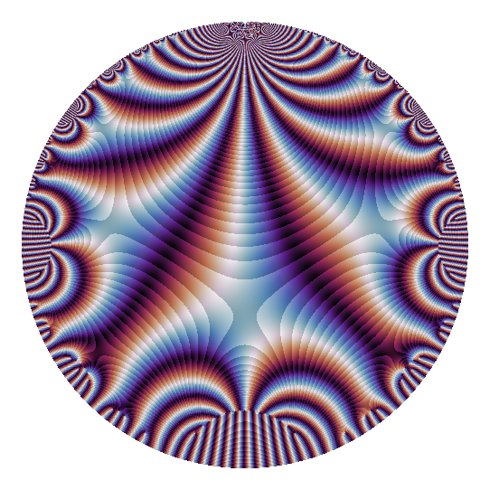
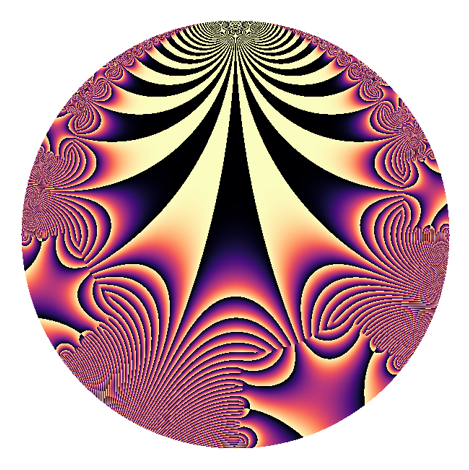
Downloaded @sagemath to play around with modular forms as I'm in the process of learning them. Here's a one with weight 12, pretty right? Cred to @davidlowryduda for the code!
This is really a jupyter notebook. The notebook is also available on github: https://t.co/EGALKBIa6P
And for those with access to the PCMI server, it's also there.
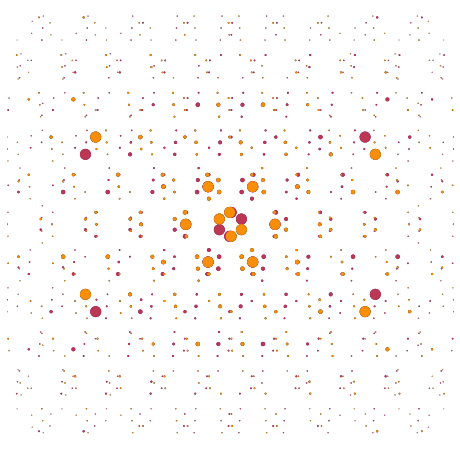
This week at PCMI, we talked about how one might try to make "portraits" for number fields. We came up with a few ideas. In a post, I describe some of these ideas and give sage implementations. https://t.co/NVyeS3eWSl
Can we compute coset representatives for quotients of congruence subgroups? Yes! I was asked how this can be done and wrote an answer.
https://t.co/6B9jETpoCT
A rendering of a mathematical object known as a "Modular Form". (released as creative commons).
https://t.co/vCHCaoH7T1
#ModularForm
With thanks to @davidlowryduda
@kimdayers As others note, latexmk is great. But it can also be set to run automatically on saving the file, so that you get continuous compilation and can read a very up-to-date document version.
I made some visualizations for the new video from Quanta and @AlexKontorovich on the Langlands Program! I wrote a little bit about some of these visualizations here: https://t.co/iSsgzBzTH8
Recently, Manjul Bhargava uploaded his paper proving van der Waerden's conjecture to the arXiv. In this post, I discuss his proof and some of its similarities with recent work with my collaborators. https://t.co/dd3vSYNt4A