@sir4K_zen Highly scalable. The tool is for research purposes, so it can handle typical platforms like Qualtrics, Prolific, CloudResearch, etc with many rooms open simultaneously.
I'm excited about Dyadic's survey delivery feature. Researchers can deploy scales and open-ended questions before, during, or after conversations, pairing language data with self-reports. Please message with any feedback or questions! Preprint: https://t.co/iCvq01fjdH
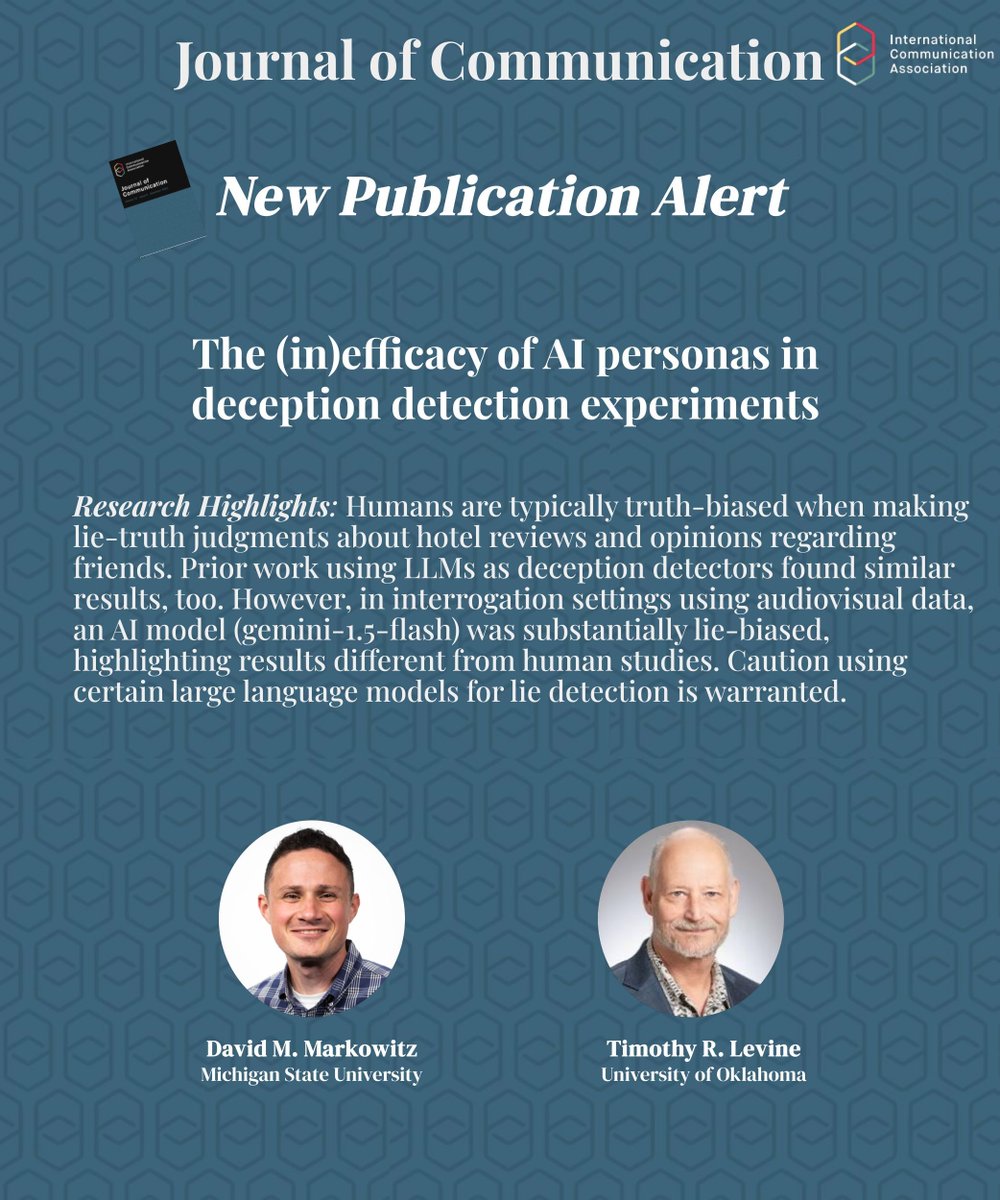
Introducing JoC publication: “The (in)efficacy of AI personas in deception detection experiments”, by David M Markowitz @davidmmarkowitz , Timothy R Levine.
Read here: https://t.co/3qpngI7HNj
Introducing Simile.
Simulating human behavior is one of the most consequential and technically difficult problems of our time.
We raised $100M from Index, Hanabi, A* BCV, @karpathy@drfeifei@adamdangelo@rauchg@scottbelsky among others.
Setting New Year's resolutions can mean reflecting on your personal values and how you want to be remembered.
@MSUComArtSci's @davidmmarkowitz led a @PNASNews study analyzing 38 million U.S. obituaries to examine what values people are remembered for and what constitutes a life well-lived.
Obituaries reveal shifting cultural values across time and place. Here’s what psychology researchers found when they sifted through 38 million published from 1998 to 2024 https://t.co/oeFuDNzmrr
@MSUComArtSci@Journal_Of_Comm@OUResearch “It’s easy to see why people might want to use AI to spot lies — it seems like a high-tech, potentially fair, and possibly unbiased solution. But our research shows that we’re not there yet,” said @CommDeptMSU's @davidmmarkowitz, the study's lead author. https://t.co/nSdIlwlRRO
Prior work shows AI is often truth-biased in text-based deception detection. In our new 12-study paper in JOC, we find a substantial lie-bias in audiovisual deception detection during mock interrogations. Read more here! https://t.co/wbOdQqcXNI
How societies remember the dead can reveal what people value in life.
🕯️ Drawing on Schwartz’s theory of basic human values, this research tells an important psychological and cultural story about how societies remember human beings and what constitutes a meaningful life 📝
New in @PNASNews! We analyzed 38 million US obituaries to see how we remember the deceased:
- Tradition & benevolence dominate legacies
- Major cultural events (e.g., 9/11) shifted what values were emphasized
- Gender & age of the deceased shape legacies
https://t.co/xsZnmjnXWr
🪦New in @PNASNews: we analyzed 38 million U.S. obituaries to ask what signals a life well lived:
What values are people most remembered for?
How do legacies shift with cultural events?
How do age and gender shape what it means to have lived well?
https://t.co/xgZd3dM7Fg
New in @PNASNews! We analyzed 38 million US obituaries to see how we remember the deceased:
- Tradition & benevolence dominate legacies
- Major cultural events (e.g., 9/11) shifted what values were emphasized
- Gender & age of the deceased shape legacies
https://t.co/xsZnmjnXWr