@ID_AA_Carmack@dimitrov2k Thanks for making Quake! It inspired me to get into coding, 3D, and simulations, that has had a far reaching impact on many lives.
What I'm trying to say, is who knows what might have transpired if it went differently, it's computationally irreducible, but thanks
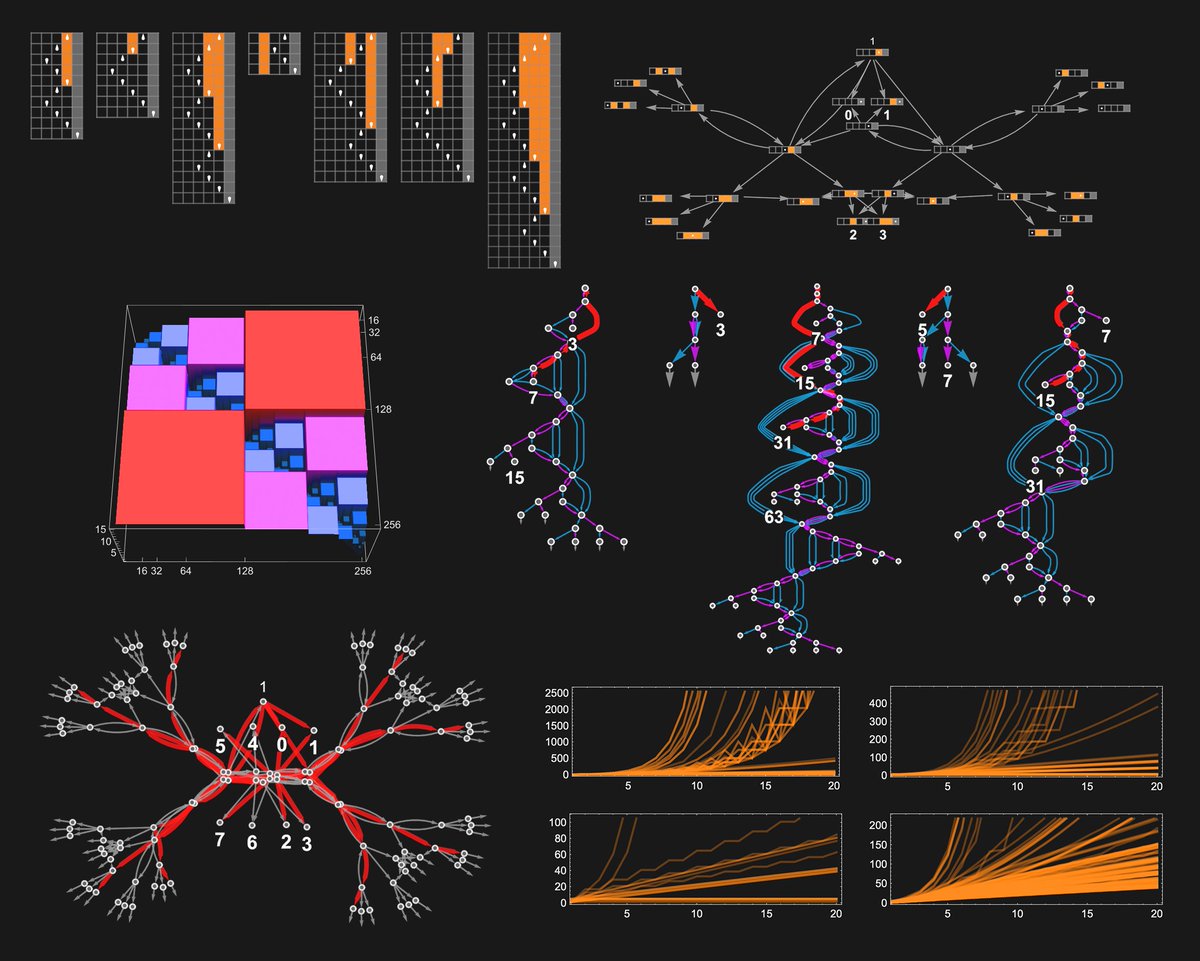
What happens when agents with all possible strategies compete? That's a question for ruliology. With some surprising answers...
https://t.co/5RdL27qQc3
We're building a Moon Base!
@NASAMoonBase will serve as a habitat where astronauts live and work during long-term science missions.
Join us at 2pm ET on Tuesday, May 26, for a live news event where we’ll share updates on our lunar exploration plans: https://t.co/IJXA7xYwju
Testing off-axis projection demo.
Basic scene layout in Blender
glb -> detailed splat via World Labs
Three.js for engine
MediaPipe for face tracking
Next step is to add a character you can move around in the environment
How does an embryo reliably "compute" its form - "cell by cell" - using only local interactions and mechanics, yet produce a precise global body plan? I’m excited to share our Nature Methods paper "MultiCell: geometric learning in multicellular development", presenting #AIxBiology research led by @HaiqianYang and the result of a great collaboration with Ming Guo, George Roy, Tomer Stern, Anh Nguyen and Dapeng Bi.
A long-standing challenge in developmental biology is to predict how thousands of cells collectively self-organize as tissues fold, divide, and rearrange. In MultiCell, we represent a developing embryo as a dual graph that unifies two complementary views of tissue mechanics with single-cell resolution: cells as moving points (granular) and cells as a connected foam (junction network). This lets the model learn dynamics from both geometry and cell–cell connectivity.
On whole-embryo 4D light-sheet movies of Drosophila gastrulation (~5,000 cells), our model predicts key cell behaviors and the timing of events, including junction loss, rearrangements, and divisions with high accuracy, at single-cell resolution. Beyond prediction, the same representation supports robust time alignment across embryos and offers interpretable activation maps that highlight the morphogenetic "drivers" of development. The broader goal is a foundation for cell-by-cell forecasting in more complex tissues, and eventually for detecting subtle dynamical signatures of disease.
Kudos to the team for this inspiring collaboration with brilliant researchers to push the boundary of AI for biology!
Citation: Yang, H., Roy, G., Nguyen, A.Q., Buehler, M.J., et al. MultiCell: geometric learning in multicellular development. Nature Methods (2025), DOI: 10.1038/s41592-025-02983-x
Code/data links are in the manuscript.
<rant> A periodic reminder that Sprints, Backlogs, Daily Scrums, Scrum Boards, Scrum Masters, Product Owners, Points, Velocity, PIs, etc., have NOTHING AT ALL to do with "Agile." Agility comes from working small, delivering frequently for feedback from actual customers, and adapting based on that feedback. It has to do with teams working in whatever way they see fit to get stuff into the customer's hands as quickly as possible and acting on the feedback without bureaucratic obstacles. Any way that you can accomplish that is fine. All that garbage I listed in the first sentence just gets in your way.</rant>
Atoms, captured in the highest resolution ever.
What you’re looking at is praseodymium orthoscandate (PrScO₃), magnified 100 million times. Each dot in the image represents a single atom, locked into a crystal lattice.
It may look slightly blurry – but that’s not a flaw. Atoms never sit still. They vibrate constantly due to thermal motion, and this image captures them in their natural, restless state.
The milestone was achieved using a technique called ptychography, a form of electron interferometry. By analyzing how electrons scatter when they bounce off atoms, researchers reconstructed an image with unprecedented precision – pushing atomic imaging to its theoretical limits.
Here’s what you’re seeing:
◦ Praseodymium atoms – bright blobs appearing in pairs
◦ Scandium atoms – single bright blobs
◦ Oxygen atoms – faint red dots
[📷 Cornell University]











![Rainmaker1973's tweet photo. Atoms, captured in the highest resolution ever.
What you’re looking at is praseodymium orthoscandate (PrScO₃), magnified 100 million times. Each dot in the image represents a single atom, locked into a crystal lattice.
It may look slightly blurry – but that’s not a flaw. Atoms never sit still. They vibrate constantly due to thermal motion, and this image captures them in their natural, restless state.
The milestone was achieved using a technique called ptychography, a form of electron interferometry. By analyzing how electrons scatter when they bounce off atoms, researchers reconstructed an image with unprecedented precision – pushing atomic imaging to its theoretical limits.
Here’s what you’re seeing:
◦ Praseodymium atoms – bright blobs appearing in pairs
◦ Scandium atoms – single bright blobs
◦ Oxygen atoms – faint red dots
[📷 Cornell University]](https://pbs.twimg.com/media/G5y3ZL4XwAAHGVp.jpg)


