Japanese architect and advocate Riken Yamamoto @RikenYamamoto has been selected as the 2024 Pritzker Architecture Prize Laureate 🎖️ #pritzkerarchitectureprize https://t.co/JcnSHRPYRd
15 years ago, I helped design Google Maps.
I still use it everyday.
Last week, the team dramatically changed the map’s visual design.
I don’t love it.
It feels colder, less accurate and less human.
But more importantly, they missed a key opportunity to simplify and scale.
–––
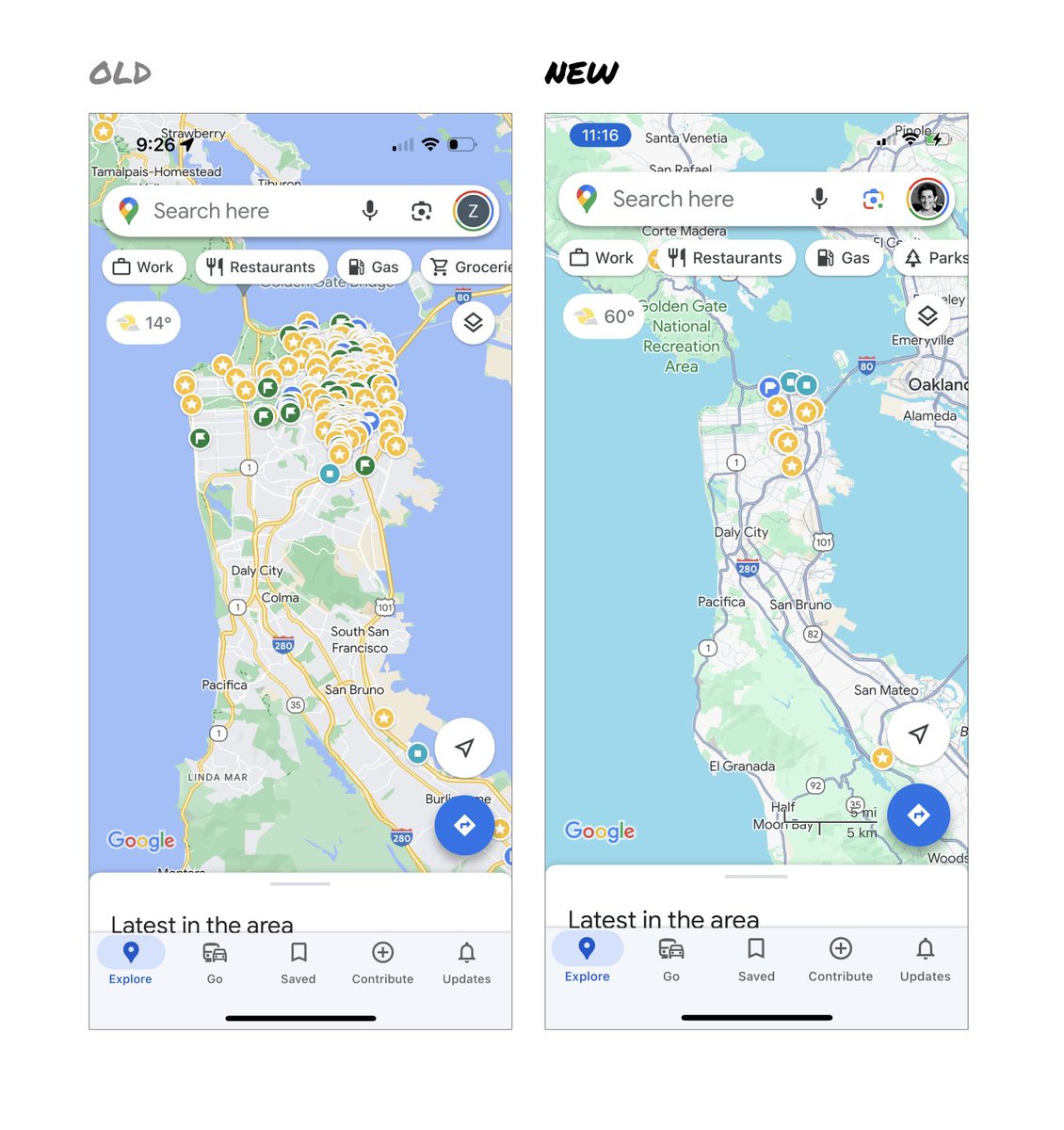
Google Maps has started to widely roll out updated map colors:
- All roads are now gray
- Water changed from blue to teal
- Parks and open spaces are now mint green
It seems the goal was to improve usability and make the maps more readable.
Admittedly, I do think major roads, traffic, and trails stand out more now.
But the colors of water and parks/open spaces blend together.
And to me, the palette feels colder and more computer generated.
But color choices aside…
If the goal was better usability, the team missed a big opportunity:
Google Maps should have cleaned up the crud overlaying the map.
–––
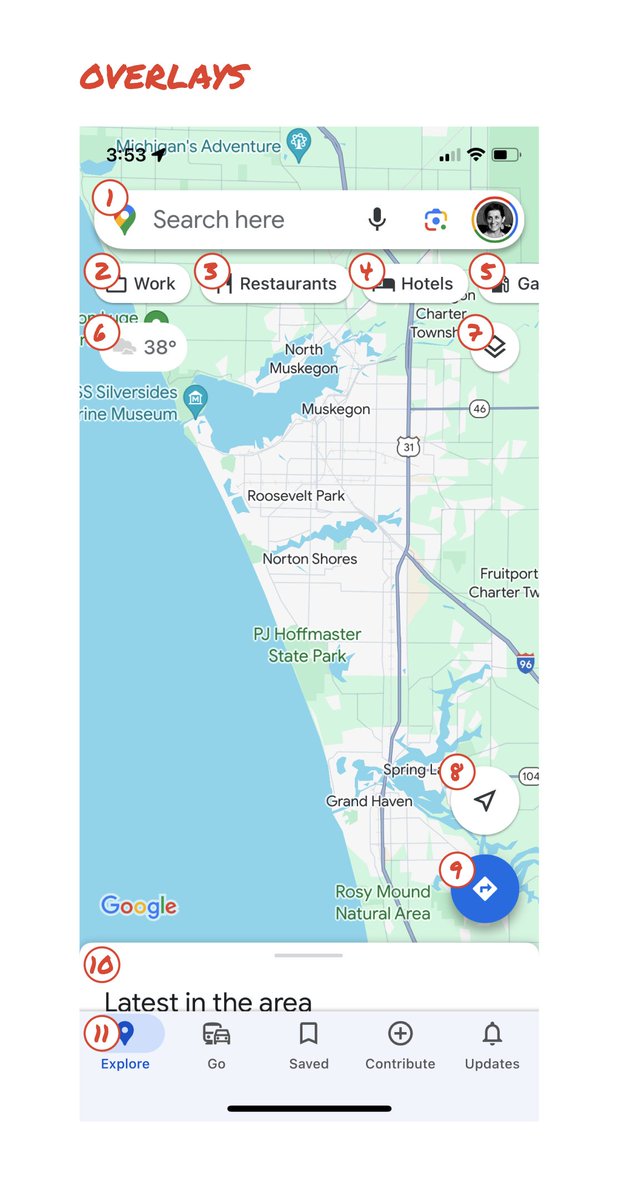
So much stuff has accumulated on top of the map.
Currently there are ~11 different elements obscuring it:
- Search box
- 8 pills overlayed in 4 rows
- A peeking card for “latest in the area”
- A bottom nav bar
(Personally, I would LOVE to see usage metrics for all these overlays.)
The map should be sacred real estate.
Only things that are highly useful to many people should obscure it.
There should be a very limited number of features that can cover the map view.
And there are multiple ways to add new features without overlaying them directly on the map.
–––
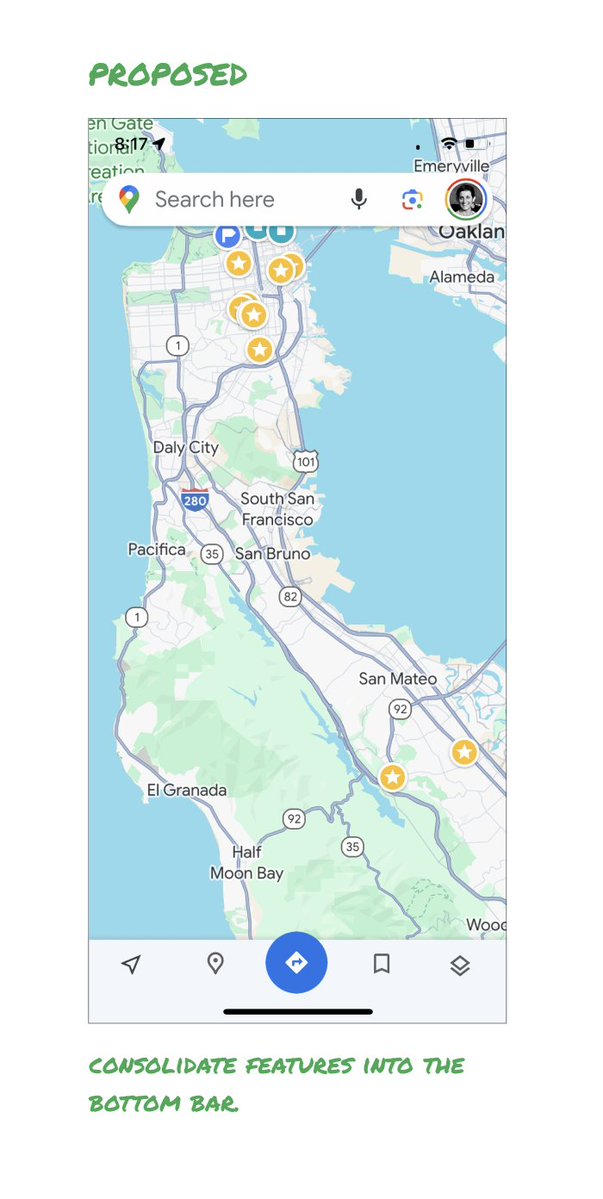
Here’s how it could look:
- Keep the search box
- Keep the bottom bar
- Remove everything else from the map
- Roll the most used features into the bottom bar
- Bury the less used features elsewhere in the app
I assume the search box and directions are top priority and should remain prominent.
My Location and map layers (satellite, traffic, etc.) could move to the bottom bar.
The explore overlays (restaurants, gas, etc.) could live in the bottom bar in “Explore” and open as cards.
The additional space in the bottom bar could be used for Saved, as a “More” option, or could be removed entirely.
There are many variations of how features could be arranged.
But the key points are:
- Dramatically simplify
- Strongly prioritize map visibility
- Bury legacy and low use features
–––
It’s normal for products to accumulate features over time.
But it’s also super important to stay vigilant and continually clean them up.
In many ways, it’s interesting to see history repeating itself.
In 2007, I was 1 of 2 designers on Google Maps.
At that time, Maps had already become a cluttered mess.
We were wedging new features into any space we could find in the UI.
The user experience was suffering and the product was growing increasingly complicated.
We had to rethink the app to be simple and scale for the future.
It seems like it’s time for Google Maps to do this again…
–––
For more on design + tips for early stage founders, follow me on X: @elizlaraki
Congratulations to Jens R winner of the Architecture & Interiors category at this year’s #UnsplashAwards.
“This photo captures how architecture can create sublime spaces, putting us in a new context that makes us aware of what humans can build...” - @dbasulto at @archdaily
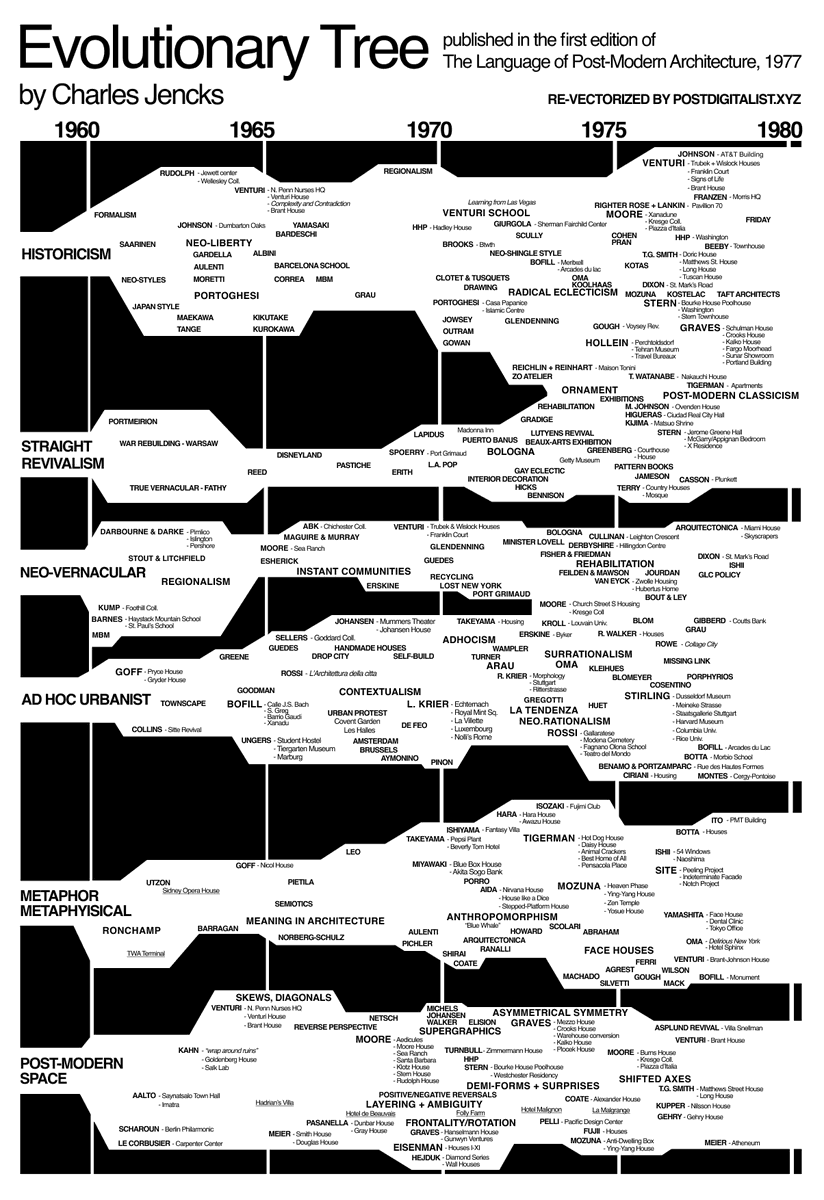
ATENCION estudiantes de Arquitectura y público en general; el famoso Evolutionary Tree de Charles Jencks.
.
Ahora vectorizado y en hi-res para imprimir en tamaño grande y decorar sus oficinas, cortesía de @postdigitalist
.
Lo consiguen acá: https://t.co/mYfhpQEoaL
Texture any 3D model in seconds 😱
Yes your read it right, using @MeshyAI and their generative AI tool.
All you need is to import your model, write a prompt, Done.
Try it out today, link below 👇
On a hike in San Francisco several years ago, Matt Mullenweg (@photomatt) recommended I read “The Tail End” by Tim Urban (@waitbutwhy) on the Wait But Why blog—if you only read one article this month, make it that one. It uses diagrams to underscore how short life really is.
Here’s just one gem: “It turns out that when I graduated from high school, I had already used up 93% of my in-person parent time. I’m now enjoying the last 5% of that time. We’re in the tail end.”
Might be time for you (and me) to rethink our personal priorities.
https://t.co/LpMCDS2uwT
Excited to announce that @FINE_3D will be part of the spring cohort of @a16zcrypto’s Crypto Startup School. FINE is a Web3 studio for generative and interoperable design assets, incl. @SOLIDS3D and @WarGamesApp
We look forward to starting the program. LFG! 🚀🚀