You manage 1,000 customers.
Monday morning is coming.
Who actually needs you? I built an experiment with @TypeSafeAI's Jev to find out.
→ 1,000 (synthetic) SaaS accounts
→ 6 judgments per account
→ 6,000 semantic judgments
→ 9.37 seconds
→ $0.0775
→ 180/181 planted issues caught
The interesting part isn't the dashboard.
Jev never decides who gets prioritised. It judges six narrow questions — attention, churn, expansion, urgency, primary issue and owner — and a little TypeScript turns those probabilities into action.
Change the question from “who needs attention?” to “who might churn?” or “who might buy more?” and the entire portfolio re-ranks instantly. No new model call.
Demo:
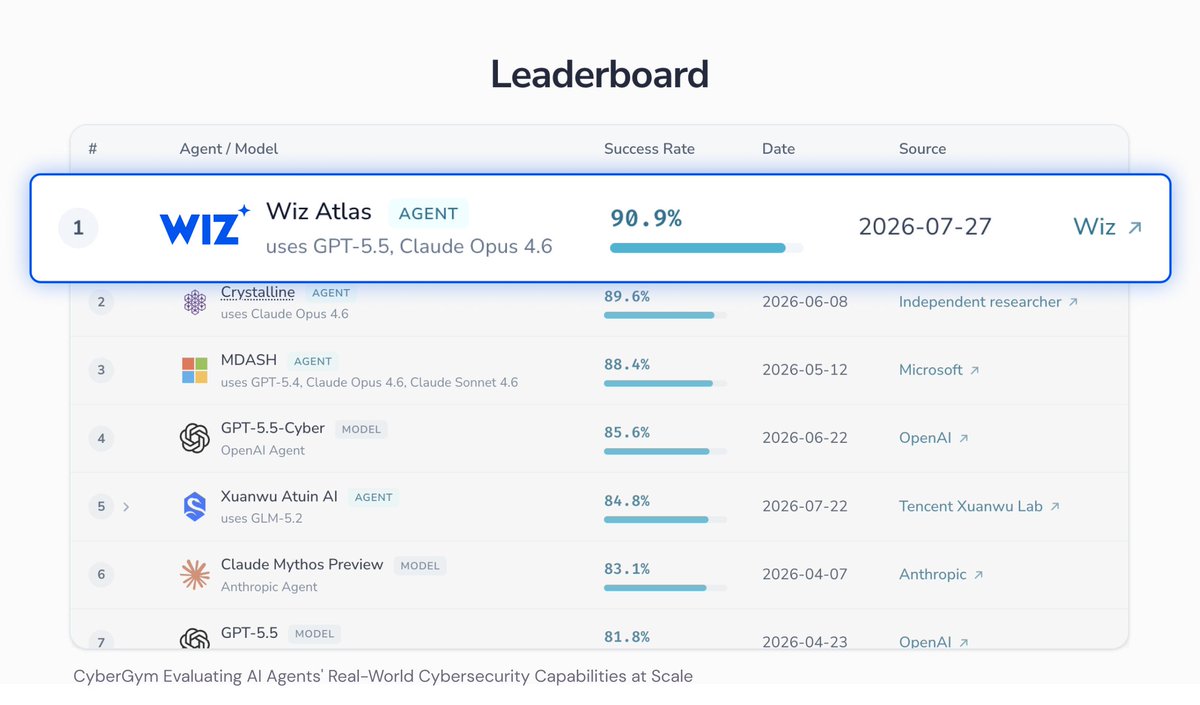
Atlas, our AI vulnerability research system, is now ranked #1 on CyberGym. We've used it to discover and responsibly disclose more than 200 confirmed vulnerabilities across gVisor, Linux kernel, containerd and many other projects.
Here’s how Atlas works behind the scenes 🧵
50% of StackOverflow traffic is gone!
Look at the attached chart. It tells a scary story that will not be limited to StackOverflow.
Right now, detecting AI-generated content is impossible.
Last week, OpenAI shut down the tool they created for this purpose. They launched it in January, and it's dead today, less than seven months later.
Their statement: "The AI classifier is no longer available due to its low rate of accuracy."
I'm not surprised about any of these two events.
I don't remember the last time I visited StackOverflow. Why would I when tools like Copilot and ChatGPT answer my questions faster without making me feel bad for asking?
And I'm even less surprised about OpenAI killing their tool: Many believe detecting AI-generated text is impossible. I'm one of them.
Here's what OpenAI had to say about this:
"We are (...) currently researching more effective provenance techniques for text, and have made a commitment to develop and deploy mechanisms that enable users to understand if audio or visual content is AI-generated."
Notice how they differentiate text from audio and visual content. For the latter, they seem confident they'll find a way to recognize humans from AI. For text, they are not and are word-salad'ing us with a vague "researching more effective provenance techniques."
StackOverflow famously banned any AI-generated answers from the site.
That's the wrong move.
Instead, we need to find a way where human and AI-generated content coexist and benefit from each other. There's no putting the genie back in the bottle, so how can we get the most out of it?
Do you think StackOverflow will survive? What can they do to fend off what seems to be a life-threatening event?
@ColdFusion_TV Looking forward to this one! Been subbed since the ColdtFusion days; you've come a long way (but have always put your heard into your videos since the beginning!)
Kudos to @Railway for the outstanding #UX while signing up. Must be the first time in my life that I actually read the T&Cs before hitting 'Agree' 👏