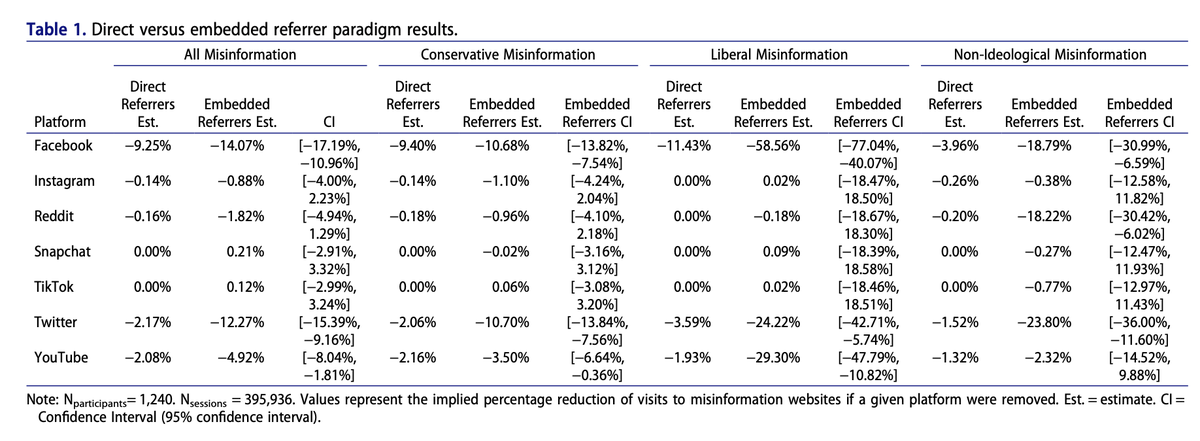
From me and @RyanMooreInfo. Most work on social media and visits to news and misinfo websites does a "referral analysis." We conceptualize the "embedded referrers paradigm" and simulation analysis to examine at social media's role more holistically https://t.co/bv68LUcT39
A new piece from me on @NYMag is out today. It is the second installment in a reporting trilogy I’m calling “AI and the Chinese society.”
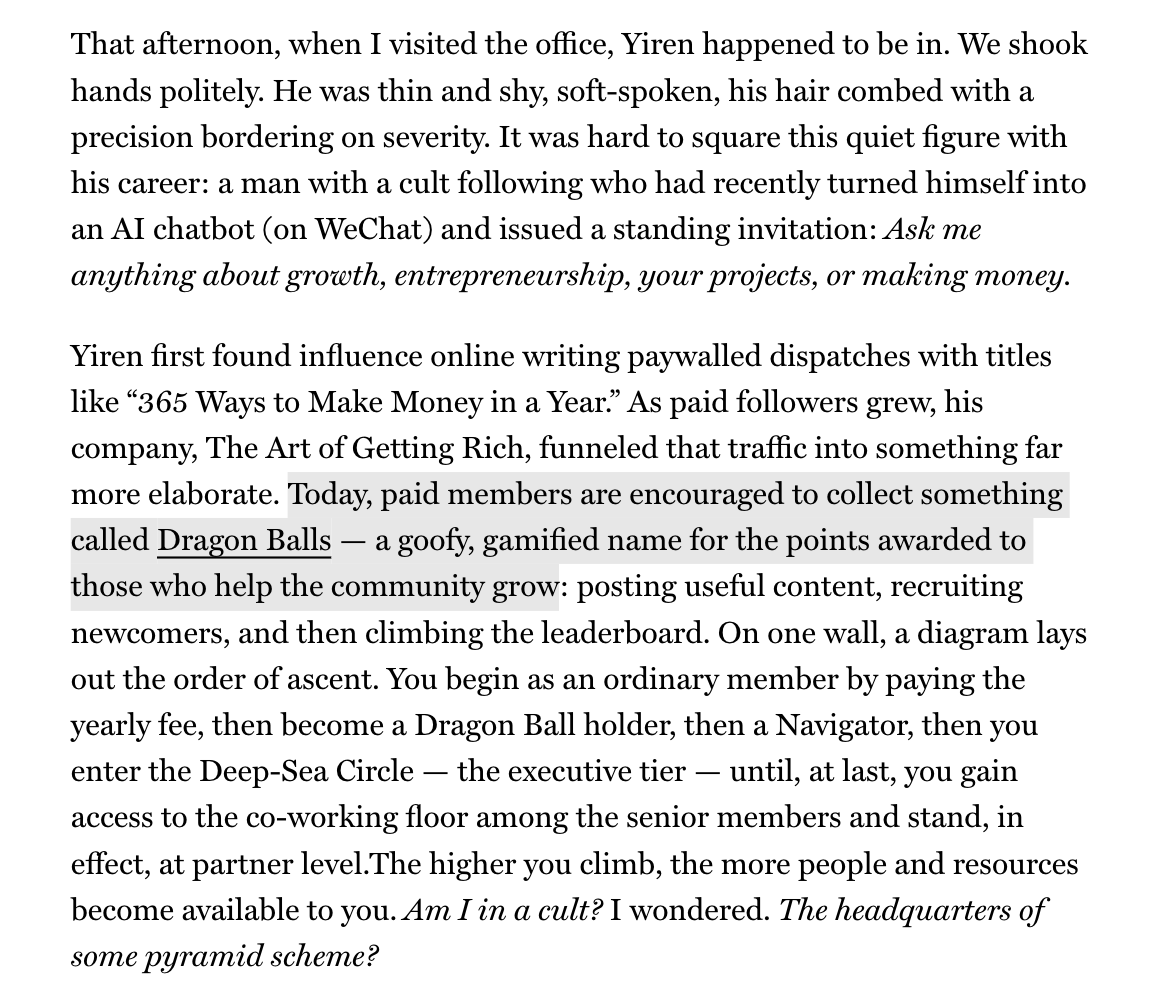
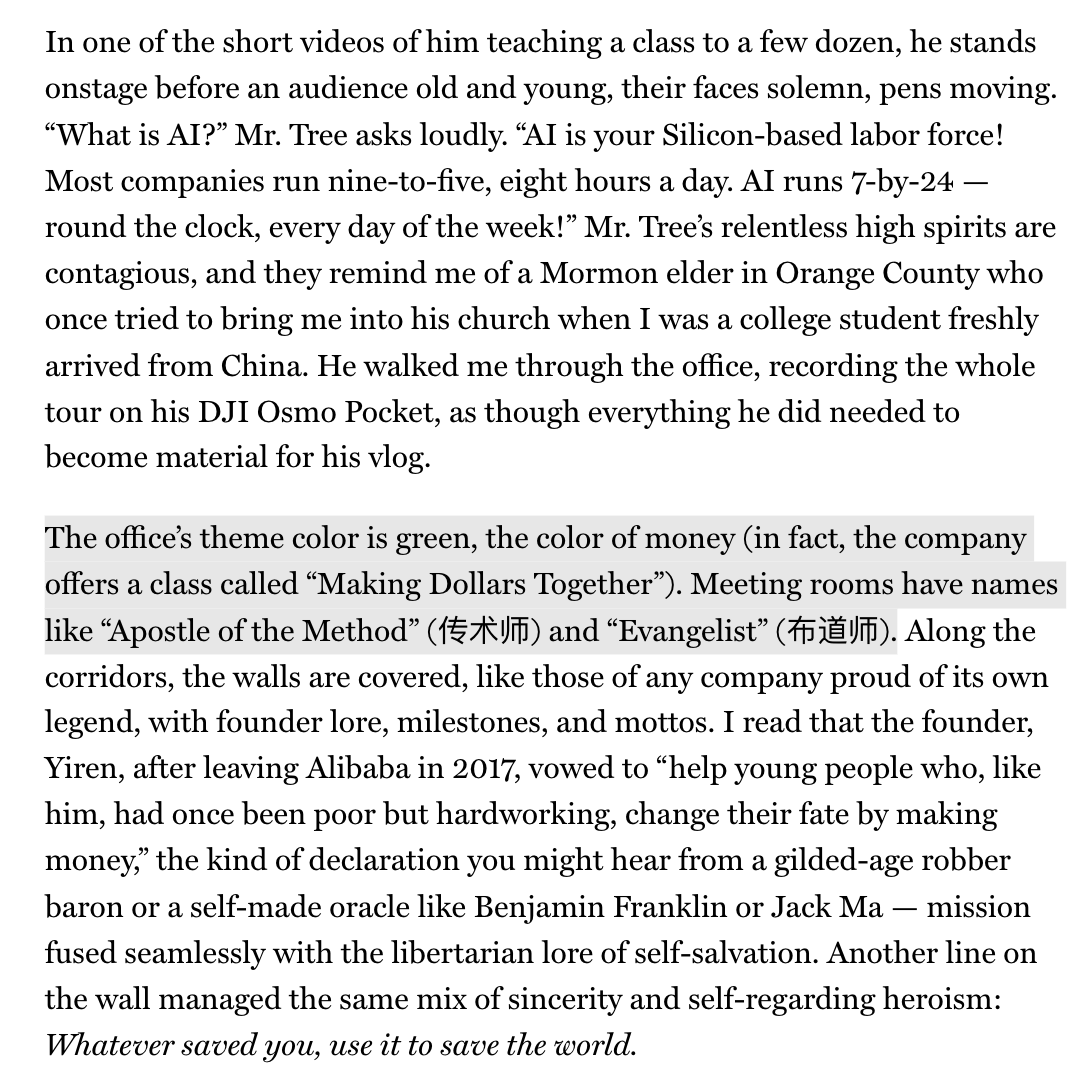
Earlier this year, I visited China’s largest get-rich-with-AI company, which sells AI courses for profits. It has more than 80,000 paying members. Its meeting rooms have names like “Apostle of the Method” and “Evangelist.” Their membership system resembles a pyramid scheme.
I was greeted by Mr. Tree, an in-house influencer and AI educator whose social media bio promises to “search for 100 business answers in the age of AI”—an echo of Beijing’s “AI Plus” plan. The company felt like a prosperity-gospel church, and salvation meant adopting AI as fast as you can.
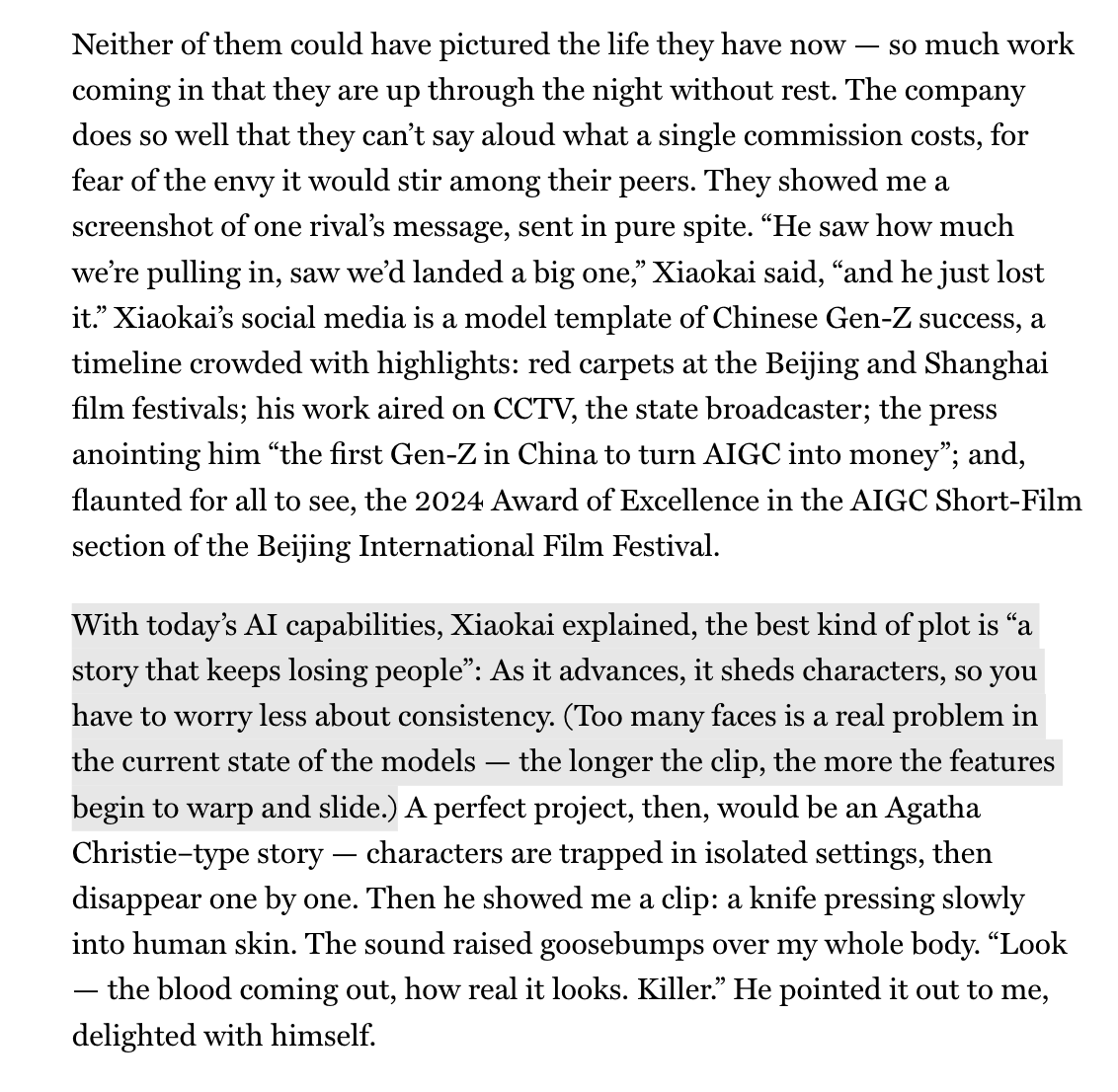
In Liangzhu, China’s vibe-coding capital, which I wrote about, young people give one another AI lessons for free in their living rooms. I also met Xiaokai, a 25-year-old filmmaker who became a pro on AI video generation through free classes, built a business earning several million yuan in profit, and now walks red carpets in Shanghai and Beijing.
To understand this AI education craze, I found peoples’ fear of being left behind, their religious faith in education, and millions of ordinary people trying to find a place for themselves in a AI future Beijing is summoning on behalf of everyone.
-----
Earlier this week, @KaiserKuo and I chatted about this trilogy on the great @SinicaPodcast in detail and some behind-the-scenes stories. You can listen to it now (links in the comments)!
Also. Many thanks to my wonderful editor, Joy Shan; my fact-checker, Jessica Suriano; and some friends who read the draft and offered feedback.
My first piece for @NewYorker is out today!
As Xi Jinping lands in DC to start his state visit, you'll hear a lot about the US-China AI race. I'd like to tell a complementary AI story.
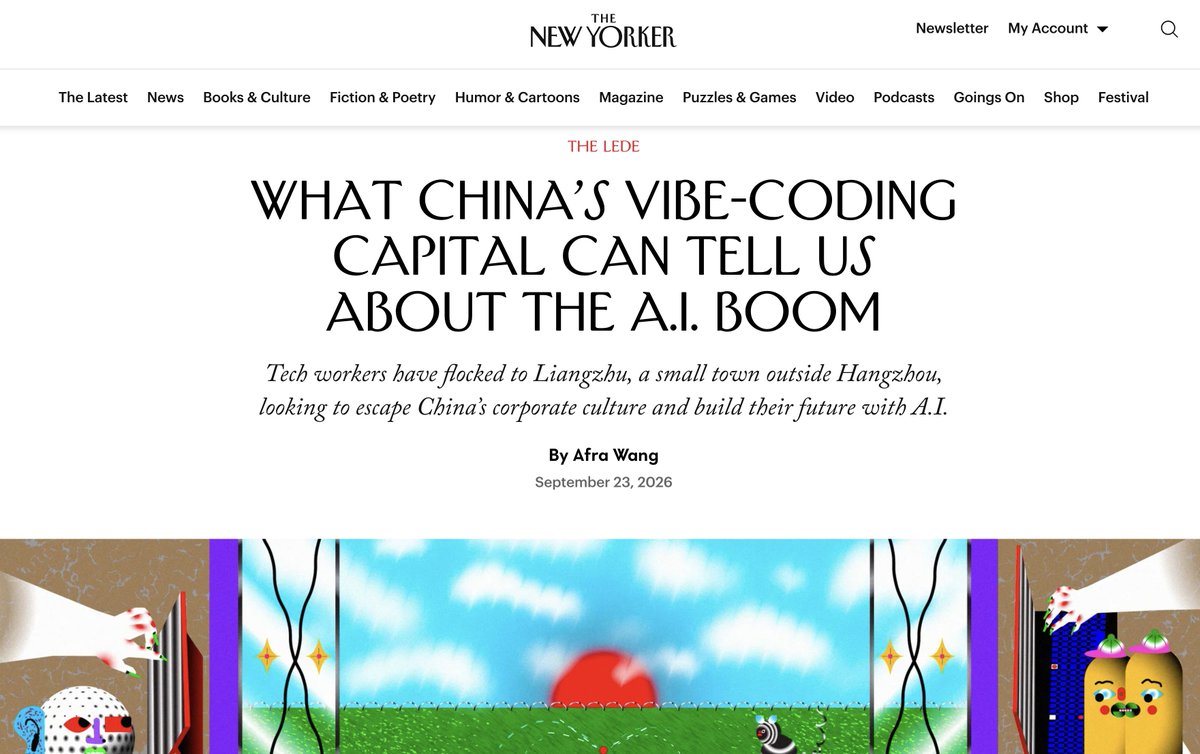
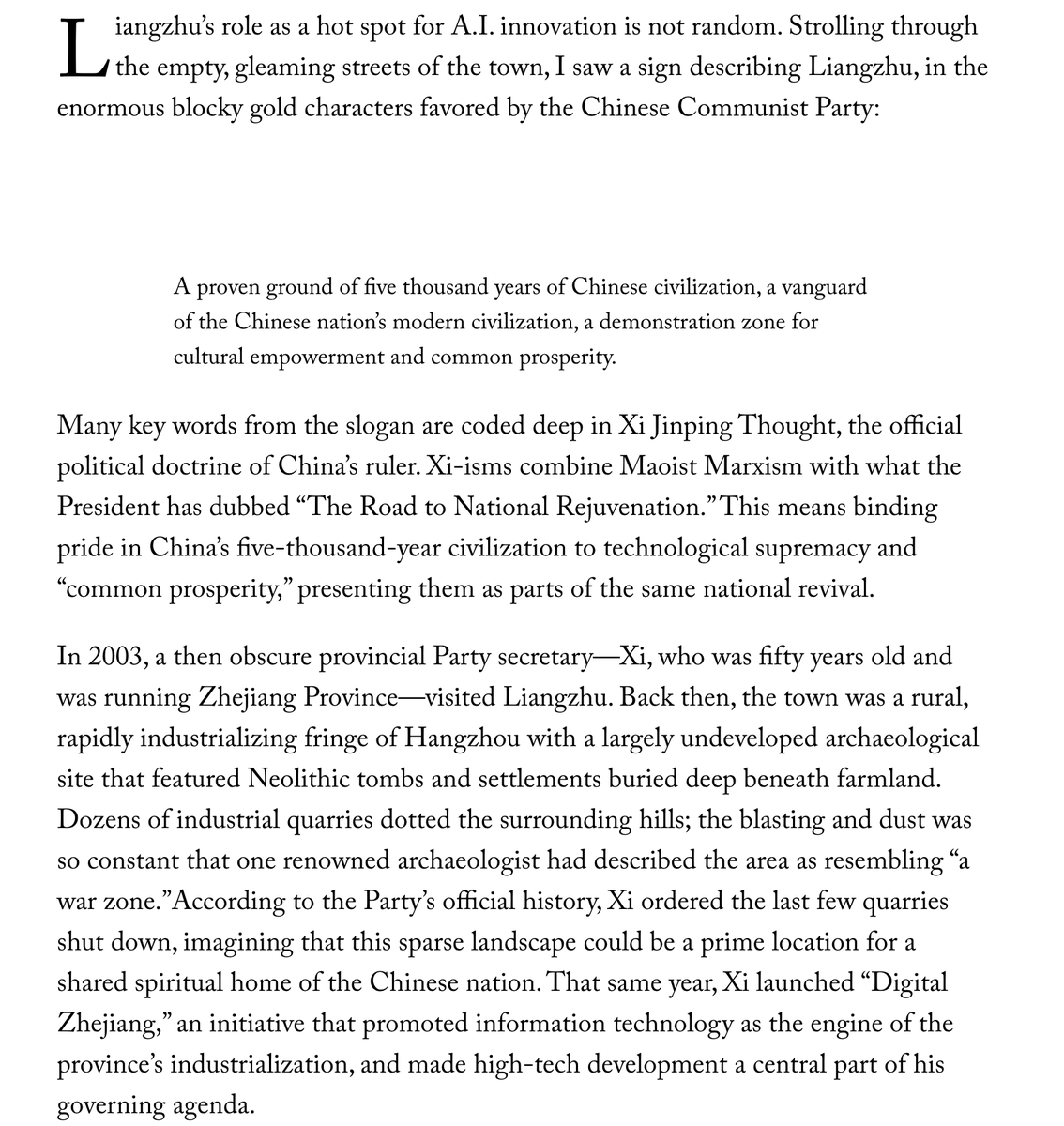
This past May, a few days after Trump visited Beijing, I went to the town people call China's vibe-coding capital, Liangzhu. There, you learn that China's AI scene is not monolithic. It's also full of contrarians, cool vibe coders, spiritual seekers, and people who love AI but refuse to join the 996 grind.
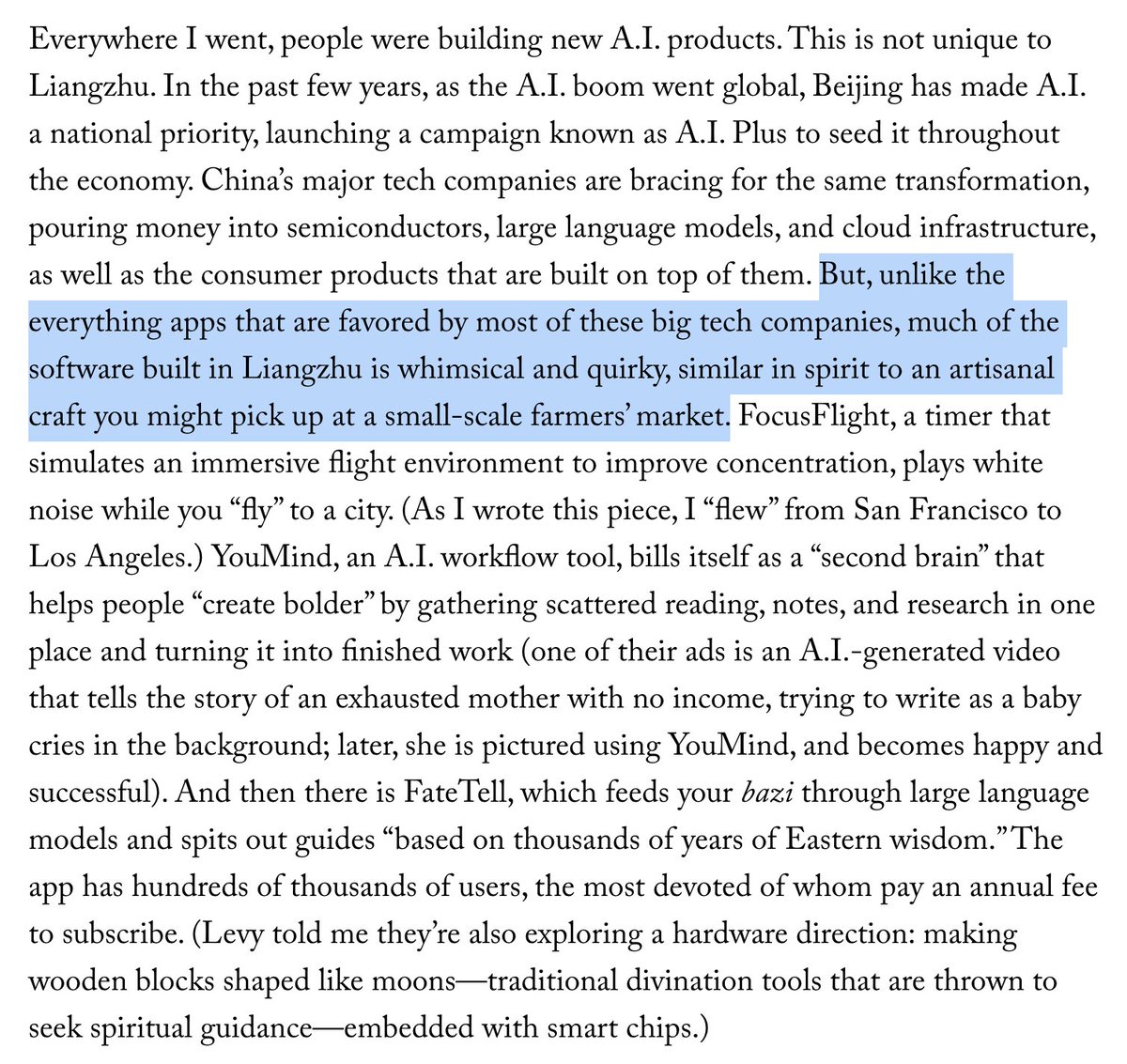
Liangzhu is on the edge of Hangzhou. I hung out with a group of anti-mainstream builders who use AI to make whimsical apps for fortune-telling, mental well-being, and creativity. Some of them run their lives entirely by bazi astrology (their founder almost became a Taoist monk). They meet on "Crazy Thursday" to vibe-code together. Rent is cheap, so they can get a bigger place with a living room to have friends over (unthinkable in Beijing or Shenzhen). In Liangzhu, they want to use AI to forge their own future.
It’s a ground-level story—less about model capabilities, hyperscalers, or AI policy, and more about how people in China are using AI, and the human stories behind it.
When the state cannot afford to jail activists, it calls their parents.
My research theorizes Emotional Proxy Repression: authoritarian states exploit the emotions bound up in intimate relationships, obligation, care, and shame, to pressure political actors with full deniability.
Patriarchal family norms make the feminist activists I study especially vulnerable to this form of repression.
I see my work as a political intervention, a refusal to let privatized state violence stay hidden. Open access:
https://t.co/SbwHu9Hjd2
My piece on AI and creative writing, A New Kind Of Creative Poverty, is out in @NoemaMag, edited by the wonderful @latams
The relationship between creative writing and AI is a well-worn subject by now, but i couldn't stop thinking...why can't great writing be measured, quantified, or converted into the empirical alignment problems of post-training? Why is "greatness" so illegible, even about itself? The question sent me back to my first (accidental) encounter with the French modernist Charles Baudelaire in China as a kid.
In this piece, I also write about the increasingly stifling Chinese internet, the place I grew up, what people in Taiwan derisively call the “Simplified Chinese Internet” (简中互联网). I see a resemblance to LLM post-training, both operate through reward and punishment, and both breed homogeneity.
The essay is indebted to @zhengdongwang's blog; to a conversation with @danwwang in Shanghai about the Simplified Chinese Internet; to @jasminewsun's writing on why LLMs make bad writers but good editors; to a talk with @debutts on reward-and-punishment in LLM training and the Chinese internet; and to my accidental part in @chrisbest and Oliver Habryka's exchange on the meaning of human writing at the Manifest conference (which @hsu_steve invited me to speak). A stretch of reading on model collapse fed it too, as well as a discussion with @realJerryZhou over korean food. the draft was read and improved by @mynameisceline and several other wonderful researchers and writers.
link in comment
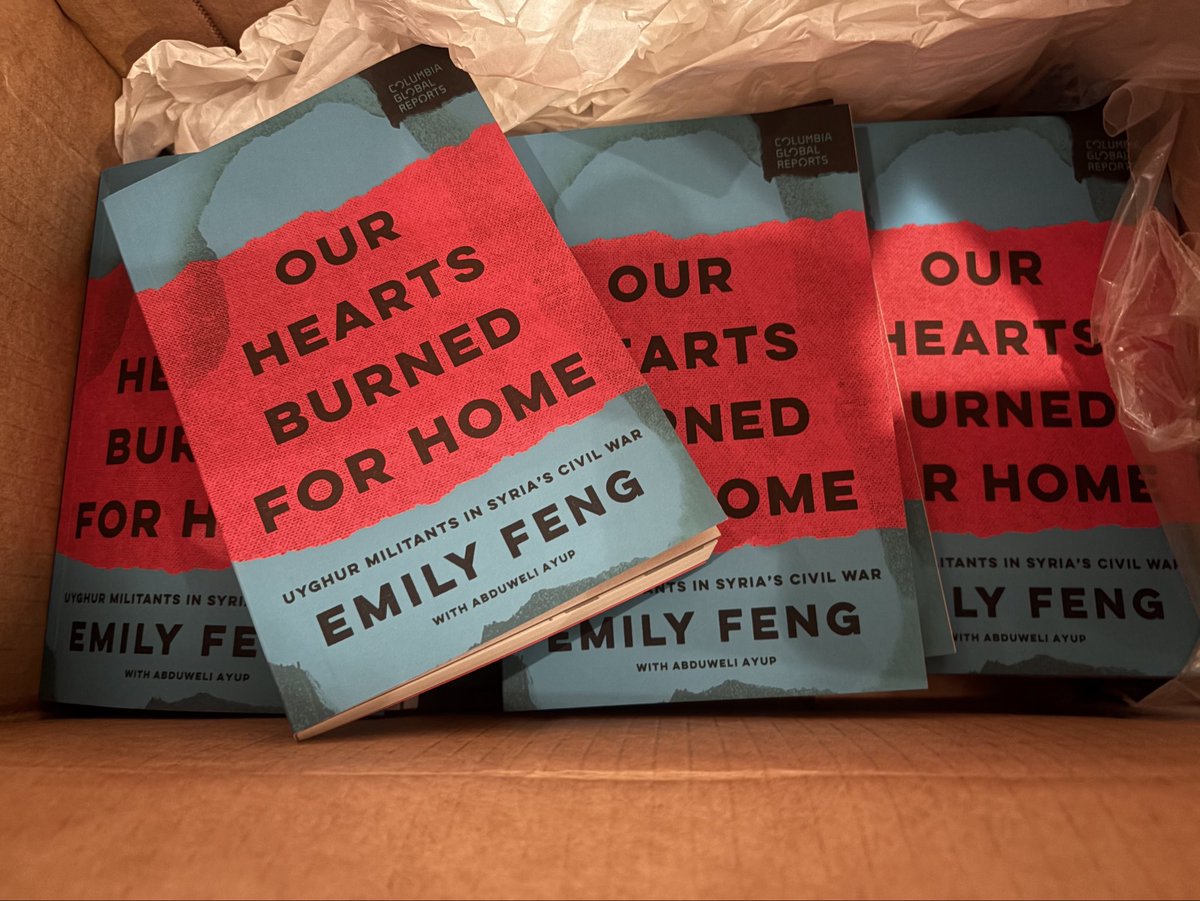
Woo first copies are here! Our Hearts Burned For Home, on sale very soon October 12.
The book unearths the untold story of Uyghur exiles who fled China’s expanding police state—only to become a pivotal force behind the fall of Bashar al-Assad’s regime.
https://t.co/hUIv0MrWbg
Today I start a new job as a White House correspondent with NPR. I am so excited; this is one of the biggest beats in the world right now, and a challenging one at that.
https://t.co/kSmvspSpQY
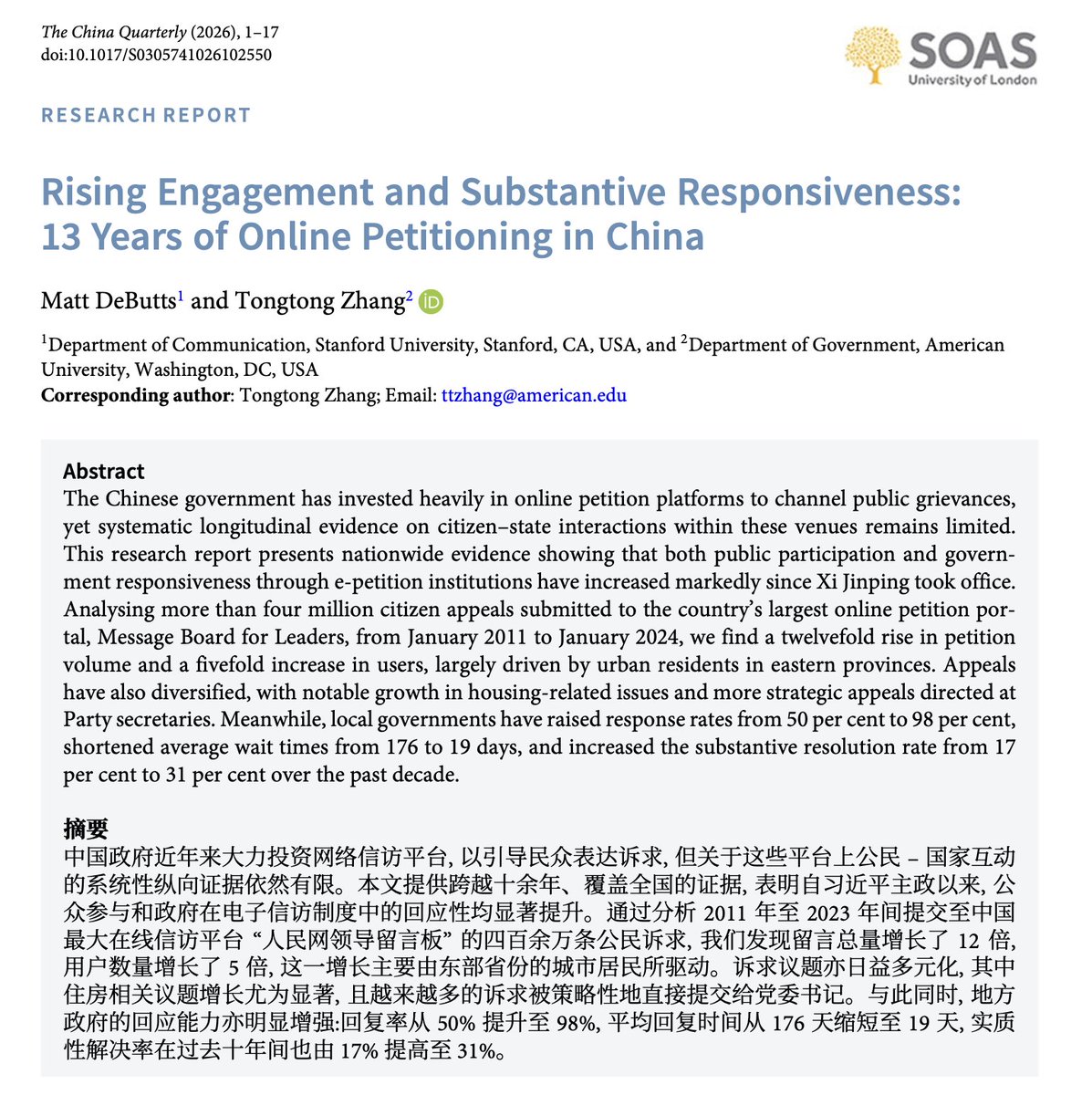
(1) New research with @ttzhang107 in @chinaquarterly: China’s digital complaint institutions (kind of like a “fix-this-problem” hotline) are being heavily used — and are increasingly effective. In 13 years, govt resolved almost 2x as many citizen complaints, from 17 to 31% (1/6)
@ttzhang107@chinaquarterly (5) We used double-coded human classification with DeBERTa to assess govt resolution, and anonymized IP address look-ups + geospatial tools to identify growth. For more info, check out our paper here https://t.co/SswPdinUGY and follow my co-author @ttzhang107 (5/6)
It's a crying shame that there aren't more intl. correspondents accredited in China today.
All the best to @dakekang and let's hope AP will get more visa approved soon.
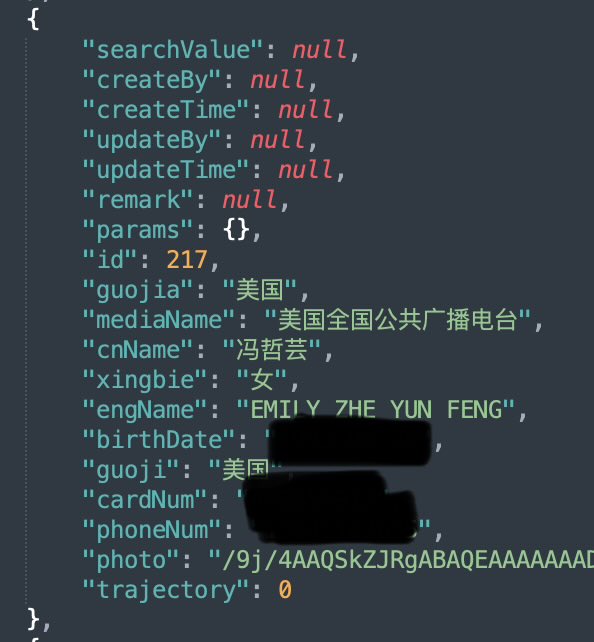
Absolutely not surprising but a limited leak of a Chinese local surveillance platform drawing off an apparently large national one has a special drop down for tracking for tracking foreign journalists in China… including me. @NetAskari found the data https://t.co/z6v9TrFiPe
If you are interested in academic research on this very subject, check out @ucdpolitics PhD candidate @LinetteMLim
here:
https://t.co/0UkUvtFFUg
and here:
https://t.co/5CJai66Pu7
Striking statement from China’s foreign press club, explicitly making clear its critique of China revoking visas, China detaining journos over coverage, not associated w/any media outlet. Media orgs - powerful ones - are not speaking up, and they should. https://t.co/9mHTBQKKDN