F2Pool has successfully integrated TAP Protocol, and is distributing dual Bitcoin block-rewards to their miners (BTC + NAT)
We'd like to commend @f2pool for their commitment to sustainable miner-revenue 👏
and congratulate their miners who now receive two native Bitcoin rewards
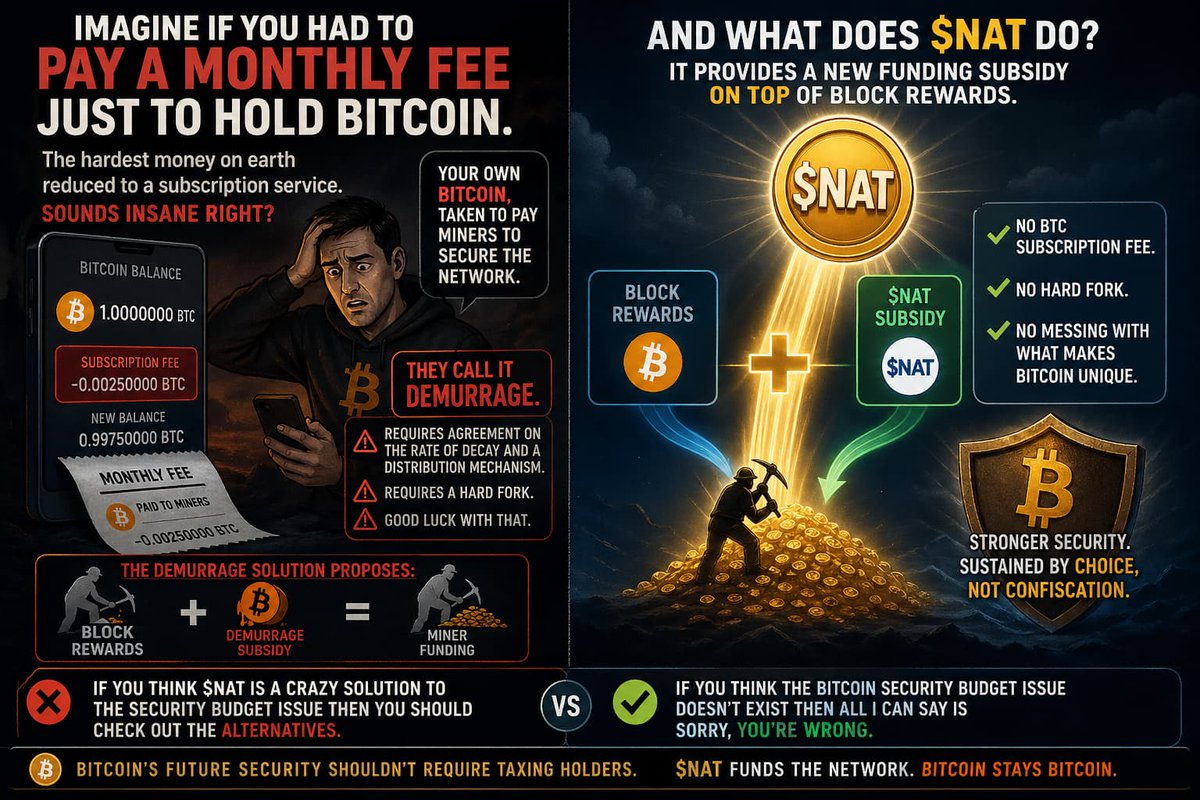
Imagine if you had to pay a monthly fee just to hold Bitcoin.
The hardest money on earth reduced to another subscription service.
Sounds insane right?
But this is one on the genuine solutions proposed to solve the Bitcoin security budget issue.
Your own personal Bitcoin, taken to pay miners to secure the network.
They call it demurrage.
It'd require agreement on the rate of decay and a distribution mechanism. It'd require a hard fork. Good luck with that.
The demurrage solution proposes miners receive a new funding subsidy on top of block rewards.
And what does $NAT do?
It provides a new funding subsidy on top of block rewards. No BTC subscription fee. No hard fork. No messing with what makes Bitcoin unique.
If you think $NAT is a crazy solution to the security budget issue then you should check out the alternatives.
If you think the Bitcoin security budget issue doesn't exist then all I can say is sorry, you're wrong.
Imagine if you had to pay a monthly fee just to hold Bitcoin.
The hardest money on earth reduced to another subscription service.
Sounds insane right?
But this is one on the genuine solutions proposed to solve the Bitcoin security budget issue.
Your own personal Bitcoin, taken to pay miners to secure the network.
They call it demurrage.
It'd require agreement on the rate of decay and a distribution mechanism. It'd require a hard fork. Good luck with that.
The demurrage solution proposes miners receive a new funding subsidy on top of block rewards.
And what does $NAT do?
It provides a new funding subsidy on top of block rewards. No BTC subscription fee. No hard fork. No messing with what makes Bitcoin unique.
If you think $NAT is a crazy solution to the security budget issue then you should check out the alternatives.
If you think the Bitcoin security budget issue doesn't exist then all I can say is sorry, you're wrong.
Bitcoin's security budget isn't a debate; it's math.
We break down the numbers that prove Bitcoin’s subsidy issue isn’t something we made up to build a narrative to pump $NAT.
These are the numbers nobody in Bitcoin culture wants to say out loud, and the reason @SpiderPool_com and now @f2pool are adopting @natgmi matters more than it looks.
NAT’s Organic Rise | NAT Math | Our Final Video?! | TBR #312
We sit down to pull on a thread most Bitcoin podcasts are happy to leave alone: what does it actually cost to secure the network, and who pays for it once the block subsidy has halved itself into irrelevance?
The framing is simple. Pick the total store-of-value pie, multiply it by the percentage you would be willing to spend on keeping the underlying asset secure, and see what comes back. When you are talking about roughly a hundred trillion dollars in global store-of-value assets and a three to three-and-a-half percent haircut, the number that falls out is uncomfortable for anyone who has been repeating that Bitcoin's security problem will solve itself. It is also the number almost nobody in Bitcoin culture has been willing to say out loud.
From there, we walk through why just-make-Bitcoin-infinite shrug doesn't hold, why the security budget hoax crowd keeps moving the goalposts, and where the resilience argument quietly breaks down. The math matters because it frames every downstream question, whether miners can stay liquid through a halving cycle, whether the network can keep expanding its attack surface without a second source of revenue, whether the Bitcoin-maximalist answer is a real answer or a vibe.
About halfway through, the Spider Pool thread from last week comes back with new weight. If pool participants are already receiving NAT alongside BTC, that is not just a novelty payout, it is a live experiment in whether Bitcoin's security can be subsidized by ecosystem activity Bitcoin itself does not produce. The conversation gets into why that kind of arrangement would have been unthinkable three years ago, and what it implies for every other pool watching Spider Pool's numbers right now.
Near the end Will pulls the argument into its real shape. The security question is not rhetorical and it is not decades away. The runway you have been told about is shorter than most in the space want to admit, and the set of viable answers is much narrower than the culture suggests. Watching miners coordinate around an actual revenue mechanism instead of arguing about whether the problem exists is the part that shifts the center of gravity.
@Bankless@drakefjustin There's already a solution that helps solve the security budget issue without any changes to Bitcoin itself.
$NAT rewards miners with a token derived from pure Bitcoin block data.
@SpiderPool_com are already distributing these rewards to miners, with more pools expected soon.
@Jackkk Looking for the next novel thing? You should check out $NAT @natgmi
A Bitcoin native token for miners to protect against the impending security budget issue
Growing since 2023. First mining pool adoption went live this month. Only solution to rewards halving without a fork
Picture this: It's 2032. Bitcoin hits $1 million. Miners are earning just 0.78 BTC per block, down from today's 3.125 BTC. The network is worth $21 trillion, but the security budget in BTC terms is pittance relatively.
A hostile actor, maybe a nation state, hedge fund or just some troll with generational wealth, decides they want chaos. They want fear. They want panic. But most of all, they want more Bitcoin. Lots more.
Here’s their playbook: Take a $100 billion short position on Bitcoin, MicroStrategy, every public miner stock and as many alts as possible. Build this over weeks so it doesn’t spook the market. At the same time, quietly approach major mining pools. Offer them 2 BTC per block in bribes, more than they’d earn legitimately, along with insider information about the coming price move. The miners take the deal, hedging with their own massive shorts.
Then comes 48 hours of chaos: mining empty blocks to slow the network, selectively double-spending major exchanges, and reversing high-profile transactions. Detection is inevitable, but by the time users react, the damage is done. Mainstream media headlines scream: “Bitcoin Broken! How a 20 Year Old Known Issue Was Never Resolved.”
Bitcoin crashes 50%. MicroStrategy drops 70%. Mining stocks crater 80%. Alts jump off a cliff. The hostile actor’s combined short positions print $50+ billion profit.
And then the twist: they know Bitcoin isn’t dead, just wounded. They know this security budget issue will finally be taken seriously. This is a one time arbitrage play. Using their profits, they accumulate as much Bitcoin as they can at the bottom. They’re not Bitcoin bears, they’re predators exploiting a structural weakness.
When miners earn almost nothing, loyalty becomes cheap. When the cost of an attack is dwarfed by the profits from chaos, the incentives shift. And when that happens, the question isn’t if someone will run the numbers, it’s whether we’ll have fixed the problem by the time they do.
We need a solution, because somewhere, someone is already running said numbers. Whether it’s fee market reform, a change in block rewards, or something new, like subsidising miners with Bitcoin native digital commodities, the point is simple: act now, or let inaction become the real attack vector.