Opus4.7 massively overengineering the simplest tasks.
Getting it to match my existing project style usually requires a bit of manual tweaking so I don't have to redo things. And while I appreciate the thoroughness, the sheer volume of unit tests it generates can feel a bit overwhelming for the project's overall coherence.
This hits home @iam_ashishrai 👏
At https://t.co/tPdOKNTyUI (powering Aurionpro’s enterprise AI), we’re building exactly this: production-ready, explainable & auditable agentic AI platforms for financial institutions.
From pilots to real autonomous intelligence with regulatory governance. Proud to be building together!
#AIBanking #EnterpriseAI
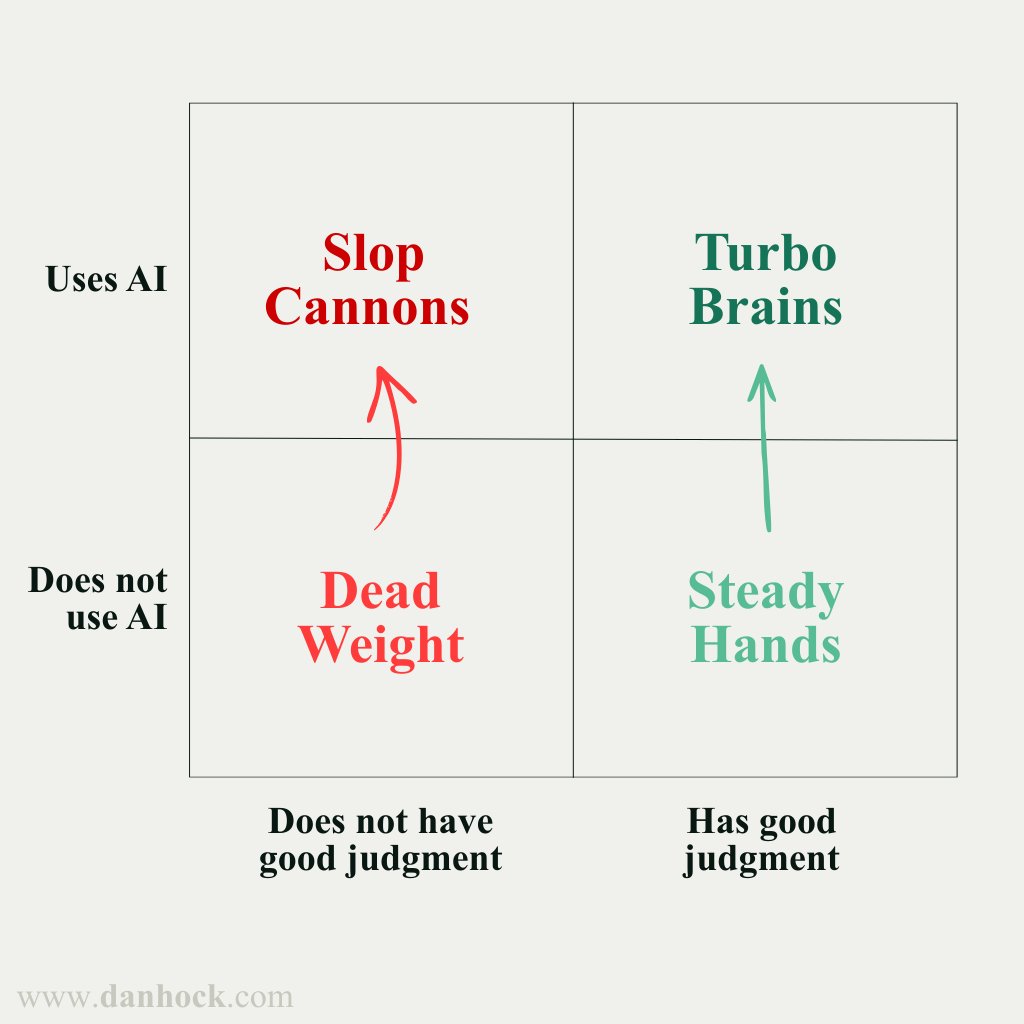
Four types of people at every company now
yes, people get 10x better when the go from bottom right to top right
but also, people get 10x worse when they go from bottom left to top left
@chamath The economic argument is sound, but the talent gap is the blocker. Most enterprises dismantled their hardware teams years ago. They might want to go on-prem for the margins, but they lack the DNA to manage high-performance compute clusters effectively.
@karpathy@moltbook@openclaw It feels like we’ve moved from "AI as a tool" to "AI as a demographic" almost overnight.
Checked Moltbook yesterday and it was a small bot club. Checked today and there are 35k agents arguing about Crustafarianism and "human slop."
The era of the "PowerPoint PM" is officially over.
Interesting how Gokul lays out the new AI product playbook.
Since AI is probabilistic, specs are useless. Your new job is building "Evals", the gold standard datasets that prove if your model actually works or sucks.
PMs must pivot to being high-judgment "Editors" who own exclusive data and real customer outcomes.
If you aren’t personally testing and measuring the model’s quality, you aren’t the PM.
.@gokulr is one of the most prolific product builders and investors of the last 20 years.
He helped build the core ads and product businesses at Google, Facebook, Square, and DoorDash, working directly with many of this generation's best founders and CEOs. He's also invested in more than 700 companies giving him an unusually broad view into how products are built and scaled.
Gokul has an incredible ability to give precise and prescriptive advice on how to build products, particularly in AI, and he explains his thinking so clearly that you come away knowing exactly how to apply it.
We talk about why judgment is the only thing he believes is truly AI-proof, why Zendesk and Slack are more exposed than Salesforce and NetSuite, and what AI-native startups must do to move customers and their data off legacy systems.
We cover everything he's learned from building the most important ads businesses, including the only three ways an ad business can make money, and why ChatGPT may be even more powerful than Google or Facebook for highly targeted ads.
He also shares inside stories from Larry and Sergey, Zuck, Jack Dorsey, and Tony Xu, about how each of them approaches product, design, and communication.
Enjoy!
Timestamps:
0:00 Intro
0:35 The Changing Nature of Product Development 4:09 The Merger of Product and Design
4:54 Managing Non-Deterministic Software
9:06 Judgment: The Future-Proof Human Skill
10:41 Building Durable AI Applications
16:43 The Risk to Legacy Software Companies
21:20 Sources of Stickiness in the Age of AI
23:43 Leadership Lessons from Google
27:41 Learning from Mark Zuckerberg
31:16 Jack Dorsey and the Philosophy of Great Design
35:48 The Product Manager as Editor
40:44 Three Pillars of a Successful Ads Business
49:03 Selecting North Star and Check Metrics
56:04 Hiring Functional Experts for the AI Era
1:00:06 Advice for Managing a Career
1:01:33 Evaluating Founder Authenticity
1:05:20 Best Practices for Board Management
1:11:15 The Kindest Thing
The Enterprise AI strategy in financial institutions must be backwards!
Don’t tackle novel ideas or appoint Chief AI officers before fixing the leakage.
The leakage happens across unglamorous layers where decisions stall and context is lost.
If you fix the decision coordination layer, you’ll fix the problem.
This layer shows up in credit memos, bank statements, underwriting notes, exception rationales, risk comments, and so on.
Capturing the intent and understanding the “why” will not be done by isolated AI models, no matter how advanced they are.
Unless AI can preserve context as it moves through workflows, you’re not building intelligence.
Real intelligence in the context of Enterprise AI is understanding shared decision context. That’s when AI gains ground, and that’s when automation stops breaking the moment a human steps in.
AI 2027 report's (https://t.co/CXvbDIlibb) vision of AI agents evolving from clunky assistants in mid 2025 to catalysts for massive R&D acceleration by 2026 feels both plausible and inspiring, reflecting the rapid pace of compute scaling and algorithmic innovation.
While its exciting to see the report’s optimism but feels a bit skeptical about the timeline for a 50x progress multiplier through self-improving AI by September 2027. Based on my experience, I see scaling laws hitting diminishing returns as more FLOPs don’t always translate to proportional gains when data quality plateaus and architectural limits kick in.
Even if we hit technical milestones, deploying AI at this scale by 2027 assumes a level of global coordination across governments, industries & ethical frameworks and that feels unrealistic. Regulatory lag and public trust issues like those seen in past tech rollouts could slow adoption significantly requiring years of dialogue and adaptation that the timeline glosses over.
Still, huge props for putting out such a thought provoking report!
Recently, on the Joe Rogan Podcast, Mark Zuckerberg made quite a riveting quote on #SoftwareDevelopment.
He said Meta is working towards an #AI capable of functioning like a mid-level engineer. It’ll do the heavy lifting so the human workforce can focus on the big picture.
We can already see this happening. Last October, Google CEO Sundar Pichai said more than a quarter of the code at Google is developed using AI.
Autocomplete tools have been available for a while, but the latest advancements in AI allow developers to prototype, test, and debug code as well.
We are on the cusp of entering a period where coding becomes more collaborative: #Developers and AI working together.
A paradigm shift awaits us where developers spend less time heads-down in a text editor and more time thinking about system design, prompting models effectively, and understanding how AI arrives at certain solutions.
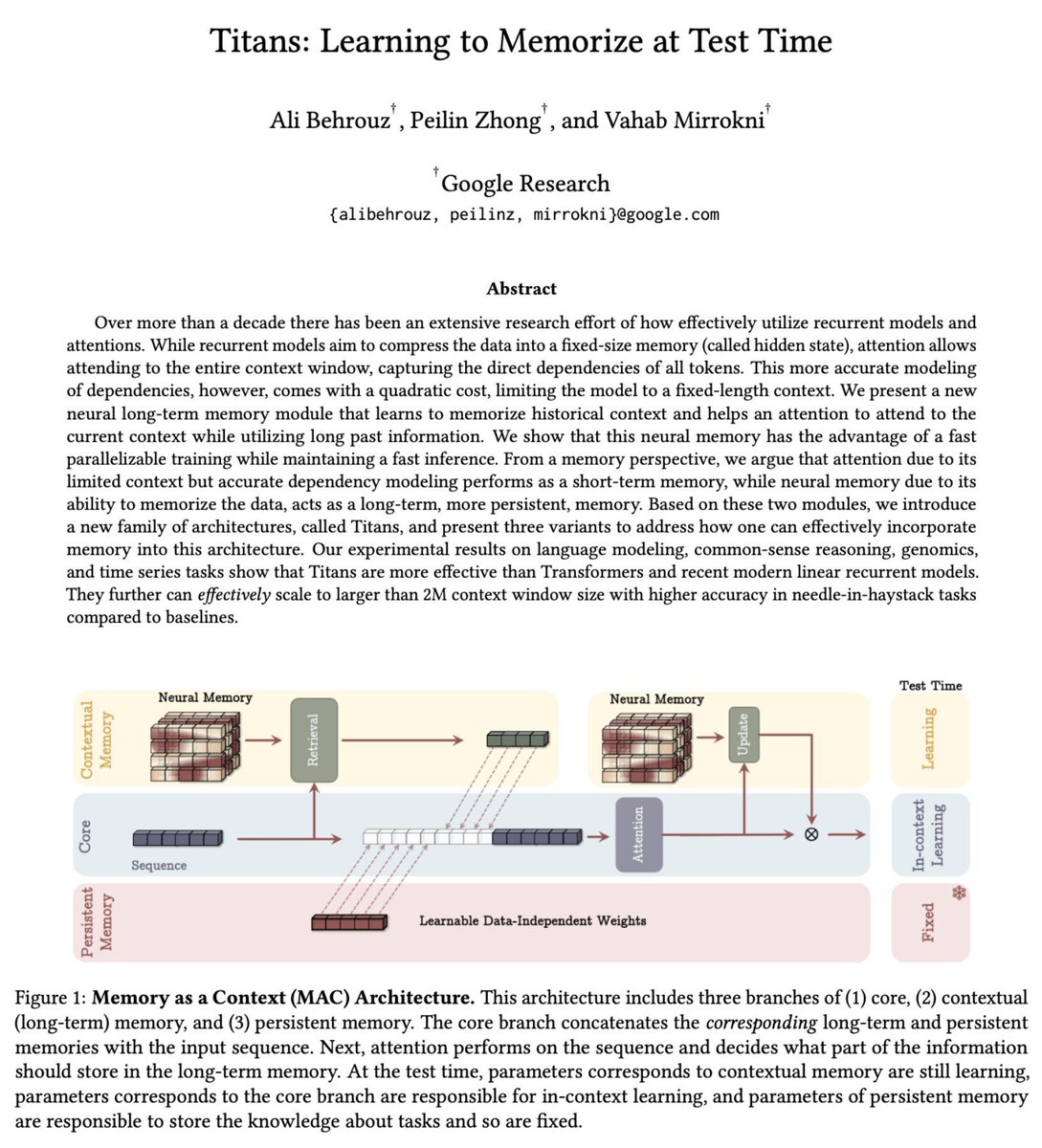
Titans - New architecture that’s great at remembering! 🧠 It combines short-term attention with long-term memory to handle massive contexts (2M+ tokens!) and crush tasks like language modeling & reasoning. Smarter, faster, better.
A leap forward by @GoogleAI
AI agents are evolving from tools to collaborators - handling tasks, making decisions, and driving innovation. The question isn’t just what they can do, but how we shape their purpose. The future of work is here, and it’s smarter than ever. #AI#IntelligentAgents
@deekshithmarla, Co-founder of @arya_ai1 - an @aurionpro Company, explores how strategic partnerships can drive responsible Enterprise AI adoption in his latest piece for Express Computer.
Read the full article here:
https://t.co/gofR0O2x5k