A surprising amount of what I do in office hours is give founders permission to do something simpler than they were planning to. I'm always saying things of the form "You don't need to x. Just y."
If your startup's potential market is huge, make very conservative assumptions when estimating its size. There is nothing investors like more than an obviously conservative estimate that still ends up being huge.
Being good (in either sense) will bring you what seems like good luck, but isn't as random as it seems. People will talk about you behind your back, just as they do if you're bad, but instead of secretly harming you, they'll secretly help you.
Just talked to a founder working on the sort of unsexy idea that gets overlooked by new Stanford grads looking for startup ideas. I told him that since his idea wasn't AI, it was even more likely to remain overlooked by them in the future.
Every day I appreciate this meme a little bit more.
It works for pretty much everything. It’s different people at the same time, or the same person over time.
Modern society’s greatest contribution to the philosophical discourse.
At Facebook, I coined a term called Filipino Product Market-Fit:
Every year a product manager would observe their new product getting intense adoption in the Phillipines and proclaim their idea was working. Directors would quickly staff the team and alert their VPs of the newfound discovery—only to find out that the pattern was not reproducible in other countries.
The Philipines has one of the highest time-spent online in the world and they will try literally anything for a few days.
The great ones don’t do it for money or fame or power.
Or to build an institution, or to help others, or to save the world.
Like a child tinkering, they create it for its own sake.
Free of the burden of ambition.
Deaf to the demands of the world.
How to Do Great Work by @paulg
The average PG essay contains condensed wisdom packed into 500-1500 words.
So when he dropped this 10k word essay in the summer of 2023 on how ambitious people could do great work, it was—as they say—Christmas in July.
The essay reminds me of Hamming's "You and Your Research" but written for technologists in the 21st century.
Here's my mindmap of the essay but of course go read the whole thing for yourself (link in following comment)
My biggest takeaway was the importance of following your curiosity and pursuing projects you find personally meaningful.
In some ways I've been inclined towards that approach my whole career.
Yet I didn't always have the confidence to double down on my curiosity when others doubted.
And as I transition from Youth to Age, I need to truly internalize this wisdom.
Last January, I noticed something peculiar in my 2yo’s bedroom that - after a year of obsessive reporting - led me to a profound cosmic revelation about what’s even possible in our universe. A 🧵.
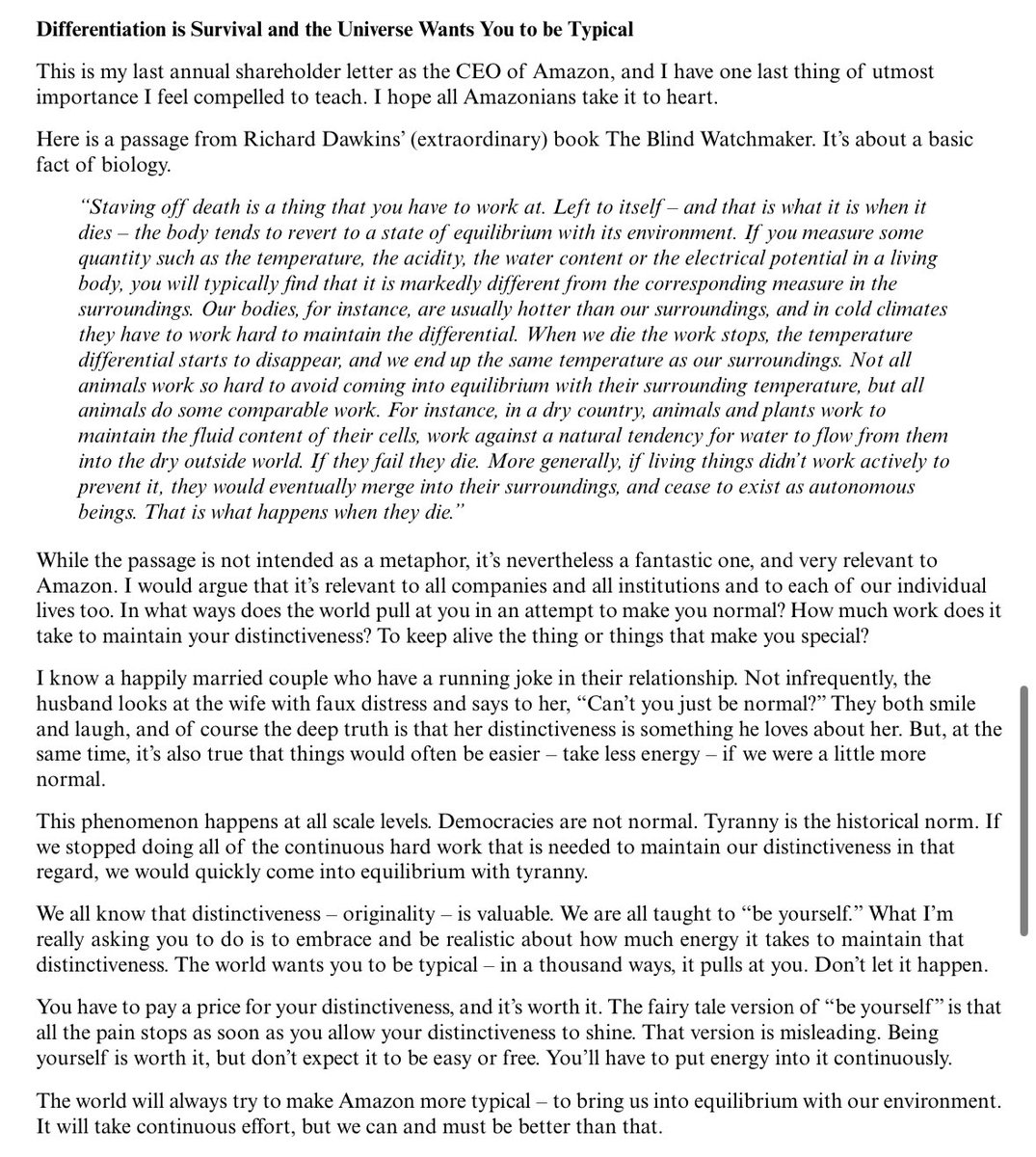
Jeff Bezos is an exceptional writer: “The universe wants you to be typical- in a thousand ways it pulls at you. Don’t let it happen.”
From letters to shareholders (1997).
One of Y Combinator's most important traditions is conciseness. There is so much vague blather in business. It wastes people's time and, worse still, is a sign of unclear thinking.
There are already a huge number of books written by (or for) people who are ambitious for fame but have nothing original to say. AI is going to multiply this number shockingly. ChatGPT is these people's dream.
The average cat's reaction time is approximately 20-70 milliseconds, which is faster than the average snake's one (44-70 ms). The average human one about 220 ms
[source: https://t.co/hZYUZFkMDA]
[📹 https://t.co/RHgEdahdzt]
https://t.co/gf0o2W4EB5
14 yo and 11 yo showed up at my office door asking for startup advice. I told them that the way to get really rich was to get good at programming now and start the startup in a few years, when knowing how to program had started to make good ideas visible.
Noticed something fascinating(ly digusting) about AI-generated summaries of essays: they don't just make them shorter, but also make the ideas more conventional. Which makes sense given the way the AIs are trained.
funny misalignment:
- most employees (esp high performers) want SMALLER teams—fewer people to deal with, more work done
- most managers want BIGGER teams—more people = more power, more to “manage”
you can tell how strong a manager is by how often they ask for more headcount
"The remote workers of the world have already won. Don't spoil that victory by becoming an entitled, totalitarian whiner who won't let some companies make different choices than the one you now happen to like the very best." https://t.co/6KM7gYq7eZ