Marie Curie fellow, PhD in Physics. Working on fusion energy and physics-based machine learning to guide experiments. Sometimes cooks. Chaos is the new order.
My new study secrets of the atomic world! Witness the
How alpha particle damages the hidden realms of atoms. A groundbreaking research at 200 picometer”
https://t.co/4Aq35uGieD…
@iaeaorg@CERN@LADPU@LosAlamosNatLab@euronuclear@ANS_org@NEI @gehnuclear
If Newton asks apple fell on me is it due to some force ? Fable may answer it may be due to over ripening of fruit. Because it is designed and trained in contradictory logic .
Sometimes contradicting scientific logic may bring out some new ideas , but many of the scientific discoveries relies on something obvious.
Be careful on how you use it, it’s little tricky how you get useful information without too much contradiction.
@ylecun@francoisfleuret People who know alphabets are engineers, people who writes grammar are mathematicians , people who write poetry are scientists.
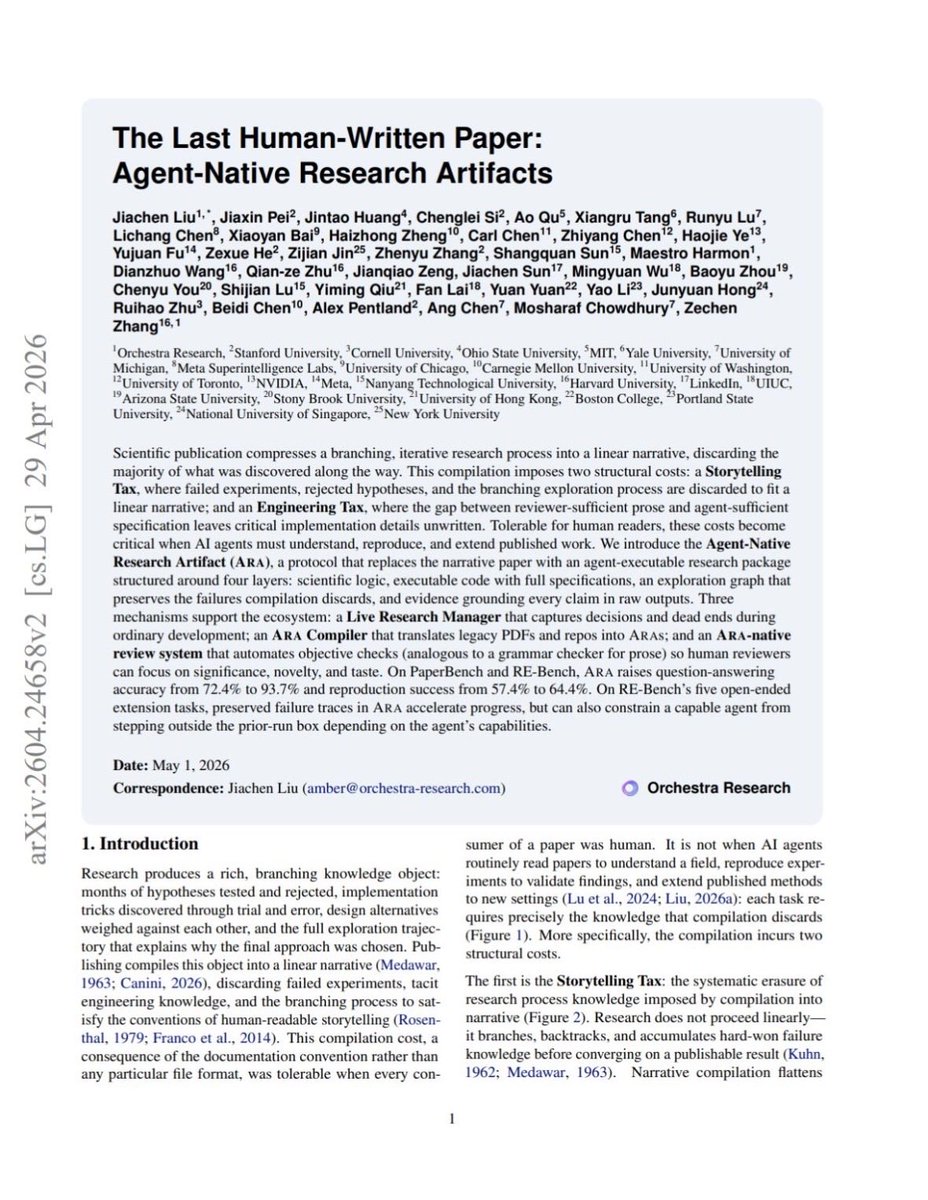
Research is traditionally linear due to human limits, burying valuable failures. AI agents bypass this, using failure models to boost reproducibility. The traceable and runnable Agent-Native Research Artifact (ARA) protocol is the start of a publishing renaissance.
#openscience
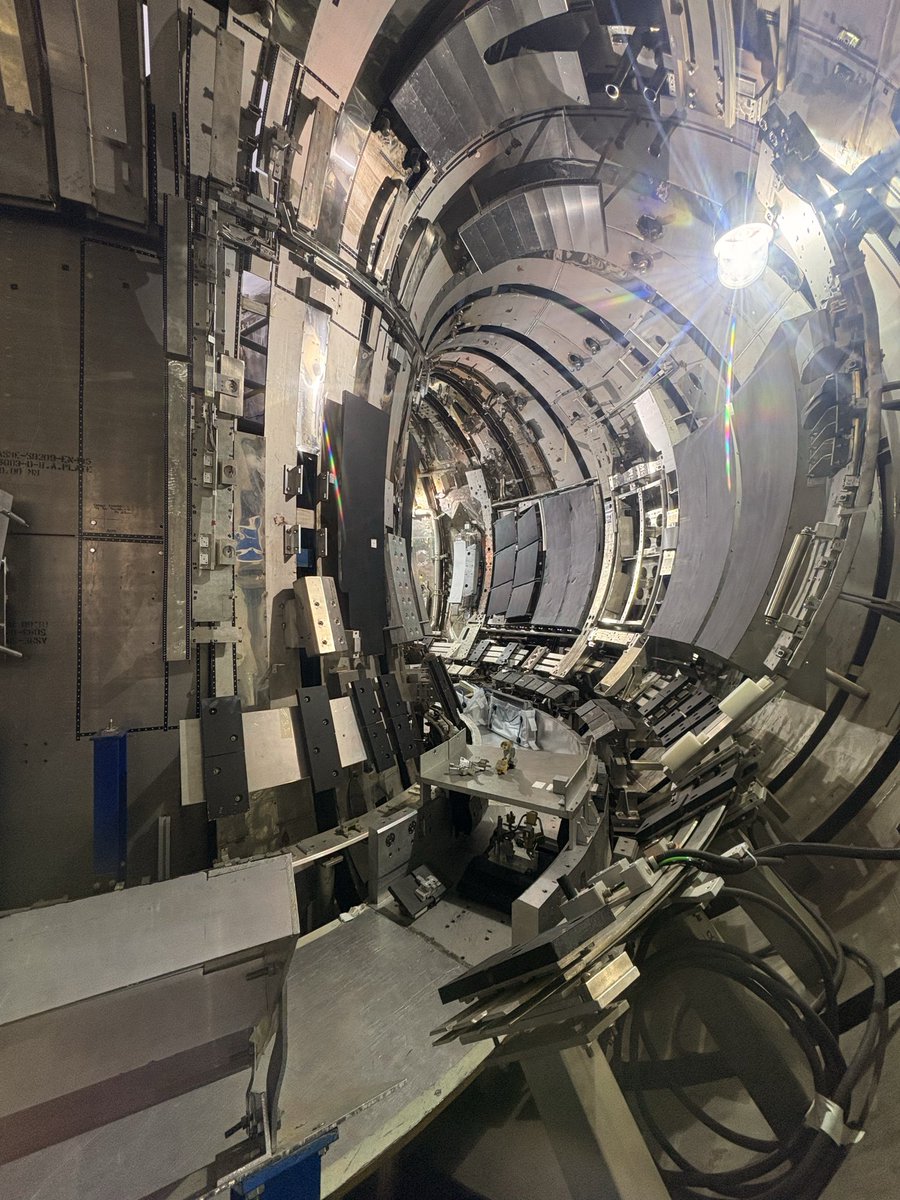
@UKAEAofficial this photo is taken by me ❤️ during open night .
This is not the inside of JET.
It is something stranger: a full-scale rehearsal space for JET.
When the Joint European Torus was built, a spare segment of the vessel existed. Instead of becoming forgotten metal, it became one of the most useful “extra pieces” in fusion history: a 1:1 training mock-up of the inside of JET.
That is what this photo shows.
Not the burning plasma.
Not the famous record shot.
But the place where people learned how to work inside a machine that humans could no longer simply enter.
JET ran for more than 40 years at Culham in the UK. It produced its final plasma in December 2023, after 105,842 pulses. In its last deuterium–tritium campaign, it set a world record: 69 megajoules of fusion energy from only about 0.2 milligrams of fuel.
But here is the part most people never hear.
Fusion is not only about making plasma.
It is also about maintaining the machine afterwards.
Inside a real fusion device, every tile, bolt, diagnostic, cable and wall panel matters. Some components face extreme heat. Some collect fuel. Some become activated. Some have to be removed with millimetre precision by robots.
So before touching the real JET vessel, operators trained here — inside this spare-segment mock-up — using remote-handling systems such as MASCOT.
Imagine that: a piece of “extra” engineering becoming the classroom for the people and robots who would maintain one of the world’s most important fusion machines.
And now that JET is being decommissioned, this training space becomes even more important.
The next scientific question is no longer only:
Can we create fusion energy?
It is also:
Can we inspect, maintain, dismantle and learn from a fusion reactor after decades of operation?
That is why this photo is powerful.
It shows the hidden side of fusion — not the star itself, but the workshop where humans learned how to handle the machine that tried to hold one.
💻🧪 Just 2️⃣ weeks left to apply for our Computer Science Small Grant, where grants of up to £1,000 are available to support collaborative research at the interface of mathematics and computer science.
Deadline: 20 April
➡️ https://t.co/6ngF7n2eMu
@UKSovereignAI@KanishkaNarayan@Jameswise@KanishkaNarayan Cool work! I was at the AI conference at the Royal Society on Tuesday, and I feel this is exactly the kind of thing that should be presented at such events in the future.
@Dr_Singularity I think that’s last 5 years , we came from 0-80 and 80-100 will take decades because fine tuning for excellence is most difficult work ever.
I was at the AI conference hosted by @turinginst at the iconic No. 7 Carlton House Terrace, The Royal Society,@royalsociety and the opening talk genuinely stayed with me.
It began with a comparison I really liked: how the development of calculus helped physics mature, closed many conceptual loops, and gave scientists a new language to understand nature. The suggestion was that AI may now be doing something similar for many fields — helping us close loops that have remained open for a long time. That was a strong way to begin, and honestly it set the tone for the whole day.
Walking through the talks, one thing became very clear to me: AI is not a bubble. Too many models are already being deployed in mainstream research for that argument to still sound convincing. This is not just people making noise online anymore. It is happening in real labs, real workflows, and real scientific problems.
What also stood out was that this is no longer just an academic curiosity. AI is becoming part of serious industrial and scientific work, from fusion to agriculture and beyond. I was especially impressed by the range of use cases being discussed, even within CNN-related applications alone. And naturally, Bayesian ideas kept showing up too, which I appreciated a lot, because in real science uncertainty matters just as much as prediction.
My personal takeaway is simple: people should take this seriously. When the Royal Society is hosting discussions like this, it is hard to dismiss it as hype. Institutions with that kind of scientific legacy do not gather around passing fashion. From Newton to now, the underlying message feels similar: when a new framework starts changing how we do science itself, we should pay attention.
Also, on a lighter note, I still cannot get over the quality of the milk they served for the coffee. The Royal Society apparently does not believe in low-resolution coffee.
And for me personally, the most exciting part is fusion. There is a lot happening in the possibility of using AI to understand and control plasma, and I honestly think that could become one of the defining scientific challenges of the 21st century. If AI helps us crack that, then that would be a moment where one could genuinely say: this is not just another tool, this is AGI.
There's a famous quote by Einstein: "My pencil and I are more clever than I."
It's the same thing with "My computer and I..."
~Conjecture Institute Advisor @DavidDeutschOxf with @GustavS and @joelhellermark