We trained @Meta’s Muse Glimmer on Kalshi outcomes. One pass put it 11.2 percentage points ahead of Jev in prediction accuracy. In a backtest, it returned +7.1% to Jev’s −8.1%. Good thing the money was hypothetical.
Train it for free with SFT through Nov 30. Try our recipe: https://t.co/AkWX4lM65J
@vigyso@petergyang@sama Hi Vignesh, we'd love to have access to "Sign in with ChatGPT".
Just a DM on the details. Looking forward to the conversation.!!
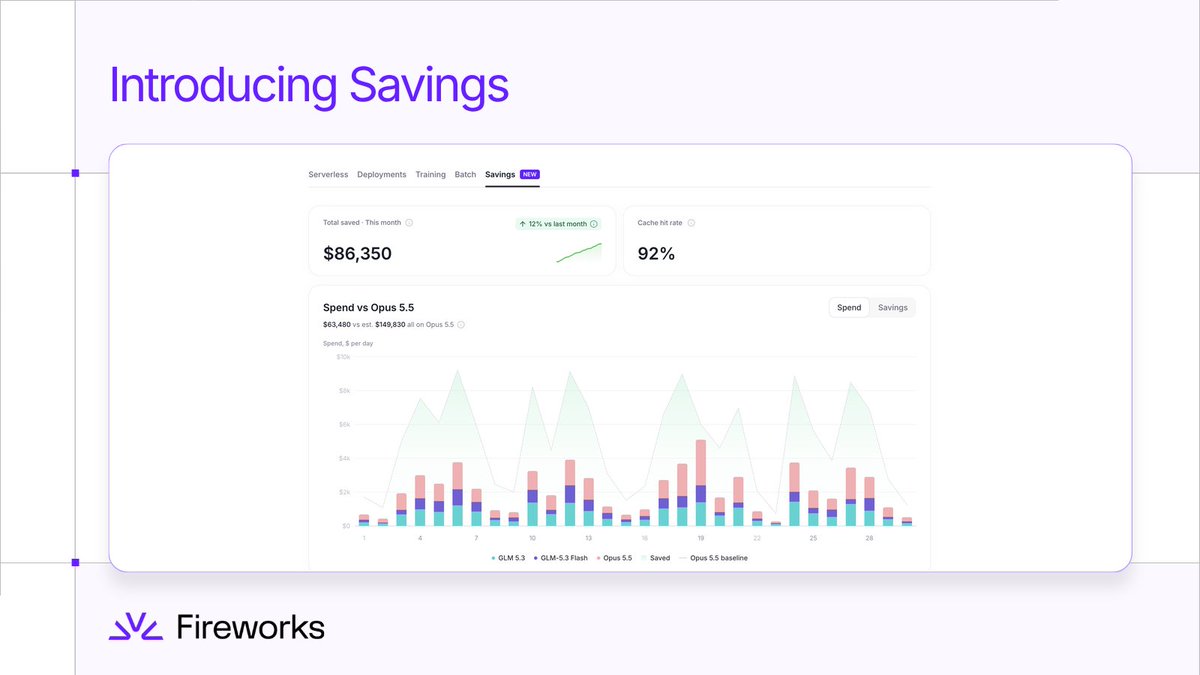
New in Nexus: Savings
See how much Fireworks open models and FireRouter are saving your team, by user and model.
Plus, track your cache hit rate.
Check out Nexus: https://t.co/JZj0wXB3Ug
@MatthewBerman Hi Matthew,
have you tried using fireconnect. It takes < 1 min to do the setup if you have an account with fireworks: https://t.co/ES77TPvaee
Introducing Ember-1.
A model with K3-level quality at ~40% fewer tokens, live on Fireworks Serverless.
Fireworks Research & Training team has spent years helping AI companies build specialized models for their use-case.
So we asked: what if we bring the efficiencies to open models and offered them to everyone?
Ember-1 is a specialized model from Fireworks Research designed to make every token go further.
Built on Kimi K3, it produces shorter reasoning traces, using roughly 40% fewer tokens while maintaining top-tier quality.
https://t.co/PLD1l5aeh4
You can't just rely on vibes around the model. A model that is good at coding, can be bad at securing your service or preparing your slides.
We built something very cool so you can see how models do on REAL benchmarks, not the benchmaxed ones.
If you are building a product in a specific domain or evaluating a model, point yourself and your agent at https://t.co/AZSSeAX2OC.
Lots more coming :)
Today we're launching the Specialized Intelligence Index (SII): one destination for real-work benchmarks across industries, built by the teams that use them every day.
Hear from Fireworks co-founder @the_bunny_chen on the importance of specialized benchmarks:
We ran 18 models across 113 real coding tasks on DeepSWE, then went back and asked a simple question: what if every task had routed to the model that handled it best?
Answer: 97.6% solve rate at $1.88 per task, versus the best model at 74.1% at $6.52.
The next frontier is a router.
Full analysis: https://t.co/yzpA9I3V39
Prediction: within 12 months, top three models will be open source.
Economic winners will be the American clouds that serve them:
Nebius
Iren
Baseten
Together
Fireworks
Excited to continue our partnership with the @alibaba_cloud team on this one, bringing the latest version of Qwen's flaship model to the Fireworks community. Start building with Qwen3p8 today: https://t.co/PJfRDyxtZ8
We invite you to Forge.
At Forge, we will challenge you to make your own frontier.
You'll spend the day with the builders, researchers, and technical leaders pushing AI forward.
Lin Qiao. Jensen Huang. Jay Parikh. And more.
Apply to attend: https://t.co/9TTDskVI73
GLM 5.3 is now available for training on the Serverless Training API, joining Kimi K3, Qwen 3.8 27b and more. GLM 5.3 Flash coming soon.
No sales demo or DMs required.
Here to help as needed, but you can also spend that time building.
Start with docs or a pre-made recipe ➔ https://t.co/URmbsVlNp2
Many assume that agent spend goes toward output tokens.
When we ran DeepSWE on Astra vs. DeepSeek V4.1-Flash, input tokens outnumbered output 174 to 1. 99.6% were cache hits. Those hits are 60% of the bill.
Net result? Same quality. $0.43/task vs $6.52. https://t.co/dVUPe5EzWP
Inference is one of the most interesting systems problems at scale.
Near unlimited demand, wildly different workloads. Constantly shifting targets for models to optimize, and trade offs between cost, latency, throughput.
periodic reminder: cache hit rate and model token efficiency (# of turns, # reasoning tokens) matter more for cost than per-token sticker price
working on more updates to ⬆️ cache hit rate on @FireworksAI_HQ