WE FINALLY KNOW WHY THE MARKET CRASHED ON 10 OCTOBER AND WHY IT JUST CANT BOUNCE!
We never really understood why the big crypto crash started on October 10th and why we couldn't even get a single meaningful bounce!
Today the answer seem simple!
Let me break it down.
1. DAT's like MSTR, BMNR and others have been one of 2 big buyers that powered this cycle.
2. The DAT game is simple, you need to be the biggest so that you get into the big indices and when you do, passive index trackers are forced to buy large amounts of your stock. As they do you get bigger and get added to more indices, and so the cycle perpetuates.
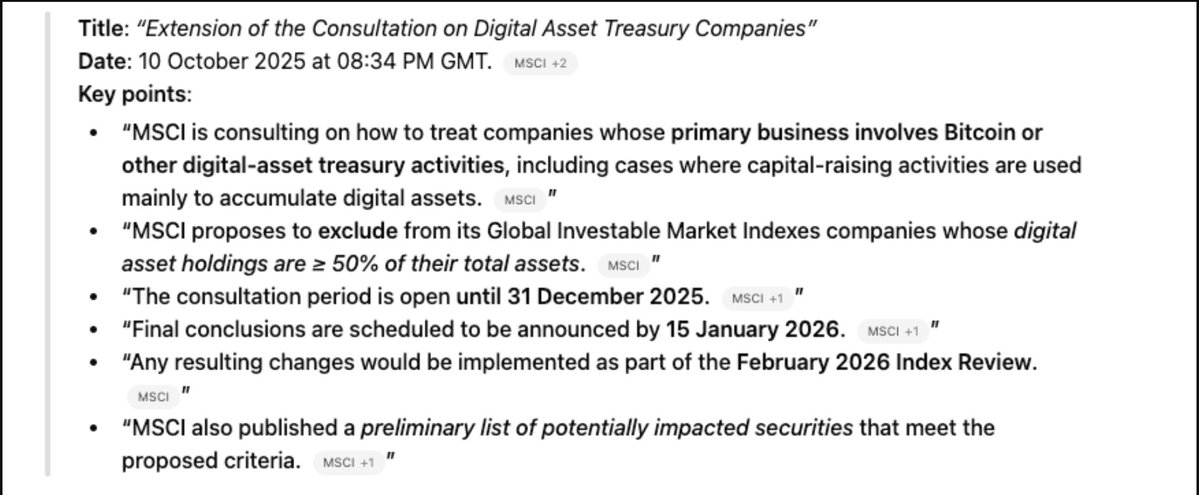
3. On EXACTLY 10th October, MSCI , the world's 2nd biggest Index company published the below. They are questioning whether companies that hold crypto assets as their core business, should be considered as "companies" or "funds".
4. If they are "funds" they are not included in passive indexing. why, because this creates a circular loop. The fund buys assets , gets bigger and then is included in more indices and buys more assets.
5. The expected ruling will be announced on 15 January 2026 and if this does pass, the companies like MSTR will be automatically removed from all indices.
6. If this happens it would mean that all the pension funds, normal funds and all other passive index holders would dump their MSTR automatically.
7. It would also mean that going forward they would never be included and as such , one of the big reasons why they actually exist would disappear.
8 . Since DATs have been powering this cycle and have been most the buying pressure, the smart money saw this immediately after the 10TH of October announcement and positioned accordingly.
9. The 10TH of October wasn't a coincidence after all - It was smart money seeing a big risk to crypto and the current market structure.
10. The market will probably continue to dum until around the end of December and if the announcement is negative, we will get a huge dump in preparation for the removal from the indices.
11. On the other hand , if it is positive , the bull market is back!!
I broke this down on a 10 minute video this morning and I will leave a link in the next tweet!
If you enjoyed this analysis, please retweet and follow this account!
A few months before he died I had dinner with Charlie Munger.
I spent over 3 hours with him.
I got to see his library.
I could ask him any question I wanted.
At 99 he was still *ferociously* intelligent.
The most important lesson I learned from him that night was: Go for great.
In typical Charlie fashion it’s a combination of 4 simple ideas:
1. Charlie looks at everything through the lens of history. Human nature does not change. The same behaviors repeat forever.
2. Charlie has a complete indifference to problems. Troubles from time to time should be expected. This is an inescapable part of life.
3. Wise people do not whine about problems. They prevent them:
"Wisdom is prevention." —Charlie Munger
4. Great businesses are rare. Great people are rare too.
Great people *and* great businesses produce fewer problems.
Your mission in life is to get into a great business (and stay there!)
and build relationships with great people.
Doing so will prevent the majority of problems that are under your control.
All of this can be remembered in the simple maxim: Go for great.
Some of my favorite @naval ideas:
1. If you don't know yet what you should work on, the most important thing is to figure it out.
2. Books make for great friends, because the best thinkers of the last few thousand years tell you their nuggets of wisdom.
3. You will get rich by giving society what it wants but does not yet know how to get. At scale.
4. To make an original contribution, you have to be irrationally obsessed with something.
5. The internet has massively broadened the possible space of careers. Most people haven't figured this out yet.
6. Learn to sell. Learn to build. If you can do both, you will be unstoppable.
7. Fortunes require leverage.
8. Leverage is a force multiplier for your judgment.
9. Arm yourself with specific knowledge, accountability, and leverage.
10. Specific knowledge is found by pursuing your genuine curiosity and passion rather than whatever is hot right now. Building specific knowledge will feel like play to you but will look like work to others.
11. Work as hard as you can. Even though who you work with and what you work on are more important than how hard you work.
12. Become the best in the world at what you do. Keep redefining what you do until this is true.
13. If you're not 100 percent into it, somebody else who is 100 percent into it will outperform you. And they won't just outperform you by a little bit—they'll outperform you by a lot because now we’re operating in the domain of ideas, compound interest really applies and leverage really applies.
14. Technology democratizes consumption but consolidates production. The best person in the world at anything gets to do it for everyone.
15. Escape competition through authenticity.
16. If you are fundamentally building and marketing something that is an extension of who you are, no one can compete with you on that.
17. When I talk about specific knowledge, I mean figure out what you were doing as a kid or teenager almost effortlessly. Something you didn't even consider a skill, but people around you noticed. Your mother or your best friend growing up would know.
(My mom told me that when I was a kid and ran out of things to read, I'd read the back of cereal boxes)
18. The more you know, the less you diversify.
19. The best jobs are neither decreed nor degreed. They are creative expressions of continuous learners in free markets.
20. Whenever you can in life, optimize for independence rather than pay.
21. You decide it's important to you. You prioritize it above everything else. You read everything on the topic.
22. The really smart thinkers are clear thinkers. They understand the basics at a very, very fundamental level.
23. The most important skill for getting rich is becoming a perpetual learner.
24. If you're evenly split on a difficult decision, take the path more painful in the short term.
25. What are the most efficient ways to build new mental models? Read a lot—just read.
26. I probably read one to two hours a day. That puts me in the top .00001 percent. I think that alone accounts for any material success I've had in my life and any intelligence I might have.
27. In the intellectual domain, compound interest rules.
28. All the real scorecards are internal.
29. A calm mind, a fit body, and a house full of love. These things cannot be bought. They must be earned.
30. Your real résumé is just a catalog of all your suffering. If I ask you to describe your real life to yourself, and you look back from your deathbed at the interesting things you've done, it's all going to be around the sacrifices you made, the hard things you did.
31. What you want in life is to be in control of your time.
32. Being at the extreme in your art is very important in the age of leverage.
33. Enjoy yourself. Do something positive. Project some love. Make someone happy. Laugh a little bit. Appreciate the moment. And do your work.
This is Anthony Pompliano.
The most in-demand guest for podcasts about money.
He teaches people how to think about money. I've spent 100s of hours learning from him.
Here are 17 of his strategies that transformed my life (and will do the same for you):