i gave yall $cypher at 3 sats
10x in a week
i gave yall $pups at $0.02
10x'd twice
wait til you see what $wzrd and $wanko can do 👀
follow for more not financial advice
"These are the real top stars that we should follow!"
Many Chinese cities are recently putting scientists on big public screens instead of commercial ads.
These are the people who lifted China from weak to strong in defense, food, health, and tech...
people who stored their btc on coldcard got drained because of entropy.
the seed generation was reproducible, anyone could recompute their keys.
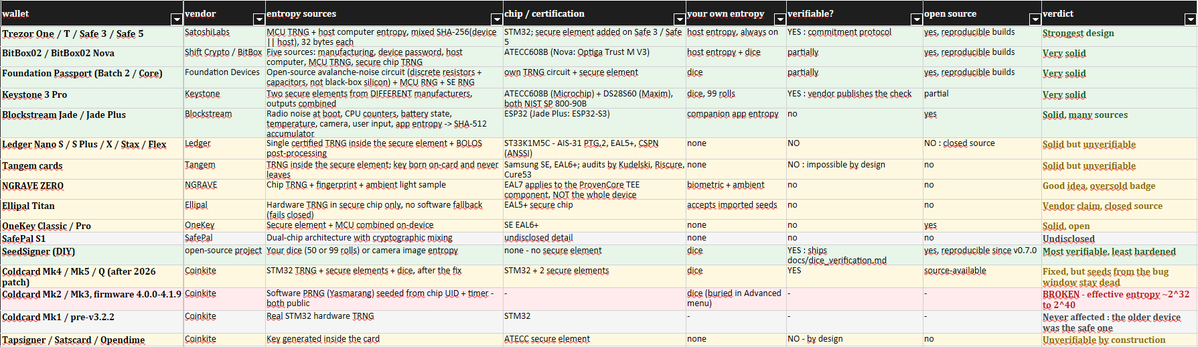
so i went through every other hardware wallet to see how they make your seed, and whether the same thing can happen again.
@Trezor: mixes the device's randomness with randomness from your computer, and the device has to prove it used both. even if its chip is fully broken, you're still fine. the best design here by far.
@BitBoxSwiss: 5 separate sources of randomness combined. one bad source can't sink you. open source, reproducible builds, dice supported.
@FoundationHQ: built their own randomness circuit out of plain resistors and capacitors, open source, on top of two other sources. no black-box chip to trust. supports dice.
@KeystoneWallet: 2 secure chips from 2 different manufacturers, combined. also lets you roll 99 dice and publishes how to check the result yourself.
@Blockstream: jade pulls from 7 things: radio noise, cpu counters, battery, temperature, camera, your input, the app. very hard to break all of them.
@SeedSigner: your dice are the only source. no chip to trust at all. and they ship a guide teaching you to verify their own math. weakest hardware, strongest proof.
@OneKey: secure element plus mcu combined on device, open source firmware. solid, but you can't add your own randomness.
@Ledger: one certified chip (AIS-31, EAL5+). good randomness. but it's a single source, closed source, and you cannot verify any of it. you're trusting them completely.
@Tangem: key is born inside the chip and never comes out. audited by three firms. same trade: strong, and impossible for you to check by design.
@ngrave_official: mixes chip randomness with your fingerprint and room light. clever. but the "EAL7" badge covers one software component, not the whole device.
@ELLIPAL: single certified chip, no software fallback, fails closed instead of guessing. closed source, so take it on faith.
@SafePal: 2 chips mixed. they've never published the details.
@COLDCARDwallet: patched now, and dice on coldcard were always verifiable. but every seed made between 2021 and 2026 is permanently burned.
one source = ledger, tangem, ellipal. that one source fails, everything fails. their answer is to make it excellent and certified. that's exactly the bet coldcard lost.
many sources = trezor, bitbox, passport, jade, keystone. one broken source never reaches your key.
and every one of these claims 128 or 256 bits.
coldcard did too. certification doesn't help either, coldcard's chip was fine, the code just stopped calling it.
the only thing that saves you is being able to check.
roll your own dice. verify the words yourself.
The AI world is being reduced to two tribal labels:
China AI = open AI = authoritarian AI.
U.S. AI = closed AI = democratic AI.
The absurdity is almost perfect.
China offers open weights, local deployment, lower costs, and greater technological autonomy—and this is called “authoritarian influence.”
American corporations keep the models closed, control the infrastructure, set the prices, rewrite the rules, and can revoke access at any time—and this is marketed as “democratic AI.”
In this new theology, openness becomes authoritarianism, while corporate monopoly becomes freedom.
The argument is no longer about what the technology does.
It is about who is permitted to define the rules.
“Democratic AI” apparently means intelligence owned by American companies.
“Authoritarian AI” means intelligence the rest of the world can actually possess.