Our latest Claude Code hackathon is officially a wrap.
500 builders spent a week exploring what they could do with Opus 4.6 and Claude Code.
Meet the winners:
+1 for "context engineering" over "prompt engineering".
People associate prompts with short task descriptions you'd give an LLM in your day-to-day use. When in every industrial-strength LLM app, context engineering is the delicate art and science of filling the context window with just the right information for the next step. Science because doing this right involves task descriptions and explanations, few shot examples, RAG, related (possibly multimodal) data, tools, state and history, compacting... Too little or of the wrong form and the LLM doesn't have the right context for optimal performance. Too much or too irrelevant and the LLM costs might go up and performance might come down. Doing this well is highly non-trivial. And art because of the guiding intuition around LLM psychology of people spirits.
On top of context engineering itself, an LLM app has to:
- break up problems just right into control flows
- pack the context windows just right
- dispatch calls to LLMs of the right kind and capability
- handle generation-verification UIUX flows
- a lot more - guardrails, security, evals, parallelism, prefetching, ...
So context engineering is just one small piece of an emerging thick layer of non-trivial software that coordinates individual LLM calls (and a lot more) into full LLM apps. The term "ChatGPT wrapper" is tired and really, really wrong.
I'M BLOWN AWAY.
Andrej Karpathy just explained Software 3.0 at YC.
BIG IDEAS: English is coding. AI is electricity. And, build for LLMs, not just people.
Key takeaways:
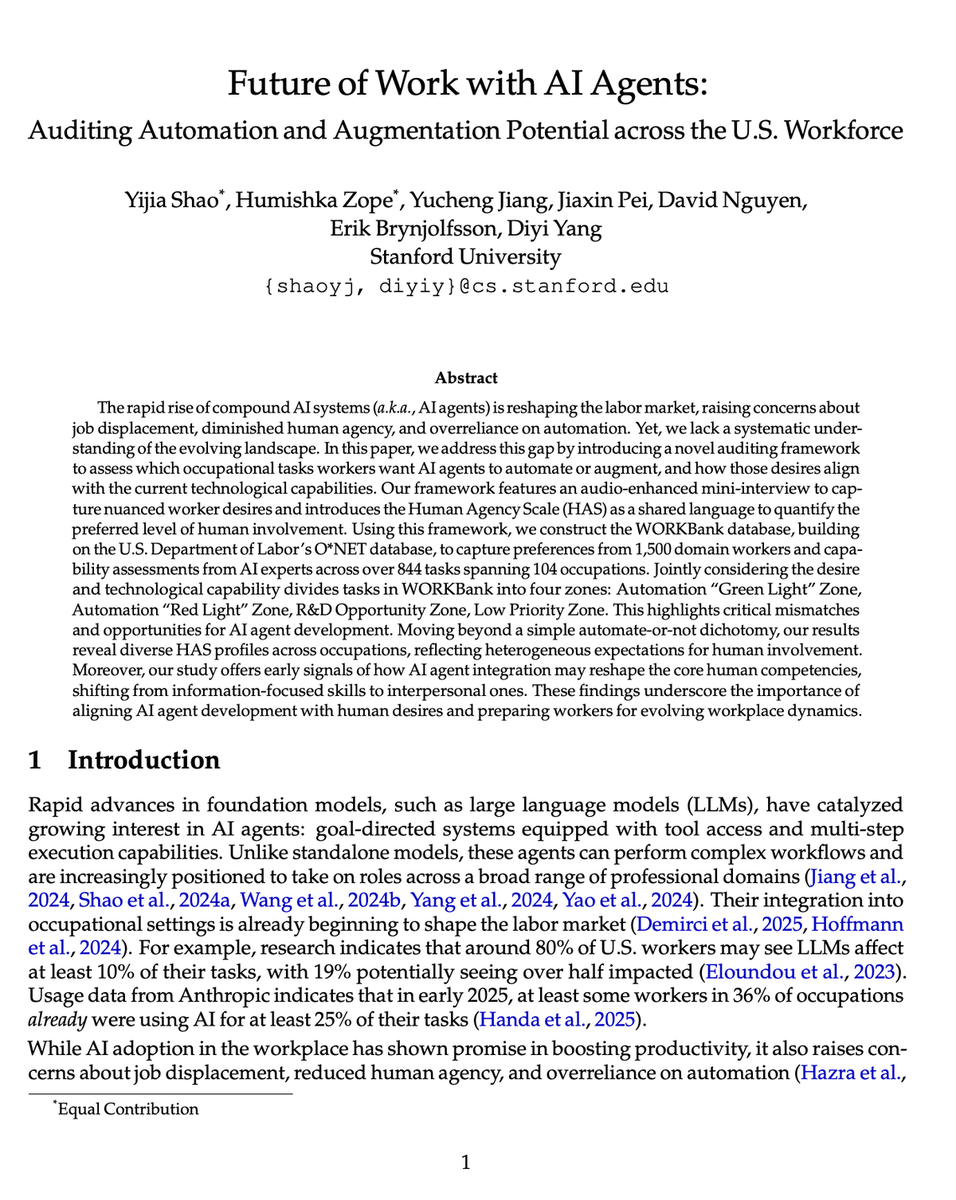
BREAKING: Stanford just surveyed 1,500 workers and AI experts about which jobs AI will actually replace and automate.
Turns out, we've been building AI for all the WRONG jobs.
Here's what they discovered:
(hint: the "AI takeover" is happening backwards)
OpenAI quietly dropped a 34-page technical manual on building AI agents that 99% of people will never read.
I spent 3 days coding every single pattern they revealed.
Here's the practical guide to autonomous AI agents:🧵
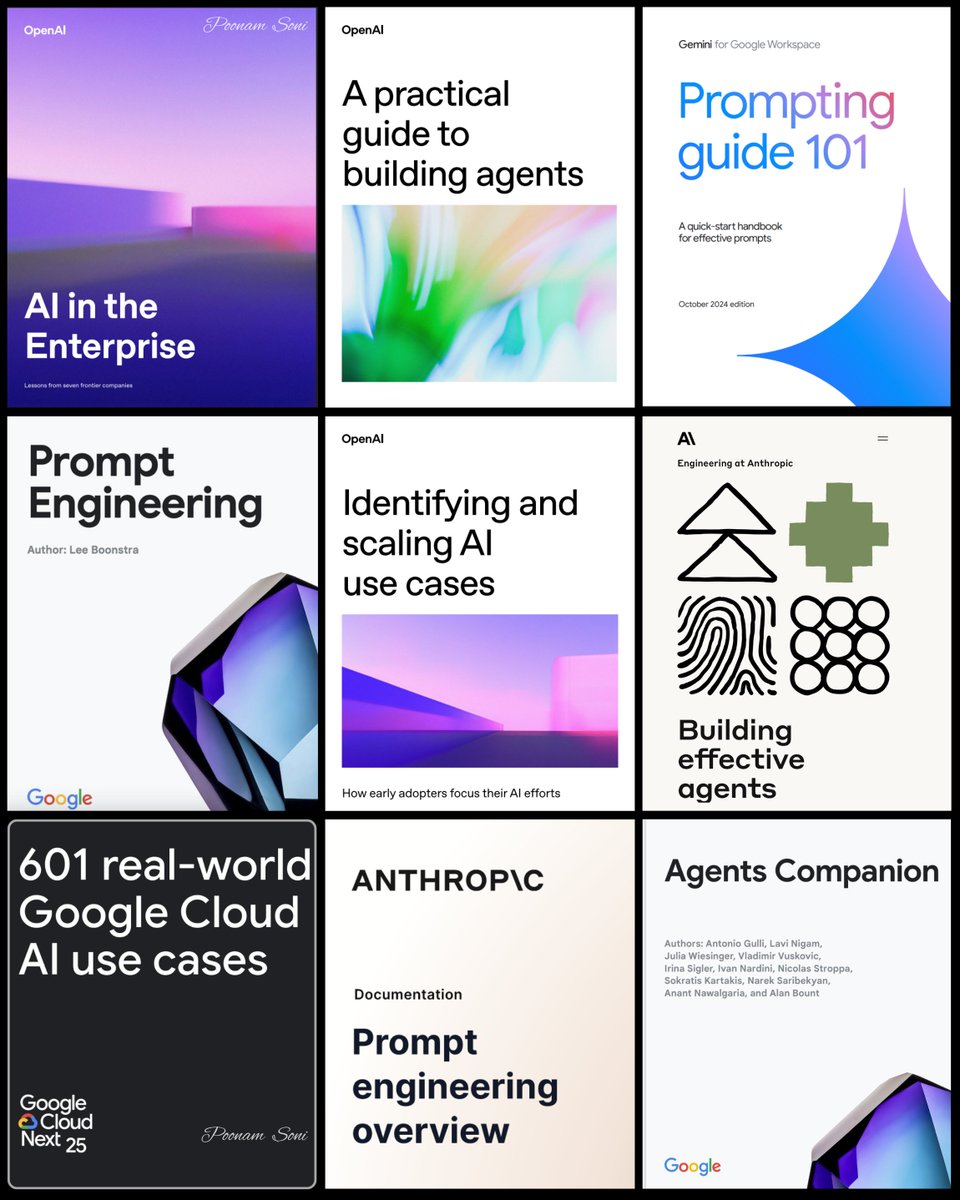
OpenAI, Google, and Anthropic released best guides on:
- Prompt Engineering
- Building effective Agents
- AI in Business
- 601 AI use cases
and so much more...
9 best guides you can’t afford to miss:
There’s a new breed of GenAI Application Engineers who can build more-powerful applications faster than was possible before, thanks to generative AI. Individuals who can play this role are highly sought-after by businesses, but the job description is still coming into focus. Let me describe their key skills, as well as the sorts of interview questions I use to identify them.
Skilled GenAI Application Engineers meet two primary criteria: (i) They are able to use the new AI building blocks to quickly build powerful applications. (ii) They are able to use AI assistance to carry out rapid engineering, building software systems in dramatically less time than was possible before. In addition, good product/design instincts are a significant bonus.
AI building blocks. If you own a lot of copies of only a single type of Lego brick, you might be able to build some basic structures. But if you own many types of bricks, you can combine them rapidly to form complex, functional structures. Software frameworks, SDKs, and other such tools are like that. If all you know is how to call a large language model (LLM) API, that's a great start. But if you have a broad range of building block types — such as prompting techniques, agentic frameworks, evals, guardrails, RAG, voice stack, async programming, data extraction, embeddings/vectorDBs, model fine tuning, graphDB usage with LLMs, agentic browser/computer use, MCP, reasoning models, and so on — then you can create much richer combinations of building blocks.
The number of powerful AI building blocks continues to grow rapidly. But as open-source contributors and businesses make more building blocks available, staying on top of what is available helps you keep on expanding what you can build. Even though new building blocks are created, many building blocks from 1 to 2 years ago (such as eval techniques or frameworks for using vectorDBs) are still very relevant today.
AI-assisted coding. AI-assisted coding tools enable developers to be far more productive, and such tools are advancing rapidly. Github Copilot, first announced in 2021 (and made widely available in 2022), pioneered modern code autocompletion. But shortly after, a new breed of AI-enabled IDEs such as Cursor and Windsurf offered much better code-QA and code generation. As LLMs improved, these AI-assisted coding tools that were built on them improved as well.
Now we have highly agentic coding assistants such as OpenAI’s Codex and Anthropic’s Claude Code (which I really enjoy using and find impressive in its ability to write code, test, and debug autonomously for many iterations). In the hands of skilled engineers — who don’t just “vibe code” but deeply understand AI and software architecture fundamentals and can steer a system toward a thoughtfully selected product goal — these tools make it possible to build software with unmatched speed and efficiency.
I find that AI-assisted coding techniques become obsolete much faster than AI building blocks, and techniques from 1 or 2 years ago are far from today's best practices. Part of the reason for this might be that, while AI builders might use dozens (hundreds?) of different building blocks, they aren’t likely to use dozens of different coding assistance tools at once, and so the forces of Darwinian competition are stronger among tools. Given the massive investments in this space by Anthropic, Google, OpenAI, and other players, I expect the frenetic pace of development to continue, but keeping up with the latest developments in AI-assisted coding tools will pay off, since each generation is much better than the last.
Bonus: Product skills. In some companies, engineers are expected to take pixel-perfect drawings of a product, specified in great detail, and write code to implement it. But if a product manager has to specify even the smallest detail, this slows down the team. The shortage of AI product managers exacerbates this problem. I see teams move much faster if GenAI Engineers also have some user empathy as well at basic skill at designing products, so that, given only high-level guidance on what to build (“a user interface that lets users see their profiles and change their passwords”), they can make a lot of decisions themselves and build at least a prototype to iterate from.
When interviewing GenAI Application Engineers, I will usually ask about their mastery of AI building blocks and ability to use AI-assisted coding, and sometimes also their product/design instincts. One additional question I've found highly predictive of their skill is, “How do you keep up with the latest developments in AI?” Because AI is evolving so rapidly, someone with good strategies for keeping up — such as reading The Batch and taking short courses 😃, regular hands-on practice building projects, and having a community to talk to — really does stay ahead of the game.
[Original post: https://t.co/I3alxNs0vn ]
Sir Demis Hassabis is the most dangerous CEO alive:
• Chess prodigy at age 4
• Knighted in 2023 for services to AI
• Nobel Prize in Chemistry in 2024
He now leads Google's DeepMind AI
His vision of the next 10 years will terrify you 🧵
Today, at Build we showed you how we are building the open agentic web. It is reshaping every layer of the stack, and our goal is to help every dev build apps and agents that empower people and orgs everywhere. Here are 5 big things we announced today:
NVIDIA just shook the AI and Robotic world at NVIDIA GTC 2025.
CEO Jensen Huang announced jaw-dropping breakthroughs.
Here are the top 11 key highlights you can’t afford to miss: (wait till you see no 3)
Some people today are discouraging others from learning programming on the grounds AI will automate it. This advice will be seen as some of the worst career advice ever given. I disagree with the Turing Award and Nobel prize winner who wrote, “It is far more likely that the programming occupation will become extinct [...] than that it will become all-powerful. More and more, computers will program themselves.” Statements discouraging people from learning to code are harmful!
In the 1960s, when programming moved from punchcards (where a programmer had to laboriously make holes in physical cards to write code character by character) to keyboards with terminals, programming became easier. And that made it a better time than before to begin programming. Yet it was in this era that Nobel laureate Herb Simon wrote the words quoted in the first paragraph. Today’s arguments not to learn to code continue to echo his comment.
As coding becomes easier, more people should code, not fewer!
Over the past few decades, as programming has moved from assembly language to higher-level languages like C, from desktop to cloud, from raw text editors to IDEs to AI assisted coding where sometimes one barely even looks at the generated code (which some coders recently started to call vibe coding), it is getting easier with each step.
I wrote previously that I see tech-savvy people coordinating AI tools to move toward being 10x professionals — individuals who have 10 times the impact of the average person in their field. I am increasingly convinced that the best way for many people to accomplish this is not to be just consumers of AI applications, but to learn enough coding to use AI-assisted coding tools effectively.
One question I’m asked most often is what someone should do who is worried about job displacement by AI. My answer is: Learn about AI and take control of it, because one of the most important skills in the future will be the ability to tell a computer exactly what you want, so it can do that for you. Coding (or getting AI to code for you) is a great way to do that.
When I was working on the course Generative AI for Everyone and needed to generate AI artwork for the background images, I worked with a collaborator who had studied art history and knew the language of art. He prompted Midjourney with terminology based on the historical style, palette, artist inspiration and so on — using the language of art — to get the result he wanted. I didn’t know this language, and my paltry attempts at prompting could not deliver as effective a result.
Similarly, scientists, analysts, marketers, recruiters, and people of a wide range of professions who understand the language of software through their knowledge of coding can tell an LLM or an AI-enabled IDE what they want much more precisely, and get much better results. As these tools are continuing to make coding easier, this is the best time yet to learn to code, to learn the language of software, and learn to make computers do exactly what you want them to do.
[Original text: https://t.co/HdI3Jb9HmF ]
A couple reflections on the quantum computing breakthrough we just announced...
Most of us grew up learning there are three main types of matter that matter: solid, liquid, and gas. Today, that changed.
After a nearly 20 year pursuit, we’ve created an entirely new state of matter, unlocked by a new class of materials, topoconductors, that enable a fundamental leap in computing.
It powers Majorana 1, the first quantum processing unit built on a topological core.
We believe this breakthrough will allow us to create a truly meaningful quantum computer not in decades, as some have predicted, but in years.
The qubits created with topoconductors are faster, more reliable, and smaller.
They are 1/100th of a millimeter, meaning we now have a clear path to a million-qubit processor.
Imagine a chip that can fit in the palm of your hand yet is capable of solving problems that even all the computers on Earth today combined could not!
Sometimes researchers have to work on things for decades to make progress possible.
It takes patience and persistence to have big impact in the world.
And I am glad we get the opportunity to do just that at Microsoft.
This is our focus: When productivity rises, economies grow faster, benefiting every sector and every corner of the globe.
It’s not about hyping tech; it’s about building technology that truly serves the world.
Introducing Agentic Object Detection!
Given a text prompt like “unripe strawberries” or “Kellogg’s branded cereal” and an image, we use an agentic workflow to reason at length and detect the specified objects. No need to label any training data. Watch the video for details.
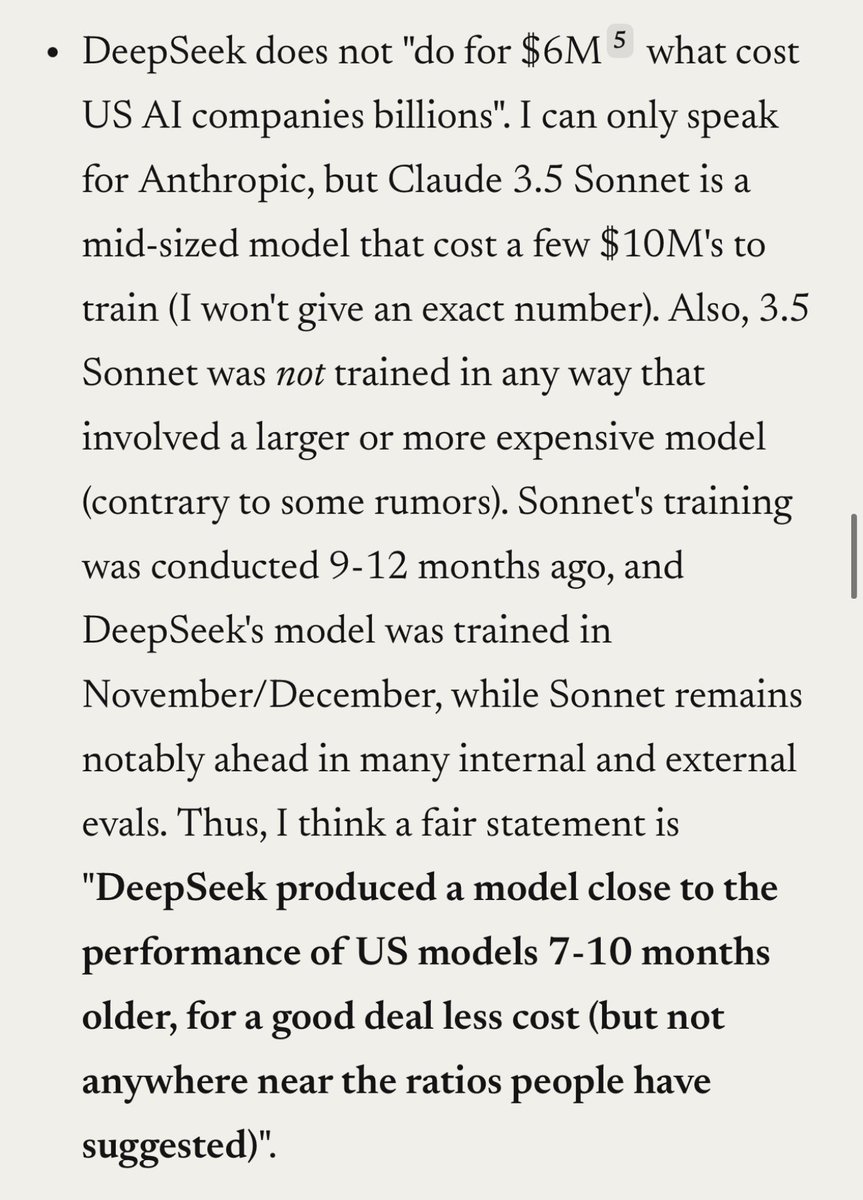
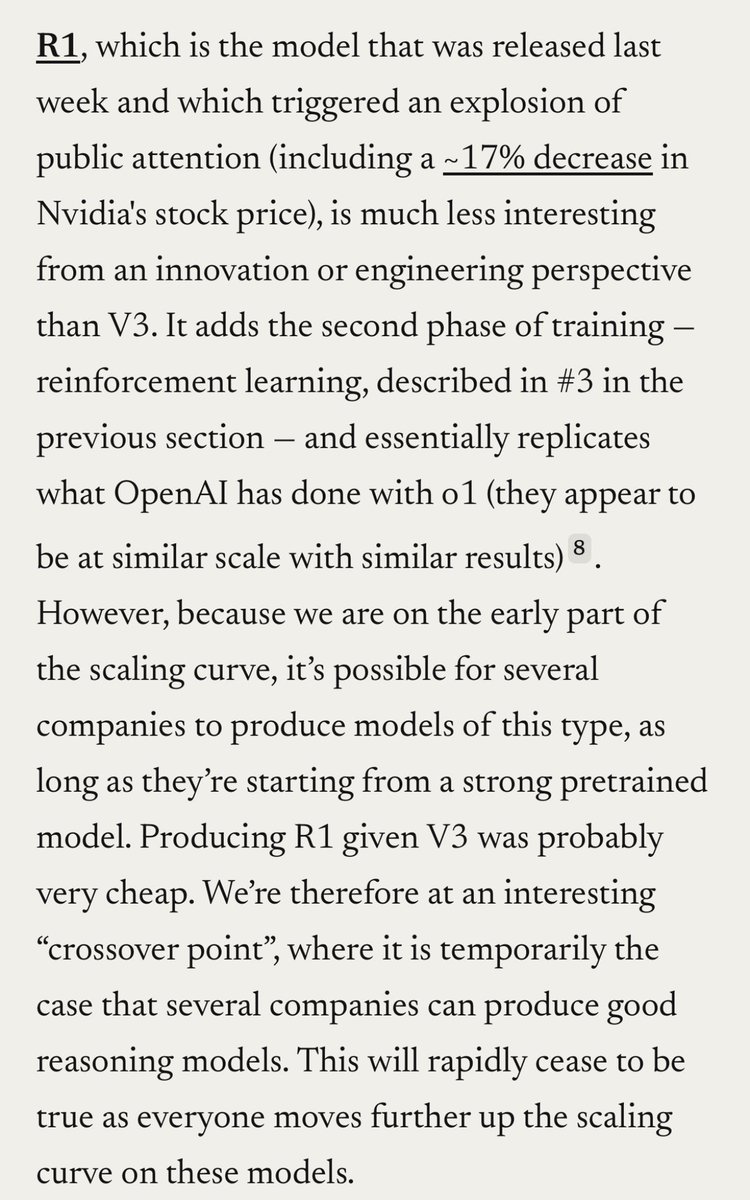
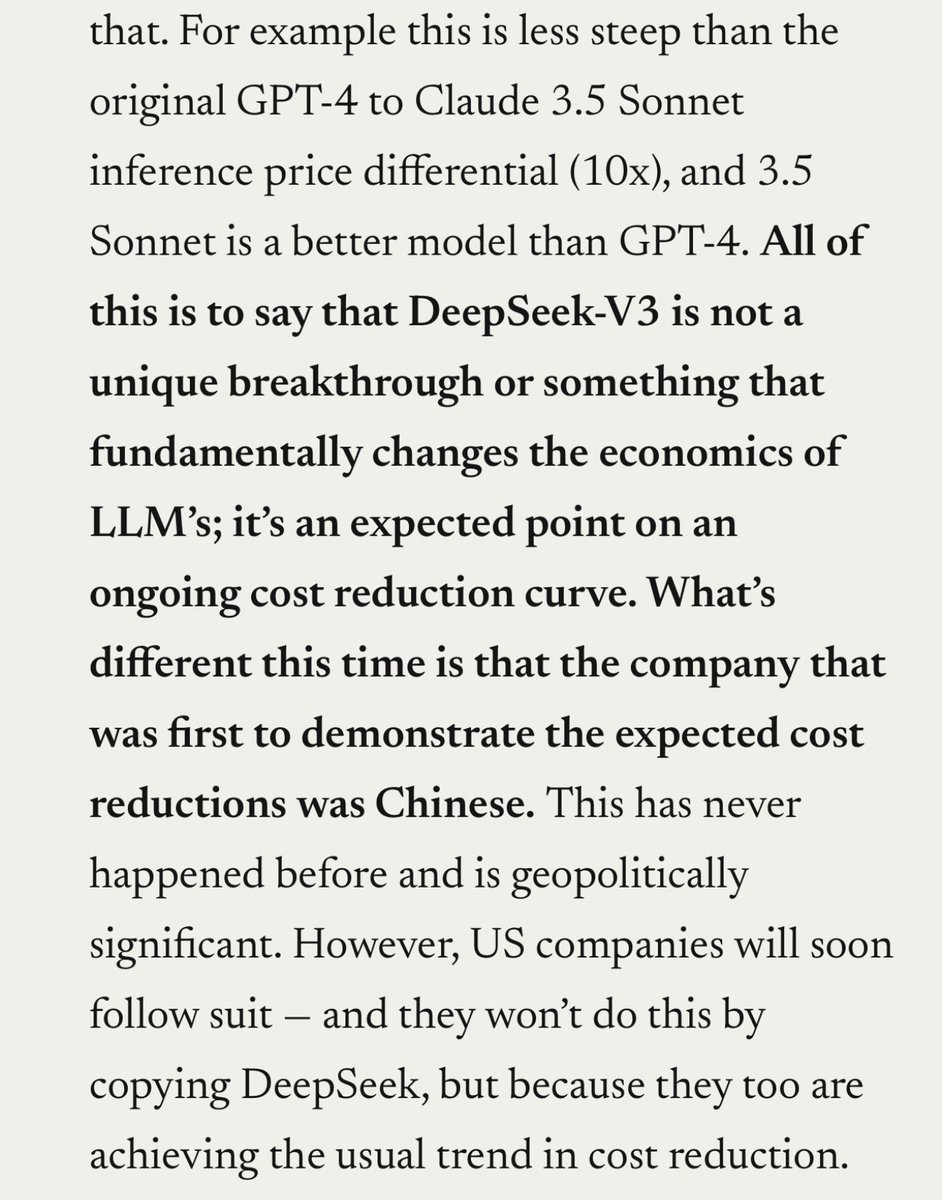
These four points on DeepSeek seem very likely correct and important to understand about the economics of building AI models and what DeepSeek actually did. .
Writing software, especially prototypes, is becoming cheaper. This will lead to increased demand for people who can decide what to build. AI Product Management has a bright future!
Software is often written by teams that comprise Product Managers (PMs), who decide what to build (such as what features to implement for what users) and Software Developers, who write the code to build the product. Economics shows that when two goods are complements — such as cars (with internal-combustion engines) and gasoline — falling prices in one leads to higher demand for the other. For example, as cars became cheaper, more people bought them, which led to increased demand for gas. Something similar will happen in software. Given a clear specification for what to build, AI is making the building itself much faster and cheaper. This will significantly increase demand for people who can come up with clear specs for valuable things to build.
This is why I’m excited about the future of Product Management, the discipline of developing and managing software products. I’m especially excited about the future of AI Product Management, the discipline of developing and managing AI software products.
Many companies have an Engineer:PM ratio of, say, 6:1. (The ratio varies widely by company and industry, and anywhere from 4:1 to 10:1 is typical.) As coding becomes more efficient, teams will need more product management work (as well as design work) as a fraction of the total workforce. Perhaps engineers will step in to do some of this work, but if it remains the purview of specialized Product Managers, then the demand for these roles will grow.
This change in the composition of software development teams is not yet moving forward at full speed. One major force slowing this shift, particularly in AI Product Management, is that Software Engineers, being technical, are understanding and embracing AI much faster than Product Managers. Even today, most companies have difficulty finding people who know how to develop products and also understand AI, and I expect this shortage to grow.
Further, AI Product Management requires a different set of skills than traditional software Product Management. It requires:
- Technical proficiency in AI. PMs need to understand what products might be technically feasible to build. They also need to understand the lifecycle of AI projects, such as data collection, building, then monitoring, and maintenance of AI models.
- Iterative development. Because AI development is much more iterative than traditional software and requires more course corrections along the way, PMs need be able to manage such a process.
- Data proficiency. AI products often learn from data, and they can be designed to generate richer forms of data than traditional software.
- Skill in managing ambiguity. Because AI’s performance is hard to predict in advance, PMs need to be comfortable with this and have tactics to manage it.
- Ongoing learning. AI technology is advancing rapidly. PMs, like everyone else who aims to make best use of the technology, need to keep up with the latest technology advances, product ideas, and how they fit into users’ lives.
Finally, AI Product Managers will need to know how to ensure that AI is implemented responsibly (for example, when we need to implement guardrails to prevent bad outcomes), and also be skilled at gathering feedback fast to keep projects moving. Increasingly, I also expect strong product managers to be able to build prototypes for themselves.
The demand for good AI Product Managers will be huge. In addition to growing AI Product Management as a discipline, perhaps some engineers will also end up doing more product management work.
The variety of valuable things we can build is nearly unlimited. What a great time to build!
[Original text: https://t.co/OIeAQXpriK ]
New randomized, controlled trial of students using GPT-4 as a tutor in Nigeria. 6 weeks of after-school AI tutoring = 2 years of typical learning gains, outperforming 80% of other educational interventions.
And it helped all students, especially girls who were initially behind
Watch Nadella describe SaaS apps as nothing more than a CRUD database with some business logic, but once the business logic moves to AI agents, SaaS is over:
This year, I read ten important historical novels: Jane Eyre, Middlemarch, To The Lighthouse, Bleak House, Portrait of a Lady, Anna Karenina, Life and Fate, Heart of Darkness, Madame Bovary, and The Magic Mountain.
Reflections:
• Four of these are more than 800 pages long. The Magic Mountain and Portrait of a Lady, while shorter, are not short. Of the ten, 5 are British, 2 are Russian, and there was one from each of France, Germany, and the US.
• For me the clear standouts are Middlemarch, Bleak House, Karenina, and Life and Fate. I would enthusiastically reread any of them. If I had to choose just one to go to again, I would probably select Middlemarch. There's something memorably compelling in Eliot's affection and empathy for almost all of her characters. If Succession is a show with no likable personalities, Middlemarch is the opposite. Bleak House is a close second. Life and Fate is quite different to the others: it’s not exactly entertaining (or even notably well-written), but it is true and profound. (Most works designated “important” are not, but Life and Fate surely merits that as well.) If kindness is one of the core adjurations of Life and Fate, Eliot is the author that most embodies it.
• I'd underestimated Dickens's lyricism. I had thought of him as a master of the plot (contra Nabokov), but he is just as accomplished in prose itself. “Chesney Wold is shut up, carpets are rolled into great scrolls in corners of comfortless rooms, bright damask does penance in brown holland, carving and gilding puts on mortification, and the Dedlock ancestors retire from the light of day again. Around and around the house the leaves fall thick, but never fast, for they come circling down with a dead lightness that is sombre and slow. Let the gardener sweep and sweep the turf as he will, and press the leaves into full barrows, and wheel them off, still they lie ankle-deep. Howls the shrill wind round Chesney Wold; the sharp rain beats, the windows rattle, and the chimneys growl. Mists hide in the avenues, veil the points of view, and move in funeral-wise across the rising grounds. On all the house there is a cold, blank smell like the smell of a little church, though something dryer, suggesting that the dead and buried Dedlocks walk there in the long nights and leave the flavour of their graves behind them.”
• Three of these four were written by authors in their 50s (Eliot, Tolstoy, and Grossman). Dickens was a mere 41 -- and this shows. The plot is very entertaining, and immensely intricate, but the characters are somehow flatter. So, maybe one lesson from the set is simply that wisdom is real, and that skill in the domain of fiction compounds for quite some time.
• Russian literature puzzles me. Why did it suddenly become so good in the 19th century, and why did it decline so much in the 20th? I don't think the latter answer can just be a story of oppression, since we got many great works during Stalin’s reign. But what's the best Russian novel since Master and Margarita? On the issue of the rise, I often encounter explanations claiming that it was related to Russian intellectuals being excluded from political influence and consequently retreating to the artistic domain -- but this feels obviously inadequate. Again, how does this explain the post-Bulgakov decline? And where are the great, say, Saudi works of the past 50 years?
• Whatever happened to the novel around the turn of the century (Conrad, Woolf, Mann in my reading) was not obviously salutary. All three are interesting works, and there is something very distinctly modern in Woolf's in particular, but they simply don't compel -- at least for this reader -- the way their predecessors do: maybe it's just the particular selection, but I was generally looking forward to finishing the early 20th century works, and a bit disappointed when completing those dating from before 1900. The dislocation that Blom describes in Vertigo Years is clearly manifest. Woolf's “Mr. Bennett and Mrs. Brown” essay, and her claim that “human character changed” in 1910, is consistent with the turn in the novels. She was speaking of different works, but her assessment rings true in a broader way: “Yet what odd books they are! Sometimes I wonder if we are right to call them books at all. For they leave one with so strange a feeling of incompleteness and dissatisfaction.”
• I should note that some of Woolf’s descriptions are great, even if her brooding interiority leaves me ultimately unenthralled. “The house was left; the house was deserted. It was left like a shell on a sandhill to fill with dry salt grains now that life had left it.” “He lay on his chair with his hands clasped above his paunch not reading, or sleeping, but basking like a creature gorged with existence.”
• Tom Wolfe attributes modern architecture and the international style to a post-1917 sympathy for the proletariat and a desire to strip indulgent bourgeois ornament from our construction, and, yes, Schoenberg explicitly motivated atonality in egalitarian ideals, but this set of novels makes me doubt the political explanations. You can clearly see the embrace of some kind of disharmony in the books, and I don’t think Conrad was trying to make any Marxist point. I still struggle to explain what happened, but I think I would reverse some of the standard causality, and it seems to me that the coopting of communist ideals is probably itself downstream of the broader social unease that also gave rise to these artistic tides. Blom’s description of the rise of various mental disorders -- neurasthenia and the like -- seems relevant. (All of this does make me want to better understand 1848.)
• The railway, and its attendant social upheaval, features repeatedly, and maybe most memorably in one chapter of Middlemarch. I hadn't appreciated just how significantly disruptive a force it was perceived as being even at the time. (Given the scale of the construction that was entailed, maybe this shouldn't be surprising.) More broadly, there is some sense of a society in transition through most of these works: these aren't neat and timeless tales. You have the rise of the bourgeois and broader urbanization in Bovary, the emerging social consciousness in Bleak House, the exposure of the shabbiness of Victorianism and its gender expectations in Lighthouse, and the postwar shell shock of Magic Mountain.
• The works written before 1900 are primarily about romance (Bleak House the exception, with romance only a subplot), and those written afterwards (Conrad, Mann, Grossman, Woolf) are emphatically not. I don’t know what to make of this. Perhaps just an accident of the selection.
• Ruxandra Teslo points out that there’s a moral gravity in the 19th century works that seems foreign today: people treat their own characters as important constructions in their own right. In a similar vein, I was struck by Grossman’s conception of freedom: he perceives it more as the right to self-define than a more typical liberty of action. Perhaps because actions were so circumscribed in Victorian societies (for women) and Soviet societies (for everyone), the seriousness of being weighed heavily.
* Money and its mechanics get extensive treatment in the pre-1900 novels. The details of Bovary’s debt were made famous by Piketty, but Eliot also spends time on Lydgate’s financial struggles, and Tolstoy on Levin’s agricultural economics. Pecuniary considerations are absent in the later works. Again, maybe just happenstance stemming from the particular selection, but I don’t get the feeling that it’s just that: I think something about authors’ attitudes to the topic changed.
• Today’s scientific papers are far harder to read, and jargon-replete, than those of 1960. However, the novels of the 19th century use significantly more sophisticated construction (and vocabulary) than those of today. What should we make of the countervailing trends? To me, both seem suboptimal.
• Pleasure aside, should one read these books? Does one derive moral betterment from doing so? I'm not sure. Probably not in any narrow sense. Ethicists are supposedly no more ethical than regular people -- if deliberate study doesn't help, what hope does mere fiction have? And, anecdotally, I don't consider the humanities majors to be the moral betters of the STEM students. I do think they've helped with my understanding of history, though. This year, I reflected on how the major historical moments that I've lived through -- the weeks after 9/11, the aftermath of Trump's 2016 election victory, March of 2020 -- cannot really be understood in terms of particular events, and must instead be apprehended through the vibes that prevailed. Rather than trying to assemble a logical causal chain, I think it's more helpfully explanatory to see many happenings as simply arising from a mood. History books struggle to capture such sentiments, and understandably so: the historian usually wasn't there; even if they were, vibes are ethereal things, and they feel out-of-place in a work that aspires to footnoted rigor and exactitude. As such, complements are required, and these novels have definitely helped me. This view also makes biography and autobiography seem of greater importance in developing such comprehension. The small details -- that Herbert Hoover's parents used to attend lectures and debates in a nearby town since that was the only entertainment available, that both died before age 35, or that Hoover himself once walked 80 miles in 3 days to join a geology class trip -- say a lot about a period, and are rarely captured in the grand sweep of events. I feel like I gained much more understanding of historical Vienna and of the emotions around WWI from reading Zweig's memoir than from any direct history of the period.
• Another argument made for reading these works is to simply better understand humanity and the human experience. There is almost certainly some extent to which this argument is valid, though I always wonder: do they help you better understand humanity, or better understand the kind of people who write books like these? Is Isabel Archer actually reflective of someone in that kind of position, or merely of the kind of hyper-intellectual James family? Karenina is ultimately a kind of demented obsessive (as was Tolstoy) – in learning about her, do we learn about love and its travails, or simply about unusually unstable personalities?
• There’s clearly some value in reading them for somewhat tautological reasons: they're worth reading because they are the books that we’ve decided are worth reading. They form part of our cultural context, and other works probably make somewhat more sense and are more memorable when interpreted through their lens. They are intellectual capital cities: you sorta have to go to Paris and New York in order to understand the rest of the world, and whether you “enjoy” them isn’t really the operative question.
• Ultimately, a utilitarian case for better understanding history or even humanity would not be my primary argument for why one might choose to read them, though. With self-consciousness about the platitude, they are simply some of the finest intellectual achievements of humanity, and worthy of engagement for that reason alone: a deeper appreciation for excellence is itself a valuable thing.
"In 20 years only your children will remember that you worked late" — This quote SHOULD make you think.
Over my career, I've been a part of many close teams. Teams that worked hard together, ate lunch together every day, and attended social events together.