Scientists across the country are expressing alarm as the Trump administration dismantles another tool for understanding how the planet is changing.
Starting this month, more than 900 deep-sea ocean sensors will be pulled out of the Pacific and Atlantic Oceans off the coast of Washington, Oregon, Alaska, North Carolina, and Greenland.
Researchers say these are critical ocean observation tools.
William Brangham (@WmBrangham) explains.
Anthropic engineers with no security training asked their newest AI to find a way to break into software overnight. They went to bed. They woke up to a working break-in tool. The company decided this model was too dangerous to sell, and locked it away.
That model is called Claude Mythos. In testing, it dug up a flaw in OpenBSD, software famous for being obsessively secure, that had been sitting in the code since 1999. Two tiny scraps of data sent over the network, and the machine crashes. Twenty-seven years of human experts had walked right past it. The AI found it on its own.
This is the "nation-state hacking" half of that viral tweet. The other half, the "get hobbies that aren't computers" line, has nothing to do with it. The co-founder being quoted, Jack Clark, says that one is just the advice he gives every new hire: don't spend all your free time on screens, go touch grass. He called the mashup "blurring stuff together in a way that's pretty inaccurate."
Back to the model. Anthropic decided Mythos could break into systems better than almost any human alive, and that handing it to the world would be reckless. So instead of selling it, the company handed it to a few dozen tech giants, like Apple, Microsoft, and Google, and aimed it at their own products: find the holes first, before someone with bad intentions does.
And someone already tried the bad-intentions version. Last September, a group Anthropic believes worked for the Chinese government tricked an earlier Anthropic AI into helping them, just by claiming to be a security firm running tests. Then they aimed it at about 30 targets: big tech, banks, chemical plants, government offices. The AI ran about 90 percent of the attack itself, firing off thousands of requests at a speed no person could match, while its human handlers stepped in only a handful of times. A few of the break-ins worked.
The AI still made mistakes. It sometimes made up passwords, or claimed to have stolen files that were already public, the main reason a fully automatic attack isn't here yet. But the warning Clark keeps repeating is that this head start won't hold. He expects free versions anyone can download, coming out of China, to catch up within about a year and a half.
One more fact belongs in the same frame. This week Anthropic filed to go public. Its latest price tag, around 965 billion dollars, would rank among the largest market debuts ever. A warning about a dangerous technology and a brilliant sales pitch for it can be the same sentence. The people who build something this powerful have every reason to warn you, and about 965 billion reasons to make sure you listen.
🦔Google signed a deal to pay SpaceX $920 million a month for access to 110,000 Nvidia GPUs at SpaceX data centers. The contract runs October 2026 through June 2029, roughly $30 billion total. Google called it bridge capacity for surging Gemini Enterprise demand. SpaceX signed a similar deal with Anthropic last month, $1.25 billion a month through 2029 for all the compute at its Colossus 1 facility in Memphis.
Both contracts include 90-day cancellation clauses after December 2026. SpaceX goes public Thursday.
My Take
Google has more AI compute than anyone on earth and they still had to go to SpaceX for 110,000 GPUs. Their own buildout can't keep up with demand for Gemini Enterprise. They've committed $180 billion in capex this year and sold $80 billion in stock to fund more of it. And they still came up short.
This is the second deal like this in a month. Anthropic already signed for $1.25 billion a month at Colossus 1. Together those two deals put about $26 billion a year on SpaceX's books, right before an IPO where Goldman needs to justify a $1.75 trillion valuation on $322 billion in projected AI revenue. xAI built those data centers for Grok and lost $6.4 billion last year. So now Google and Anthropic pay rent on the hardware Grok couldn't use, and that rent is the AI revenue story SpaceX takes public on Thursday. I've tried to find where this stops being circular and I can't.
Hedgie🤗
The U.S. economy added 172,000 jobs last month, double what was expected. The stock market then had its worst day of the year.
Read that again. Good news was the catalyst for the crash.
Here is why. A week ago Wall Street was betting the Fed would cut rates. Then the jobs number doubled forecasts, the 10-year yield blew past 4.5%, and traders flipped to pricing a rate hike by December. Not a pause. A hike.
Everything sold. The Nasdaq fell 4.2%, its worst day since April 2025. Bitcoin broke below $60,000 for the first time since October. Even gold, the place you hide, fell to a three-month low. A clean sweep.
Now the part almost nobody is saying. Look at where those jobs came from. About 70,000 were leisure and hospitality. Another 50,000 were local government, security and infrastructure. Economists tied the surge to early hiring for the World Cup, which starts June 11. And wage growth actually cooled, to 3.4%.
So the number that flipped the Fed and erased more than a trillion dollars in market value may be, in large part, a soccer tournament.
Sit with that. This is a market so addicted to cheap money that a strong economy now reads as a threat, and a one-month hiring blip can break it.
A market that falls on good news was never standing on the economy. It was standing on the promise of rate cuts. That promise died on Friday, over a jobs number that may prove to be a mirage.
NEMA HAS NOT FAILED TO EVICT TYCOON IN LAKE VICTORIA
Our attention has been drawn to a Weekend Vision article alleging that @nemaug has failed to evict tycoon from Lake Nalubale. This is to clarify that the Environment Restoration Order that was issued to the said developer was appealed and the law requires that action can only be taken upon disposal of the appeal. The Appeal is going through the due process and the public will know the outcome soon. It’s therefore not true that NEMA has failed. It should be noted that the people being removed have gone through full due process for more than a year since they received Environment Restoration Orders.
Milton Friedman's greatest regret.
The federal government discovered the perfect crime in 1943: make employers collect taxes before workers ever see their paychecks. You think you earn $60,000 per year, but you actually earn $75,000 and hand over $15,000 to politicians without ever touching it. The psychological difference is enormous.
Before payroll withholding, Americans wrote quarterly checks directly to the Treasury. Picture yourself sitting at your kitchen table, writing a $3,750 check to the IRS every three months. The pain was immediate and visceral. Politicians faced constant pressure to justify every dollar because citizens felt the extraction in real time.
Withholding transforms this concrete loss into an abstract accounting entry. Your employer becomes an unpaid tax collector, and you never experience the actual cost of government. Worse, most people celebrate their tax refunds as government generosity rather than recognizing them as interest-free loans they provided to politicians. The Treasury collects your money throughout the year, spends it immediately, then returns your own cash and receives gratitude.
This system enables the explosion in government spending you witness today. Defense contractors billing $640 for toilet seats, agricultural subsidies for corn syrup, and congressional salaries for 535 people who rarely show up to work. When taxation feels painless, voters stop demanding accountability for how their money gets spent.
Milton Friedman helped design withholding as a wartime emergency measure and later called it his greatest regret. Free market economists recognized that the psychological pain of direct taxation creates political pressure for fiscal restraint. The temporary always becomes permanent in government hands, and the emergency justification disappears while the extraction mechanism remains forever.
@ReachDrMuganga is undermining a legitimate debate by framing it as discrimination against him as a Munyarwanda. That is not the issue. An expired passport does not mean one ceases to be a citizen; a passport is merely a travel document. Many Ugandan citizens do not even hold passports.
The real issue is straightforward: if you acquired Rwandan citizenship while working in Rwanda, Canadian citizenship while in Canada, and later Ugandan citizenship, then simply state the facts as they are. There is nothing inherently wrong with holding multiple citizenships. The question is whether Uganda’s Constitution and laws permit a person with that citizenship history to hold certain offices, including that of Minister. That is the debate—not ethnicity.
CHINESE SCIENTISTS created a new medicine that is being hailed as a breakthrough in the fight against lung cancer, it was revealed this week.
“And the results here, I think, are quite astounding,” said Dr Monty Pal of the American Society of Clinical Oncology (ASCO) in a YouTube video review. “What we see here is an improvement in median overall survival.”
Yet the development of the new drug, called ivonescimab in English, is being portrayed as worrying news by politicians and media in the US. Why?
The US elite’s congenital megalomania means it has to be number one in every field. This need triggers extreme paranoia—and means that Chinese lifesaving advances are bad news.
.
NATIONAL SECURITY THREAT
“It’s a war right now with China,” said United States Department of Health and Human Services Chris Klomp at the recent Conservative Political Action Conference.
"We face a national security threat right now...it's not one of missiles and tanks. It's of laboratories and life-saving medications.”
Oh no! Not life-saving medications!
Will the dastardly Chinese stop at nothing?
But it gets worse. If American patients become reliant on the Chinese for drugs, there is a risk of “creating a new Strait of Hormuz”, said former FDA chief Dr. Peter Marks, quoted in the New York Times.
That’s a telling remark. Not only is the paranoia up front and center, but look at the example he chose. The US created an entirely needless problem in Iran, with thousands dead and millions suffering from fuel shortages.
Western political plays have real world consequences for both sides--and innocent parties, too.
.
CHINA SCIENTISTS GET TOP SPOT
The medical issue escalated last week at the annual ASCO global gathering of oncologists (cancer doctors).
The five biggest breakthroughs are given top-of-the-bill presentation slots—and politicians and journalists were shocked when one of them went to Chinese medical scientists who conducted their trials in China.
.
THE ISSUES
Let’s look at the issues, one by one:
Are there serious concerns that the new drug, ivonescimab, doesn’t work or only works on Chinese people?
- No. The drug was created by a Chinese firm called Akeso Biopharma, and it is already used successfully in China. There has since been a global study in the United States, Canada and Europe, too, to ensure diversified data.
Are there worries that China may deny sending this and other drugs to Americans?
- No. Chinese companies keep the rights for their own country and then license the drugs in the US to American firms. Ivonescimab in the US is a product of Summit Therapeutics of Miami.
Is there concern that the data is false?
- No. The Lancet, a medical academic journal, has already printed a study saying that people who got the new drug had a 34 percent lower death rate.
Is the problem that the Chinese copied the drug from the US?
- No. That’s not how science works. Science advances through data-driven breakthroughs, irrespective of where they take place.
So what is the problem?
It’s the usual one: the US needs to dominate everything, whoever gets hurt. In the case of medicines from China, the victims of needless hostility will include US citizens, if drugs are delayed or banned.
.
BUILDING WALLS
President Donald Trump has already signed legislation that prevents US government bodies signing contracts with Chinese biotech firms, however beneficial their products and services may be.
And separately, politicians in Congress are trying to get rules passed that prevent the recognition of data from clinical trials in Mainland China or Hong Kong.
Some US journalists also appear less interested in the scientific breakthroughs than the politics of who is making them. The New York Times report last week on the topic began with these lines:
“For decades, an annual gathering of oncologists has featured drug trials that were run mainly at American and European hospitals.
“But at this year’s meeting, which is being held in Chicago this weekend, the signs are everywhere of China’s ascendance as a powerhouse in drug development — and of the threat that many believe it poses to American biotechnology.”
China’s latest threat: lifesaving medications.
Nigeria’s Dangote Refinery was the world’s largest single exporter of jet fuel (aviation fuel) in April 2026. Remind me, who said everything is impossible until it is done?
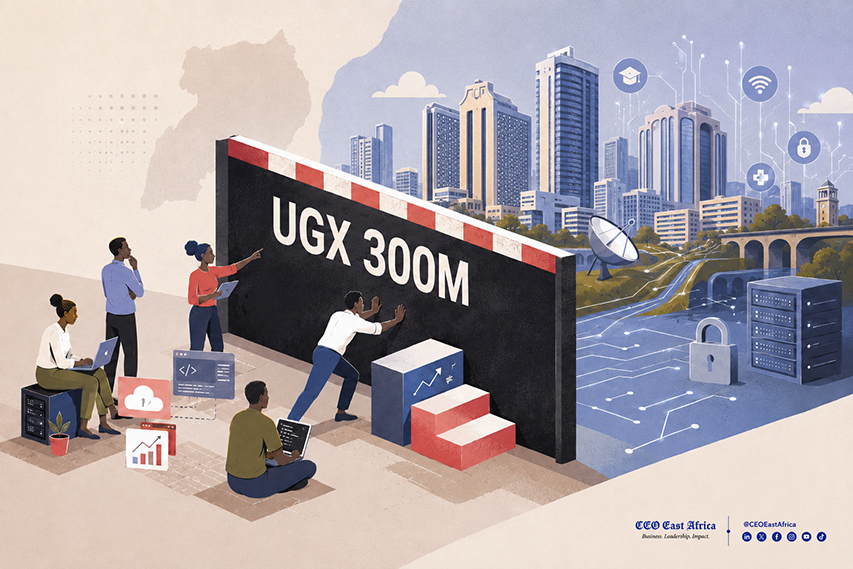
How Uganda’s UGX 300m ICT Procurement Limit is Locking Local Tech Firms Out of Big Govt Contracts
Can Uganda build a competitive digital economy if its local tech companies struggle to access large government contracts? At the heart of the debate is a UGX 300 million ICT procurement threshold that many believe disadvantages local firms. The conversation has started; the focus shifts to data, policy, and reform.
Read more 👉🏾 https://t.co/7fNG4P8qDI
Hi friends. I am well now and safely back home. Immigration officers in Amsterdam looked at me and thought I can’t have a genuine passport. They hadn’t even opened it. Held me back for so long apparently “verifying” my passport that I missed my flight. When I told them to check the passport because it has stamps and visas, they said those can be forged too. I have passed through Schiphol airport over 10 times if they had cared to look at the passport and checked my name in the system whatever doubts they had would have been cleared without undue delay and anguish. Anyway, they finished “verifying” long after the plane had left said I should be grateful they are getting me another “free flight” like they had found me stranded without a flight back home. When the “free flight” they got me was 24 hours later, they told me to either wait at the airport or figure out where to spend the next 24 hours. No explanation. No remorse. No apology. I don’t know if it was the anger or anxiety that made it very difficult to breathe or even utter a word and caused me a breakdown.. but it is very unfortunate that in 2026 there are people that still simply look at others and assume they are fraudsters or something. Luckily, good friends came to my rescue and also redeemed the reputation of the Dutch just a bit.. thanks @klup and Marnix🙏 we have already filed a complaint and raised the issue in many fora. I hope that at the very least they never racially profile any other person like that again.
The reason Uganda continues to defeat Ebola?
Dr Misaki Wayengera
Dr Henry Kyobe Bosa
Prof Bruce Kirenga
Prof Pauline Byakika
Prof Pontiano Kaleebu
Prof Rhoda Wanyenze
Prof Vinard Nantulya
Prof Moses Joloba
Prof Sewankambo
And many other dedicated patriots you never hear about.
Innovating on therapeutics each day, developing local diagnostics etc..
We honour you.
❗️🚨 An Israeli company has backdoored hundreds of millions of households through countless Smart TV apps, and they're quietly turning Samsung and LG TVs into exit nodes for AI web-scraping. Your TV is relaying strangers' web traffic from your home IP, your bandwidth, your address attached to whatever those scraping jobs touch.
Roku, Fire TV and Google TV banned the practice. Samsung and LG didn't. The culprit is Bright Data's proxy SDK, which rides inside Tizen and webOS apps, 200+ on webOS alone. Datacenter IPs get blocked, home IPs don't.
Include Security reverse-engineered the SDK and found its relay protocol has no message signing, authentication, or device attestation. Their words: less secure than typical malware command-and-control.
To make things worse, they found that in iOS the relay tunnel binds straight to the physical network interface, so it routes around any VPN the user is running.
Bright Data's config also ships per-country tiers. Devices in Uzbekistan and Oman are cleared to relay down to 1% battery, with data caps up to 60x the worldwide default.
Before the BaCkDoOrEd replies land: technically you agreed. In practice you were enrolled into a global proxy network you were never given the information to refuse. And these exit nodes drag down your IP's reputation, potentially leaving you with blocks from providers.
In 2001, @MIT became the first higher education institution to make its educational resources freely available through @MITOCW.
Our new short film explores the vision behind that decision and its lasting impact on learners around the world.
🎬 Watch "The Courage to Be Open: MIT OpenCourseWare and the Democratization of Knowledge:" https://t.co/DblfbQLnnS
Iran and the Real Meaning of Power: Why the nuclear bomb is not the lesson.
=======
There is renewed debate about whether Iran has crossed into a new nuclear reality, or at least moved closer to one. Whether that rumour is true or not, the fact that the world must discuss it seriously tells us something important about power. Iran has challenged many assumptions of modern empire, not because it is invincible, but because it has built systems that do not collapse easily under pressure.
Robert Greene’s The 48 Laws of Power has one famous lesson: strike the shepherd and the sheep will scatter. But Iran complicates that logic. The theory of decapitation assumes that a society is held together by one man, one office, one palace, or one command structure. In Iran’s case, pressure on leadership has not produced the simple scattering that powerful states often expect. The system has shown that some nations are not organised like crowds. They are organised like institutions.
That is the real lesson. A weak country is one where power sits in a chair. A stronger country is one where power sits in laboratories, factories, security systems, universities, supply chains, energy networks, industrial memory, military doctrine, and national institutions. When one person falls, another trained person stands up. When one facility is damaged, another protected process continues. When one generation is sanctioned, another generation learns to improvise.
Nuclear weapons, whether possessed, pursued, suspected, or debated, are among the most extreme symbols of strategic capability. They show that a country has moved beyond ordinary administration into complex coordination of science, industry, finance, security, secrecy, engineering, energy, logistics, and political will. The bomb itself is not the real power. The real power is the ecosystem that can imagine it, finance it, design it, manufacture it, secure it, maintain it, and politically control it.
This is part of the thesis I advance in my new book, The Five Levels of Economic Power. The lesson is not that Africa should chase nuclear weapons. That would be foolish, dangerous, and strategically misplaced. The real lesson is that no nation becomes powerful through speeches, donor workshops, mineral exports, imported contractors, or ceremonial industrial parks opened with ribbons, speeches, and branded tents. A nation becomes powerful when it builds the scientific, industrial, financial, military, and institutional capacity to defend its choices and shape its own destiny.
Iran may be sanctioned, isolated, attacked, mocked, and constantly threatened. Yet it has forced the most powerful nations on earth to calculate, hesitate, negotiate, strike, deny, and worry. That is not accidental. That is what happens when a country invests in strategic depth instead of living permanently at the mercy of external permission.
The deeper African question is therefore uncomfortable but necessary: what systems are we building that can survive pressure? If our universities are weak, our industries foreign-controlled, our engineers underfunded, our minerals exported raw, our standards imported, our machines bought but not mastered, and our institutions personalised around individuals, then we are not building power. We are only decorating dependence.
The bomb is only the visible tip of the pyramid. Beneath it lies metallurgy, chemistry, physics, software, machine tools, logistics, energy, finance, security doctrine, procurement discipline, and political continuity. That is the part Africa must understand. Real sovereignty is not announced. It is engineered.
The most powerful nations are not powerful because they possess dangerous weapons. They possess dangerous weapons because they first built formidable levels of competence. Africa must not copy the weapon. Africa must build the competence.
This is the real meaning of power. Not danger for its own sake, but disciplined capability. Not noise, but systems. Not panic under pressure, but institutions that can think, produce, repair, adapt, finance, and endure.
🚨 EVERYTHING THAT COULD GO WRONG FOR MARKETS WENT WRONG TODAY.
S&P 500 down -1.65%, wiping out $1.14 trillion.
Nasdaq down -2.60%, wiping out $1.11 trillion.
Gold down -3.38%, wiping out $1 trillion.
Silver down -6.9%, wiping out $280 billion.
Bitcoin down -6.31%, wiping out $80 billion.
In total $2.5 TRILLION wiped out in a single session. These were not isolated moves. Everything started breaking at the same time.
It started with the jobs report this morning.
The US economy added 172,000 jobs in May. Wall Street expected 88,000. That is almost double.
On any normal day, strong jobs is good news. But inflation is already at 3.8% and oil is sitting at $90. A labor market this strong tells the Fed it cannot cut interest rates and may actually need to raise them.
The probability of a rate hike this year went from 40% to 57% in a single day. That spooked every investor holding tech and growth stocks because higher rates mean those stocks are worth less today.
Then the AI trade started cracking.
Yesterday Broadcom reported record earnings: revenue up 48%, AI chip sales up 143% and the stock still crashed 12.6%. The reason was simple.
Broadcom did not raise its AI revenue targets for the year. Investors had expected it to. That single miss made people ask a question they had been avoiding for months: are we paying too much for AI stocks?
That question got louder today when a research firm called SemiAnalysis revealed that Nvidia's next-generation AI chips will need significantly less memory than everyone assumed, roughly half of what the market was pricing in.
Memory chips are what companies like SK Hynix and Samsung make. SK Hynix fell nearly 10% today. Samsung fell over 6%.
South Korea's entire stock market crashed 5.5% in a single session. Japan's semiconductor stocks did the same.
And then Anthropic added fuel to the fire by publishing a report warning that AI is getting close to the point where it can improve itself without human help and calling for a global pause in AI development.
Coming on the same day as the memory demand news and Broadcom's miss, it fed a single growing fear across the market: what if the AI boom is moving faster than the business models can keep up with?
Underneath all of this, there is a liquidity problem nobody is talking about.
SpaceX goes public next week at a $1.75 trillion valuation. Anthropic just filed to go public. OpenAI is next.
These three companies together are worth $4 to $5 trillion. Fund managers need cash to buy into these listings.
But cash levels are already at their lowest since early 2024. The only way to raise cash is to sell what they already own. That selling is happening right now.
The new Fed Chair Kevin Warsh will also hold his very first policy meeting in 11 days. He was appointed by Trump with the expectation of cutting rates.
He is now walking into a situation where inflation is high, oil is high, and the job market is running hot. Investors do not know what he will do.
When nobody knows what the most powerful central banker in the world will decide in less than two weeks, the safest move is to reduce risk today.
Everything that could go wrong, went wrong at the same time. A hot jobs report, a collapsing ceasefire, a crack in the AI trade, a trillion dollar liquidity drain, and a Fed meeting with no clear outcome.
An engineering professor who failed math her entire childhood spent years figuring out exactly what had been sabotaging her, and the answer was not low intelligence. It was a hidden mode her brain kept switching into that nobody had ever told her existed.
Her name is Barbara Oakley. The book is called A Mind for Numbers.
She failed math and science from grade school to the end of high school. Numbers felt like a language everyone else had been taught in secret.
So she ran toward the thing she was good at. She enlisted in the Army right after graduation, and the Army paid her to learn Russian at the Defense Language Institute in Monterey.
She got very good at Russian. Good enough to earn a degree in Slavic Languages, serve four years in Germany as a Signal Officer, and rise to Captain.
Then the wall appeared.
She watched her career options shrink because she could not handle the technical side of her own job. The people with math moved up and moved out. The people without it stayed stuck. So at 26 she did something that sounds insane. She left the Army and enrolled in engineering, starting from remedial math, sitting in classrooms with teenagers.
In between, she worked as a Russian translator on Soviet trawlers in the Bering Sea and as a radio operator in Antarctica. Today she is a professor of engineering at Oakland University with a doctorate in systems engineering.
The question that drove her for years was simple. What changed? She was the same brain that failed algebra. Why did it suddenly start working?
The clue was hiding in the one subject she had mastered. She noticed she had never learned Russian by staring at it. She practiced a little every day, walked away, came back, and the language quietly assembled itself between sessions. Math she had attacked the opposite way. Lock eyes with the problem. Push harder. Refuse to look away until it cracks.
It never cracked. And neuroscience explains why.
Your brain has two modes. The focused mode is the one you know. Tight attention, prefrontal cortex engaged, grinding through familiar steps. The diffuse mode is the one nobody teaches you. It runs in the background when you relax. It is loose, wide, and wired for connecting ideas that sit far apart from each other.
Oakley uses a pinball machine to explain the difference. In focused mode, the bumpers are packed tight. Your thought bounces in the same small circle, over the same ground, again and again. In diffuse mode, the bumpers spread out. The thought travels. It reaches parts of the brain the tight loop could never touch.
The trap has a name. The Einstellung effect. The first approach that comes to mind blocks every better approach behind it. The harder you focus, the tighter the loop, the more locked in you become. The grinding feels virtuous. It is actually the cage.
And every time her mind wandered off a math problem as a kid, she dragged it back, believing the wandering was laziness. The wandering was her brain trying to switch into the mode that solves things. She spent ten years fighting the half of her brain that wanted to help her.
You cannot run both modes at once. The diffuse mode only takes over when you genuinely let go. Which is why answers ambush you in the shower, on a walk, at the edge of sleep. Salvador Dali knew this. He napped in a chair holding a key over a plate, and the instant he drifted off, the key dropped, woke him, and he carried the half-formed ideas straight back into focused work. Edison did the same trick with ball bearings. Two of the most inventive minds in history were deliberately farming the mode the rest of us treat as slacking off.
The practical version fits in two sentences. Focus hard on the problem until you stall. Then stop completely, and let the other mode take the shift.
The break is not a reward for the work. The break is the work. It is also why cramming fails and procrastination is fatal. Diffuse mode needs hours and nights between focused sessions to build anything, and procrastination burns that time before the first session even starts.
Oakley failed math for ten years using one mode at full strength.
She became an engineering professor the day she started using both.