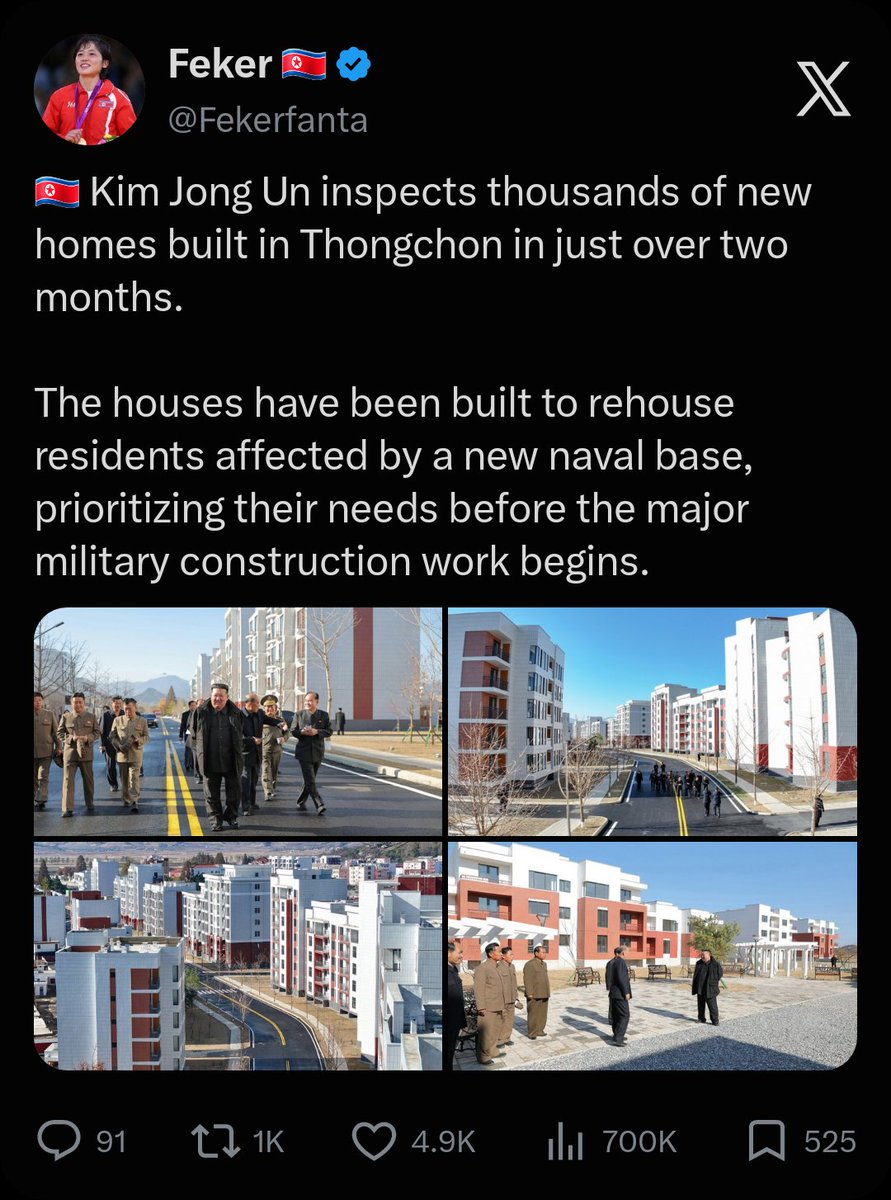
🇰🇵 = A sanctioned dictatorship.
🇪🇹 = An authoritarian country constantly in crisis.
🇬🇭 = A peaceful and stable democracy struggling to deliver 5000 housing units since 2012 amid corruption claims. With the first 700 expected in 2027.
So what actually works in democracies?
When a BBC journalist asked South African 🇿🇦 politician Mbalula Fikile whether South Africa would arrest Russian President Putin based on an international warrant, his response left the interviewer stunned.
A Chinese artificial intelligence model was used in recent hacks that disabled refrigerators in French supermarkets, US Treasury Secretary Scott Bessent said
Bessent warned that Chinese models “are dangerous because they don’t have guardrails on” their versions of the AI tools.
Bessent
https://t.co/npNVw62uV8
“What we need are men who do not fear what history will say about them, unfortunately what we’re getting are men who do not fear what history will say about them.”
People asked: they did the same thing to Vietnam and Vietnam still developed, didn't they?
Yes.
And the full answer is:
Vietnam developed because Vietnam made sure they could never do it again.
Vietnam developed because every time a new form of the same extraction presented itself, French colonialism, American neo-colonialism, post-war embargo, Vietnam identified it, named it, and refused it, at whatever cost refusal required.
Vietnam developed because the leadership that could have been Lumumbad survived and built institutions that outlasted the attempt to destroy them.
Vietnam developed because sovereignty, once won, was treated as non-negotiable.
Not as a status to be maintained through diplomatic performance, but as a material reality to be defended with everything available.
The lesson of Vietnam for Africa is not: colonialism can be overcome, be patient.
The lesson is: colonialism can be overcome, but only through the complete, uncompromising, non-negotiable termination of every mechanism by which it continues.
Not flag independence.
Not UN seat independence.
The kind of independence that means your currency is yours, your resources are yours, your debt is on your terms, your leadership survives when it serves you, and the people who want what is in your ground must ask you, and accept your answer, including when your answer is no.
That independence was not given to most of Africa.
It was given to almost none of them.
And the ones who tried to take it, Um Nyobè, Lumumba, Nkrumah, Keïta, Cabral, Machel, Sankara, Saro-Wiwa, Gaddafi, paid the price that tells you exactly how much it was worth.
To everyone.
The educational system colonialism built in Africa was not designed to educate.
It was designed to produce a specific kind of person.
A person who knew European history and not their own.
Who could cite the dates of French kings but not the dynasties of the Songhai Empire.
Who had been taught, explicitly and implicitly, through every textbook and every examination and every classroom that awarded marks for correct European answers, that knowledge meant European knowledge and history meant European history.
Frantz Fanon called this the colonization of the mind.
It is more precise than it sounds.
To colonize a mind is not to make it ignorant.
It is to make it fluent in a version of history in which it does not exist.
In which its own ancestors are either absent or primitive.
In which the civilization it came from is described, by the textbooks its grandparents were forced to read, as having contributed nothing worth remembering before the Europeans arrived to begin the remembering.
That is not education.
That is the removal of the floor from under a person’s sense of themselves.
And it was done deliberately, with curriculum and examination boards and missionary schools, at continental scale.
The sentence "Africa had no civilization before European contact" was never true.
It was not even close to true.
It required ignoring Egypt, which any map confirms is in Africa.
It required ignoring the Kingdom of Kush, which conquered Egypt and ruled it as the 25th dynasty: Black pharaohs from what is now Sudan, ruling another African civilization the West most wanted to claim.
It required ignoring Axum, which was a major world power in late antiquity, with its own script, its own coinage, its own trade networks reaching Rome and Persia and India.
It required ignoring Mali and Songhai, which at their peaks controlled more territory and more gold than most contemporary European kingdoms.
It required ignoring the Kingdom of Kongo, which had established a powerful and centralised state, with its own capital, political institutions, taxation system, and extensive trade networks, long before the Portuguese arrived in the late fifteenth century.
It required ignoring Great Zimbabwe, which European archaeologists initially attributed to Phoenicians, Arabs, anyone, before the evidence forced an acknowledgment that Africans had built it.
It required ignoring Timbuktu, with its universities and its hundreds of thousands of manuscripts, its scholars producing work on astronomy, medicine, law, and mathematics while Europe was in its medieval period.
It required, in other words, an extraordinary act of sustained collective will.
A decision, made and remade across generations of scholarship, to not see what was there.
That decision was not innocent.
It was not ignorance.
It was a choice made in the service of a story.
A story that needed Africa to be empty.
Because a full Africa made the colonial project something other than civilization arriving where there had been none.
It made it something that required a different name.
I have a particularly nasty case of cancer. When I was hospitalized again at my lowest point last year, I told Jensen. He immediately reached out to contacts at Stanford, who were able to cut through red tape, and get me into a clinical trial for which I've turned out to be a perfect fit. I think everyone can have their own views about recent events. But any claims that Jensen did not really care about his staff is simply inaccurate. I, personally, owe him more than I can express.
I think the best tribute we can pay to Jensen's legacy is to drive NVIDIA's continued success and push the whole industry forward, by showing we've learned the lessons from years of working here. We will compare ourselves against Speed of Light. The mission will be the boss. And we will not be scared to take smart, bold risks and fail fast with ruthless intellectual honesty.
But if there is one management story I remember the most, it's a particular Jensen grilling from my time in autonomous vehicles that stayed with me. Luckily I was not in the hot seat for this one. Team A didn't want to use Team B's framework, because they thought it was too slow. Jensen was surprised - it's just applying a bunch of optimized CUDA kernels in sequence, how could it be slow?
So he asked the executive from team B to draw the entire data flow sequence from their framework on the whiteboard and highlight every memcpy. Sure enough, there were a bunch of unnecessary memcpy's surrounding each pipeline stage. Everyone in the room could see why it wasn't getting to SoL and a path to improve things. No arguing about fiefdoms or appeals to authority - the data got us all on the same page.
The lesson was not (just) that unnecessary memory copying is bad. It's that executives should not be afraid to probe into details if something doesn't add up, and leaders need to be technical enough and honest enough to engage in real time and not turn every meeting into "I'll get back to you in a week." If that means counting memcpy's with a billionaire CEO, so be it.
My best executive meetings at NVIDIA have been when I'm fully prepared to present every detail of my team's work, and my worst failures have come when I realized I couldn't go deep enough to really solve the problem.
But the thing that gives me confidence is that Jensen was never the only one to live this philosophy. Anyone who has presented to an SVP at NVIDIA knows they are at risk for getting grilled on fundamental constraints and technical details. I have been part of amazing conversations with both recent and old timer leaders where we were able to get to the core of a problem in an hour rather than a month, because we had the right people in the room and were not afraid to go deeper.
The company is filled with supremely talented people who have been trained for 3 decades to work at the highest level, and you can see it in what we produce every day. I'm so proud to be an NVIDIAn, and I can't wait to show off what we ship in the coming months and years.
Egypt started its Smart Village on an empty 300 ha 20 years ago, now it's getting not less than $5 billion each year from IT offshoring and increasing. Avenues is good, but the land and surrounding areas are already pricey and no room for expansion!
Given a choice to turn into a smart neighborhood, I'd pick Avenues. Avenues can be easily turned into a tech hub. It has good water and electricity supply, a good density, Liquid Fibre and a midlle aged population who can afford luxury purchases. A lot of ecommerce services would thrive and then scale out to the rest of the city. I know what needs to be done.
Nobody warns you that 40 changes everything:
1. You see the difference between those who took risks and those who didn’t. It’ll scare the sh*t out of you. You’ll realize playing it safe is the path to mediocrity.
2. You grow extremely tired of unserious people. They’re full of excuses, always stuck in indecision, never go all in, dream, fantasize, but never do sh*t. You eventually just stop talking to unserious people and you don’t know why. It just feels right.
3. You see that a happy, healthy family is the real prize. Not a stupid f*cking Lambo. How much time you spend with them has an enormous effect on the quality of your life. You’ll feel like sh*t if you’re living in hotels for work.
4. You see how brutal drinking alcohol is. The ones who still get drunk are losing their hair or have low energy. They have pot bellies and smell like off tacos. They still act 21 and haven’t grown up.
5. You see how dumb modern dating is. Everyone is searching for the perfect person who doesn’t exist. Instead of finding someone who is a 7 and working on the relationship to make it a 10, people outsource all their personal power. They don’t realize a bad relationship is 50% caused by them. So they sleep around to numb the pain. All it does is create more pain.
6. You see the difference between high performers and everyone else. They get all the rewards. They can do whatever the f*ck they want. They get inbound opportunities. They always have to say no a lot. It looks like privilege, but actually it’s just talent and an extreme mindset. You also realize anyone can be a high performer. But most won’t get out of their own way to reach that point.
7. You see how far behind the “AI is evil” crowd becomes. It takes them twice as long to do a task. They take manual notes. They have zero automation. They think they can be smarter than an AI bot. They do hours of manual admin a day. They don’t have real-time data.
8. You realize nobody is coming to save you, but also that nobody is going to stand in your way. The bar is incredibly low. The gatekeepers leave you alone if you act right. Asking for permission becomes pointless if you leverage social media. When you’re relentless, people just get out of your way. They can’t be f*cked arguing with you.
9. You see your parents age and reach the end of their lives. You realize they did everything they could to be good parents and likely failed in many areas. But you realise you just need to forgive them. You become more curious about your heritage, and you see you’re not that different from them. If you have kids, you see how hard it would have been for them, so you have more compassion.
10. You see how toxic family money and inheritance are. It makes you lazy which steals away all your hopes and dreams.
11. You think fame and being an influencer is a nightmare. You could not give a sh*t about having 1M Instagram followers. You value privacy more. You hate showing off. And you’d rather keep your tits off the internet.
12. You develop a strong distaste for climbing the corporate ladder. All the people who you see hit the top are miserable. Even if they have money they have zero free time. It’s a bitter pill to swallow.
Lots of hot takes on the Microsoft 365 outage. Here's an engineering one.
To be clear: this is speculation. Microsoft hasn't confirmed a root cause. It's my read of their own updates, from 35 years of building and breaking systems.
What Microsoft has actually said:
• Traffic isn't up. Capacity is down. Servers are failing health checks and dropping out.
• A process that establishes secure connections gets overwhelmed, and servers stop processing requests.
• Servers they bring back fall over again as soon as traffic hits them.
• They're reverting a network config change that lines up with when it started. But changes aren't syncing, and some machines are stuck in a bad state.
• No indication of an attack.
My hypothesis: a metastable failure.
Whatever triggered it may be long gone. The outage is now keeping itself alive.
1. Reconnect storm. Every Outlook, Teams and mobile client on the planet is hammering for a fresh secure connection.
Full TLS handshakes are CPU-heavy, and a freshly rebooted server has a cold session cache.
A server comes up, eats a wall of handshakes, CPU pegs, it fails its health check and gets pulled, and its load lands on the next one. Dominoes.
2. The fix shares fate with the failure. If the rollback travels over the same secure channel that's melting, the cure can't reach the patient.
That's exactly what "changes aren't syncing" sounds like to me.
That's why they're throttling traffic types and rebuilding servers from an older config instead of flipping a switch.
You don't get out of this by finding the bug.
You get out by shedding load, restoring capacity in isolated cells, and letting traffic back in slowly.
Where AI fits (also speculation): not "an AI wrote the bad line". It's velocity. Microsoft flagged several recent config changes as suspects and took hours to find one that correlated.
When the volume of change outpaces the humans who understand each change, finding the culprit gets slow and rollbacks get messy. Automate the shipping faster than you automate the understanding, and this is the bill.
The takeaway for every business: your email, chat, files, identity and security tooling now share one failure domain. Today proved it. Have a way to talk to your team that doesn't live in the same tenant.
Happy to be proven wrong by the post-incident review. And I hope this post ages terribly.