Claude Code works now free. Unlimited. No subscription 🤯
It’s called free-claude-code. You get a free NVIDIA API key, point Claude Code to localhost, and the proxy converts your Anthropic API calls to NVIDIA NIM format.
40 requests per minute. No bill. Ever.
It supports Kimi K2, GLM 4.7, MiniMax M2, Devstral, and more. Streams thinking tokens and tool calls in real time.
There's also a Telegram bot built in so you can control Claude Code from your phone.
2-minute setup. 100% open source.
🚨 Anthropic's own team just showed how to actually use Claude Code properly.
30 minutes. free. the person who created Claude Code.
watch the workshop. bookmark it.
worth more than every $500 course you almost bought.
you've been using Claude without knowing 40 of its commands.
Then read the guide below.
I broke my phone addiction in 30 days.
• Screen Time down ~70%
• Phone pickups down ~50%
I reclaimed 4 hours 30 minutes per day. That's 1,635 hours across a full year. 68 days of life from a single behavior change.
Here's exactly what I did (save this):
1. Grayscale Mode
Put your phone on Grayscale Mode for the entire day.
Grayscale Mode removes the colors to make your phone immediately less appealing and addicting.
It takes 30 seconds to set up.
If you have an iPhone, follow these steps:
• Settings
• Accessibility
• Display & Text Size
• Color Filters -> On
• Grayscale
Next, create a simple shortcut:
• Settings
• Accessibility
• Accessibility Shortcut
• Color Filters
Now, if you triple-click the side button, you'll be able to toggle it on and off.
For non-iPhone users, you can find instructions with a simple search.
I kept my phone on Grayscale at all times and only removed it for specific reasons (like posting something that required me to see the color, looking at photos, etc.).
It made me less interested in grabbing my phone for the random "just checks" during the day.
2. No-Phone Zones
Set specific locations, times, and events where you won't have your phone on you.
I called them No-Phone Zones:
• Downstairs (kitchen, living room)
• Creative flow time (from ~5-8am)
• Family flow time (from ~5-7pm)
• Family gatherings
During these windows, my phone would be in a lock box or in a drawer in my office. If we were out at a family gathering, I would leave it in the car or in my wife's bag where I couldn't feel it.
Specifically listing out these No-Phone Zones had the benefit of making it a clear rule that I could cement in my mind.
Create your list of No-Phone Zones. Write it down if you need to.
3. Strategic Friction
Even with the Grayscale Mode and No-Phone Zones, my phone addiction intervention would have been difficult to execute without this final piece of the puzzle.
Motivation and discipline are never enough when you're trying to crack a deeply entrenched behavior.
There's a theory in cognitive science called Choice Architecture, which is the idea that you can design your environment to make good choices easier and bad choices harder.
Basically, I wanted to add strategic friction to make it much easier to adhere to my rules (and much more difficult to break them).
Three primary ways I did that:
1. I locked my phone in a lock box during my morning creative flow (5-8am) and evening family flow (5-7pm). It was a timed lock so I couldn’t get it without emailing the company.
2. I left my phone far away from where I was going to be working. If I wanted to get it, I'd have to walk to the other side of the house or down a few flights of stairs to get it.
3. I added really low screen time restrictions to social apps. If I wanted to overuse them, I'd have to keep approving more time, which felt like letting myself down when I did it.
Breaking the addiction is going to be difficult at first. Create strategic friction that helps you stick to the change. Make it difficult to make a bad choice.
The Life Impact
I'm not going to sugarcoat it at all:
This was the single most powerful behavior change I've ever made in terms of the tangible impact and ripple effects on my life.
That is not an exaggeration.
I was more present, less stressed, and able to connect on an entirely different level. In short, I showed up more aligned with how my ideal self would.
My capacity for deep work expanded significantly from simply placing my phone in another room or a lock box.
I got more done, faster, at a higher quality bar. It was like the holy trinity of productivity improvement, with no fancy productivity tool required.
Reviewing the research, this isn't surprising: There is clear scientific evidence that even having your phone in your pocket or on your desk reduces your cognitive capacity.
I felt happier and less stressed immediately upon making the change.
So, just keeping score...
This was a single, zero cost behavior change that had the net effect of:
• Improving my relationships
• Improving my work
• Improving my happiness
To be completely transparent, just a few days in, the only negative thought I had related to the intervention was simple:
Why didn't I do this sooner?
I hope this is the push you need to make this change in your life.
Start small and stick to it. Aim for a 10-20% screen time reduction week-over-week. Keep yourself accountable with a friend.
Having now gone through it, I can guarantee you'll see and feel the positive impact immediately.
Onward and upward.
giving soul to a product
it’s all there is to my life
need a mattress, food, ai
and people with same beliefs around
it’s all you need, for giving soul to a product
transform a product into entity
creating next generation of products
If I lost all my social media accounts tomorrow and had to rebuild from 0 followers, here's how I’d do it in 30 minutes a night using AI.
Most people would panic.
Start posting random content and hope something sticks.
I'd let AI do the heavy lifting..
Day 1: I'd deploy my AI research team.
Instead of manually studying competitors, I'd feed 50 top posts into ChatGPT.
Prompt: "Analyze these posts. Extract the top 10 problems discussed, engagement patterns, and emotional triggers. Return as a ranked table."
30 minutes of AI work = 20 hours of manual research.
Day 2-7: I'd let AI validate my content market.
I'd upload customer emails, support tickets, and Reddit threads to GPT.
"From these sources, identify the 5 most urgent problems people discuss. For each: pain level, urgency signals, and 3 content angles that would resonate."
AI finds patterns humans miss.
Week 2-4: I'd automate content creation.
Every Sunday, I'd give AI my week's worth of validated problems.
"Create 7 LinkedIn posts using these pain points. Monday = story, Tuesday = step-by-step, Wednesday = mistake-fix. Each post: strong hook, 3 practical steps, engagement question."
One prompt = seven days of content. No more staring at blank screens.
Week 5-8: I'd scale engagement with AI.
Instead of manually commenting on posts, I'd use AI to craft thoughtful responses.
"Based on this post about [topic], write 3 insightful comments that add value and showcase expertise in [my field]."
10x my engagement reach without burning out.
Week 9-12: I'd optimize based on data.
AI would analyze which content performs best and double down.
"Review these 50 posts. Identify the top 5 performing formats, topics, and hooks. Create 10 more posts using only the winning patterns."
Most people try to manually create content and burn out in month 2.
I'd use AI to work 24/7 while I sleep, eat, and handle my real job.
The AI revolution is happening with or without you. Choose your side.
This content system is just one piece of the puzzle. In my free masterclass, I'm revealing the complete AI business-building framework: market research, content creation, lead generation, sales copy, and customer acquisition.
Everything you need to build a real business on nights and weekends.
Grab your spot here: https://t.co/aWow3u65w5
My open letter to the new Startup Founders:
( It's extremely negative. An unfiltered truth. Proceed at your own risk )
1/ There is no easy, quick, risk-free & proven way to succeed.
Everyone who gives this promise lies. 99% of makers fail on their 1st, 2nd, and Nth try.
Don't be fooled by super rare success stories of an 18yo college dropout on TechCrunch. Those odds are lower than a lottery.
2/ Any successful person has spent way more time before their "overnight" success than it might seem.
I may start a product today and reach $30k MRR in 6 months. Can I teach you this? NO!
I can do that because I've spent 20 years building startups.
3/ There is no magic bullet to succeed at startups.
U must be above average in ideas, design, UX, coding, sales, marketing, presentation, copywriting, content, customer support, etc.
Think of a soccer player. Can u be a winner if they run like a snail? Or shoot like my grandma?
4/ The only way to learn all those skills is by DOING!
No amount of reading, watching youtube, consuming the courses and bookmarking the tweets will help, if you don't actually apply this knowledge right away. That's why u must be in "action" all the time. Every hour of the day
5/ Stop wasting your time.
Do you wanna succeed with your startup or express your valuable opinion about politics that nobody gives a sh*t about?
Remove everything from your life to focus only on one thing. Just a gladiator. Forget hobbies, parties & fun. Focus, Focus. Focus.
6/ I monitor profiles of people here on X.
People who seem to be eager to do stuff. But their feed is full of nothing. Nothing is being shipped. Nothing is being learned. They go around writing totally senseless comments nobody wanna read.
7/ Don't mix fun & education.
It inevitably kills your bias for action. Suddenly you get dopamine when u consume, not when u act.
————————————-
Enough being negative, here is what works:
a) Pick one topic and make a bet on it.
Don't spread to wide audiences. Pick a narrow niche. You should have some connection to the audience or be able to understand the audience and emulate their thought, pain, taste, and desires.
b) Learn the topic really deep.
Be in the top 1%. It's not easy. You will have to read/try/experiment for 1000s of hours to get there.
But this won't be a waste of time. I've never yet seen any true "expert" being poor & unsuccessful.
c) Educate the audience!
Share things that save them time so that they don't have to spend 1000 hours learning it. This type of content is worth sharing following the author. You can also launch newsletters and info directories out of your expertise.
d) If you have a crisis of ideas now, by the time you complete the steps above, you'll have a new problem: too many ideas!
Start discussing these ideas with the audience and build little tools to demonstrate them.
Often, they don't even make a tool, but instead, they are the tool.
e) Spend months iterating with micro MVPs and doing things manually for your audience and inevitably, one of the tools/services will gain more attention, and you'll clearly see you need to put more time into it.
f) Don't even hope that it'll take weeks/months.
Enter the game as it's a marathon.
Not prepared for a marathon? Go back to be employed or try dropshipping biz, I heard kids make millions there with no effort.
College is a $200,000 scam when AI + YouTube exist. Here's how a 19-year-old could land a $120,000 job in 6 months with no degree and no connections:
The Old Way: 4 years studyingan outdated curriculum. $200K in debt. Hope someone hires you. Compete with thousands of other graduates.
The New Way: 6 months learning AI skills on YouTube. Build 3 real projects for actual clients. Document everything publicly. Get hired based on proof, not papers.
Follow this “curriculum”...
I recorded a full guide on How to Build a Mobile App without writing a single line of code
This video covers everything, from idea to scale 👇
Timestamps:
0:00 - Intro
2:21 - Validating your app idea
10:53 - Building a clean UI and product
25:41 - Marketing & scale
Top 5 MCP Servers for Vibe Coding
If you’re building with AI and still doing everything manually, this thread will change your workflow forever.
Bookmark this ↓
If you're using Cursor, Windsurf, Cline, Bolt, Lovable, Replit or v0.
And you don't know what these docs are:
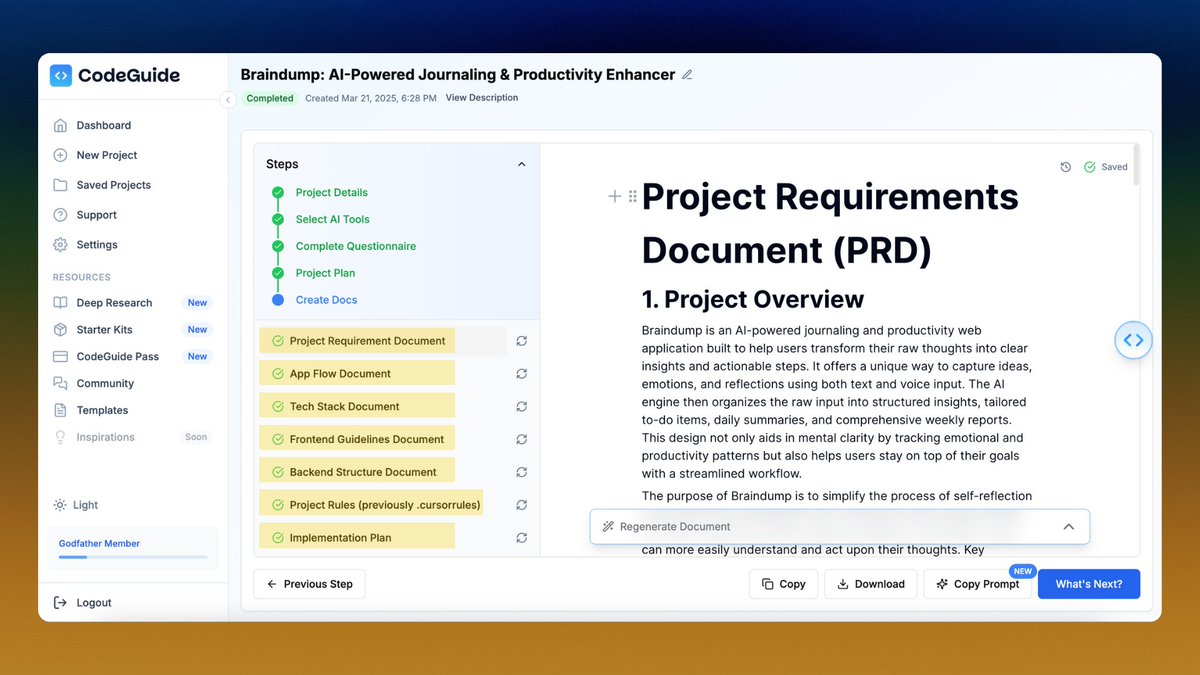
- PRD
- app-flow-doc
- tech-stack-doc
- frontend-guidelines
- backend-structure
- security-checklist
etc
You're not gonna make it.
I've built 36 projects with AI in last 14 months.
All AI dev tools are different. Every tool is good at ONE specific thing, like:
@windsurf_ai is best IDE for beginners (1st right now)
@cursor_ai is great for full stack apps (2nd right now)
@CodeGuidedev is great for writing project coding docs
@Replit is great for one-shotting MVPs/mobile apps
@v0 is great at designing modern UI components
@boltdotnew is great for Micro SaaS using Supabase
@lovable is great for coding modern landing pages
@SoftgenAI is great for Micro SaaS with firebase
@cline is best VS Code extension/works with MCPs
@base44 is great for dashboard-like apps (new tool)
@manusai is great for agentic/browser based work
@perplexity_ai is best for web search/summarization
@ChatGPTapp is great for voice to voice/writing work
@grok 3 is great at web based research/X information
@AnthropicAI is great for Coding (Sonnet 3.7 model)
@OpenAI is great for all types of AI models via API
@GeminiApp is great for multimodal (Flash 2.0 model)
This weekend I am also testing:
- Tempo labs
- Databutton
- Srcbook
I'll update you if I found more good dev tools.
I code with AI tools for 6-7 hours daily.
Built over 36 projects in last 12 months.
Truth: "Build me ........... app" in 1 prompt is not possible.
So, here're all the MISTAKES you might be making with AI code:


![TomBilyeu's tweet photo. If I lost all my social media accounts tomorrow and had to rebuild from 0 followers, here's how I’d do it in 30 minutes a night using AI.
Most people would panic.
Start posting random content and hope something sticks.
I'd let AI do the heavy lifting..
Day 1: I'd deploy my AI research team.
Instead of manually studying competitors, I'd feed 50 top posts into ChatGPT.
Prompt: "Analyze these posts. Extract the top 10 problems discussed, engagement patterns, and emotional triggers. Return as a ranked table."
30 minutes of AI work = 20 hours of manual research.
Day 2-7: I'd let AI validate my content market.
I'd upload customer emails, support tickets, and Reddit threads to GPT.
"From these sources, identify the 5 most urgent problems people discuss. For each: pain level, urgency signals, and 3 content angles that would resonate."
AI finds patterns humans miss.
Week 2-4: I'd automate content creation.
Every Sunday, I'd give AI my week's worth of validated problems.
"Create 7 LinkedIn posts using these pain points. Monday = story, Tuesday = step-by-step, Wednesday = mistake-fix. Each post: strong hook, 3 practical steps, engagement question."
One prompt = seven days of content. No more staring at blank screens.
Week 5-8: I'd scale engagement with AI.
Instead of manually commenting on posts, I'd use AI to craft thoughtful responses.
"Based on this post about [topic], write 3 insightful comments that add value and showcase expertise in [my field]."
10x my engagement reach without burning out.
Week 9-12: I'd optimize based on data.
AI would analyze which content performs best and double down.
"Review these 50 posts. Identify the top 5 performing formats, topics, and hooks. Create 10 more posts using only the winning patterns."
Most people try to manually create content and burn out in month 2.
I'd use AI to work 24/7 while I sleep, eat, and handle my real job.
The AI revolution is happening with or without you. Choose your side.
This content system is just one piece of the puzzle. In my free masterclass, I'm revealing the complete AI business-building framework: market research, content creation, lead generation, sales copy, and customer acquisition.
Everything you need to build a real business on nights and weekends.
Grab your spot here: https://t.co/aWow3u65w5](https://pbs.twimg.com/media/G7Gco8kW4AAi4RG.jpg)