I’m very happy to share the final version of this, now published in @Nature
https://t.co/an3t14AziH
Hippocampal neurons that initially encode reward shift their tuning over the course of days to precede or predict reward.
Building compositional tasks with shared neural subspaces
One of the big open questions in cognitive neuroscience is how the brain pulls off the kind of flexible, compositional behaviour that modern AI systems are still struggling to match. We know animals can recombine simple skills—“categorize this,” “move eyes there”—to solve new tasks, and that artificial networks trained on many tasks tend to reuse internal components. But what does that reuse look like in real neural populations?
Sina Tafazoli and coauthors tackle this by training monkeys on three cleverly related tasks that recombine the same subtasks: categorizing by colour or shape, and responding along one of two saccade axes. While the animals switched between tasks without explicit cues, the authors recorded from prefrontal, parietal, temporal cortex and striatum. Using population decoding, they show that task-relevant information—colour category, shape category, motor response—lives in low-dimensional subspaces of neural activity. Crucially, these subspaces are shared across tasks: the same colour subspace is reused whenever colour matters, and the same motor subspace is reused whenever a given response axis is required.
The really interesting part is how these shared subspaces are engaged. The authors decode an internal “task belief” signal from prefrontal activity during fixation, and show that as the monkeys infer which task is currently active, the brain selectively scales the relevant subspaces (amplifying useful colour or shape information, suppressing irrelevant features) and funnels activity from the appropriate sensory subspace into the appropriate motor subspace. Motor axes are updated quickly; sensory representations adjust more slowly, matching behaviour. The picture that emerges is strikingly aligned with ideas in multitask and continual learning in AI: flexible behaviour arises not from isolated, task-specific circuits, but from a set of shared neural primitives that can be recombined and gain-modulated on the fly.
Paper: https://t.co/oXjrDC6jNm
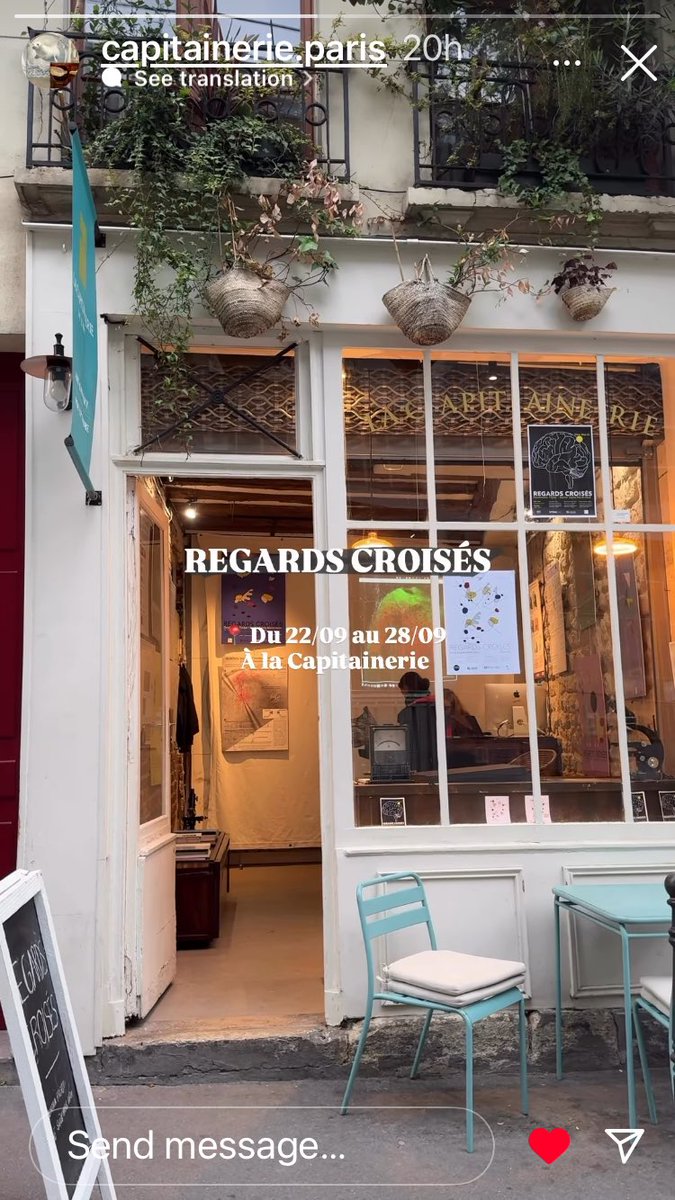
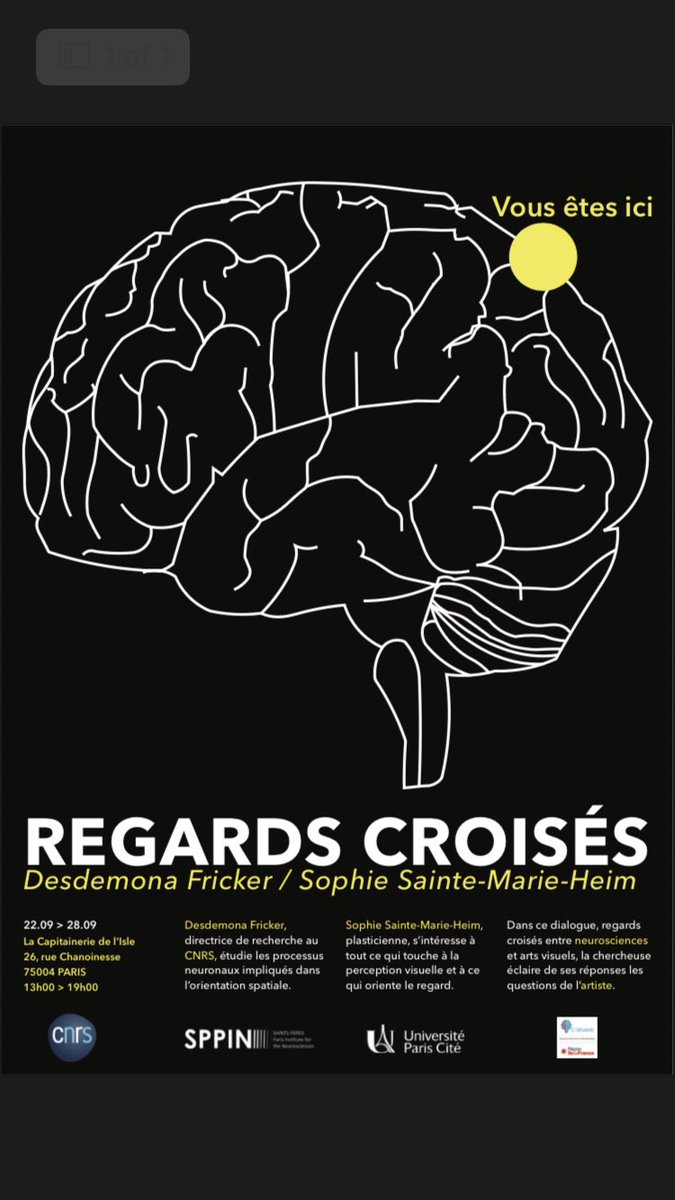
🧠 When Art meets Science! Exhibit “Regards Croisés” presented our research along with an abstract interpretation by Parisian artist 🎨 Sophie Sainte-Marie-Heim. Proud of the Orientation & Coordination team @CNRS and grateful to @RegionIleFrance for their support
On that note, I'll be looking for postdocs, students, and likely a computational lab tech/lab manager or research software engineer. Please share, and if this kind of work (and the prospect of helping get a new lab off the ground) sounds interesting to you, please reach out!
I'm thrilled to announce that our work to develop the Neuropixels-NHP 1.0 neural recording probe is now out in print in Nature Neuroscience.
https://t.co/ZU4VxxZjVY
Out today in @Nature: we show that individual neurons have diverse tuning to a decision variable computed by the entire population, revealing a unifying geometric principle for the encoding of sensory and dynamic cognitive variables.
https://t.co/sqNl4v8CgR
5 years ago during a midnight confocal session I got intrigued about unknown to me at the time brain area. Today we are excited to share our review and our obsession about the lateral thalamus: https://t.co/O9hSUxcZyf
1. If your eyes follow the movement of the rotating pink dot, you'll only see one color, pink.
2. Green Catastrophe: If you stare at the "+" in the center, the moving gap turns to green.
3. Reality Shatter: Now, concentrate on the +. Soon, many of the pink dots will slowly disappear, and you may only see a green dot rotating.
What does this tell us about the nature of reality? There really is no green dot, and the pink ones really don't disappear. If our brains are so easily fooled, what aspects of reality are we missing? https://t.co/DUBRExY1EM
We are pleased to announce the 2025 Paris Spring School in Optical Imaging and Electrophysiological Recording in Neuroscience. AKA the Paris Neuro Course.
The course will run 14-27 May 2025.
https://t.co/i3HaEtux2h
Please forward to anybody you feel may be interested 🧠👩🔬
1/ 🚨 Thrilled to share the final version of our paper in @eLife! Both LC & VTA pathways release dopamine in CA1, but how might they uniquely modulate CA1 activity? Using VR, we imaged these pathways in mice to uncover their distinct roles. https://t.co/XMs628hf6t #Neuroscience
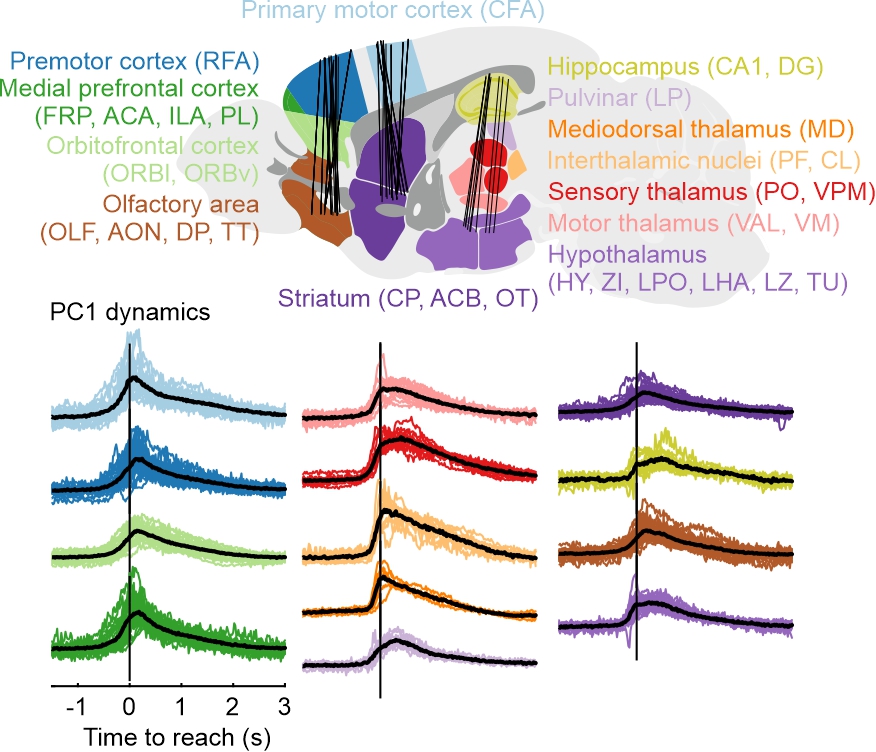
Delighted to share my postdoc project on https://t.co/0YyVILokb8! We used multi-Neuropixels during reaching and found preserved population dynamics across regions, sessions and animals that are not only linked to movement, but also the continuous expectation of action outcome.
Dive into the intricate connections in the mouse brain!
This video showcases 107 reconstructed neurons, thanks to the combined efforts of our teams at the Allen Institute, global collaborators, and tools from @GoogleAI.
Imaged using our cutting-edge ExA-SPIM microscope. 🧠��
🚨New preprint from the lab!🚨
We found a preference for visual objects in the mouse spatial navigation system and discovered that visual objects dynamically boost the encoding of head-direction!
https://t.co/fHx37Kt9ak
🧵👇1/
📢 Opportunity Alert! We have two open PhD positions in our lab at @PDN_Cambridge starting in Autumn 2025. Exceptional candidates may have the opportunity to join earlier as RAs and receive PhD funding if scholarship applications are unsuccessful.
Advert: https://t.co/fFdNGTqqQk
@marco_gaertner@CSProfKGD@DeepLabCut 🤗 https://t.co/zgxSGtNRkX has the full caption, but
TL;DR: neural networks to extract latent features from the visual cortex of mice and show we can predict what they were watching 📺🐭
🎉Exciting news! Our lab's first paper, "Vocal labeling of others by nonhuman primates," is now published in @Science! 🐒 Dive into our findings on how marmoset monkeys use vocal labels similar to human names and dialects. Check it out! 1/6
https://t.co/7iHBLByfRW
What is the nature of sensory prediction error signals in the neocortex?
Our research published in @Nature reveals that these error signals are amplified responses to unexpected inputs, mediated by a cooperative thalamocortical circuit mechanism! 1/4
https://t.co/fS9ztjB1St