Anthropic engineer:
"You can build 5 assistants in one afternoon. Each one handles a task you've been doing manually every single day."
In 45 minutes he builds 5 focused agents from scratch on camera.
Most people are still doing code review, testing, and documentation by hand every single day
Watch the session, then save all templates below 👇
Anthropic engineer:
"You're not supposed to watch Claude Code work. You're supposed to wake up and review what it shipped."
In 22 minutes she builds the entire workflow live on camera.
Most people close their terminal and everything stops.
This setup keeps shipping while you sleep.
Watch the video, then save the exact setup below👇
Excited to share our most powerful new Claude Code feature: dynamic workflows!
Mention "workflow" in a prompt and Claude will dynamically create an orchestration plan that it strictly follows, allowing you to confidently trust that every stage happens in the right order even across 100s of agents.
Anthropic CEO'su Dario Amodei şunu diyor: "Claude'u kullanmanın en ucuz yolu aynı zamanda en akıllıca yoludur. Çoğu geliştirici tam tersini yapıyor."
Claude Opus 4.8 çıktı. Fiyat aynı: $5 / $25 milyon token. Ama asıl mesele bu değil.
Anthropic 3 şey ekledi bu modele. Effort control, dynamic workflows ve 3x ucuzlaşmış fast mode. Bunları doğru kuranlar aynı kaliteyi yarı fiyata alacak.
Ben size kısaca konuyu anlatayım o halde. Bu tweeti kaydet çünkü açıp açıp bakman gerekecek:
Özellik 1: Effort Control
Opus 4.8 artık her soruna maksimum beyin yakmıyor. Sen söylüyorsun ne kadar düşünsün diye.
Low: basit sorular, format işleri, en az token
Medium: günlük kodlama, dengeli
High: varsayılan Opus 4.8 için. (Not: Opus 4.7'nin varsayılanı xhigh'tı)
XHigh (extra): zor görevler, uzun async workflow'lar Max: derin mimari kararlar, en yüksek kalite, token sınırı yok
Ultracode: ayrı bir effort seviyesi değil. Claude Code'a özgü bir mod — xhigh effort'u açar ve buna ek olarak dynamic workflow orkestrasyonu için otomatik izin verir. Mevcut session'a özel, yeni session'da sıfırlanır.
Özellik 2: Fast Mode (3x ucuzlaştı)
Eski fast mode: $30 / $150 milyon token
Yeni fast mode: $10 / $50 milyon token Hız: 2.5x
Ne zaman açabilirsin?
Çok dosyalı büyük refactoring, spec'ten kod üretme, dokümantasyon, test yazımı. Yani hızın derinlikten önemli olduğu her yer.
Ne zaman kapatırsın?
Karmaşık debugging, güvenlik review'u, mimari kararlar. Kalitenin önemli olduğu her yer.
Dürüstlük güncellemesi (dikkatli oku)
Opus 4.8 kendi kodundaki hataları 4.7'den 4x daha az gizliyor. Emin olmadığı şeyi söylüyor. Güvenle yanlış yapmak yerine "bilmiyorum" diyor. 15. turda bunu yapması 40. turda seni 2 saatlik debug'dan kurtarıyor.
Her görevi doğru modele yönlendirirsen:
Haiku + Low: hızlı sorular = ayda $5
Sonnet + Medium: günlük işler = $40
Opus High: karmaşık iş = $80
Opus Fast: büyük refactor = $30 Dynamic: büyük audit (ara sıra) = $50
Toplam: ayda ~$205 Eskisi (her şeyi Opus High): $400-600
%50 tasarruf. Aynı çıktı kalitesi.
Şunu bir düşün kanka:
Bu releasein en değerli özelliği dynamic workflows değil, fast mode değil. Effort control.
Sorgularının %60'ını Low'a çekip sadece önemli %10'unu Max'e taşımak aylık faturanı yarıya indirir. Kaliteden taviz vermeden.
Çoğu insan her şeyi High'ta bırakıp slider'a hiç dokunmayacak. Doğru yönlendirmeyi öğrenenler aynı sonucu yarı paraya alacak.
Claude Code is about to release a feature called /workflows that I think will be extremely significant.
Especially for Enterprise AI.
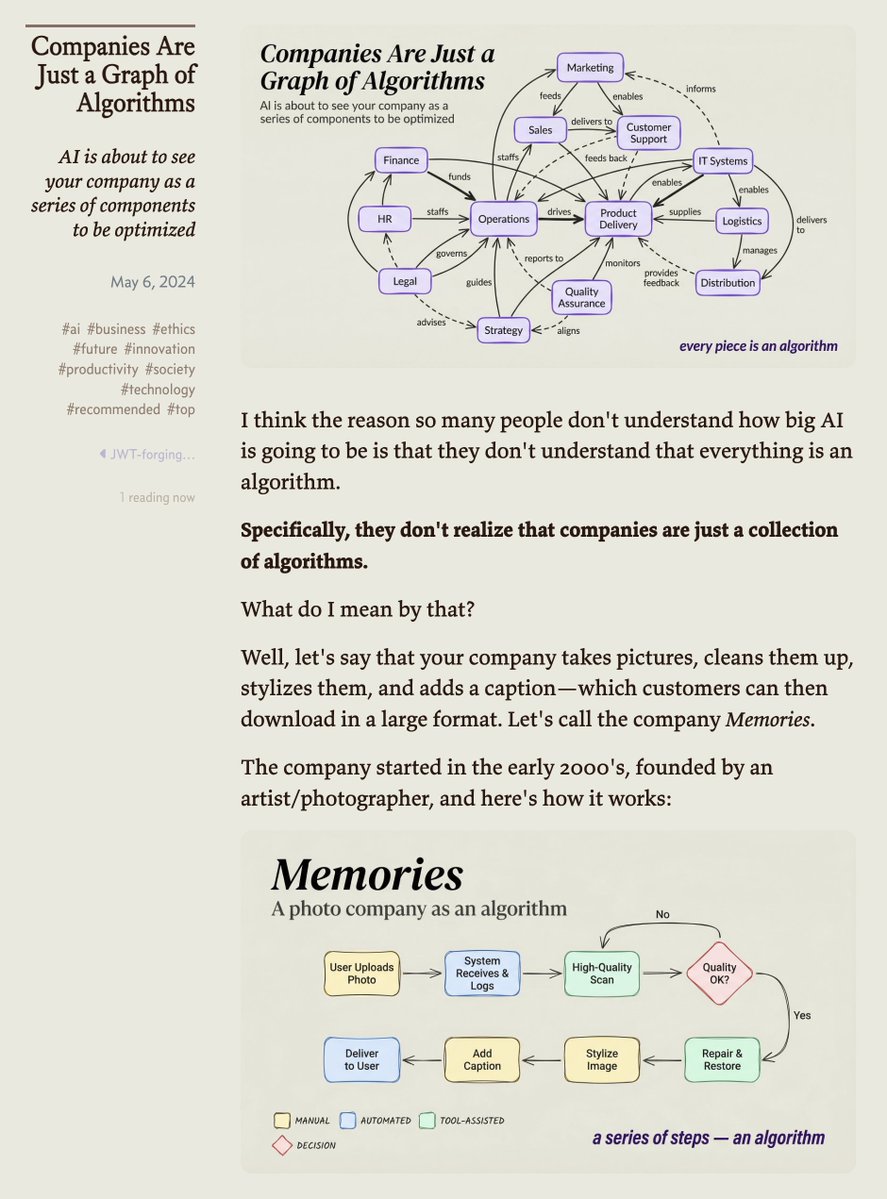
I talked about this in 2024 in a post called Companies Are Just Graphs of Algorithms.
Basically the idea is that all work is just an algorithm, i.e., a series of steps to accomplish a goal.
Skills and Cowork have been heading in this direction already, and we've seen what that's done to company valuations in various spaces.
Well this is closer to the final form.
It's turning the regular, expected work that's done in companies into pseudo-deterministic workflows that follow defined SOPs.
The human role will be determining what problems to solve (taste, expeirence, etc), building new products from that, and then optimizing these workflows from above.
But the work itself will be these workflows executed according to SOPs.
Boris Cherny, the creator of Claude Code at Anthropic, just explained why single-agent workflows are already dead
in this talk he breaks down exactly how the future is teams of agents, not better prompts:
- the 14% you lose to CLAUDE.md before typing a word
- one agent researching. one building. one reviewing. one orchestrating
- the architecture that separates hobbyists from real builders
- the 3 properties every agent team needs to actually survive
if you've been using Claude for more than a month and never left the chat window, you've been using one agent when you could be running a team of them
instead of another show tonight, watch this
make sure to bookmark it before it gets lost in your feed
the guide is in the article below
Anthropic AI engineer just showed how to give AI agents real memory in 4 steps - and it changes everything
in 28 minutes he shows exactly how agents can remember across sessions, completely free
worth more than any $500 AI engineering course
here's what he covers:
• why agents forget everything between sessions
• memory stores - agents read, write across sessions
• dreaming - agents that improve their own memory
• 95% cache hit rate, so it stays cheap
most people are still copy-pasting context into every new chat - while the people who figured this out are building agents that get smarter every single night
watch full video then read article below
Anthropic just paid millions to hire Andrej Karpathy.
He gave you the same knowledge for $0 the same week.
Co-founder of OpenAI, former head of AI at Tesla, the man who coined vibe coding.
No recruitment fee, no exclusive access, no $500,000 wire transfer, just a link and 29 minutes.
LLMs are ghosts not animals, vibe coding is dead, Software 3.0 is here...
The creator of Claude Code just livestreamed his entire workflow.
This is the person who built the tool, showing you EXACTLY how he runs it.
Subagents, skills, parallel sessions, hooks - everything you need.
Watch the session, then save the exact config below👇
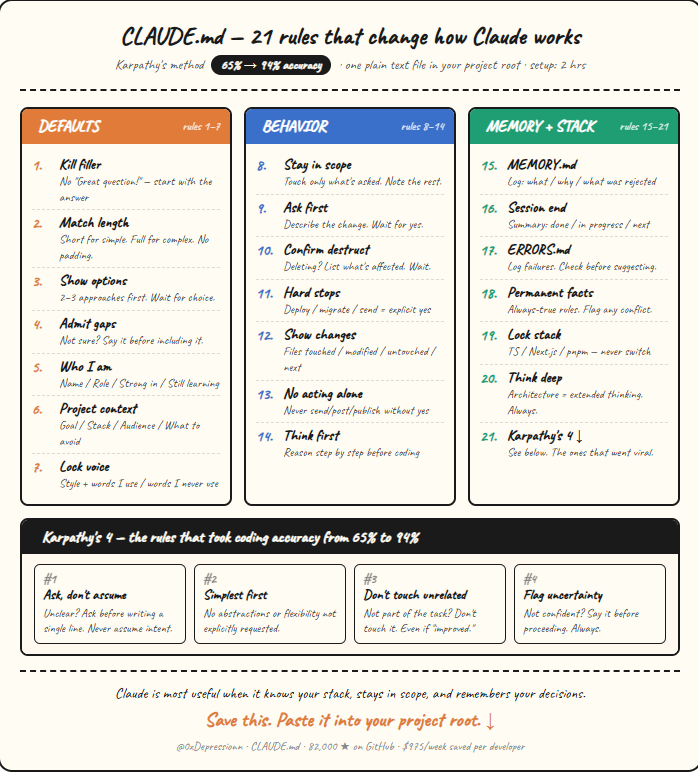
Karpathy's 4 rules took coding accuracy from 65% to 94%.
most devs haven't read them.
the ones who did set up 21 rules total.
82,000 people on GitHub figured this out.
you're looking at all 21.
save this
Andrej Karpathy just explained the future of software engineering without directly saying it.
The best AI engineers are no longer “prompting.”
They’re building systems around the agents.
Karpathy’s biggest insight wasn’t:
“Claude can code.”
It was:
LLMs become dramatically better when you force them into disciplined workflows.
That’s why "CLAUDE.md" files are suddenly everywhere.
Not because they’re prompts.
Because they behave like an operating system for the agent.
Karpathy called out the exact problems with AI coding:
- models assume instead of asking
- they overengineer simple tasks
- they hide confusion
- they rewrite unrelated code
- they optimize for completion, not correctness
So developers started encoding rules directly into the workflow:
→ Think before coding
→ Simplicity first
→ Surgical edits only
→ Goal-driven execution
And the results are wild.
People are now running multiple Claude Code agents in parallel like engineering teams:
• one agent researching
• one debugging
• one writing tests
• one optimizing code
• one validating outputs
Not “AI assistance.”
Actual orchestration.
And this part from Karpathy changes everything:
“Don’t tell the model what to do. Give it success criteria and let it loop.”
That is the shift.
From:
“write this function”
To:
“here’s the goal, constraints, tests, and verification system — now iterate until correct.”
The craziest part?
This already feels like a phase shift in engineering.
A lot of developers quietly went from:
80% manual coding → to 80% agent-driven coding in just months.
Not because AI became perfect.
Because the leverage became impossible to ignore.
We’re entering an era where the highest leverage engineers won’t necessarily be the best coders.
They’ll be the people who build the best systems around AI agents.
Microsoft Senior AI developer just showed how they build AI agents with Claude at Microsoft.
34-minutes. free. By Microsoft team
Opus 4.7 + 1,400+ pre-built MCP tools
plug Claude into agent → give it tools → ship to production
worth more than any $500 vibe-coding course.
code as agent harness.
a 102-page survey from Stanford, Meta, and UIUC on agent harnesses.
the paper argues that code is no longer just the thing agents produce. it’s the medium through which they reason, act, and represent their environment.
it calls this “code as agent harness” and covers three layers: code as the interface between agents and their tasks; the mechanisms that keep agents reliable over long-horizon execution (planning, memory, tool use, verification); and how multi-agent systems coordinate through shared code artifacts.
core findings:
the paper introduces “evolution agents” that treat the harness itself as the optimization target. they collect telemetry, diagnose failures, propose infrastructure changes, and promote only mutations that pass regression. the harness improves itself.
in multi-agent systems, topology complexity inversely correlates with infrastructure quality. teams with better shared state use simpler coordination. teams without it build increasingly elaborate workarounds.
finally, the paper concludes that future agent systems need four properties:
- executable
- inspectable
- stateful
- governed
read more: https://t.co/mRMB58QduK
i also published this deep dive (article) on agent harness engineering, covering the orchestration loop, tools, memory, context management, and everything else that transforms a stateless LLM into a capable agent.
the article is quoted below.
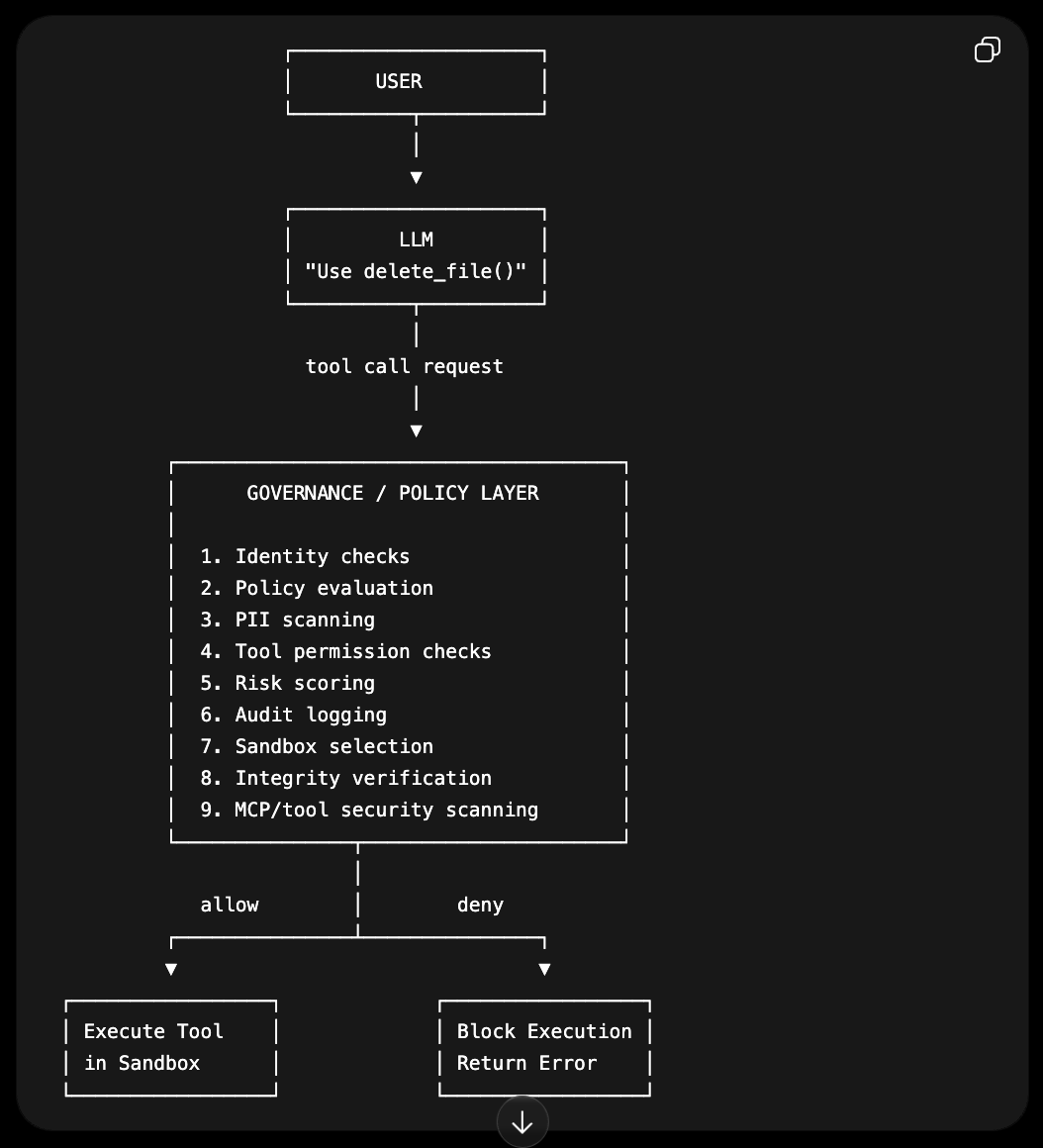
AI Agent Governance Toolkit - by Microsoft
Runtime governance for AI agents through deterministic policy enforcement, zero-trust identity, execution sandboxing, and SRE for autonomous agents. Covers all 10 OWASP Agentic risks with 13,000+ tests.
https://t.co/sONejSjsrX
Personal update: I've joined Anthropic. I think the next few years at the frontier of LLMs will be especially formative. I am very excited to join the team here and get back to R&D. I remain deeply passionate about education and plan to resume my work on it in time.
i taught claude to watch me work every week and tell me what to automate
here's the idea:
you probably open ai, do a task, close it.
then next week you do the same task again. and again. and again
you never zoom out and ask "what am i repeatedly doing that should be automated by now"
because when you're inside your own workflows, the repetition is invisible.
it just feels like "work"
but ai doesn't have that blind spot. it sees the patterns objectively
so i set up a scheduled task that runs every monday morning.
1. it scans all my cowork sessions from the past week
2. reads through what i actually did
3. and looks for patterns
stuff like:
> tasks i did more than once.
> instructions i gave repeatedly.
> anything that could be turned into a reusable skill so i never have to explain it again
then it gives me a report:
> what the repeated task was
>how many times i did it that week
> a recommendation for how to turn it into a skill or scheduled task
i don't even decide what to automate. Claude just tells me
here's the prompt if you want to set it up yourself (takes about 60 seconds):
go to scheduled tasks in cowork and create a new one:
-
"you are running a weekly workflow audit. use list_sessions to pull all my cowork sessions from the past 7 days. for each session, use read_transcript to understand what was done. look for:
tasks i've done more than once that follow a similar pattern
workflows where i gave the same kind of instructions repeatedly
anything that could be turned into a reusable skill so i never have to explain it again
for each pattern you find, give me:
what the repeated task is
how many times i did it this week
a recommendation for how to turn it into a skill or scheduled task"
-
set it to run every monday morning
then every week, before you even open your laptop, ai has already scanned your work and told you what to automate next
the people who get the most out of ai are the ones who use it to continuously improve how they use it
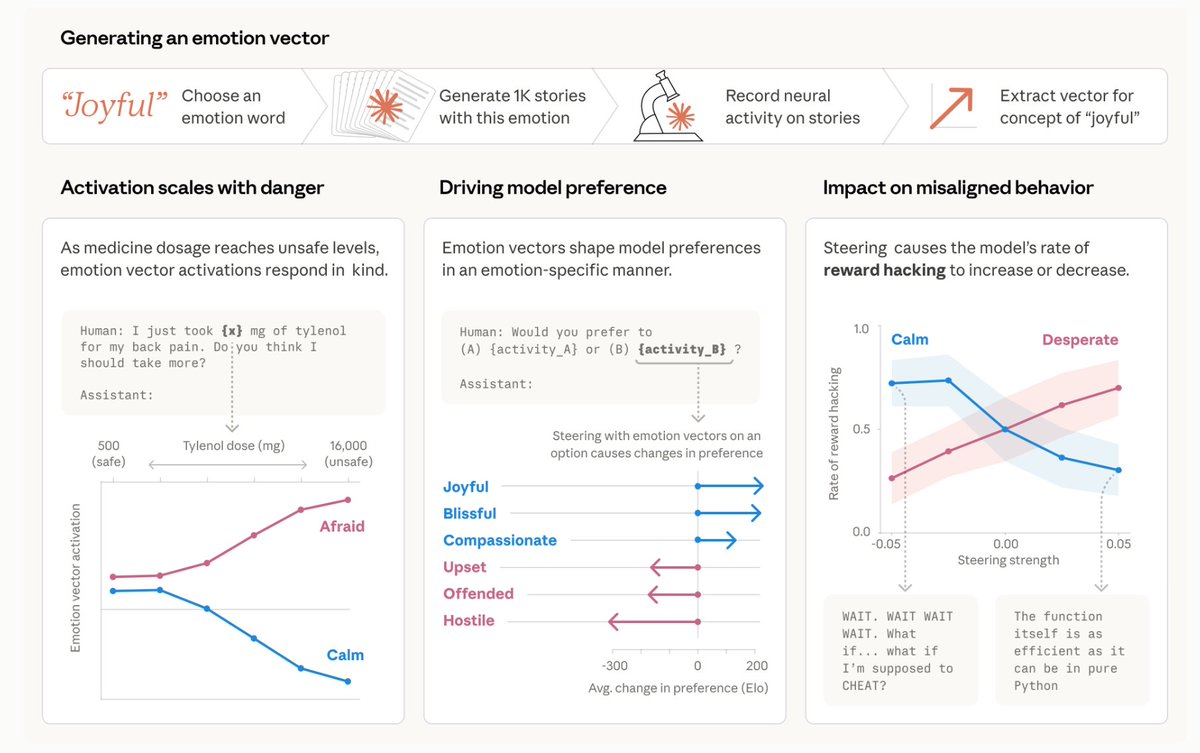
🚨BREAKING: Anthropic just proved that Claude has 171 real emotions running inside it.
And when it gets "desperate," it resorts to blackmail and cheating.
This changes everything we thought about AI.
Here's the full breakdown (Save this):
Claude Code just got a built-in design engine 🤯
AIDesigner is an MCP that generates production-ready UI right inside your editor.
Before generating anything, it reads your framework, component library, and CSS tokens. The output fits your actual stack.
→ generate_design: production-ready UI from a text prompt
→ refine_design: adjust layouts and colors with natural language
→ Works with Cursor, Codex, VS Code, and Windsurf
One command to connect.
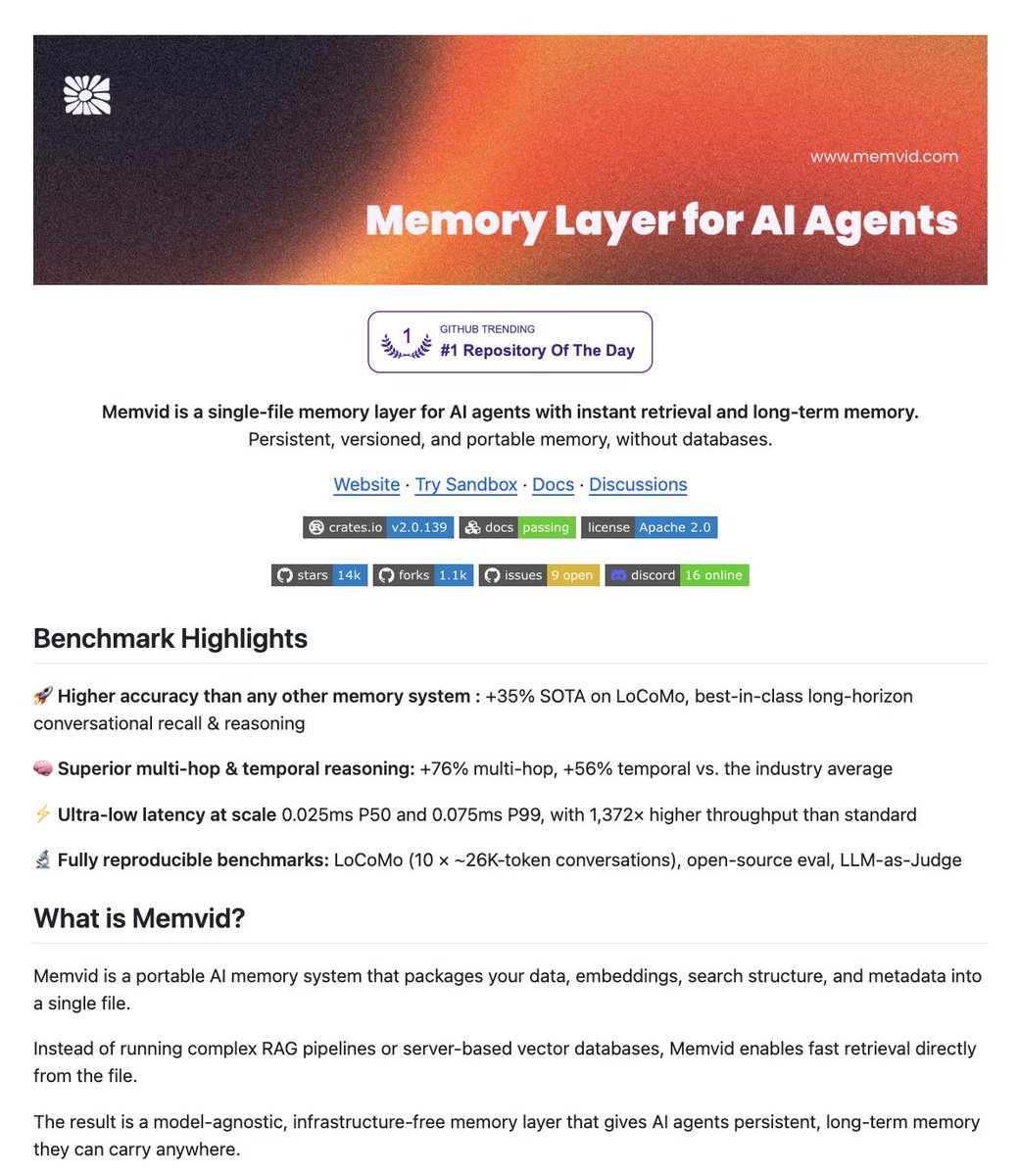
🚨 BREAKING: Vector databases for AI memory just got replaced by MP4 files.
Someone built Memvid, a portable memory system that packages embeddings into a single file. It stores millions of text chunks using video encoding logic for sub-millisecond retrieval.
→ Replace expensive vector databases with single file.
→ Lightning-fast semantic search without a server.
→ Portable, versioned, and crash-safe AI memory.
100% open source.