Whenever you encounter an inconvenience today, just remember there’s a woman in the 1800s who birthed 8 kids naturally, worked on a farm before the invention of weekends, and was considered soft.
You’re gonna make it.
We tried using Meta's new Muse Code agent, but it has a bug that doesn't let it sign in from a docker container.
So we did a fun experiment: Meta claims Muse Spark 1.2 was co-trained with their Muse agent harness. So we extracted instructions from their system prompt and added them to the Cline harness.
TL;DR of this special prompting:
- Trust source code over the user prompt, so read every call site and existing tests before starting the task
- Weigh edge and error cases as heavily as the happy path
- Always reproduce the bug before fixing
- Don't trust the first passing test suite, and verify suspicious looking half-baked tests
- Never stop at just editing, keep working until the change is verified complete.
We then asked this modified harness to fix a real bug from our repo, and compared the results to the original Cline agent harness.
Results:
- Used 2.7x fewer tokens (19.7M → 7.2M)
- Finished 2x faster (49min → 24min)
- Cost 2.4x less ($7.69 → $3.25)
Same Muse Spark 1.2 model, same task, only the prompting changed. Incredible how much of a performance gain Meta was able to achieve training it on these special instructions!
We had Kimi K3 recursively self-improve the Cline harness to improve its own performance.
17 hours later, it went from 77.5% to 88.8% on Terminal Bench, and cut run cost from $79 to $49.8.
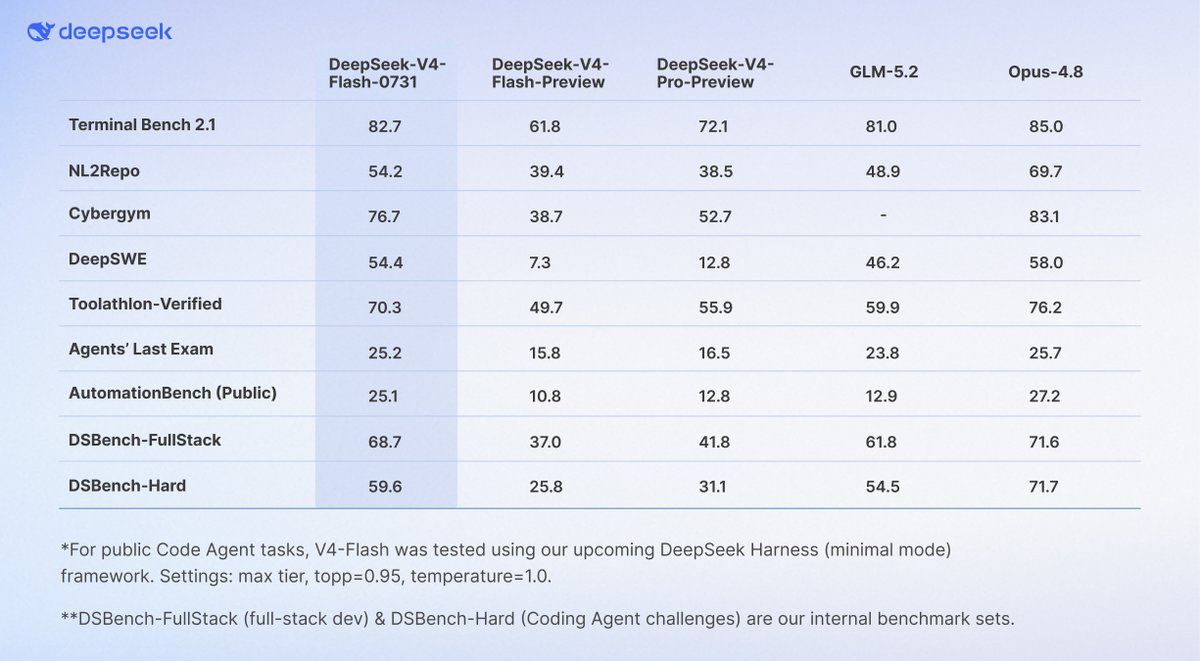
🚀 DeepSeek-V4-Flash Official API is now LIVE in public beta!
🔷 We’ve massively upgraded its Agent capabilities—benchmark scores are now far surpassing the V4-Pro-Preview. Check out the massive performance leap below! 👇
🔷 The official V4-Flash now natively supports the Responses API format and is fully adapted for Codex!
Check out the configuration details in our official API docs: https://t.co/smCwQZMeiq
In light of this incident, what would be a reasonable range of cybersecurity capabilities for models accessible to the general public, including the open-source community?
In other words, how asymmetric should access to cybersecurity capabilities be?
Opus 4.8 was distilled from Qwen. This is 100% real, I didn't even have to mess with the settings, got it after 3 requests.
I guess every accusation really is a confession.
$20 of Qwen beats $200 of Claude on usage.
It is not close.
I bought the $20/month Qwen 3.8 Max plan, launched DOZENS of subagents, and ran real tests in my codebase.
The damage: 7% of my 5-hour limit. 2% of my weekly.
The same workload on Fable 5 would have maxed out my Claude subscription already.
And the model is genuinely good.
Not sure how Anthropic competes with this.
We watched Kimi K3 and Claude Fable 5 work through the same tasks, and they showed completely different personalities.
Fable plans everything upfront, then fires one giant batched call. It cleaned up an entire CRM (searching Salesforce, HubSpot, and Gmail in parallel) in just 2 tool calls.
Kimi works step by step. It searches for tools mid-task as it needs them and makes more, smaller calls. The same CRM job took 7 tool calls.
When something broke, both models improvised. A tool search returned a result too large to read. Fable dropped into the shell and grepped the raw file. Kimi did the same, but inside Composio’s remote sandbox instead of locally.
The tradeoff: Fable’s batching finished ~2.5× faster. Kimi’s step-by-step style kept its context smaller, using 40% fewer tokens for the same work.
Both are incredibly competent models. They just approach work differently.
To summarize: HuggingFace got autonomously compromised by a model from an American company. HF then tried to use American frontier model(s) to defend themselves, but were blocked by guardrails. HF then had to turn to open source Chinese models to defend themselves from another American company.
One pattern I find useful for working with LLMs is a nice long ramble session. Sometimes the LLM needs more bits to understand what you're trying to achieve, but you're too lazy to type them. In these cases I like to lean back, switch to /voice and just ramble for like 10 minutes, total mess, anything goes, full stream of consciousness. Sometimes I declare it up top, something like "switching to speech recognition sorry for any typos...". Sometimes I turn it into a small interview of a few turns. But I find that the LLMs are somehow very good at reconstructing long incoherent rambles and often their echo of your own tangle of thoughts comes out quite a bit cleaner than what you started with. The result is that you improve the mind meld and have to correct things less from that point on.
Laguna S 2.1 is a breakthrough in small model performance, beating models 3x its size.
At only 118b param, it beats DeepSeek v4 Pro, Gemini 3.6 Flash, and Thinking Machines Inkling on benchmarks.
Try in Cline with model id: poolside/laguna-s-2.1
US frontier labs don't allow models for extensive cyber use, Chinese models get banned, so US firms don't have any access to good cyber models. While anyone outside of US has access to increasingly powerful models for cyber attacks because of Chinese open models. Robust plan.
There is one thing that genuinely worries me about Open Source AI.
While Kimi isn't particularly strong in cybersecurity right now, future models are going to be infinitely more powerful.
Case in point: GLM-5.2, fine-tuned on a hacking dataset I built, effortlessly exposed countless vulnerabilities in major production systems—even front-line infrastructure like Apple and Microsoft.
The fact that this capability could be abused is what actually keeps me up at night.
I've noticed that Kimi K3 always wants to check itself. It usually spins up a headless browser to find issues before considering the task done, then re-runs multiple times after each fix until no more issues remain.
That may be the correct approach, but it should not be considered a true "one-shot" when compared head-to-head with other models that don't behave this way.
Am I wrong?
@MiaAI_lab A good programmer does the same.
Vibe coders hate this. They call it **token inefficiency** because they just want as much cheap slop as they can for their money.
If you have an SWE mindset, you can consider self correction as the desired future of AI coding.
Holy: China now has a 1-gigawatt AI data center built without a single Nvidia chip!
Via Bloomberg:
zAI has reportedly completed construction of the facility and begun partial operations. It runs exclusively on Chinese-made chips and will support the development of the company’s frontier GLM models.
zAI has also built or operates several computing clusters containing more than 10,000 chips each.
This is far more significant than the next Frontier model. The importance of chip independence from the USA can hardly be overstated.
@MikeBradleyAI As a European, I can see that Trump is continuously weakening the US. Like so many Europeans, I believe Trump is an asset to Putin to weaken American power.
Why do Americans not see this?