🏛️ A senior officer’s success is not measured only by the decisions they take, but by how well they empower others to make decisions.
This was the central message of Cabinet Secretary Dr T. V. Somanathan at NITI Aayog’s National Workshop on ‘Leadership as a Mission’, held at Bharat Mandapam, New Delhi.
Dr Somanathan explained that the responsibilities of civil servants evolve as they rise through the administrative hierarchy.
In their early years, officers are largely judged by the decisions they take themselves. But at the levels of Joint Secretary and Secretary, leadership means something different: delegating authority, building confidence among junior officers and allowing them to take decisions.
He emphasised that senior officers must also stand by decisions taken in good faith, creating an environment where those working under them feel confident about exercising their responsibilities.
Another important point was the impact of review meetings. The questions senior officers raise during reviews influence the priorities and actions of officials across the administrative system. Their words can shape what the entire team focuses on.
Dr Somanathan also highlighted that civil servants can learn from the leadership qualities, administrative skills and governance practices of political leaders while continuing to maintain political neutrality.
💡 The larger lesson: Leadership is not about controlling every decision. It is about creating an environment where others have the authority, confidence and support to make the right ones.
#TVSomanathan #CabinetSecretary #NITIAayog #CivilServices #IAS #Leadership #GoodGovernance #PublicAdministration #IndianBureaucracy #IndianMasterminds @NITIAayog@PMOIndia@mygovindia@DoPTGoI
It was a wonderful experience to listen to three young officers of the Central Secretariat Service, serving in @PetroleumMin, share their ideas and perspectives on India’s energy future.
Their presentations covered important themes, including E&P Sector Reforms: The Next Wave, Reforming India’s Domestic Natural Gas Sector, and Increasing Non Fuel Revenue for Oil Marketing Companies, in the presence of senior officials of the ministry and captains of energy PSUs.
It is heartening to see how, under the leadership of PM Sh @narendramodi Ji, a culture is taking shape where young officers feel encouraged and empowered to come forward, share their ideas and contribute to nation-building. Such opportunities bring fresh thinking and renewed energy to our collective efforts towards #ViksitBharat and the goal of achieving energy self-sufficiency.
The evening also took me down memory lane. I could vividly recall my own younger days, and the sense of accomplishment and excitement I felt whenever my ideas and suggestions were appreciated or accepted by senior colleagues. That encouragement inspires one to do more.
It is wonderful to see the next generation of officers bringing fresh perspectives and a strong sense of purpose to India’s energy journey.
@PMOIndia@PIB_India@MIB_India@CSSforum_@BPCLimited@EngineersIND@gailindia@HPCL@IGLConnect@IndianOilcl@NRL_MoPNG@ONGC_@Ongc_Mrpl@ongcvideshltd@OilIndiaLimited@PetronetLNGLtd@IndiaEnergyWeek@PPACIndia@DghIndia
The most expensive part of a hospital bill may never touch the hospital at all.
A patient admitted for care has no way of knowing whether the price on a medical consumable reflects its actual cost or a markup fixed long before it ever reached the ward. That gap in information is, at its core, a public health issue.
A survey of hospital consumables in Maharashtra found an IV infusion set with a trade price of ₹11.05 carrying a printed MRP of ₹325 ; a markup of 2,841%. A syringe procured at ₹6.75 carried an MRP of ₹57.20. A catheter procured at ₹29.41 carried an MRP of ₹310.
These are not elective purchases. Patients cannot compare prices, seek alternatives, or question a number printed on a box while receiving care and the MRP itself is often fixed upstream by manufacturers and distributors, disconnected from the trade price by a wide, unexplained margin. The result is a system where the party bearing the cost has the least information to evaluate it.
The regulatory gap is structural: scheduled medicines are capped under the Drugs (Prices Control) Order, 2013. Most medical devices and consumables are not leaving both the pricing and the information around it almost entirely unmonitored.
A review of these findings and clear guidelines on the permissible gap between trade procurement price and declared MRP have been recommended to the Department of Pharmaceuticals and the NPPA ; a step toward closing not just a pricing gap, but the information gap patients are left to bear alone.
#PublicHealth #GoodGovernance #Leadership #TukaramMundhe
https://t.co/Ye9CVzr8qU
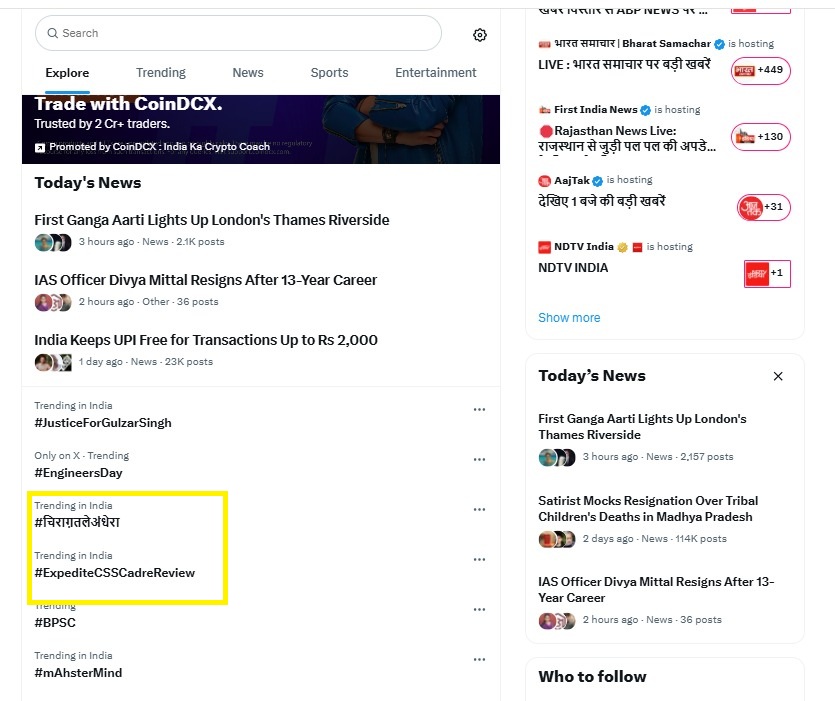
CSS officers have raised their voice—and the issue is now TRENDING on X in India! 📢🔥
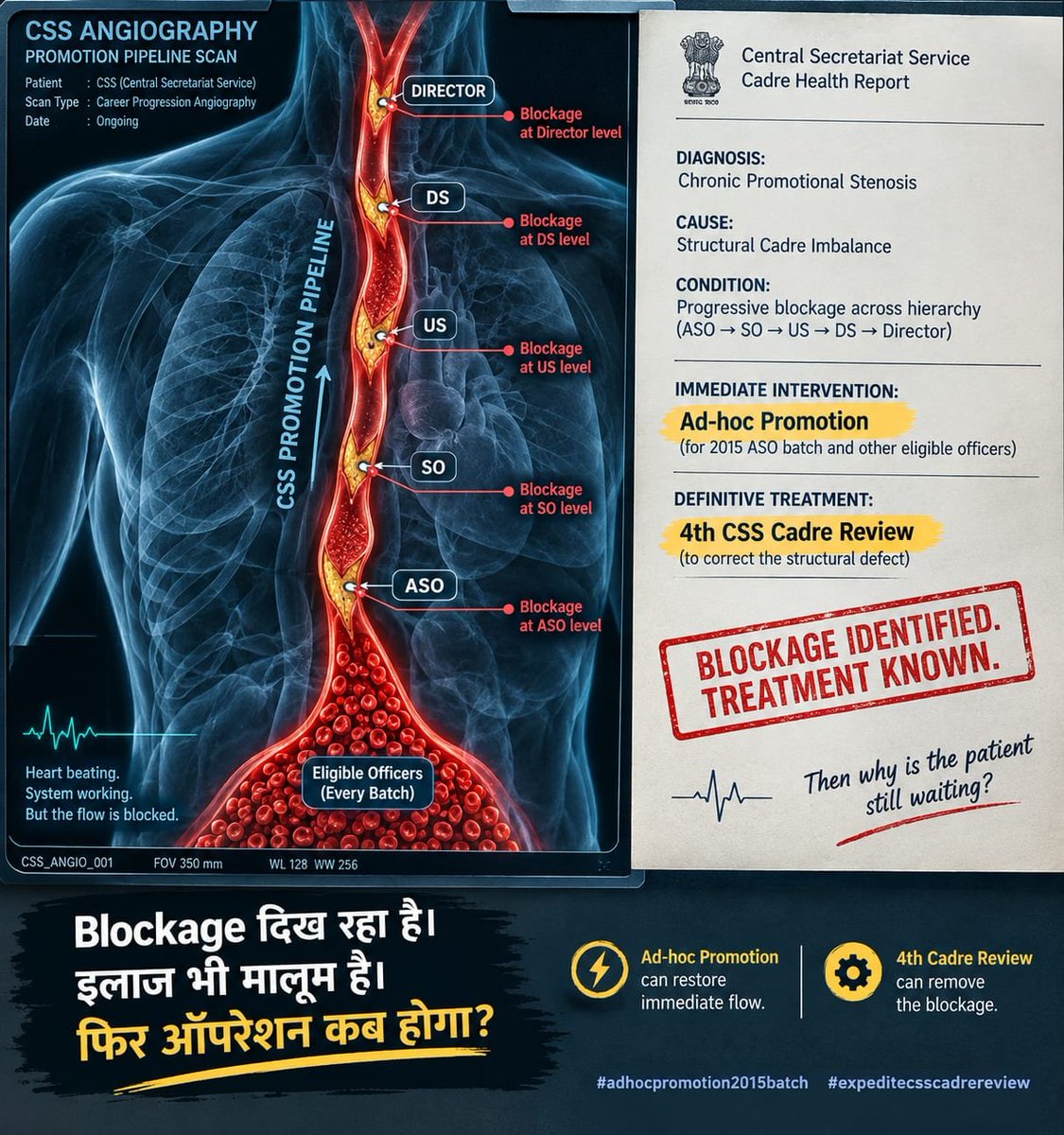
Officers came together on social media to highlight the 8-year delay in the 4th CSS Cadre Review.
When those who help light the way for others are left in the dark, it truly is “चिराग़ तले अंधेरा।”
We now urge the Government to act and complete the 4th CSS Cadre Review urgently.
@PMOIndia@DoPTGoI@DrJitendraSingh
#ExpediteCSSCadreReview #चिरागतलेअंधेरा