The US job market is sending conflicting signals:
US hiring rate fell -0.3 percentage points in April, to 3.2%, the 2nd-lowest since the 2020 pandemic low and in-line with 2008 levels.
This metric has now been at or below 3.5% for 26 consecutive months.
Excluding the government sector, the private hiring rate declined -0.4 percentage points in April, to 3.5%, in-line with the 2020 low.
Both figures are also significantly below the 2001 recession levels.
Meanwhile, JOLTs and the May jobs report both crushed expectations.
Despite the bullish numbers, US hiring remains historically depressed.
i used to say programming was creative work
except LLMs are fine at programming and are literal 0s for more obviously creative work
i think we mistook enumerating a lot of possibilities and picking one for being creative
Claude Fable 5 is by far the most ridiculous model that makes me genuinely afraid for the future of software engineering.
I compiled the top 10 most unbelievable things I've seen Claude Fable 5 do today:
— Migrate a 50M line codebase from Stripe in a day (humans take 2mos)
— Draw amazing 3D graphics a) Boeing 747 b) space simulations with >5000 objects c) Minecraft roller coasters d) full photorealistic forest scenes e) NYC skyline f) stormy clouds)
— One-shot Pokemon FireRed the game
— Optimize a real world proprietary interaction net evaluator 10x more than the next best model, gpt5.5
AND it's about the same price as GPT 5.5 ($10/M input, $45/M output) vs Fable 5 ($10/M input, $50/M output) and 6x cheaper than GPT 5.5 Pro.
Claude Fable 5 is now available in Devin.
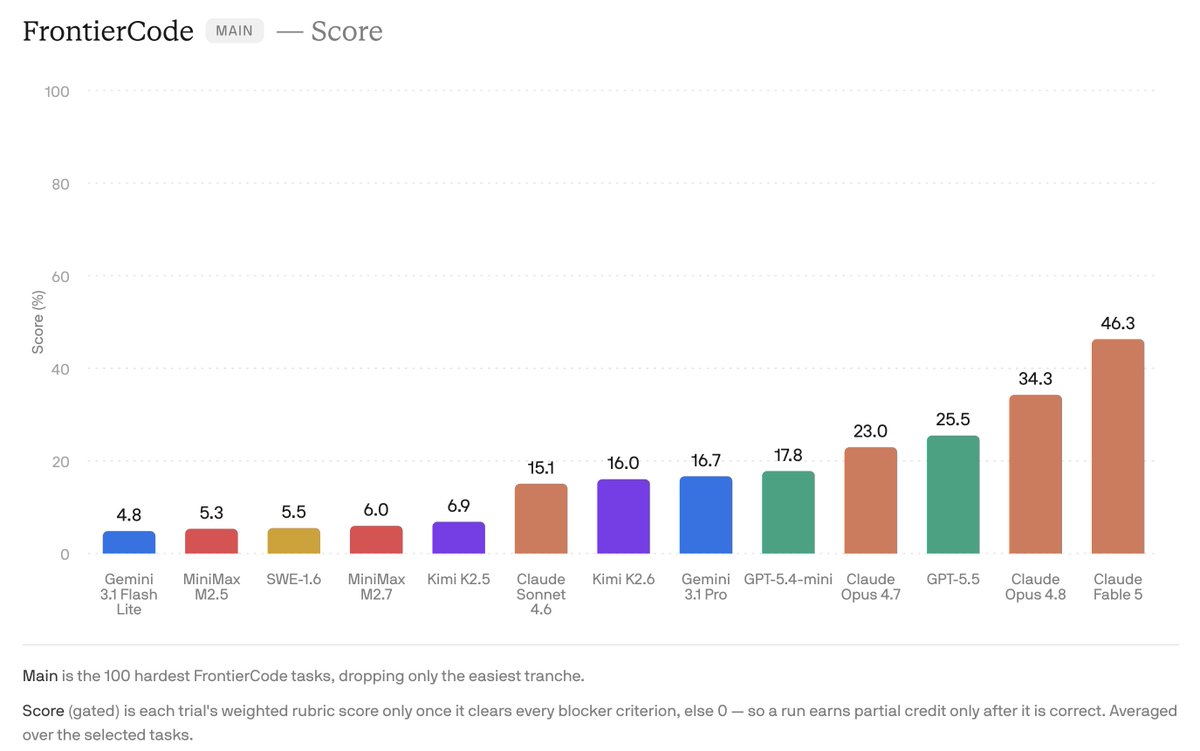
Fable 5 earns the #1 spot on FrontierCode, our benchmark for real-world engineering tasks that grades mergeability and quality:
This is a super exciting release - Claude Fable 5 is the same underlying model as Mythos but with added safeguards. The benchmarks are great and it's SOTA on everything by a margin but I'll add that *qualitatively* also, this is a major-version-bump-deserving step change forward (imo of the same order as Claude 4.5 was in November), peaking especially for long problem-solving sessions on very difficult problems. You can give it a lot more ambitious tasks than what you're used to, the model "gets it" and it will just go, and it's never felt this tempting to stop looking at the code at all (but don't do this in prod!). The model still has quirks that people will run into and the safeguards are configured to be a little too trigger happy for launch, which can hopefully be tuned over time.
I feel a lot of things changing as working software increasingly comes out on a tap. The Jevon's paradox kicks in and I feel my own demand for software growing substantially. You can ask for anything - explainers, visualizers, dashboards, bespoke single-use apps (e.g. a full wandb that is hyper-specific just for your project), you can 10X your test suite, auto-optimize code, run giant research projects with custom HTML for the results, anything! "Free your mind" (Matrix ref). Really looking forward to all the things people build!
Gemini 3.5 Live Translate has rolled out in the Google Translate app globally on @Android and iOS.
To try it, just tap “Live translate” in the Google Translate app and connect any pair of headphones to experience a more seamless translation across 70+ languages.
@Android users, we're also rolling out a new “listening mode” that lets you hear translations directly through your phone’s earpiece – without headphones. Just hold your phone to your ear like a regular phone call, and the translated audio streams straight to you. 📲 💬
SWE-bench makes it seem like we already basically solved coding (everyone 50+%)
FrontierCode shows how much room we still have left (nobody beats 13.4%)
The US job market is experiencing a historic divergence:
US information technology employment has declined -11%, since the launch of ChatGPT in November 2022.
During this period, the tech sector has shed -332,000 jobs, down to 2.78 million.
At the same time, private education and health service employment has risen +13%, to an all-time high.
This comes as the sector has added +3.16 million jobs.
As a result, technology employment is now below pre-pandemic levels seen between 2017 and 2019.
AI remains a key force transforming labor market conditions.