OpenAI recently released a guide on building agents which contains some misguided takes
There's a lot of FUD, confusion, hype, and noise around agents
I wrote a blog on how to think about agent frameworks. Includes:
Background Info
- What is an agent?
- What is hard about building agents?
- What is LangGraph?
Flavors of agentic frameworks
- “Agents” vs “workflows”
- Declarative vs non-declarative
- Agent abstractions
- Multi agent
Common Questions
- What is the value of a framework?
- As the models get better, will everything become agents instead of workflows?
- What did OpenAI get wrong in their take?
- How do all the agent frameworks compare?
"12 Factor Agents - Principles for building reliable LLM applications"
Great piece from @dexhorthy. A lot of the principles really resonate with LangGraph ethos. Would people be interested in a blog on how LangGraph enables these?
#2: Own your prompts (no hidden prompts in LangGraph)
#3: Own your context windows (in LangGraph you control exactly what goes into LLM!)
#5: Unify execution state and business state (we invested a lot in a production-ready persistence layer)
#6: Launch/Pause/Resume with simple APIs (this persistence layer enables these interaction patterns)
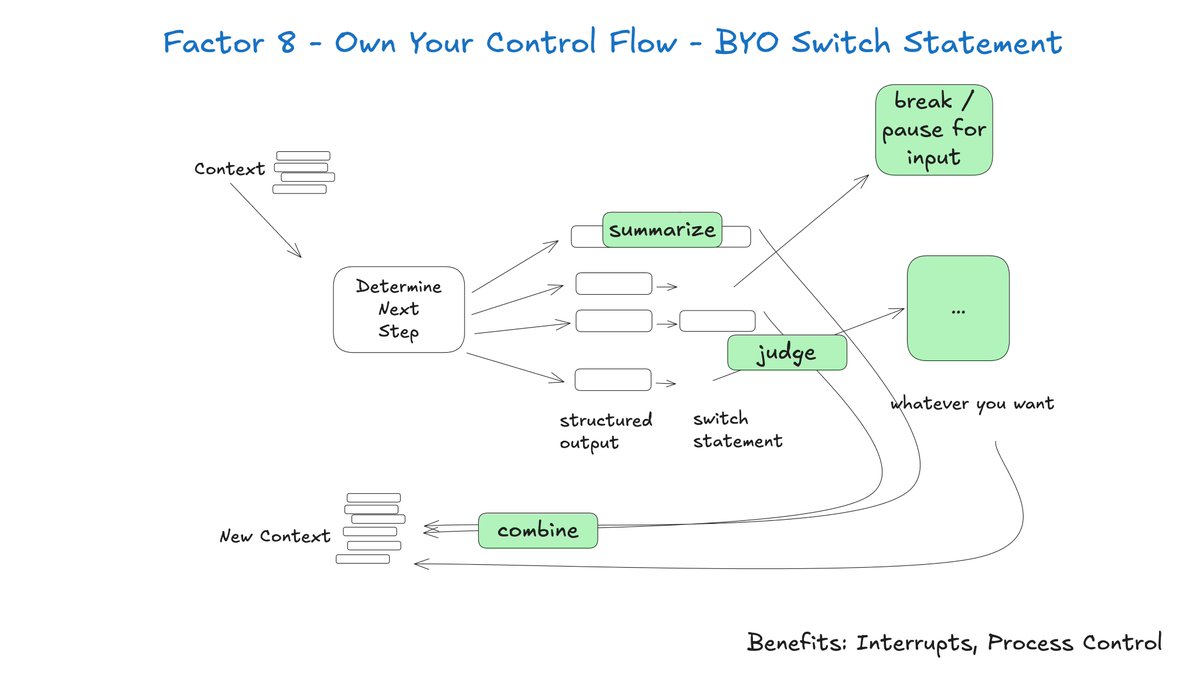
#8: Own your control flow (this is literally exactly the motivating reason for LangGraph)
#10: Small, focused agents (subgraphs!)