@_MWAURA_ I've noticed that the poor like to use all types of excuses to level with the rich. I am not rich , not yet. But we need to stop trying to level with Rich people. Oh they got drug problems, they will die too, they get sick too. That's what we try and convince ourselves. However,
You will always find Kenyans doing the most random things in the most random places.
What do you mean the Head of recruiting at OpenAI is called Liz Wamai and went to Moi University
The most common excuses for no distribution:
-> We're not ready
-> We don't have time
-> We are so heads down
-> We don't know where to start
-> We're busy building & creating
The most common excuse for failure:
-> Lack of distribution
In my lifetime, China lifted 850 million people out of poverty, while the US created one trillionaire. It is clear as day that socialism is the key to our future.
Google just dropped a guide on how to rank in AI Overviews and AI Mode. 🚨🚨🚨
I read the whole thing. Here's what i found:
AI optimization IS SEO. There's no separate playbook. AI Overviews run on the same core ranking systems as regular Google Search. You don't need a new strategy. You need to do SEO better.
Google says write from experience. Stop publishing generic "best of" posts that 50 other sites already wrote. Write things only YOU can write because you've done the work. They call everything else commodity content.
They say don't mass produce pages for every keyword variation. They're calling it "scaled content abuse" now.
Stay indexed. Google won't show pages in AI Overviews that aren't in the index. Sounds basic. But if you're invisible in AI results check your index status before you do anything else.
Add photos and video. AI Overviews pull visuals directly. Job site photos. Team photos. Process videos. Most of your competitors aren't doing this. Free advantage.
Use your Google Business Profile. Local info and products from GBP show up directly in AI responses.
New one. Prepare for AI agents. Browser agents are now reading your site's DOM and accessibility trees.
Now here's the part Google won't tell you.
Some of the things they say NOT to do still work. Listicles. Fan-out query pages. Scaled content done the right way. I still do it because it drives results.
Google publishes GUIDELINES. Not rules. Learn what they're telling you. Then play the game YOUR way.
AEO was supposed to replace SEO.
That premise only worked if Google lost.
The whole narrative was built on ChatGPT and others eating into Google's dominance.
This isn't a ranking update. It's the end of clicking entirely. AI Overviews. AI Mode. Agents searching for your customers before they ever reach your site. The brands winning the next decade aren't optimizing links, they're controlling the narrative AI builds around them.
#FutureOfSEO #AIMarketing #GoogleSearch
I came across a theory that AI is starting to make more mistakes because the internet is increasingly polluted with AI slop. The idea of AI cannibalising itself into obscurity is one of my favourite things ever. I hope it is true and I hope it becomes impossible to fix.
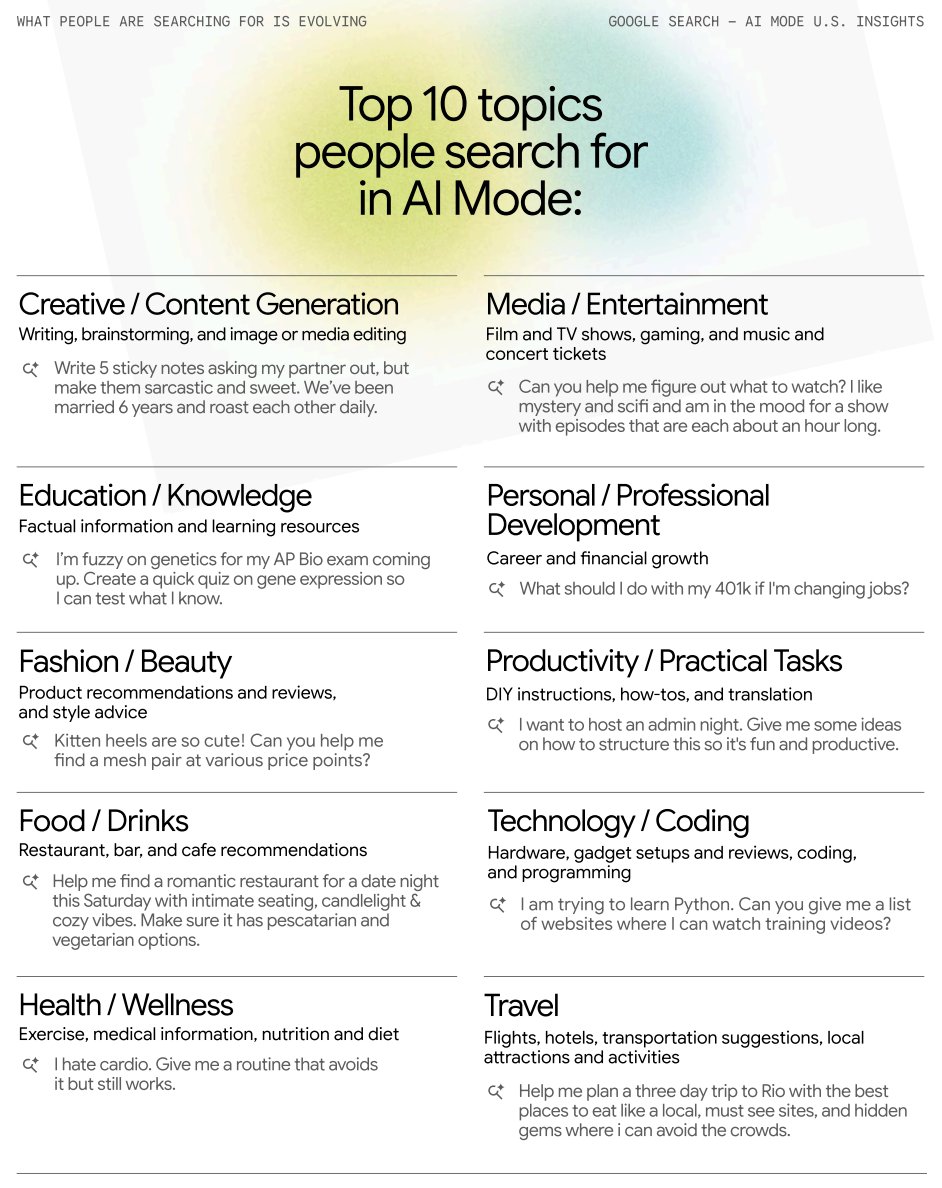
📊 Google just shared a new report on how people are using AI Mode in the US. 👇
Useful directional insights, yes. Complete market picture, no: The keyword data comes from sampled Google Trends data for AI Mode.
With that in mind, a few patterns worth paying attention to:
🔎 Searches are longer and more conversational.
The average AI Mode query is 3x the length of a traditional Search query. Keyword research now needs to be complemented with prompt, task, constraint and scenario research.
💬 Follow-up behavior matters.
Follow-up queries grew 40%+ on average per month. Brand visibility can't be analyzed only at the first prompt anymore: a brand might be mentioned, dropped, compared, misrepresented or never cited across the journey.
This means the unit of analysis is the journey, not the query.
🛍️ AI Mode is being used to decide, not only to discover.
* Which" queries grew 40% faster than AI Mode queries overall in the past six months.
* The top retail attributes people look for: price, location, color, brand, availability, size, material, style, type, quality.
This means Ecommerce AI Search optimization shouldn't be only about "more product content": it's accurate, complete, fresh and consistent product data across pages, structured data, feeds, variants, reviews and attributes.
📍 Local and availability intent is very visible.
Follow-up store queries include "near me", "in stock", "replacement parts", "car dealerships with financing".
AI systems need to understand location, inventory, services and constraints to satisfy these.
🧭 AI Mode is becoming a task layer, not only an answer layer.
Planning queries grew 80% faster than AI Mode queries overall. The opportunity is to be included in plans, shortlists, comparisons and workflows, not only ranked for individual queries.
👀 My takeaway:
Don't confuse Google's usage narrative with independent performance data. There's a behavioral shift and Google has every incentive to frame it favorably for its own ecosystem.
For SEOs and marketers, the practical next step isn't to replace SEO fundamentals. It's to expand how we research, optimize and measure:
✅ From keywords to prompts, tasks and constraints
✅ From rankings to presence, citations and representation accuracy
✅ From single queries to follow-up journeys
✅ From content-only optimization to entity, product, local and feed-level readiness
✅ From observed traffic to a more nuanced view of visibility and influence
AI Mode makes it increasingly risky to measure search visibility only through traditional rankings and clicks.
Read the full report in: https://t.co/JeBmLePG7Q
@kitonyo_john@Adele_lide Are you okay!? Ati they haven’t paid enough taxes! What do you mean babu atatoa wapi pesa. What was he campaigning for ? To take a seat and not improve his constituency. Basically blame everyone else but not take accountability as the leader? You really are high on sth!