Guy in the video could have asked "why doesn’t Amazon pay warehouse workers more?" But that doesn’t sound too smart, so he asked "why doesn’t Amazon pay warehouse workers in equity?" Except that’s not a smarter question.
If Amazon is going to give its employees an extra $5k, why make the people who supply labor bear the risks of company ownership? If the company gets into trouble and reduces its workforce, and warehouse employees have a significant portion of their savings in Amazon stock, they would lose their jobs and see their savings decline at the moment they need them most.
Workers would be better off receiving predictable compensation and investing their savings in a more diversified portfolio. The reason this gentleman thinks $5k in stock is better than $5k in cash is that he himself has unquestioning faith in the future success of Amazon -- the very company whose decisions he claims to hate.
Yikes. I think this guy owned Kevin O'Leary. Kevin did not do well explaining basic supply and demand. Though there is something to be said for stabilizing society by not creating paupers. Equity is a great way to do that.
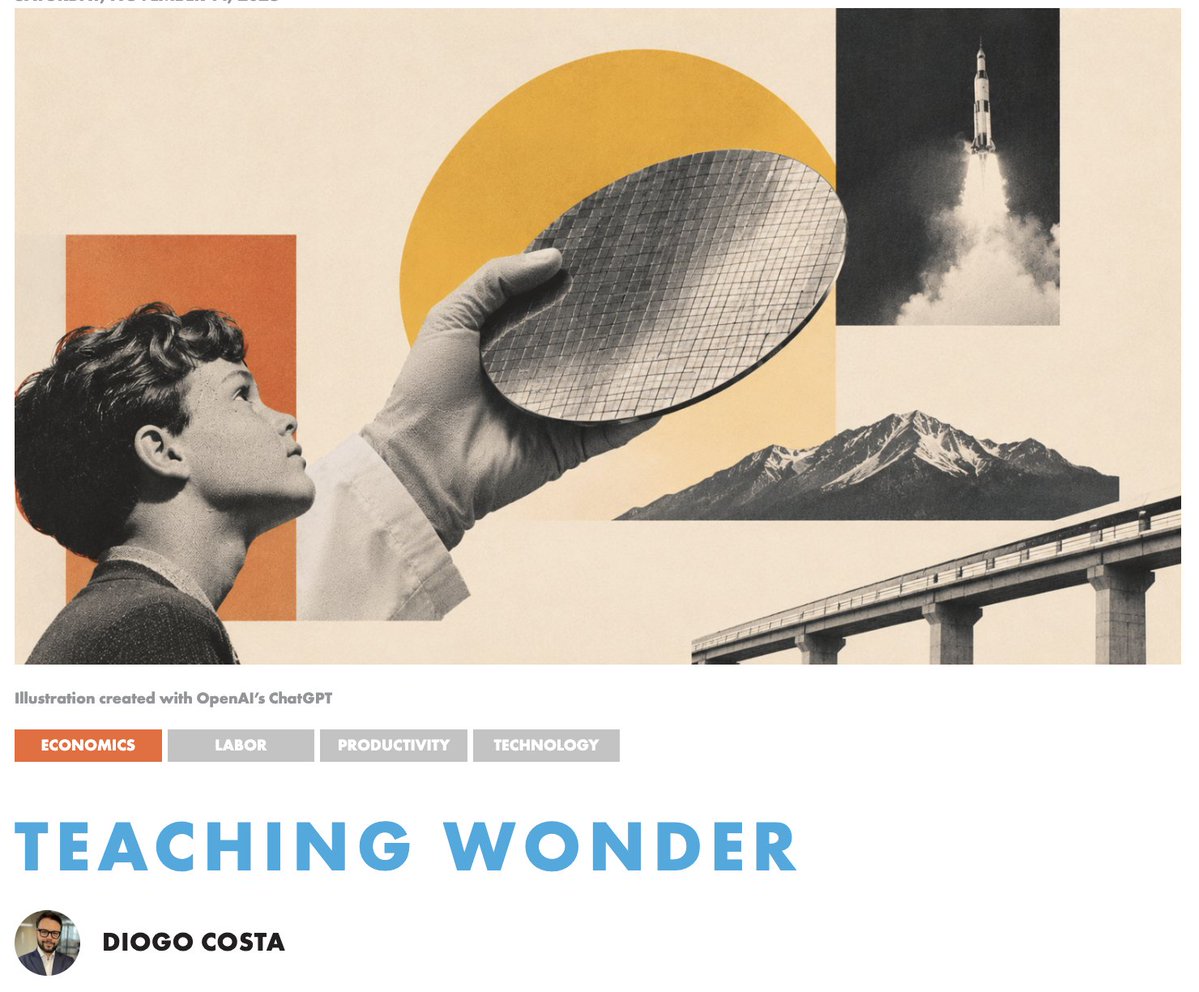
"Microchips are generating plenty of drama these days: extramarital affairs, geopolitical intrigue, plunging stock prices, leadership transitions. But perhaps we should step away from the news cycle for a moment and look at the tiny protagonist beneath all that human drama: the microchip itself.
Last month, The New Yorker published a brilliant essay by Gideon Lewis-Kraus titled “Computer Chips Are the Most Magnificent Things Humanity Has Ever Made.” He opens by comparing the semiconductor supply chain to some of humanity’s greatest achievements: the pyramids of Giza, Machu Picchu, the Great Wall of China, the Roman aqueducts."
- @dgrcosta
A própria campanha informa que os executores das ações no Ceará são Greenpeace Brasil e Terramar: https://t.co/7pYs1l1fbR
E trilha dos recursos é pública. 66% da receita do Greenpeace Brasil veio do Greenpeace International em 2024 e o Greenpeace Alemanha é o maior contribuinte nacional. O Terramar tem apoio documentado de RLS e Brot, assim como atuação documentada com a Böll nessa agenda.
O que falta é detalhamento de quem bancou especificamente campanha e caminhão.
Os dois principais executores da campanha são Terramar e Greenpeace Brasil. O Terramar recebe apoio da Rosa Luxemburg Stiftung, a fundação do Die Linke alemão, e da Brot für die Welt, agência das igrejas protestantes alemãs. A Heinrich Böll Stiftung, ligada aos Verdes alemães, também é parceira do Terramar na agenda de IA e data centers.
RLS e HBS são financiadas quase inteiramente por recursos públicos alemães. A Brot tb recebe mais da metade da receita do governo alemão, principalmente do BMZ, a USAID alemã.
Já o Greenpeace Brasil recebeu mais da metade da sua receita do Greenpeace International. E o maior financiador do Greenpeace International é o Greenpeace Alemanha.
I'm very pleased to see that 𝘛𝘩𝘦 𝘎𝘳𝘪𝘮 𝘖𝘭𝘥 𝘋𝘢𝘺𝘴 is now Amazon's #1 New Release in the category of "Historical Study"—a category where the overall best seller is typically Howard Zinn's 𝘈 𝘗𝘦𝘰𝘱𝘭𝘦'𝘴 𝘏𝘪𝘴𝘵𝘰𝘳𝘺 𝘰𝘧 𝘵𝘩𝘦 𝘜𝘯𝘪𝘵𝘦𝘥 𝘚𝘵𝘢𝘵𝘦𝘴. Zinn famously argues that the effect of the Industrial Revolution was that “the rich got richer and the poor got poorer.” 𝘛𝘩𝘦 𝘎𝘳𝘪𝘮 𝘖𝘭𝘥 𝘋𝘢𝘺𝘴 challenges that narrative.
I am honored and thrilled to see this review of 𝘛𝘩𝘦 𝘎𝘳𝘪𝘮 𝘖𝘭𝘥 𝘋𝘢𝘺𝘴 in @TheEconomist, which calls the book a "rip-roaring rebuttal of the idea that progress is a myth" and a "splendid corrective" to rose-colored views of the past.
@dgrcosta love the atlas! the fun part of tiny barcelona is that anyone can edit it: you build something on the map and the best builds get likes ❤️ https://t.co/pCzssTgf7F
I see people I respect sharing this with some admiration. I'm sorry, but "politics is downstream of culture" is a very impoverished reading of Gramsci.
Cultural influence is not hegemony. Gramscian hegemony is about turning a particular vision of the social order into a broadly accepted conception of the common good. Much of what the American right has done is pursue a kind of negative counter-hegemony. They have succeeded in challenging the legitimacy of the existing cultural establishment, but a strategy of positive hegemony means building alternative institutions (or transforming existing ones) around a set of values and social arrangements that people come to see as legitimate, desirable and commonsensical.
If you want to see a more successful example of the latter, look at Brazil's Workers' Party, which explicitly described its own political strategy in the 1980s as a struggle for hegemony. Lula and the PT have exerted such a dominance over Brazilian cultural life, that they have won public support even from the international cultural establishment.
I'm not saying the American right hasn't read or been inspired by Gramsci. I'm saying this conversation seems to be reducing Gramscianism to cultural warfare, when it's fundamentally about building a new social order.
I’ve never seen this happen in a Buttigieg interview before.
Patrick Bet David brings up Pete’s late father’s work translating Antonio Gramsci.
Pete turns it around onto the American political right.
I've been enjoying exploring isometric cities, so I put together a little atlas to aggregate all of these projects in one place: https://t.co/8rThQw55vU
So far, there are 87 isometric maps, 61 places, and 30 countries, all on one isometric Earth.
IN 3 DAYS.✨️
Gen Z grew up expecting a future of steady progress. That promise looks very different today. But is this a generational crisis, or are we missing something?
From Kyla Scanlon’s argument that predictable progress has ended to Morgan Housel’s more optimistic take, the debate is far from settled.
Join @interintellect and @feeonline in Manhattan to discuss what we get wrong about Gen Z, with @krishnanrohit, @AllisonSchrager, @FOMO_sacer, @Abi0lvera, @JosefiinaIda and @ReemAmirIbrahim. Moderated by @dgrcosta and @theannagat.
https://t.co/WecKjyIjGe
What does it mean to come of age when the economic and cultural assumptions of the past no longer hold? From ambition and money to faith and identity, Gen Z is challenging ideas that once seemed settled.
Join @interintellect and @feeonline in Manhattan for an evening of debate and discussion featuring @krishnanrohit, @AllisonSchrager, @FOMO_sacer, @Abi0lvera, @JosefiinaIda, and @ReemAmirIbrahim, with @dgrcosta and @theannagat moderating.
A mini festival about understanding a generation on its own terms, not through the usual headlines.
https://t.co/WecKjyIjGe
The more complex the modern world becomes, the more we need great writing to help us recognize just how extraordinary our ordinary lives are.
Gideon Lewis-Kraus offers us this small masterpiece in the pages of The @NewYorker.
How has Brazil performed compared to the rest of Latin America since 2002?
Out of 16 countries, Brazil ranks:
10th in poverty reduction
12th in labor productivity growth
15th in real GDP per capita growth
The 14 countries weren’t handpicked. They’re every country with comparable data that overtook Brazil. The global baseline tells the same story. Real GDP per capita grew 40% in Brazil vs 67% worldwide in 2002-2025. Brazil fell below the world average in 2016.