I'm thrilled to report that our paper on using high-throughput metabolomics to identify novel potential TOR signaling genes is out! Thanks our collaborators, our reviewers, @Elife, and @reviewcommons for the parts they played! https://t.co/EQ3qFJul2q
This is a really interesting innovation in scientific publishing. I will be interested to see how eLife handles authors making big claims (to get reviewed) and then paring their claims back in revision to comport with reviewer comments... without rejection it's hard to police
Today, we’re introducing a new model that eliminates accept/reject decisions.
By publishing every paper with eLife reviews as a Reviewed Preprint, we plan to restore autonomy to authors, ensuring that they will be judged by what, not where, they publish. https://t.co/OAsiOVFStI
Is there any feeling better than finishing a major writing/editing project and getting back into data analysis? Also, is there any joy more fleeting since the feeling disappears as soon as you hit your first coding snag?
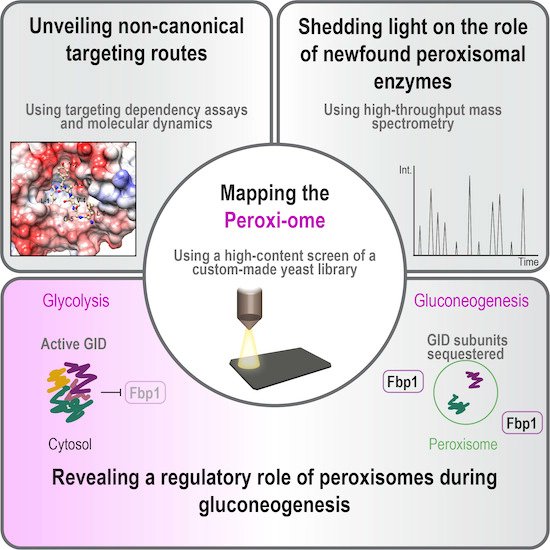
What proteins make up the peroxisomal proteome, how do they get in there, and what are their functional roles? You can find out in my recently published collaboration with the Maya Schuldiner group (and others) in @MolSystBiol!
https://t.co/12WdDsOujE
High-content imaging & whole-organellar proteome analyses reveal new players in yeast #peroxisome organization, targeting & function ➡️ https://t.co/wYIHxSrNsi
M Schuldiner @WeizmannScience
The Zampieri group offers multiple research opportunities for PhD candidates in the context of systems pharmacology, cancer and microbiology, computational biology and metabolic regulation. Check them out here: https://t.co/O7ed9UC5JX
How can we use high throughput metabolomics to uncover gene function? Check out our new preprint where we use dynamic metabolome profiling to uncover new potential TOR signaling genes in yeast
https://t.co/QNunJNdhS8
@lydfinley@Nature@paigearnold2@__btjackson@GSKGradSchool@MSKCancerCenter Really cool work! Based on the mild effect of mdh1 on the exit from pluripotency (Ext. Fig. 9), is it possible that the OAA to malate reaction (and getting malate back into TCA) is not important to this pathway the way ACLY or SLC25A1 is?
🥳 New paper out! 🥳
We found that Hfq interacts with different subsets of RNAs between strains of P. aeruginosa, hinting at a large intra-species variability in post-transcriptional regulatory networks.
in @NatureComms@inaattree@yakki97@pseudocap
https://t.co/4SLYNKfqjF
How do complex bacterial communities assemble in environments with one carbon source?
We tracked cross-feeding across members of a marine community to show that hierarchical preferences for substrates allow colonization by metabolically-diverse strains
https://t.co/WzUXTsWjUY
I'm happy to report that my new paper about predicting drug-target relationships in yeast using high-throughput metabolomics is out at MSB! Thanks to my co-authors for their roles in this project. https://t.co/VPbwwuXmCU
High-throughput metabolome profiling in yeast identifies new drug-target relationships --> https://t.co/SD6QcLlU7m from U Sauer @IMSB_ETH@ETH_en#metabolomics#DrugDiscovery