scientist. genetics researcher. Duke school of medicine prof & administrator. personal account. opinions here are my own, not my employer’s or anyone’s at Duke.
An adorable orphaned baby kangaroo in an Australian wildlife sanctuary was recorded clinging to a staff member’s leg until she was allowed back into her cloth pouch.
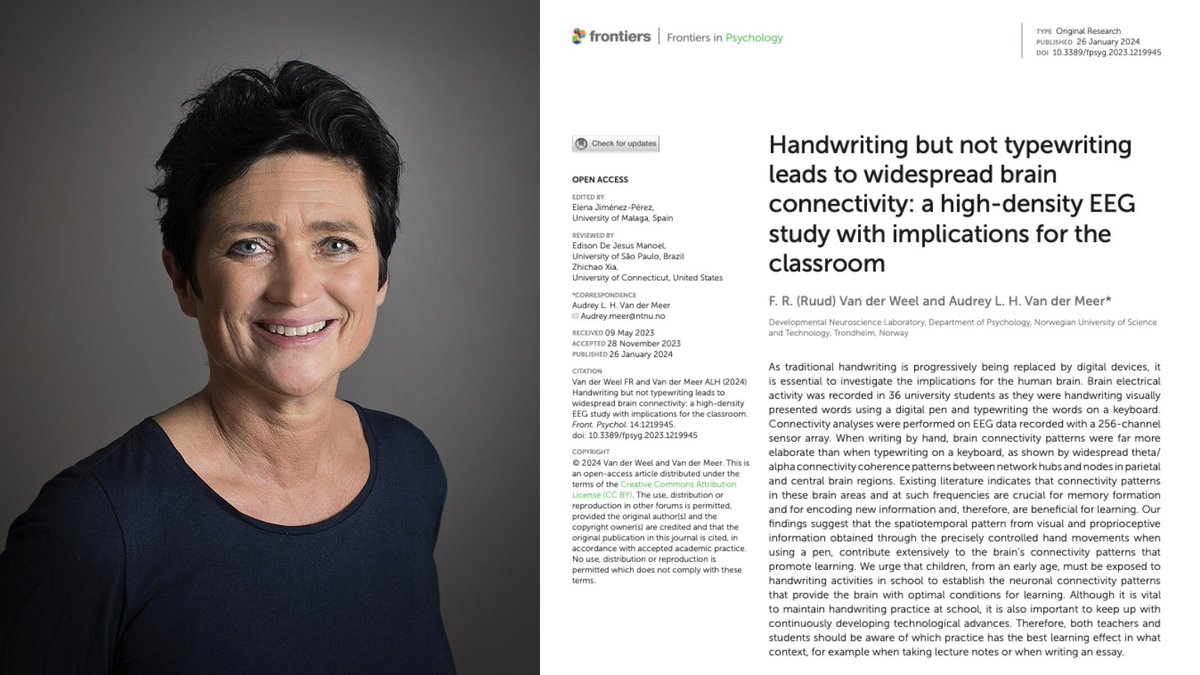
A Norwegian neuroscientist spent 20 years proving that the act of writing by hand changes the human brain in ways typing physically cannot, and almost nobody outside her field has read the paper.
Her name is Audrey van der Meer.
She runs a brain research lab in Trondheim, and the paper that closed the argument was published in 2024 in a journal called Frontiers in Psychology. The finding is brutal enough that it should have changed every classroom on Earth.
The experiment was simple. She recruited 36 university students and put each one in a cap with 256 sensors pressed against their scalp to record brain activity. Words flashed on a screen one at a time.
Sometimes the students wrote the word by hand on a touchscreen using a digital pen, and sometimes they typed the same word on a keyboard. Every neural response was recorded for the full five seconds the word stayed on screen.
Then her team looked at the part of the data most researchers had ignored for years, which is how different parts of the brain were communicating with each other during the task.
When the students wrote by hand, the brain lit up everywhere at once.
The regions responsible for memory, sensory integration, and the encoding of new information were all firing together in a coordinated pattern that spread across the entire cortex. The whole network was awake and connected.
When the same students typed the same word, that pattern collapsed almost completely.
Most of the brain went quiet, and the connections between regions that had been alive seconds earlier were nowhere to be found on the EEG.
Same word, same brain, same person, and two completely different neurological events.
The reason turned out to be something nobody had really paid attention to before her work. Writing by hand is not one motion but a sequence of thousands of tiny micro-movements coordinated with your eyes in real time, where each letter is a different shape that requires the brain to solve a slightly different spatial problem.
Your fingers, wrist, vision, and the parts of your brain that track position in space are all working together to produce one letter, then the next, then the next.
Typing throws all of that away. Every key on a keyboard requires the exact same finger motion regardless of which letter you are pressing, which means the brain has almost nothing to integrate and almost no problem to solve.
Van der Meer said it plainly in her interviews.
Pressing the same key with the same finger over and over does not stimulate the brain in any meaningful way, and she pointed out something that should scare every parent who handed their kid an iPad.
Children who learn to read and write on tablets often cannot tell letters like b and d apart, because they have never physically felt with their bodies what it takes to actually produce those letters on a page.
A decade before her, two researchers at Princeton ran the same fight using a completely different method and ended up at the same answer. Pam Mueller and Daniel Oppenheimer tested 327 students across three experiments, where half took notes on laptops with the internet disabled and half took notes by hand, before testing everyone on what they actually understood from the lectures they had watched.
The handwriting group won by a wide margin on every question that required real understanding rather than surface recall.
The reason was hiding in the transcripts of what the two groups had actually written down.
The laptop students typed almost word for word, capturing more total content but processing almost none of it as they went, while the handwriting students physically could not write fast enough to transcribe a lecture in real time, which forced them to listen carefully, decide what actually mattered, and put it in their own words on the page.
That single act of choosing what to keep was the learning itself, and the keyboard had quietly skipped the choosing and skipped the learning along with it.
Two studies. Two countries. Same answer.
Handwriting makes the brain work. Typing lets it coast.
Every note you have ever typed instead of written went into your brain through a thinner pipe. Every meeting, every book highlight, every idea you captured on your phone instead of on paper was processed at half depth.
You did not forget those things because your memory is bad. You forgot them because typing never woke the part of the brain that would have made them stick.
The fix is the thing your grandmother already knew.
Pick up a pen. Write the thing down. The slower road is the faster one.
For over 150 years, the Bodie Island Lighthouse in the Outer Banks of North Carolina and its powerful light beam have kept silent watch over the treacherous waters known as the “Graveyard of the Atlantic.”
Photo at Cape Hatteras National Seashore by Ethan Allen
The nine critically endangered American Red Wolf pups, born at our offsite facility on April 18, meeting their dad Fiddle. Both mom and dad Red Wolf parents share responsibility for raising the pups.
The pups will remain behind the scenes at our off-site Red Wolf facility. 🐾
☀️ Today in Utqiagvik (the northernmost city in the United States), the sun rose above the horizon at 2:57 AM and won’t set again for 84 straight days or until August 2nd! Here's a look at a timelapse showing the sunset and sunrise this morning. #akwx
When I was teaching at a high school in Alaska, we read Dostoyevsky's "Notes from Underground" together. Paragraph by paragraph. We spent six weeks on that one story.
Here's what paragraph-by-paragraph close reading actually looks like: I'd read a passage aloud. Then I'd ask, "What is the Underground Man really saying here?" Silence at first. Then someone would venture an interpretation. Someone else would push back. Within ten minutes, they'd be arguing about human nature, about pride and spite and self-deception.
People hear this and assume I was working with exceptional kids. I wasn't. I was working with kids who had never been asked to grapple with genuinely profound ideas before. In my experience, when you treat young people as capable of serious intellectual work, and take the time to train them how to read difficult texts, they learn how to do so.
Kids,
No one warns you that getting older mostly means deciding what to make with ground beef or chicken for the rest of your life.
Ok. Have a good night.
Science advocacy in action! 🧬 ASHG Board members met with lawmakers on Capitol Hill to push for strong FY27 research funding. With proposed cuts to NIH, NSF, and ARPA-H, you can add your voice from your state: complete the ASHG Action Alert 👉 https://t.co/ZBa93iCfoc
From the steeple of Old North Church in Boston, two lanterns signaled that British troops were on the move.
Paul Revere rode more than 12 miles, alerting a network of riders and local leaders who mobilized the militia at Lexington and Concord.
While several riders played roles that night, Revere’s swift warning became a symbol of American resistance and helped spark the first battles of the Revolutionary War. 🐎
Photo by Arlan Fonseca / NPS
In the basement of the White House, under the North Portico, is a fully functional flower shop, headed by the White House Chief Floral Designer and their staff. This team works tirelessly to provide fresh floral arrangements for the day-to-day activities of the White House as well as official events and State Dinners.
While flowers have been popular decor for many presidents, the role of White House Chief Floral Designer was formalized by First Lady Jacqueline Kennedy in the 1960s. She introduced a more natural and creative style, shifting away from the dense, dome shaped floral arrangements of the early twentieth century.
Today’s floral arrangements follow the style set by Mrs. Kennedy, with expressive arrangements frequently referencing the favorite flowers of the current first lady or important White House visitors. The arrangements are changed twice a week to keep them looking fresh.
Image: Official White House Photo by Joyce N. Boghosian
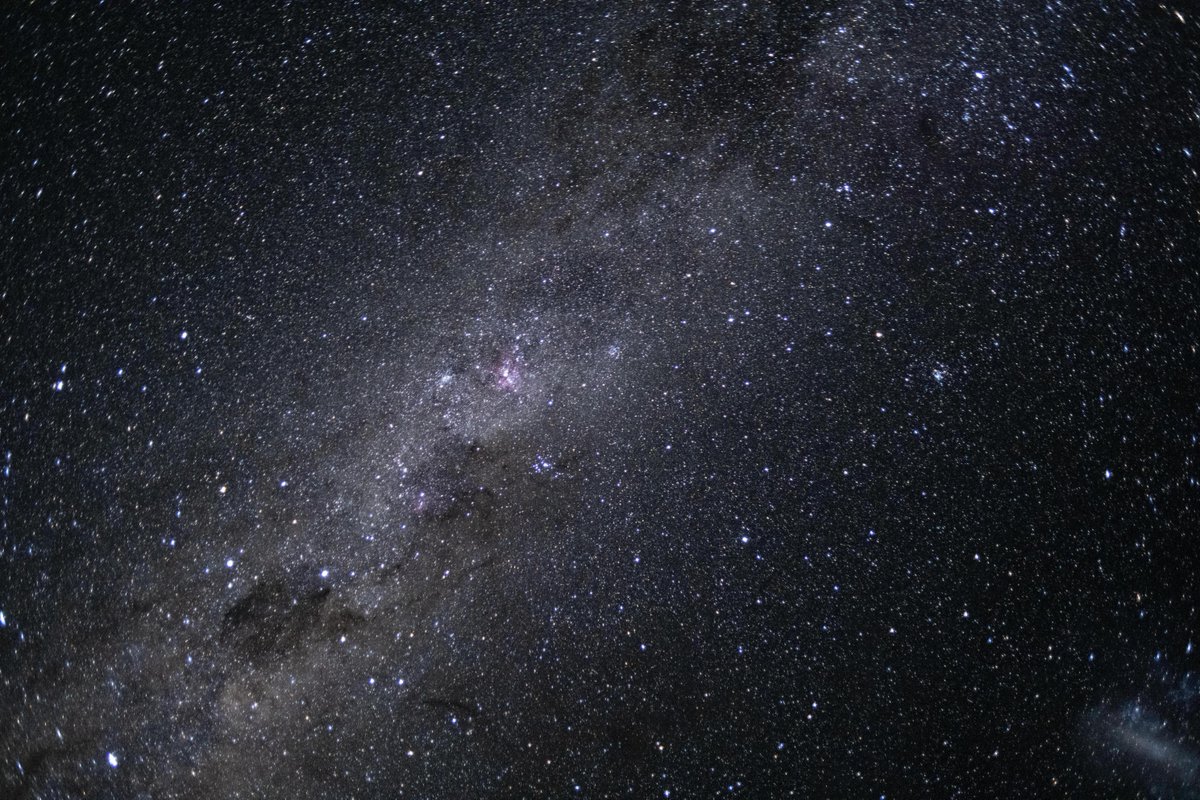
Sky full of stars.
Following a successful lunar flyby, the Artemis II astronauts captured this breathtaking photo of our galaxy, the Milky Way, on April 7, 2026.
Yosemite Valley is putting on a show right now.
As warmer temperatures melt snowpack at higher elevations, waterfalls and creeks are rushing with water.
Video by @YosemiteNPS