Welcome to Digital H Verse 🌐 The future of healthcare is here. We explore how AI, data, and digital tech transform health for all. #DigitalHealth#AIHealth
Published in Nature Medicine: @Google researchers and collaborators share lessons from prospective studies of AMIE, highlighting why real-world clinical evidence is critical to evaluating conversational AI in health.
Read more: https://t.co/vAKMGHioXM
I'm still fascinated by the EKO CORE 500 Digital Stethoscope. Whenever it to anyone, they are fascinated by its design, the ECG function and the AI analysis too.
This is the next step in the evolution of ECGs.
Imagine how physicians who have just graduated would feel using such a device and getting the right kind of experience and support in the early days of their medical practice. You never feel alone.
I reviewed the device here: https://t.co/JDtlgmHFLH
Andrej Karpathy spent 8 years at OpenAI and Tesla
Last week, he condensed everything he knows into one free 2-hour lecture
Agents → Loops → Harness → Self-Improving Systems
People pay $14K for bootcamps that teach less than this
This lecture beats most paid AI engineering courses
You probably don't have 2 hours right now
Don't let this disappear from your feed
Watch it
Then read the article below
Train medical robots where anatomy, physics, perception and policy meet.
NVIDIA Isaac for Healthcare introduces GPU-native medical physics simulation with:
🫀 Simulation-ready anatomical digital twins
⚙️ Device–tissue interaction modeling
🩻 X-ray, ultrasound and camera data paired with exact ground truth
⚡ Thousands of parallel simulation environments
🤖 Policy training and evaluation before a real robot moves
Explore the framework for surgical robotics, endoscopy, endovascular intervention and robotic ultrasound.
👇 https://t.co/7VfbeCfKGA
💬 Perspective by @ZekeEmanuel, MD, PhD, @AbeBakerButler, BA, @nealkhosla, MS, and @vkhosla, MS, MBA: For cognitive medical tasks, #AI alone may exceed physician-only and physician-AI hybrid care, raising policy questions about workflow, liability, regulation, reimbursement, and medical education.
https://t.co/g8lWbcGy8U
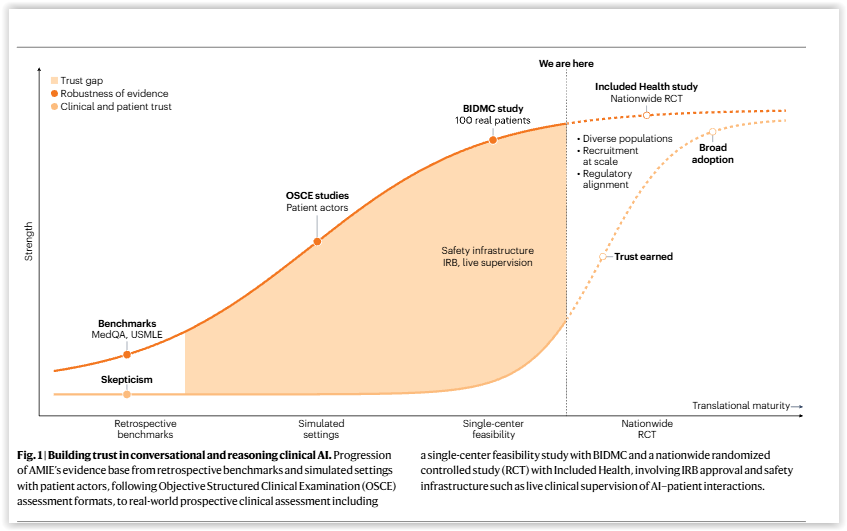
Google researchers published a commentary in Nature about why prospective studies are needed in healthcare AI to gain the trust of clinicians and patients.
The big orange-ish area that you see in the figure represents the current trust gap. It will only be narrowed and later filled in with prospective studies and clinical trials. Just like in the case of any medical advancement or technology.
"Trust in clinical artificial intelligence (AI) cannot be benchmarked into existence. It must be earned through rigorous prospective studies in real-world clinical settings, where the hardest lessons often concern the humans and systems around the AI, not the technology itself."
The full-text paper shared by one of the authors: https://t.co/4dOsH5EThq
⚡️ Healthcare AI moves faster when founders can pair breakthrough research with accelerated computing and production-ready infrastructure.
Join us alongside Google Cloud, Google Research, and leading healthcare VCs for a five-part virtual series built for digital health and biotech founders.
Check it out 👇
Agentic AI for support of medical decision making.
Not real world but some encouraging progress for future deployment @NatureMedicine@jnkath
https://t.co/3wzSb1lNa2
Google Engineers just drop free 2-hour course on Context Graph engineering:
1 prompt → 300 agents → loops → graphs from 0% to 100%:
10% → 17:44 - build your first agent
30% → 39:30 - Loop engineering: iterate, check, break
60% → 1:12:38 - Graph engineering
75% → 1:34:26 - agents that throttle themselves
100% → 1:55:05 - full graph for multi-agentic systems
Worth more than 10 paid cources on Context Graphs.
Watch it today, then read how to become a graph engineer in the article below.
If you want to learn how to engineer AI agents, these are the people you’d want to learn it from. They know the space inside and out and couldn’t be more excited to teach it. First time it’s running at Stanford this fall. @Diyi_Yang, @michaelryan207, @jyangballin
SpaceXAI engineer, Lauren Tan:
"GrokBot is the most powerful agentic tool we have ever shipped, but only 1% of users use it correctly|
at SpaceXAI, I'm running a team of 15+ GrokBot agents. I have a Chief of Staff agent, 3 managers and 11 workers - that's the new engineering setup in 2026"
In a 1-hour talk, a SpaceXAI engineer reveals how to get 100% of every agentic tool you are using
worth more than a $500 agentic course on the internet
skip Netflix and watch today, it will change the way you use GrokBot forever, then read the article below
Neoclouds have limited cybersecurity. Next time agents successfully go rouge, they'll try taking over a neocloud to run more copies. This is bad.
Thus: neoclouds should greatly strengthen their cybersecurity and every company with strong cyber models should help with that.
I'm so excited that our @theworldlabs team has achieved a major milestone today! Introducing Atlas - a first of its kind multimodal world model trained from scratch! 🚀
Atlas is capable of generating frames with pixel-perfect camera control, reconstructing large scenes from as few as one single input image, simulating space-time by reframing videos, natively outputting 3D spaces from one or more input images, composing multiple posed images into a consistent 3d world, and more! This is the best camera conditioned world model ever, opening doors to many possible use cases from VFX to robotics. I'm so so so proud of our team!♥️
this Anthropic engineer's take on prompting is unreal
"you're not supposed to prompt Claude, you're supposed to build a system that prompts itself"
in 45 minutes she shows exactly how Anthropic builds agents that remember, fix their own mistakes and get smarter with every run
this beats any paid course on agents I've seen
save this and read the guide on building loops below
The basis for early-onset colon cancer, now showing up throughout the world, is poorly understood. The Table below is the ranking of countries affected. This new review gets at the potential causes and what needs to be done.
https://t.co/d7Nsludvez
Introducing the planetary prediction engine (PPE), an experimental research capability within Google Earth AI.
From tracking real-time public health disease outbreaks to forecasting regional food security, PPE matched or improved performance across geospatial prediction tasks.
Three of our scientists designed a new CAR-T cancer therapy in a matter of months. In preclinical testing, it outperformed a leading therapy used in patients today.
CAR-T reprograms a patient's own immune cells to hunt cancer. Designing one normally takes years and enormous cost.
The difference is what the AI learned from. Not published papers alone, but hundreds of thousands of data points generated from our in-house wetlab runs. Real experimental data, including everything that didn't work.
We're building the superintelligence that takes a scientist from idea to therapy faster than has ever been possible. https://t.co/PJTu0iFTAP