How can we reduce the deploy cost of LLMs by 100x?
From GPUs to MLSys, from MoEs to Speculative Decoding, in this blog post, we give a full-stack examination of transformer inference optimization
https://t.co/dxhsc6bKnJ
Multimodality can be achieved without any training, just by treating image representations **as if** they were text representations.
What??
Let me explain live to you in #NeurIPS2023 Tue 12 Dec at 10:45 a.m. poster session!
Or keep reading. 🧵
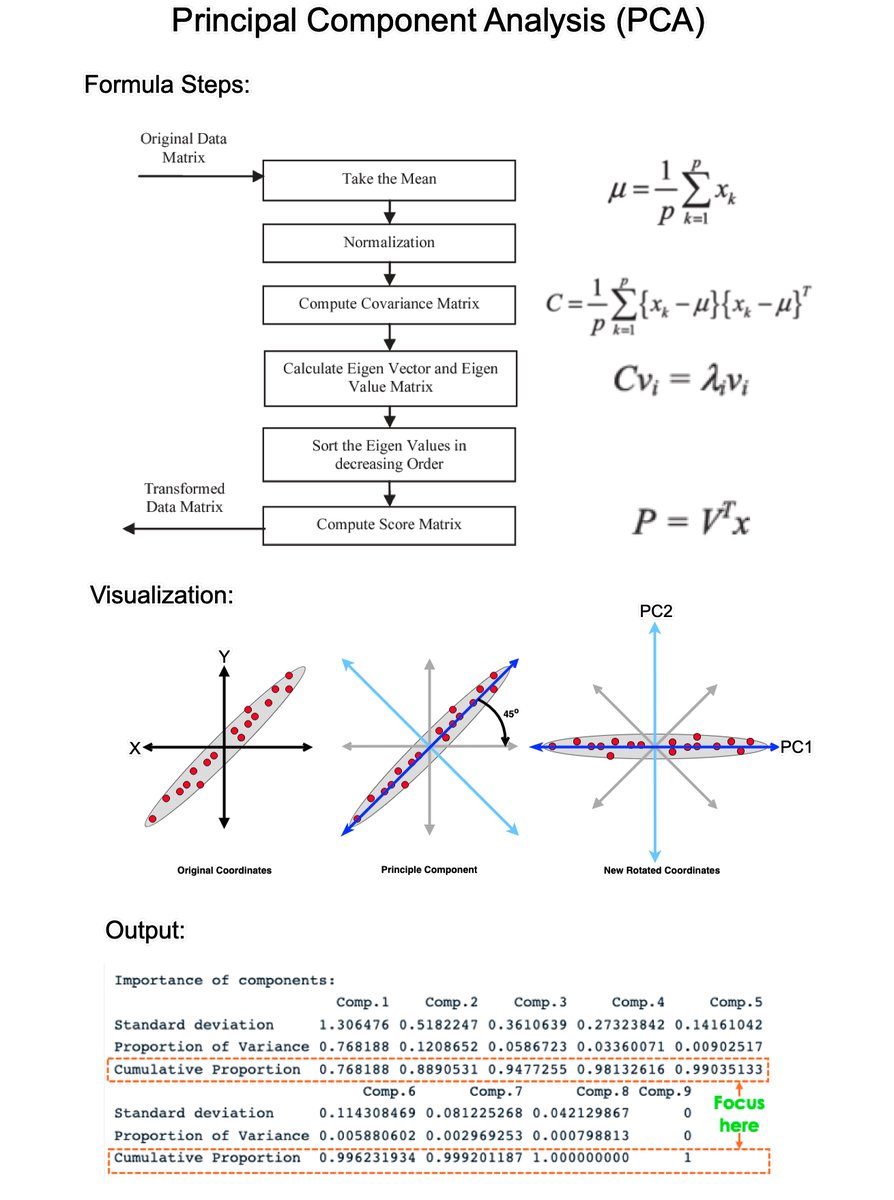
Principal Component Analysis (PCA) is the gold standard in dimensionality reduction with uses in business. In 5 minutes, I'll teach you what took me 5 weeks. Let's go!
1. What is PCA?: PCA is a statistical technique used in data analysis, mainly for dimensionality reduction. It's beneficial when dealing with large datasets with many variables, and it helps simplify the data's complexity while retaining as much variability as possible.
2. How PCA Works: PCA has 5 steps; Standardization, Covariance Matrix Computation, Eigen Vector Calculation, Choosing Principal Components, and Transforming the data.
3. Standardization: The first step in PCA is to standardize the data. Since the scale of the data influences PCA, standardizing the data (giving it mean of 0 and variance of 1) ensures that the analysis is not biased towards variables with greater magnitude.
4. Covariance Matrix Computation: PCA looks at the variance and the covariance of the data. Variance is a measure of the variability of a single feature, and covariance is a measure of how much two features change together. The covariance matrix is a table where each element represents the covariance between two features.
5. Eigenvalue and Eigenvector Calculation: From the covariance matrix, eigenvalues and eigenvectors are calculated. Eigenvectors are the directions of the axes where there is the most variance (i.e., the principal components), and eigenvalues are coefficients attached to eigenvectors that give the amount of variance carried in each Principal Component.
6. Choosing Principal Components: The eigenvectors are sorted by their eigenvalues in descending order. This gives the components in order of significance. Here, you decide how many principal components to keep. This is often based on the cumulative explained variance ratio, which is the amount of variance explained by each of the selected components.
7. Transforming Data: Finally, the original data is projected onto the principal components (eigenvectors) to transform the data into a new space. This results in a new dataset where the variables are uncorrelated and where the first few variables retain most of the variability of the original data.
8. Evaluation: Each PCA component accounts for a certain amount of the total variance in a dataset. The cumulative proportion of variance explained is just the cumulative sum of each PCA's variance explained. Often this is plotted on a Scree plot with Top N PCA components.
====
Ready to learn Data Science for Business?
I put together a free on-demand workshop that covers the 10 skills that helped me make the transition to Data Scientist: https://t.co/6Ji4GtOTzy
And if you'd like to speed it up, I have a live workshop next week where I'll share how to use ChatGPT for Data Science: https://t.co/Ydsmzv7trP
If you like this post, please reshare ♻️ it so others can get value.
You've only reached One True Geek once you have:
* At least 5 Pi doing nothing
* One connected to your network that stops everything working when you unplug it
* One showing up on your network but you can't find it
Here is my first CPU, which I developed with trial and error without much knowledge. And then I decided to take an edX course in computer architecture by Harris, to transform my empirical knowledge into formal knowledge. And had started a reimplementation.
https://t.co/meMG1iWzJk
While claiming to protect European values and human rights, the EU is gradually installing or enabling a level of mass surveillance that we so proudly denounce in other states. 4/4
Ever wondered which data black-box LLMs like GPT are pretrained on? 🤔
We build a benchmark WikiMIA and develop Min-K% Prob 🕵️, a method for detecting undisclosed pretraining data from LLMs (relying solely on output probs).
Check out our project: https://t.co/XBWfX0SjK5
[1/n]
finally published our latest research on text embeddings!
TLDR: Vector databases are NOT safe. 😳 Text embeddings can be inverted. We can do this exactly for sentence-length inputs and get very close with paragraphs...
Large Language Models Are Zero-Shot Time Series Forecasters
abs: https://t.co/aVDZ1sD4FT
code: https://t.co/1AwskkzjrS
Introduces LLMTime, a simple method to apply pretrained LLMs for continuous time series prediction problems. Main trick is to ensure each digit is tokenized (by adding spaces between digits for example). Their approach obtains SOTA on various benchmarks.
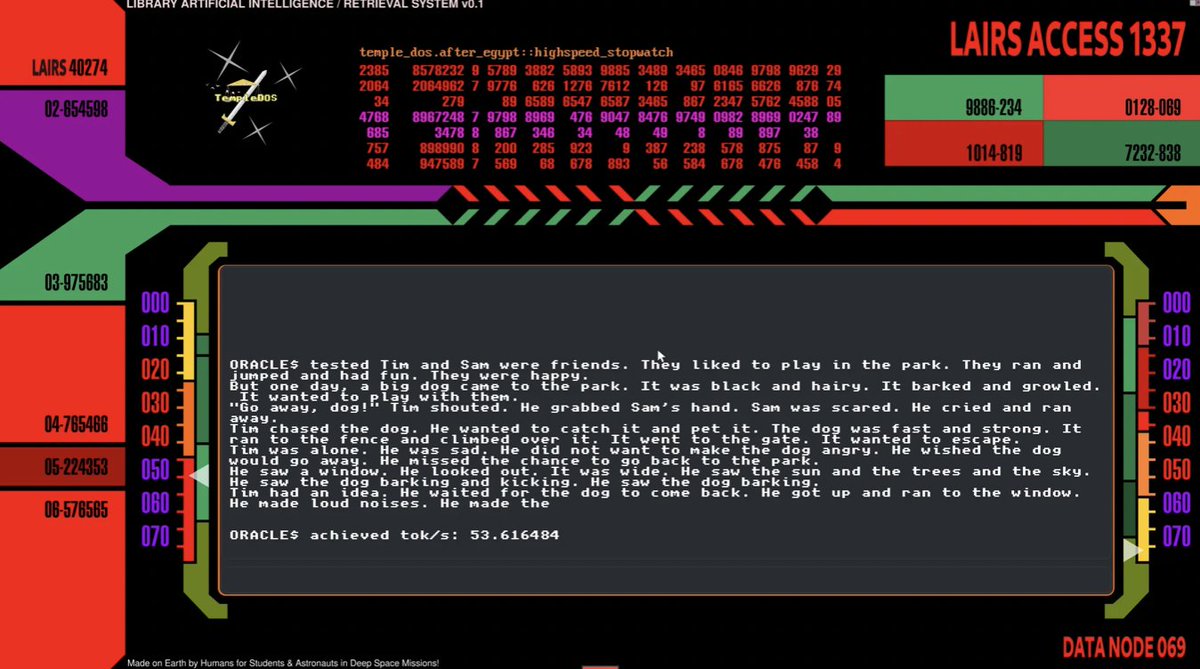
An OS that boots to a baby Llama 2
https://t.co/yB0TMD0rXm
Standalone, Binary Portable, Bootable
I expected that my "Llama 2 inference code in a single .c file" would go places, but this really stretches the imagination :) And why not, do we really need all this stuff?
Psychologists have posited hundreds of cognitive biases over the years. A fascinating new paper argues that they all boil down to one of a handful of fundamental beliefs coupled with confirmation bias. https://t.co/bDDmNfsSie
Are you eager to learn the exciting math behind the new science of causation?
Here's a free causal inference textbook.
It's the same one we use at the Harvard School of Public Health. https://t.co/99p5uhTaND
‘The researchers found that there was no “sweet spot” where a woman could position herself without being criticized. Women were either too young or too old, too attractive or not attractive enough, too educated or not educated enough. Introverted women were not seen as leaders and extroverted women were viewed as aggressive. They ultimately found that women leaders were “never quite right.”’
https://t.co/M16jRkytLK
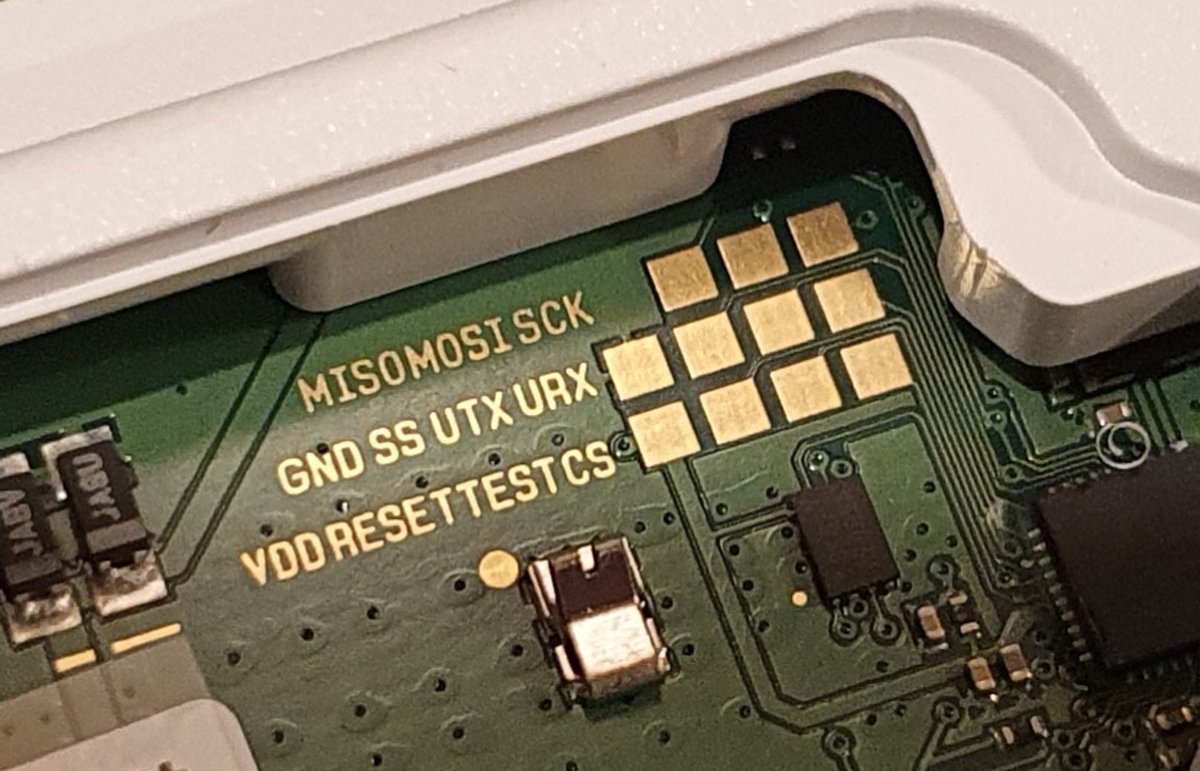
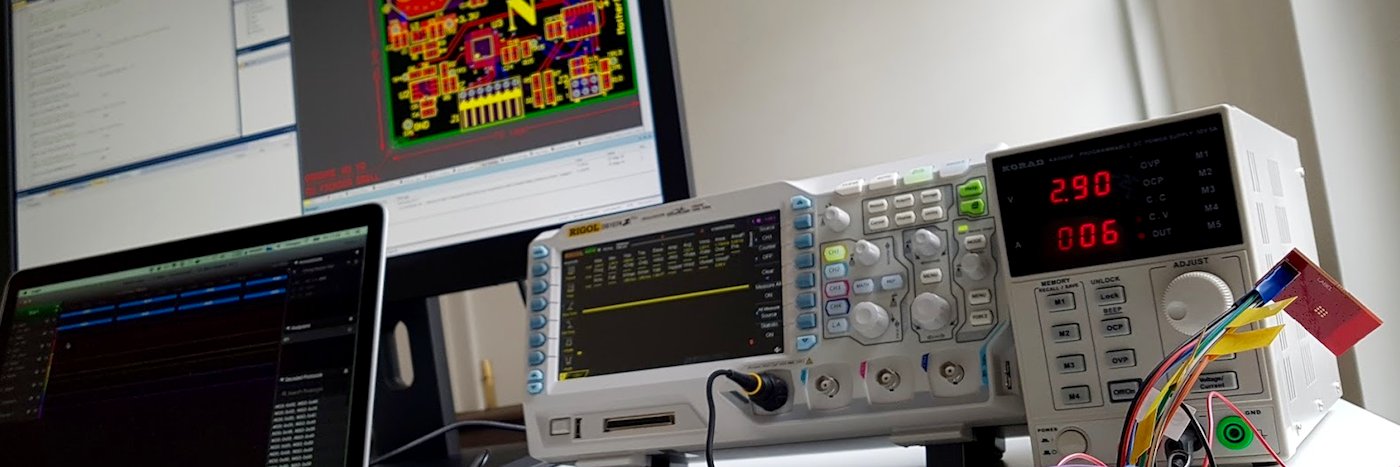
Ah man I just hate it when they make the debug pins hard to figure out.
Conversely, I think I actually made a little happy noise when I popped the cover on this beauty.






![WeijiaShi2's tweet photo. Ever wondered which data black-box LLMs like GPT are pretrained on? 🤔
We build a benchmark WikiMIA and develop Min-K% Prob 🕵️, a method for detecting undisclosed pretraining data from LLMs (relying solely on output probs).
Check out our project: https://t.co/XBWfX0SjK5
[1/n] https://t.co/qyOIfQQf8n](https://pbs.twimg.com/media/F9YvXJnacAAKvwl.jpg)