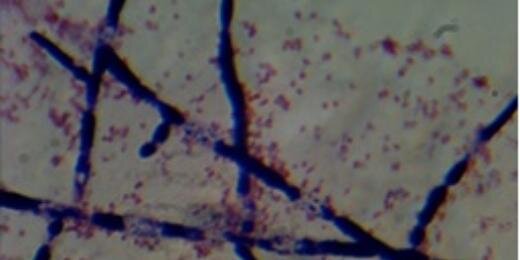
Recent work published in Nature Portfolio has introduced Zosurabalpin, a new antibiotic effective against Carbapenem-resistant Acinetobacter baumannii (CRAB). Want to know more about Zosurabalpin? Check out our latest blog: https://t.co/OVeglnkmyp………… https://t.co/Wno5qF7eIi
Growth in a skin-like medium (SLM) that strives to replicate the human skin environment stimulates expression of key virulence factors in S. aureus, supporting SLM's use as an in vitro model for assessing bacterial metabolism on skin. @mbiojournal: https://t.co/NlpTneouuf
NEW - The government releases the partially redacted business case for ServiceOntario to Global News. It shows Staples will get $8.29M over three years to run 9 locations, compared to the $3.66M a year it cost the government to run with independent owners. https://t.co/Zl2RC0kWNT
Congratulations to Dr. Paul Herbert @CBG_UofG 🇨🇦 for receiving the Benjamin Franklin Medal https://t.co/SEZZslU7tp for pioneering work in #DNABarcoding https://t.co/6UW9HtbNyW
From my PhD special topics presentation on applications of #bacteriophage to my postdoc peptide screening project using #m13, these little viruses are so interesting. Graphic of the exploding bacteria, too good 😄. #bacteriophage#AMR
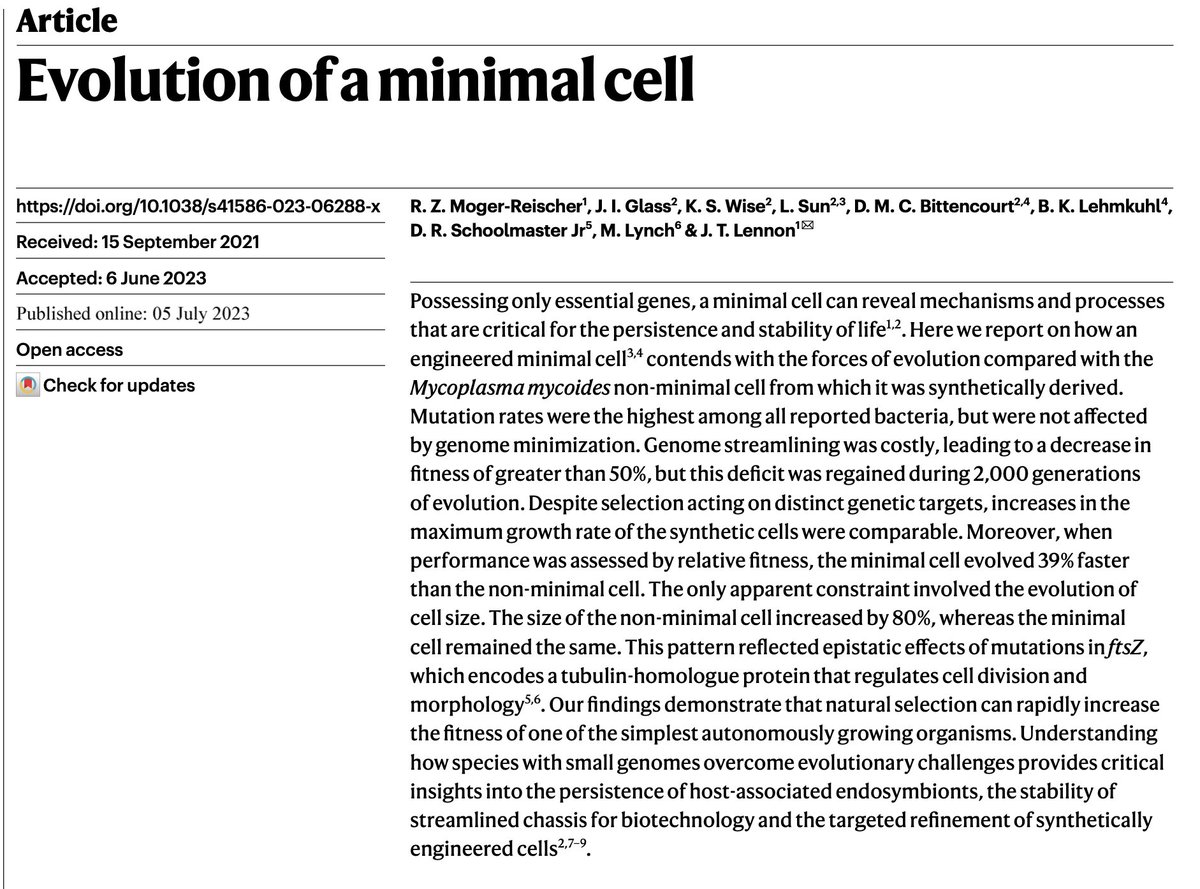
A mind-blowing paper has come out today in @Nature
In 2016, JC Venter Institute scientists trimmed a bacterial genome to its barest minimum required for life to synthesize what they called a "minimal genome" (https://t.co/Rk8oZJ0bUj).
Today, a group of scientists from Indiana University reports how that minimal genome evolved over 2000 generations in comparison to the non-minimal genome.
The authors found that even when you reduce a bacterial genome to its absolute minimum where every nucleotide matters, the genome undergoes mutational events generation after generation as much as the non-minimal genome. One simply cannot stop the evolution.
Just over 300 days of evolution (equivalent to 40,000 years in humans) the minimal cell has gained everything it lacked in fitness on day one in comparison to the non-minimal cell.
When comparing the evolved traits between the minimal and non-minimal cells, the scientists found something striking. The evolutionary process increased the cell size of non-minimal cells but not that of the minimal cell. But that is not the striking part.
The scientists were able to identify the key mutation that resulted in cell size evolution. And it turned out that the mutation that helped the non-minimal cells to grow bigger is the same that helped the minimal cells to stay smaller. Growing bigger had a survival advantage for non-minimal cells and not growing bigger had a survival advantage for minimal cells. So, the mutation had a context-dependent effect. This just demonstrates that the evolutionary effects on traits have no absolute direction. All that matter is what is beneficial for the organism's survival.
The conclusion of the paper is metaphorically a quote from the Jurassic Park movie:
“Listen, if there’s one thing the history of evolution has taught us is that life will not be contained. Life breaks free. It expands to new territories, and it crashes through barriers painfully, maybe even dangerously, but . . . life finds a way". (https://t.co/UlxRlb86CT)
https://t.co/zA9OAqSoAu