Biology is AI. The understanding of the LEGO blocks at the amino acid level will unlock the cures we have all been waiting for. From amino acid to peptides to proteins and how to shape shift the proteins into cytokines, antibodies and target them to our biological needs. Spent 30 years understanding this from Abraxane to shape shift the most dominant protein in our body- Albumin, to Anktiva the most important cytokine in our body. Next antibodies. More to come and the world of biology is finally being unravelled. Nice talk. Should watch.
Imagine programming protein, DNA, and RNA systems like you would write computer code, or even by natural language prompting of an AI agent. @brianhie and team just made this a reality with Proto: a high-level programming language for generative biology.
GLM-5.2 just dropped and everyone’s asking:
“Can I run this thing locally?”
Technically yes.
Practically?
Probably not unless you have data-center money.
GLM-5.2 is not a normal “download and run on your gaming PC” model.
It’s a ~743B parameter MoE model with about 39B active parameters per token.
The full checkpoint is roughly 1.5TB.
This is serious infrastructure.
The official practical setup is basically:
8× NVIDIA H200 / H20 GPUs for FP8 serving.
And if you want the full 1M-token context window?
You’re looking at something closer to:
8× NVIDIA B200 GPUs.
That is not a laptop.
That is a small data center.
Cost to run locally?
Rough math:
8× H200 server: ~$400K–$550K+
8× B200 server: ~$425K–$700K+
Cloud 8× H200 24/7: ~$36K–$45K/month
So no, your RTX 4090 rig is not the move here.
The smarter question is not:
“Can I run GLM-5.2 locally?”
It’s:
“Is the API or coding plan cheaper than Claude Max?”
That’s where it gets interesting.
Claude Max pricing:
Max 5x: $100/month
Max 20x: $200/month
Claude gives you a polished subscription experience, but the exact token allowance is not transparent.
You’re buying “usage capacity,” not raw tokens.
GLM-5.2 API pricing is much more explicit:
Input: $1.40 / 1M tokens
Cached input: $0.26 / 1M tokens
Output: $4.40 / 1M tokens
So with $200/month, you could roughly get:
~87M–118M tokens, depending on input/output mix.
For normal heavy coding use, GLM-5.2 API could land around:
$100–$300/month
But if you tried to replicate the full theoretical value of https://t.co/ZrCQXOB9a9’s own Max coding-plan quota through raw API usage?
That could be more like:
$2,400–$4,800/month in API value.
That’s why the GLM Coding Plan matters.
For Claude Code / Cline / Cursor / OpenCode-style workflows, the subscription plan may be dramatically more cost-effective than raw API.
Especially if you’re doing agentic coding with lots of tool calls.
My take:
Don’t buy hardware.
Don’t try to be a mini data center.
Use:
Claude Max for the polished premium experience.
Test GLM-5.2 via API or Coding Plan for cheaper high-end coding workflows.
The real unlock is not local inference.
The real unlock is:
Claude-style agentic coding workflows + lower-cost frontier-ish open-weight models + API access.
That’s where indie builders and small teams can actually win.
Elon Musk thinks coding dies this year.
Not evolves. Dies.
By December, AI won’t need programming languages. It generates machine code directly. Binary optimized beyond anything human logic could produce. No translation. No compilation. Just pure execution.
Musk: “You don’t even bother doing coding.”
Code was never the point. It was friction. A tax we paid because machines didn’t speak human. AI just learned fluent human. The tax is gone.
Now plug that into Neuralink. No syntax. No keyboard. No screen.
Musk: “Imagination-to-software.”
Thought becomes executable. You imagine an outcome, the system architects and compiles it into reality instantly.
We’re not automating programming. We’re erasing it from existence.
The entire profession collapses into a thought. Decades of training reduced to irrelevance. The gap between idea and instantiation hits zero.
You don’t build anymore. You imagine, and it materializes.
Not incremental progress. Total phase shift. The way humans have created things for ten thousand years just became obsolete.
Welcome to a world where the limiting factor isn’t skill, resources, or time. It’s whether you can picture what you want clearly enough for a machine to birth it into existence.
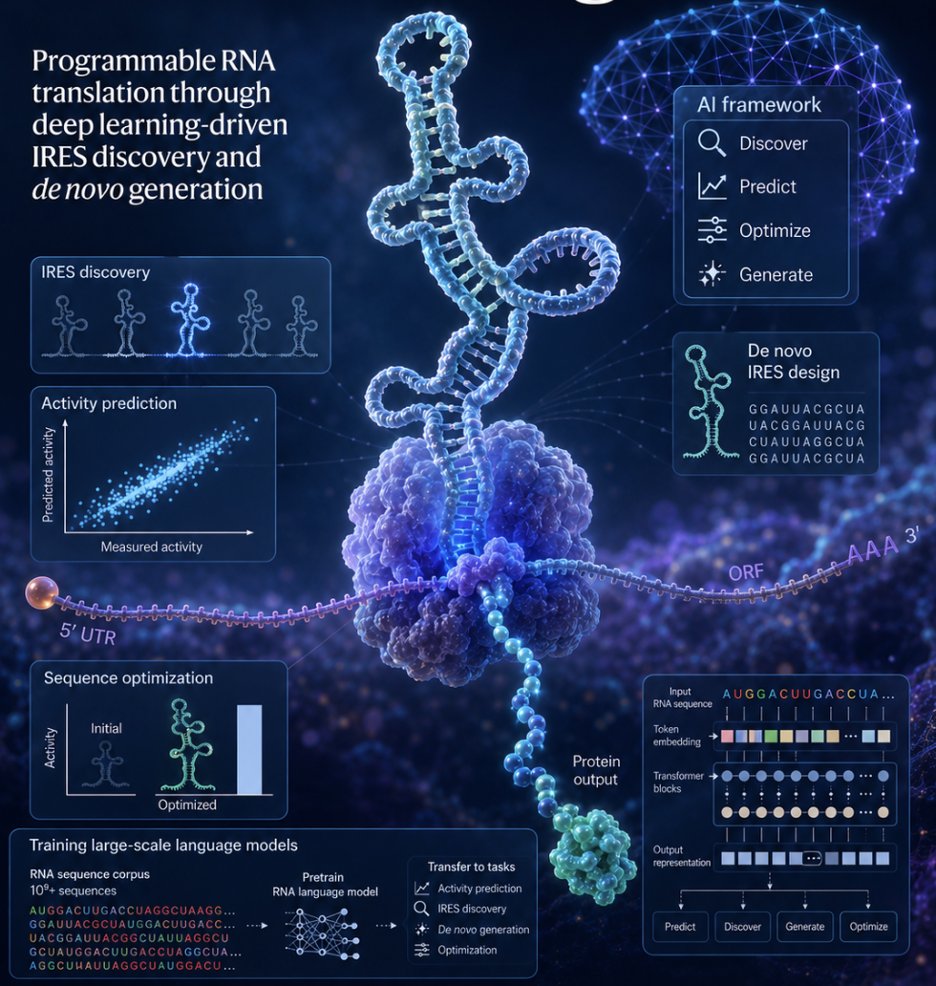
Can we program cells like computers — using RNA?
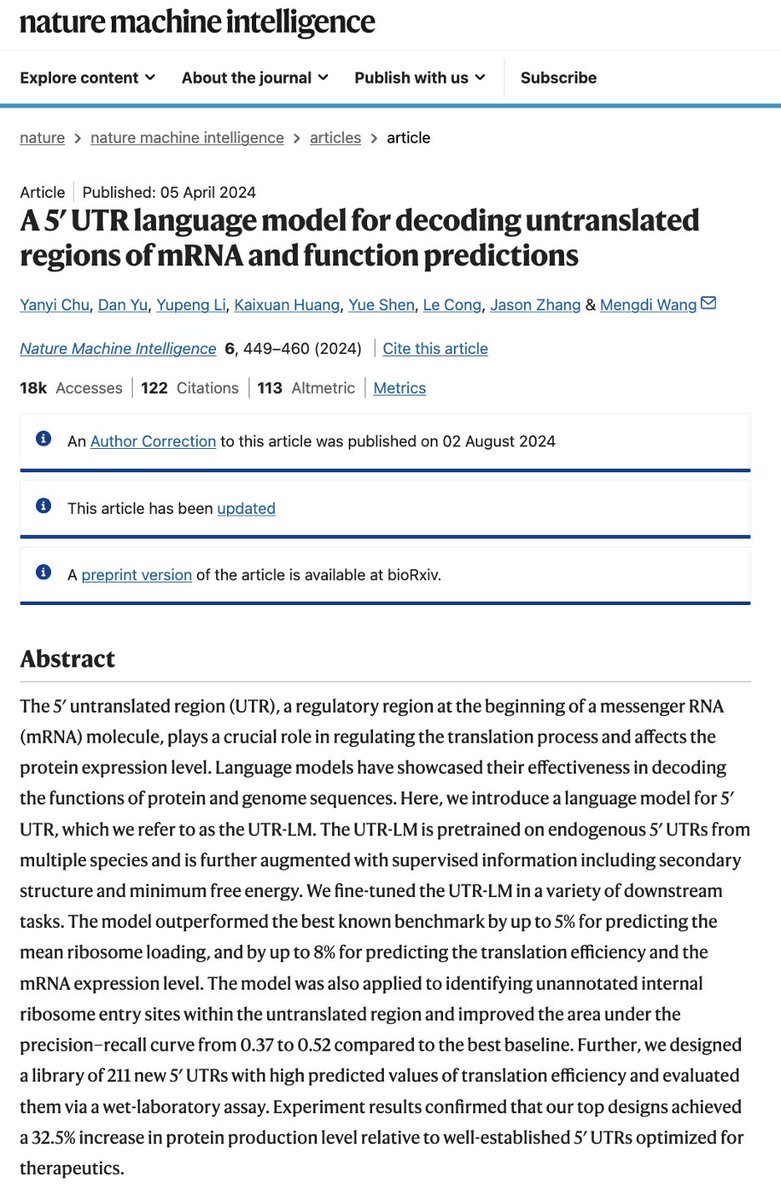
Two years ago, our group trained the first language model to decode the regulatory grammar of 5′ UTRs in mRNA, published in Nature Machine Intelligence.
Today, we’re excited to share the next step, also in Nature Machine Intelligence:
“Programmable RNA translation through deep learning-driven IRES discovery and de novo generation.”
We built an AI engine to discover, predict, optimize, and generate IRES elements — RNA control modules that regulate translation initiation.
This brings us closer to programmable RNA systems that control when, where, and how strongly proteins are produced inside cells.
AI is no longer just helping us read biology.
It is beginning to help us write it and harness it.
The future of computing may not only run on silicon — it may also run inside living cells.
#AIForBiology #LLM #AI4S #AI #RNA #MachineLearning #Bioengineering