Just gave a demo at @every's Vibe Code Camp showing how I use a kanban board to stay sane while overseeing Claude Code agents😎
Here's a quick recap video showing the whole flow:
1) Monitor progress on all tasks in one view
2) See when Claude is blocked, and respond in context
3) Read Claude's plans with nice formatting, not raw Markdown
4) Use AI to process voice notes into structured tasks
5) Get explanations of code changes... with an interactive quiz to check if you understood 🙃
I've had mixed feelings about kanban workflows in the past, but as the agents get stronger I'm warming up to them—especially for churning through small well-specified tasks.
In that context, it feels like the challenge is managing my working memory for what's going on. And having a stable "zoomed-out map" of all the tasks really helps me with offloading some of that cognitive load to a visualization of everything that's going on!
SaaS is being dismantled as we speak!
We're witnessing the slow-motion collapse of an entire business model that dominated tech for two decades. The $1.3 trillion SaaS is being quietly hollowed out from within by AI agents.
Here's how I see it playing out:
Phase 1 (Now): AI as co-pilot. We're seeing this everywhere, Copilot for developers, Gamma for presentations, Harvey for legal research etc. These AI layers sit atop existing software, making it more efficient.
The SaaS companies feel safe, even excited, as AI seems to make their products more valuable. They're bringing knives to what they think is a knife fight.
Phase 2 (Next 12-18 months): The agent invasion. AI moves from co-pilot to autonomous operator. They're replacement workers that can fully operate existing software on your behalf.
The dam breaks when someone can say "analyze our Q2 performance" rather than clicking through Tableau, or "optimize our ad campaigns" instead of navigating Meta's ad manager. The expertise previously bundled with the software gets unbundled by agents.
Phase 3 (2-3 years): Software invisibility. The final phase happens when the agents bypass the human interfaces altogether. Why render dashboards, buttons and menus when AI can just access the APIs directly?
The value proposition of SaaS, bundling software, workflow, and expertise into user-friendly interfaces unravels completely. The interfaces were designed for humans, but agents don't need them.
Most SaaS incumbents don't see it coming because this isn't a classic disruption pattern. It's not about competing products with better features. It's about the evaporation of the core assumption that humans will operate software.
What's more, the barrier to creating custom, internal software is collapsing simultaneously. Companies that once had to choose between expensive custom development or off-the-shelf SaaS can now spin up bespoke solutions in days instead of months. Why pay Hubspot $1,500/month for a CRM when your team can build 'HubspotForUs' with an AI coding assistant over a weekend? The same features, perfectly tailored to your workflow, with no ongoing subscription costs.
This democratization of software creation means every company becomes a potential software producer rather than just a consumer. The specialized knowledge that SaaS companies monopolized is now available to anyone with access to an AI coding agent and domain expertise.
It went from $1M to build an MVP to build a SaaS to basically free overnight.
I bet the metrics will be puzzling at first, DAUs remain strong while feature usage mysteriously declines. The power users who drive revenue suddenly need fewer seats.
Customer success calls shift from "how do I use this feature?" to "can your software work with my AI agent?"
Or worse: "we built our own version that better fits our workflow."
The survivors won't be those with the best features or even those who add AI features fastest (from no AI to "ai-assisted").
The winners will be companies that expose their software's capabilities through agent-friendly APIs and position themselves as the most trustworthy information sources and execution engines in their domain.
There's also the shift from monthly subscriptions to outcome based software (pay per outcome, pay per task etc) but that's a tweet for another day!
The $1T question: Will Microsoft, Atlassian, Adobe etc. successfully navigate this transition, or will they be the Digital Equipment Corporation of our era too invested in the previous paradigm to adapt to the new one?
All I know is this will be a golden era for startups in the space.
SaaS is being dismantled, piece by piece, workflow by workflow, interface by interface.
Am I wrong?
20y+ years in app dev, I just felt the humbling reality of being commoditized by https://t.co/qRU5AIYjnh. Gone from code to low-code, to no-code to no devs. The future is here. @bubble displaced
You still need a tech & product lead😉DM me.
#nocode#bubble#lovabledev#nodevs
⭐ At @defyvc we've been exploring the evolution of pricing in an an AI-first world.
🚀 AI-first companies are shifting away from traditional SaaS models and embracing more dynamic, transactional pricing strategies to capture larger market opportunities—especially those tied to labor spend.
🔑 Why the Shift?
With AI automating workflows and replacing manual labor, businesses are exploring new ways to price based on input or output rather than the typical subscription model. The goal? Align with customers' specific ROI and cost structures while tapping into industries where labor is a significant cost.
💡 Key Pricing Models for AI-First Products:
1. Fixed Cost (SaaS) – Ideal for daily-use cases, like AI generated marketing collateral or compliance checks.
2. Input-Based – Charges by consumption (e.g., data processed or queries made). Think of AI-powered discovery tools for law firms.
3. Output-Based – Pay for specific outcomes (e.g., automating administrative tasks in healthcare).
4. Hybrid Models – A mix of subscription and usage, giving flexibility without sacrificing predictability.
💬 When to Choose Which?
It all comes down to how often your customers use the product, their existing budget for labor vs software, and how aligned your pricing is with the value they perceive.
As the AI market grows, so does the opportunity to experiment with pricing that reflects real-world savings and efficiency improvements. The right model could unlock new revenue streams—and new value for your customers.
Curious how to navigate this shift? Dive deeper into the pros, cons, and use cases of each pricing model. 🌟
Link to the full post in the comments.
Services as Software Part 3 is here. And it's not about opportunity, it's about extinction.
Why? Services as Software isn't just a $4.6T opportunity.
It's the end of software as we know it. The $300B enterprise software industry is facing its asteroid moment.
SAP, @Oracle , @salesforce - the foundation these giants built on is crumbling. Not from competition. Not from the cloud. But from something far more fundamental.
For 40 years, we built software backward: Systems of Record (Salesforce) for forms, Systems of Engagement (@SlackHQ) for interfaces, Systems of Intelligence for analytics.
Each layer tried fixing problems of the last. But they all shared one fatal flaw: humans had to translate their work for computers to understand it.
Enter Systems of Agents.
Systems of Agents will begin by automating human workflows, initially coexisting with all existing systems.
The old boundaries between data entry, engagement, and analysis won’t just blur—they’ll become irrelevant. And Systems of Agents will be the new source of truth.
"Service as Software" is Silicon Valley's hottest buzzword right now.
Everyone's talking about SaaS becoming service providers, but no one's explaining HOW. The answer? After 6 months of research and 100s of startup conversations, we have the answer: Systems of Agents.
We're looking at a $4.6T opportunity.
this will be one of my favorite moments ever not just because it secured gold. nor because of the difficulty. because he is the only person on earth who not passing to one of these two, wide open, is acceptable.
This is Mansa Musa.
Even when adjusted for inflation, he is still billions richer than Jeff Bezos, Elon Musk, Bill Gates combined.
Yet most have never heard of him.
Here's the forgotten story of the richest person in human history (that you should know):
This story completely changed how I think about the world:
A professor came to visit an old Zen master to seek advice.
"I have come to ask you to teach me about Zen," the professor said.
As the master began to teach, the professor repeatedly interrupted him to share his own opinions, knowledge, and stories.
The master suggested that the two should take a break to have tea.
The master poured the professor a cup. Once it was filled, he kept pouring, until the cup was overflowing hot tea all over the table, onto the floor, and onto the professor's robes.
"Stop!" cried the professor, "Can't you see the cup is already full?"
The Zen master replied:
"You are like this cup, so full of ideas that nothing more will fit in. Come back to me with an empty cup."
The story is particularly important in an era where most people are more concerned with being right vs. finding the truth.
It's a reminder that we cannot hope to embrace new information or insights if our "cup" is too full of preconceived notions, assumptions, and beliefs.
Is your cup too full to embrace new information that the world is giving you?
Do you need to empty your cup before you can grow?
I'm 38.
When I was young I worshipped politics, went woke (broke) & believed in the myth of equality.
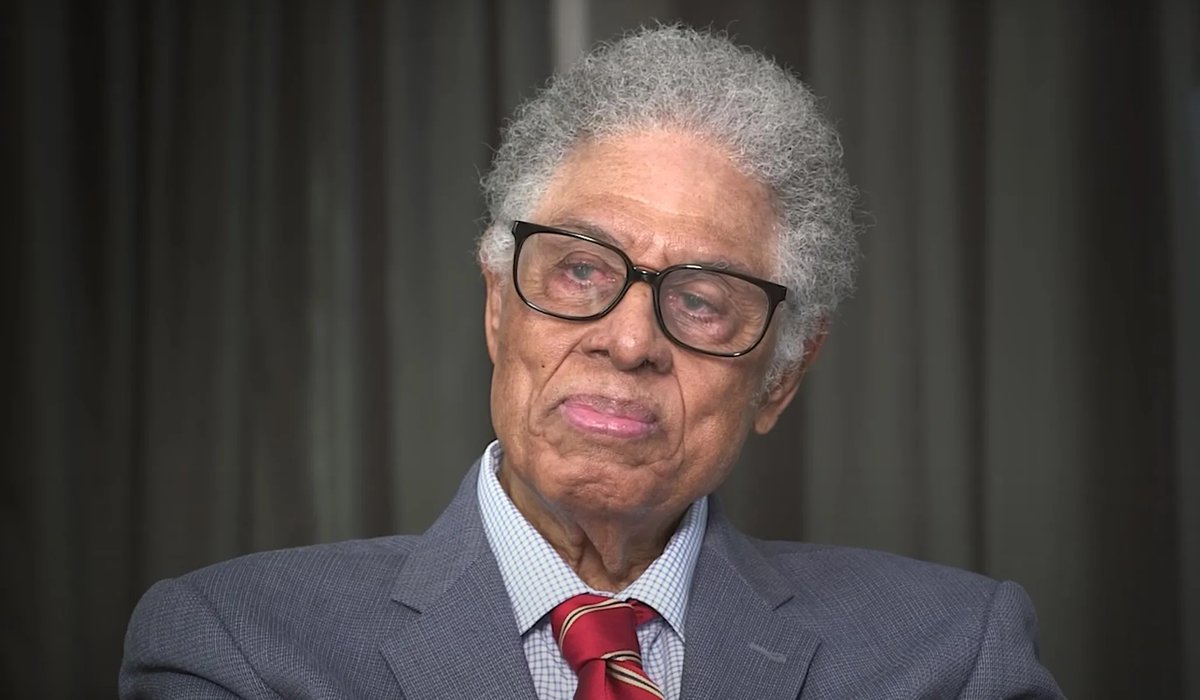
Then I discovered Thomas Sowell, and he changed my life forever.
12 lessons from America's most controversial & unknown philosopher:
5. "Inflation is a hidden tax
The money people have saved is robbed of part of its purchasing power,
Which is quietly transferred to the government that issues new money
It is a way to take people's wealth without having to openly raise taxes" – Thomas Sowell
Whenever I hear someone wants "life balance", I know they will end up dissapointed.
Not only is life balance nearly impossible to have -- it's the wrong goal. They're shooting at the wrong target.
Here's how I think about it isntead..:
“Your feelings are your responsibility." Do you agree?
You can listen to the full conversation with this week's podcast guest, Fred Luskin, by clicking this link or enjoying it wherever you get your podcasts - https://t.co/FJqV6qJihU