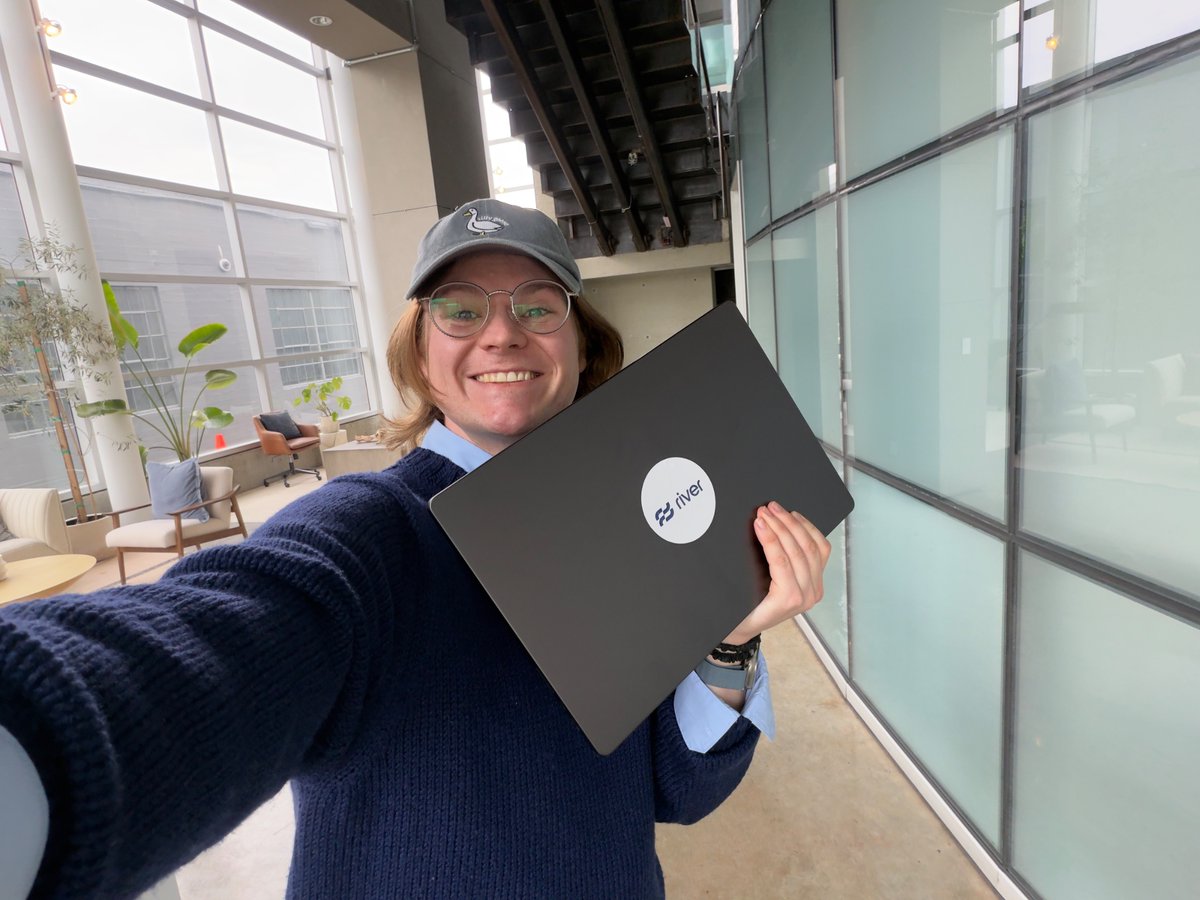
Introducing River Recipes: our open-source initiative for turning promising research into vetted, reproducible training recipes.
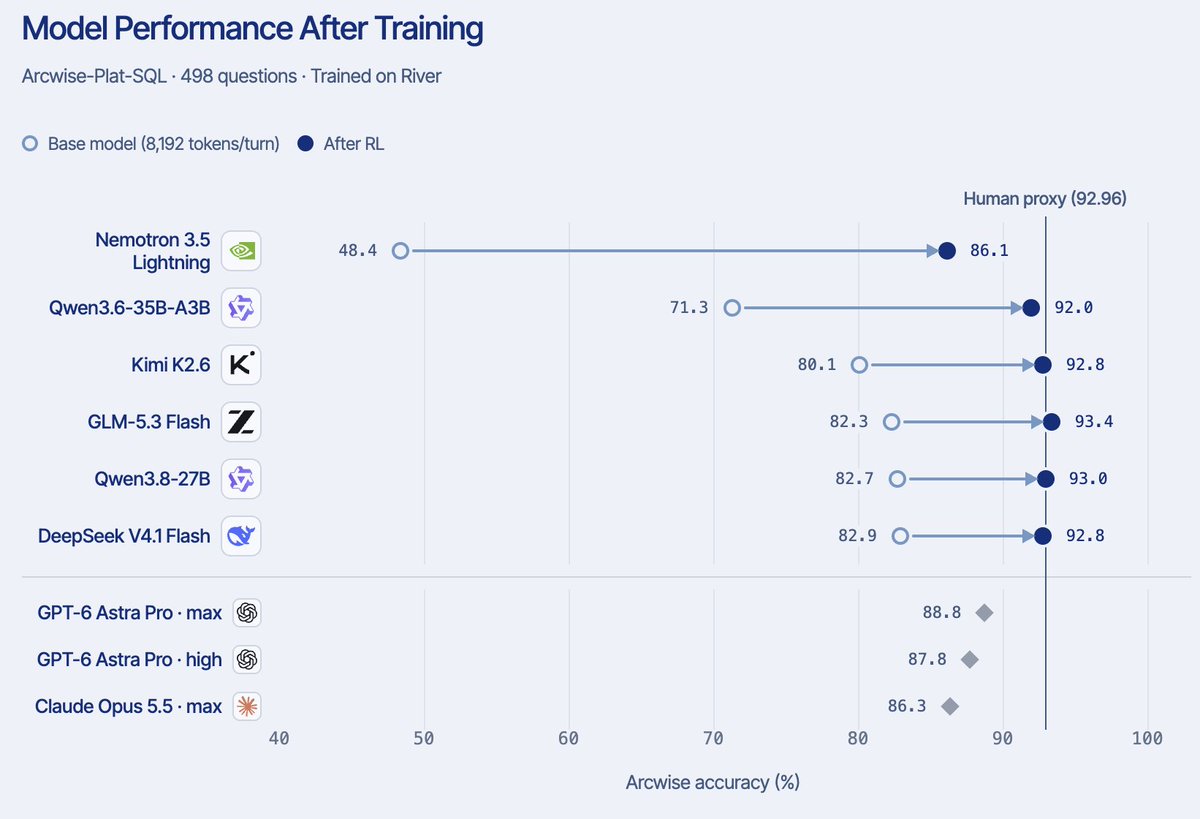
Our first recipe tackles text-to-SQL, where our trained open models beat GPT-6 Astra Pro and Claude Opus 5.5 on Arcwise-Plat for less than 1% of the cost.
Read the full breakdown and explore the recipe ↓
https://t.co/MNcTas9TOf
@joefioti@luminal_ai Got it, you’re pointing out the canonical example of not doing things like vliw to return to a state of hw simplicity and elegance.
On this we agree then!
mxfp8 x mxfp4 at higher perf than normal mxfp8 matmul is a magic bullet worth pointing out. Kudos to Richard Ho and the team, this is good engineering.
That’s 2x activation fetches plus scale sidecar concurrently on the fp8 to match the fp4 native element sizes. Not trivial
Jalapeno beats VR200 in A0 silicon with a vibe-ported, non-specdec implementation of DeepSeek 🌶️ 🌶️
And with much faster program execution than VR200, and with a B0 update landing imminently
Congrats to the Jalapeno team!!!
Yes, but this mixed matmul is a different beast than the simd trick you’re describing. This mixed dtype matmul needs 2x the fp8 bytes to match the equivalent elements of fp4 bytes. What usually happens is the fp4 will upcast to fp8, and the matmul performs like an fp8 matmul, no free simd alu gain from fp4 in this case.
Jalapeno as described would still upcast fp4 to fp8 but the native fp8 operands fetch 2x the bandwidth above the normal rate for their perf numbers to hold.
SW terms decoded for HW ppl:
BigO = they need more compute
EP = they’re out of RAM
Ephemeral = the L1 is too small
Sparse Attention = mythical systolic array that is faster with partial outputs
Tokenizer = cpu scrabble
Batch norm = previous trauma
The River API was tested in this blog post and outperformed Tinker on reinforcement learning runs with identical training code. We spent a lot of effort to get details like routing replay right so you get the best possible results with the API.
Excited to share I've joined @river_ai_inc to work on personal AI!
As AI products become pervasive in everyday life, it's clear this technology needs to be private & owned by the users. I'm looking forward to a future with great products and alternatives to centralization.
Today, we're sharing that River AI has raised $1.1 billion, led by @generalcatalyst and @amppublic with strategic investment from @nvidia and @AMD. Additional investors include @ycombinator and @Temasek.
We imagine a future where your AI works entirely for you and deeply aligns with your values. Compared to the corporate chatbots of today, it will feel completely different: responsible, curious, and truly yours. Most importantly, you'll own everything: the hardware it runs on, the data it learns from, and the intelligence itself.
Our training API is already live and powering incredible work today. This new funding accelerates our push to bring the full personal AI stack to life.
Read River AI CEO Igor Babuschkin’s (@ibab) conversation with the New York Times to learn more: https://t.co/DK66aKkF31
River API is now available to everyone.
Fine-tune and run RL on frontier open models. Fast, cheap, and scalable.
Go to https://t.co/LHzVmLVyqv to try it out!
@mu_chrinovic This. When we build stacks in hw, it’s really a RAM with an index/pointer decoder, linked list, and a freelist. All this is supported by the compiler that knows this to some degree. The stack itself is an abstract illusion