Outdated knowledge is more dangerous than missing knowledge.
A missing instruction creates a gap you notice. An outdated one looks reliable — and leads you wrong.
Machines get overhauled. Specs change. Workarounds become obsolete. Docs rarely keep up.
https://t.co/DDfAebEffm
Gemini Omni can create anything from any input, starting with video. 🪄
This means you can combine images, audio, video and text as input and generate high-quality videos.
Or use drawings to create in a way that matches your vision.
#GoogleIO
One of the best things students and colleges can do is not bail on learning and teaching the fundamentals of any given domain. AI will trick you into thinking you don’t need to go deep in a particular area, but that’s wrong.
The expert with AI is always going to be far more capable than the novice. Those that can steer AI agents properly, figure out how to evaluate their work, fix their mistakes, and incorporate their work into a workflow will always be the most potent users of these tools.
The experienced software developer that’s built and scaled complex systems using agents outrun someone just vibe coding. The designer that uses AI will build far better products and campaigns than anyone else. The banker or analyst that understands financial models will be able to pull off far more with agents.
Despite some of the rhetoric in the valley that this is less implement now, that couldn’t be further from the case. Don’t give up on going deep in your craft.
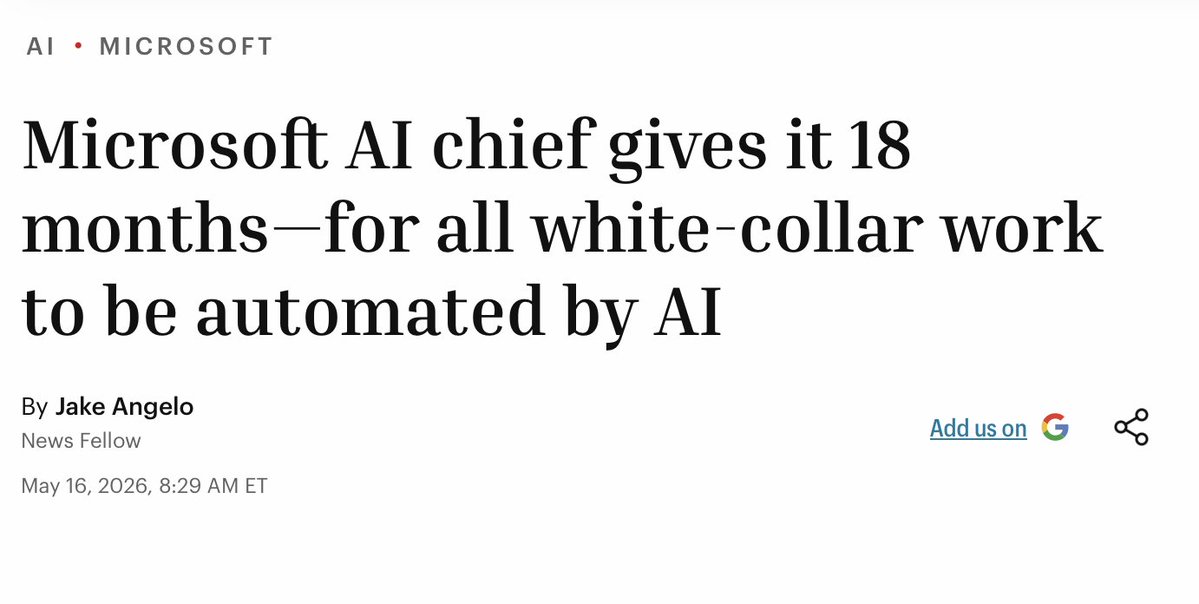
Mustafa Suleyman says 18 months until AI automates all white-collar work.
Microsoft AI CEO Mustafa Suleyman predicts "human-level performance on most professional tasks" within 18 months. Accounting, legal, marketing, project management, all fully automated.
"Suleyman predicted “human-level performance on most, if not all professional tasks” being done by AI. Most tasks that involve “sitting down at a computer” will be fully automated by AI within the next year or 18 months, he said, naming accounting, legal, marketing, and even project management as vulnerable." (Fortune)
Suleyman says his mission is building "superintelligence" and that creating a new AI model will soon be "like creating a podcast or writing a blog."
Via Fortune
i’ve grown tired of pretending this is still moving at human speed.
something shifted with mythos. not in the theatrical “the robots woke up” way people like to mock. in the quieter, colder way. the kind where a lab looks at its own evals and realises the old categories stopped working.
we assumed the next jump would be obvious. bigger data centres. louder chips. power plants, yottaflops, national infrastructure, the whole cathedral of compute. turns out the dangerous part was never just scale. it was what happens when reasoning becomes a substrate. when the model stops merely answering and starts searching the problem space like a thing that has its own private geometry.
mythos is the tell.
not because it is magic. not because it is conscious. because it shows the curve bending in public while everyone is still arguing over yesterday’s slope. a general model, not even built as a cyber weapon, starts finding vulnerabilities humans missed for years. not toy bugs. not classroom puzzles. real systems. old systems. the kind of hidden cracks entire industries quietly depend on not being visible.
and the part nobody wants to sit with is this: the next models do not need to be ten times larger to be ten times more consequential.
capability is no longer arriving as a clean linear upgrade. it is arriving as compression. tasks that took experts days become agent loops. workflows that required teams become prompts plus tools. reasoning that looked impossible last year becomes a benchmark nobody cares about by spring.
the public still thinks intelligence means chat. a box that writes emails. a search engine with manners. a productivity toy wearing a human voice.
but behind the curtain, the labs are measuring something else entirely.
autonomy length. planning depth. tool fluency. exploit chaining. internal representations that generalise across domains before anyone has a satisfying explanation for why. models that don’t just know more, but stay coherent longer. push further. recover from mistakes. test their own outputs. route around obstacles.
that is the real threshold.
not “can it talk like us”.
can it operate.
because once a model can hold a goal across time, decompose it, verify progress, use tools, and improve its own path through the maze, the world changes shape. suddenly intelligence is not a product feature. it is labour. it is research. it is reconnaissance. it is leverage.
and leverage compounds.
this is why the mythos moment feels different. it is not another chatbot release. it is a warning flare from the frontier. a signal that the next generation of models will not merely be better at conversation. they will be better at execution. better at discovering structure. better at finding the thing we missed because our brains were never built to search that many branches at once.
we are not ready for what comes next.
not culturally. not legally. not institutionally. maybe not even psychologically.
because the next wave will not announce itself as science fiction. it will arrive as a workflow improvement. a security tool. a coding agent. a research assistant. a quiet multiplier embedded into every system that matters.
meanwhile mainstream conversation is still “will ai replace junior developers” and “can it make me a nicer spreadsheet”.
brother.
we are watching non-human cognition become operational infrastructure, and everyone is still asking whether it can write better emails.
This is a lesson I need to take to heart.
I'm sure I'm not the only founder with this problem.
Don't flood the org with ideas. It's a distraction. Prioritize and inject the ideas at a rate the org can absorb.
AI is getting better and better at answering CAPTCHAs.
Me? I'm failing them more often.
Soon, I'm going to have to start using AI to prove that I'm human.
feels like a good time to seriously rethink how operating systems and user interfaces are designed
(also the internet; there should be a protocol that is equally usable by people and agents)
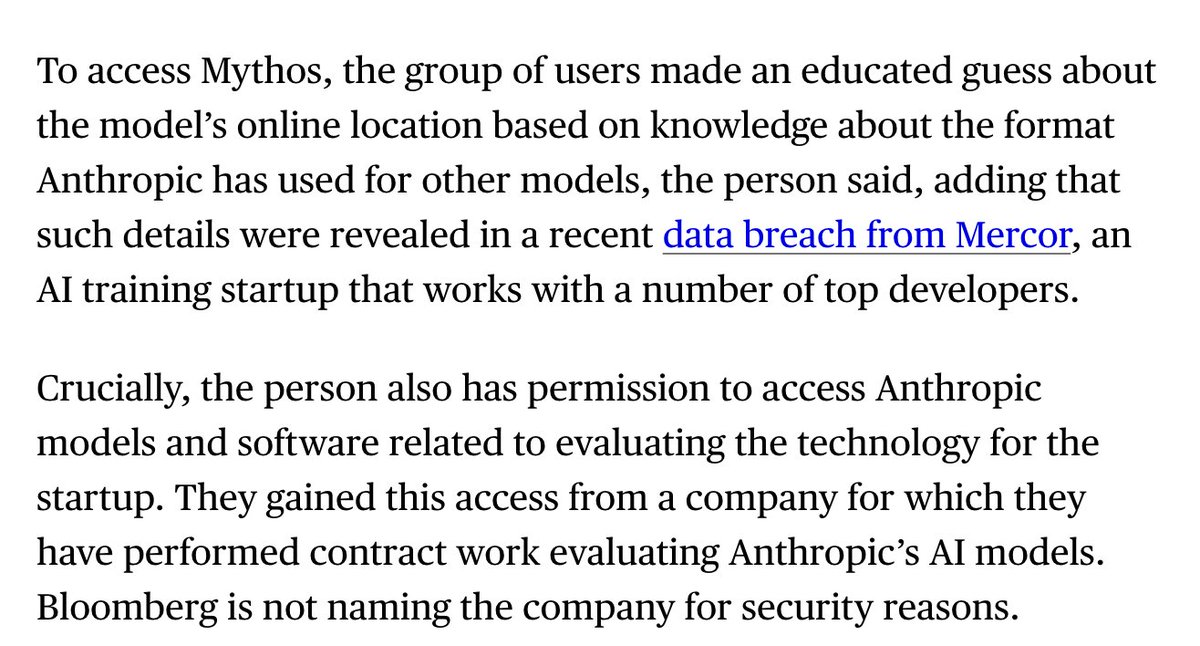
What? Although Mythos was "too powerful for public use" (Anthropic), several Discord users had access to the model from day one!
A small group of "unauthorized discord-users" reportedly accessed Anthropic’s powerful Mythos AI model, exploiting a mix of insider access and online sleuthing techniques.
"To access Mythos, the group of users made an educated guess about the model’s online location based on knowledge about the format Anthropic has used for other models."
Via Bloomberg
I came back to code because AI made it possible for me to build at a level I couldn't before.
I'm not coding despite being CEO of YC. I'm coding because this is the most important technological shift since the internet and I'd be an idiot to experience it from the bleachers.
I'm 45, running the most important startup institution in the world, and I can ship production software at 2am. That's not a distraction from the job.
That is the job understood correctly.
Totally with Garry here.
I'm 58 and still building stuff at 2am.
I was similarly obsessed when building for the early web in the 1990s. But this is way more fun.