Dear introverts,
As you get older, you start seeing things differently. You notice how people affect your peace. Who makes you feel good, who drains you, who brings you down.
You stop staying in places where you dont feel wanted. You learn that forcing yourself to fit in isn't worth the cost to your spirit.
Small moments become the big ones. Long hugs, kind messages, quiet mornings with people who understand you.
Your priorities change. Having a life that feels good becomes more important than having one that looks good. You learn that being kind never loses value. That gentleness isn't weakness.
This is what getting older teaches you: Your peace matters. Your feelings count. Your heart knows the way.
@ValerieAnne1970 Thanks, Valerie, for calling this out. Have not come across the study previously - will review, and sounds like it has valuable insights. But I also will want to see how subsequent studies over the years have built upon this foundation.
@mahdiyahShah @BackpirchCrew For perspective, just a lifetime ago, there were no "tornado emergencies" because no one tracked or declared them. My lifetime and yours is rather miniscule compared to the roughly 300,000 years homo sapiens have been on this planet.
@SBakerMD Lorazepam
Immodium (was at 5 - 10/day; pro-arrhythmic)
Also, glucose was in pre-diabetic range, now mid 80s.
BP was routinely 140/90; now routinely 120/80
Amazing.
Intermittent Fasting Study: irreparably flawed?
As a mathematician with a keen interest in intermittent fasting, I found myself perplexed by a recent study's assertion that an 8-hour time-restricted eating regimen is associated with a 91% increase in the risk of cardiovascular death. The findings seemed implausible to me.
The study monitored 20,078 individuals over a median follow-up period of 8.0 years (interquartile range, 4.2-11.8), during which there were 2,797 deaths from all causes—equating to approximately 14% of the study population.
However, this mortality rate raises questions. According to actuarial tables, the probability of death within the next eight years for a 48-year-old male in the US in 2020 was 5.4%, and for a female, it was 3.2% (interestingly, the official Social Security site still adheres to a binary gender classification). The average probability for both genders stands at 4.3%.
When considering potential asymmetries and approximations—for instance, if the study's population did not exclusively consist of 48-year-olds but was instead symmetrically distributed between ages 35 to 61—the death rate could be slightly higher. Furthermore, life expectancy between 2003 and 2018, which corresponds to the enrollment period, was marginally lower. Despite these factors, achieving a 14% mortality rate seems highly unlikely unless the study focused on a particularly unique population.
The study data and the actuarial tables in the next 'tweet'.
1/2
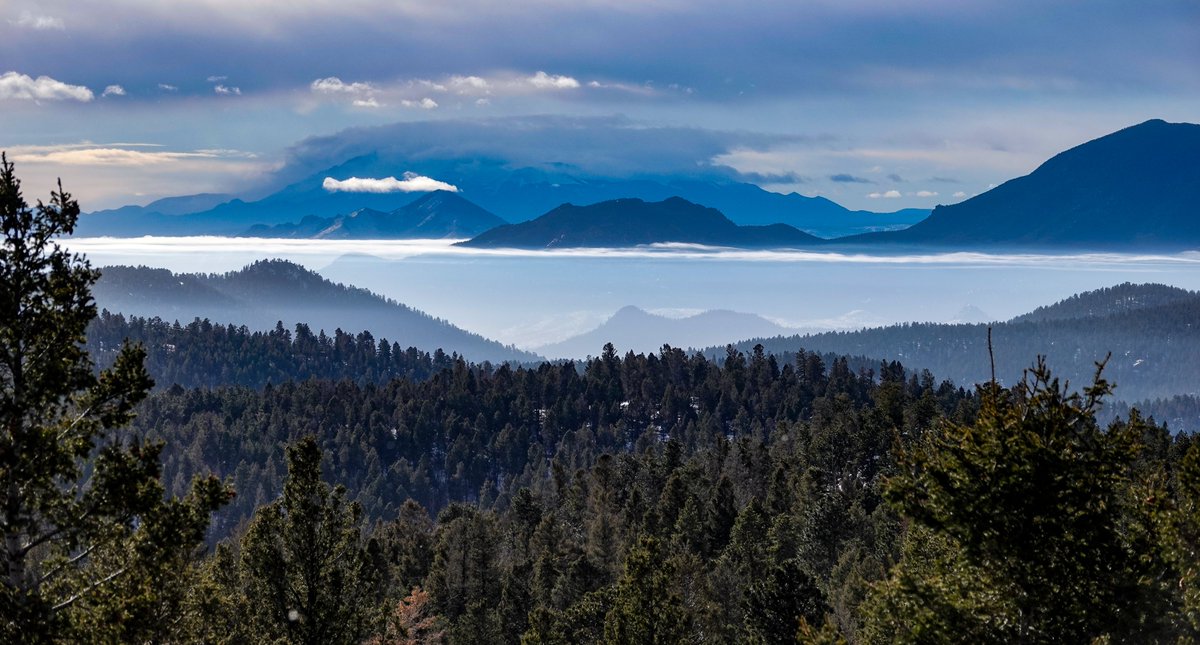
@kodythewxguy Looking south from #ConiferColorado this morning. Complex layers, cold air hanging out in the valley? R to L: Green Mountain, Little Scraggy Peak (center), Thunder Butte with "volcano steam" drifting W to E, and cloud-covered Pikes Peak mountain complex as the backdrop.
@Mercury34882@austinbarnard45@elonmusk Zebulon Pike writing in his journal about what is now Pikes Peak in 1806: "No man can scale its summit, and no man ever will."