New paper out today led by @ClaraLShaw shows that very early characteristics of disease dynamics can explain a large fraction of host jump risk https://t.co/PRukz9ktrb
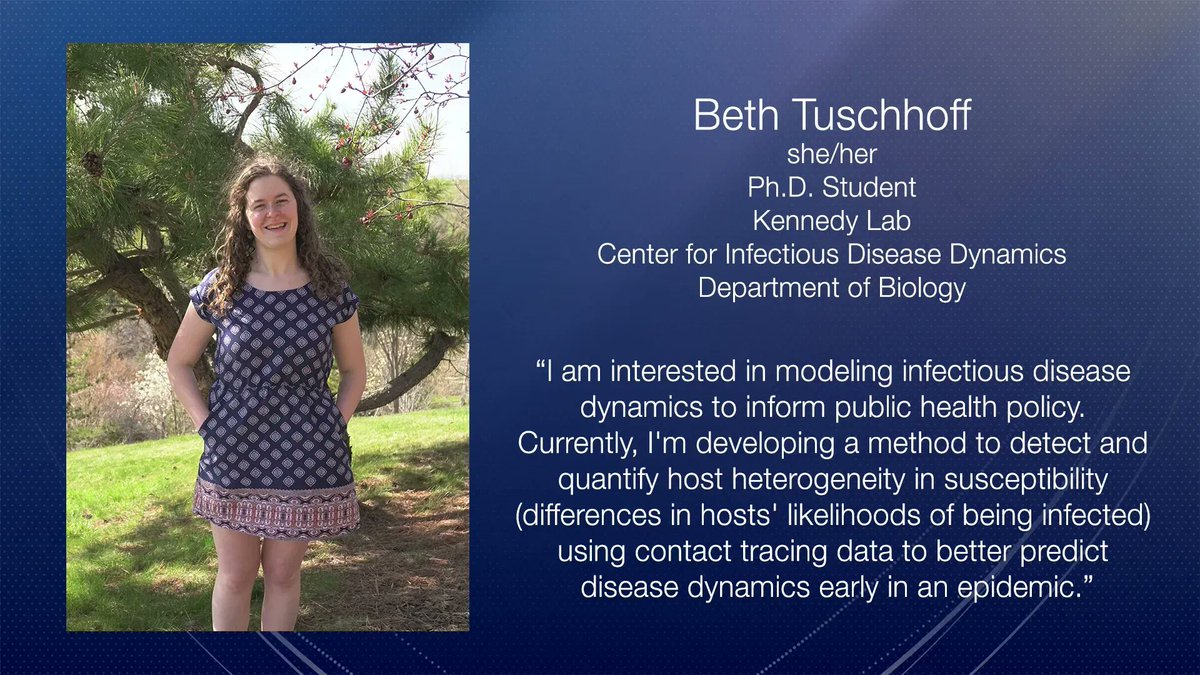
New paper led by grad student Beth Tuschhoff in JTB shows that when hosts vary, correlations between susceptibility and transmissibility can have large impacts on disease dynamics. Worth adding the Beth is currently looking for postdoc positions. https://t.co/jjyvPuVJOI
New preprint out from my lab. Work led by grad student Brandon Simony. The title is also the summary: "Spillover rate is not predictive of host jump risk". https://t.co/KjUPXm65dR
Congrats to Beth Tuschhoff on her first first-author paper, in which she developed a new method that uses contact tracing data to detect and quantify heterogeneity in susceptibility. Uncorrected proofs out today at @PLOSCompBiol https://t.co/IdpSwB0jLc
Hi all, I'm in search of contact tracing data. Specifically, where some individuals have been exposed more than once and infection outcome is known (ideally the exposures would be temporally distant, but don't need to be). Willing to investigate any leads you may have.
Long time in the making but it's finally out. Heroic effort by @amrita2989 and former undergrad Anton Aluquin exploring ecological correlates of drug resistance using the vast majority of human bacterial pathogens and the drugs used to treat them https://t.co/M1gQnZiDed
Congrats to Beth Tuschhoff on winning the best poster in "Microbiology, Immunology, Virology, and Infectious Disease" at Penn State's Life Sciences Symposium. Well deserved 👏
Parasites & pathogens have all sorts of effects on host phenotypes- from subtle to obvious! A new joint special issue in @FunEcology & @AnimalEcology digs into this topic. It was great fun to co-edit w/ lead editors @LaurenNadler & @binsan5@BES_Parasite
https://t.co/knlqz6bmpH
Forgot to tweet this right when it came out... recent paper from my lab argues that mortality costs are typically too small to constrain virulence evolution but behavioral costs aren't https://t.co/X376KkM3PG
Applications are now being accepted for the EEID2023 workshop on “Communicating Novelty and Controversy in EEID” from 20-22 May at Penn State
Details about the workshop and link to apply are here: https://t.co/lTjyHTpBb5
CLOSING SOON: Senior faculty (BLOOMINGTON, United States)
Multiple tenure-track faculty positions in the Department of Epidemiology and Biostatistics.
at @IUSPH
More details: https://t.co/N4ALbCAspK
Will a given spillover event peter out on its own or evolve to become the next pandemic, and how early is it possible to know? Reach out if you are interested in joining our group to work towards answering this using a novel empirical system (https://t.co/E9MAZVq0nr)
My lab is seeking a Research Technologist to assist with projects studying the ecology and evolution of viruses using the experimental system of nematodes and a virus that infects them. To learn more and to apply, click here: https://t.co/ubzvmOICOw. #PennState#Jobs#Hiring
New article out today led by @ClaraLShaw in which we we develop a novel empirical system for studying disease spillover and emergence. Currently looking to recruit grad students and/or postdocs interested in utilizing this powerful new system https://t.co/zpsN38JJGm
Looking to hire multiple postdocs: 1) Modeling a transmissible vaccine currently being used to control a chicken virus, 2) Experiments in a new model system (a nematode virus) to understand drivers of host jumps. I'll be at EEID the next few days, but also available by DM/email
Proud to be a part of a Focused Issue in The American Naturalist, overseen by Bret Elderd, Nicole Mideo and Meg Duffy. Our part: Can Eco-Evo Theory Explain Population Cycles in the Field? (plot spoiler: yes, w/ statistical computing).
@duffy_ma@nmideo@JRM_theory @ASNAmNat