This is one of the best primers that exist on the data center and AI industry right now
If you want to better understand the unit economics of each layer in the AI stack, I highly recommend you give this a listen
Chase Lochmiller, CEO and Co Founder of Crusoe, breaks down the inputs and outputs of data centers at a granular level
Shoutout to @apoorv03 for hosting yet another fantastic class
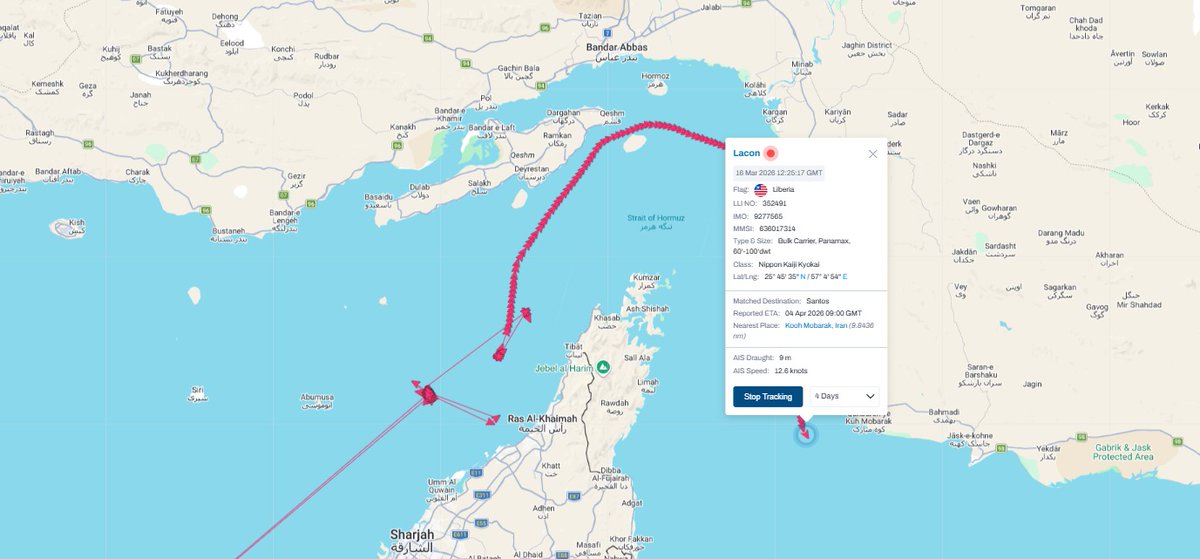
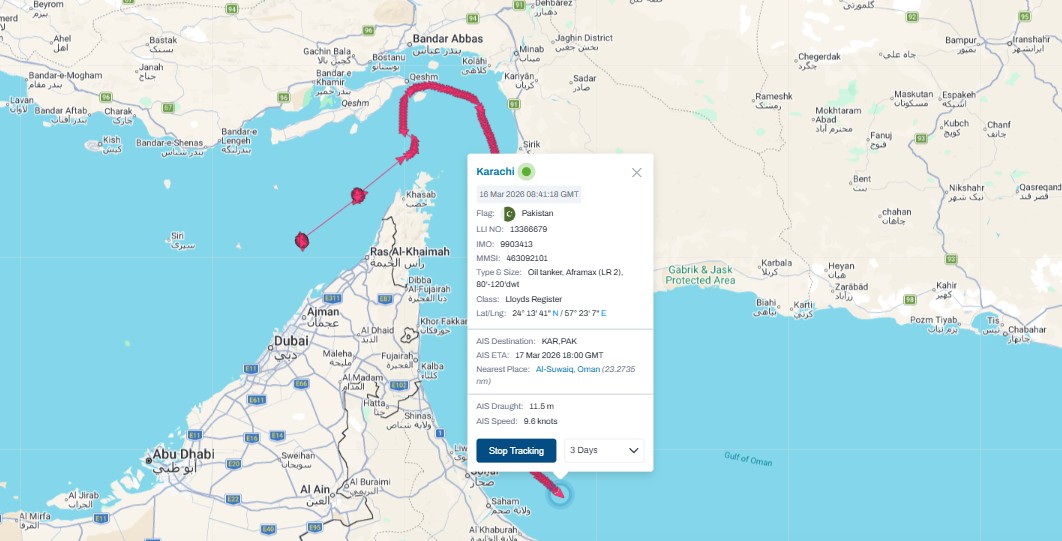
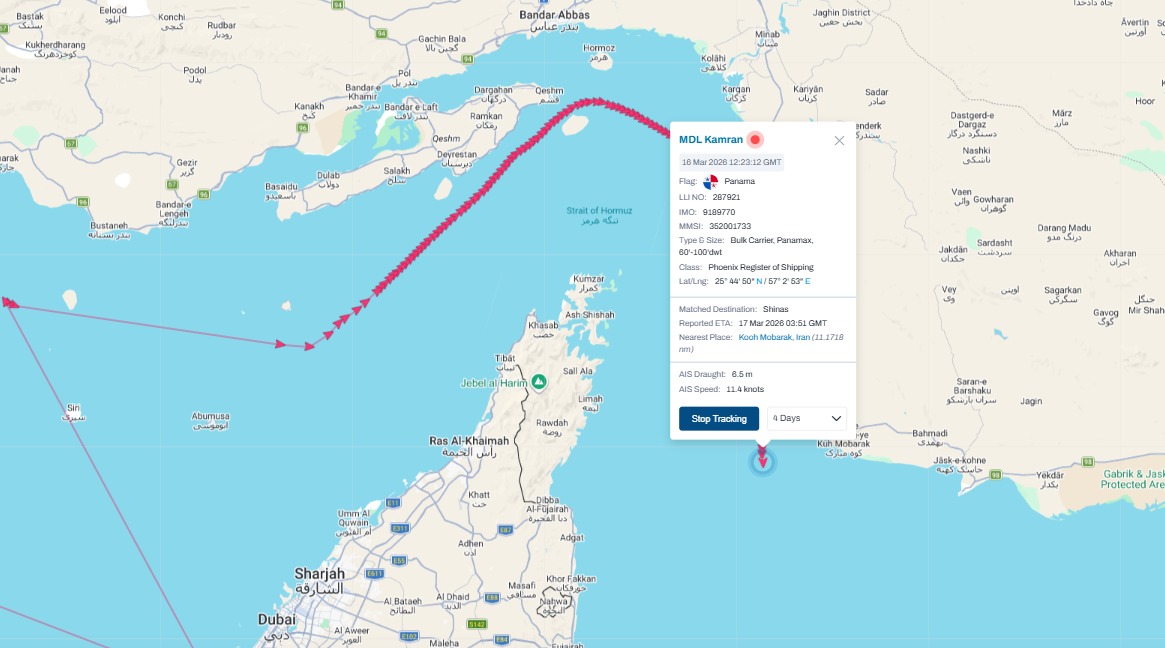
CONFIRMED - Iran is allowing select vessels transit the SoH after verfication
At least 4 vessels have transited outbound voa the Strait of Hormuz in the past 24hrs with a short diversion via the Larak-Qeshm Channel.
This appears to be a verification process whereby Iran confirms the ownership, cargo and vessel are not US, or belongs to those that Iran has permitted transit to.
The ships that have passed are 3 bulk carrier (2 Greek / 1 Indian) and one aframax tanker (Pakistan).
‼️Dubai Physical crude is trading at around $45 premium to Brent (as flagged by @ryanlemand) on our show today - with futures not necessarily reflecting the tightness in physical markets
Kirill Dmitriev just posted "paper will catch up to physical"
Keep an eye on the physical market
Foreign PM: I just realized there is a huge amount of wash trading in your market. The liquidity doesn’t look real.
Me: Interesting. How can you tell? Teach me how to differentiate fake liquidity from real liquidity.
Foreign PM: It’s not that hard if you look closely. Real liquidity comes with broad participation, consistent volume across brokers, and meaningful turnover relative to free float. What I see in many Indonesian stocks is the opposite: very small effective free float, the same brokers trading back and forth, large price moves on extremely thin volume, and order books that appear deep but disappear the moment real money tries to execute. That’s classic wash trading.
Me: So the liquidity is essentially manufactured?
Foreign PM: Exactly. It creates the illusion of activity, but when real institutional money tries to enter or exit, the market cannot absorb the flow. That is why global investors focus so heavily on investability, which is the core reason MSCI repeatedly highlights free float, liquidity quality, and ownership transparency when assessing markets like Indonesia.
Me: That explains why many foreign funds struggle to deploy capital here.
Foreign PM: Yes. Institutional investors are not just looking for growth stories. They need trustworthy market structure. If liquidity is dominated by circular trading among related parties or nominee accounts, the market stops functioning as a proper price discovery mechanism. It becomes a stage where prices can be pushed around without genuine demand or supply.
Me: Which ultimately hurts the credibility of the entire market.
Foreign PM: Precisely. When international investors see widespread wash trading, they treat it as a structural risk. It signals that a portion of the market’s liquidity may be synthetic rather than genuine. Over time that discourages serious capital from entering the market, because investors know they may not be able to exit positions without moving the price dramatically.
Me: So the emphasis on investability is not just technical. It is about trust.
Foreign PM: Exactly. Without transparent ownership, adequate free float, and real trading depth, the market becomes vulnerable to manipulation. If those issues persist, the outcome is predictable: fewer global investors, lower credibility, and a market increasingly driven by insiders and short-term speculation rather than long-term capital.
Me: That doesn’t sound like a healthy equilibrium.
Foreign PM: It isn’t. And unless the market structure improves, the perception that a portion of Indonesia’s liquidity is manufactured through wash trading will remain a major obstacle for global investors.
For anyone who still doesn't get what it means for Hormuz to be blocked...
They won't last two weeks max. Iraq, Qatar, and Kuwait have already stopped pumping, and UAE and Saudi are next.
What happens if food security starts getting hit too? Time is ticking.
#oott#iran
Day 7 of #Iran vs. U.S./Israel conflict (focus on Iranian strategic narrative):
🔹The United States significantly escalated its air campaign. U.S. B-2 bombers reportedly dropped multiple bunker-buster bombs on deeply buried Iranian missile facilities.
🔹CENTCOM reported that over the previous 72 hours U.S. forces had struck around 200 targets in Iran and also destroyed dozens of naval assets. According to U.S. officials, Iranian ballistic missile attacks have decreased sharply.
🔹Israeli operations also intensified. Reports indicate that roughly 50 Israeli fighter jets were used in strikes targeting an underground command facility believed to be connected to Iran’s leadership emergency command network.
🔹Iranian sources acknowledge that major missile infrastructure has been damaged, including production and fuel facilities such as the Khojir complex near Tehran.
🔹Tehran, however, remains defiant. Iranian officials claim that the new phase of the war involves the use of more advanced missiles, including Khorramshahr-4, Kheibar Shekan, and Fattah, which have already been used in recent waves of attacks, some of which have successfully hit their targets in Israel.
🔹This pattern aligns with earlier assessments that Iran initially focused on degrading early-warning radars and interception systems before deploying its most advanced missiles.
🔹The spokesperson of Khatam al-Anbiya headquarters of the armed forces openly mentioned that targeting radar and early-warning networks was a core element of the first phase of the war.
🔹Iranian state-affiliated media also argue that the United States may eventually face shortages of interceptor missiles because of the cost, complexity, and production time required to replenish them.
🔹Meanwhile, Iranian attacks against U.S. targets in Iraq continued, including strikes on bases hosting American diplomatic facilities near Baghdad International Airport.
🔹Hezbollah has continued its involvement in the war, with some Iranian analysts arguing that Hezbollah’s early participation may have been a preemptive move intended to prevent Israel from launching a surprise campaign against its leadership.
🔹Iranian officials have also warned European governments against joining the conflict, stating that any country participating in attacks against Iran would become a legitimate target.
🔹On the diplomatic front, reports suggest that China may be considering providing Iran with financial assistance or logistical support, although Beijing remains cautious due to concerns about energy security.
🔹China is also reportedly negotiating with Tehran to ensure safe passage for Chinese oil tankers and LNG shipments through the Strait of Hormuz.
🔹These developments highlight China’s dual challenge of protecting its energy interests and undermining America’s strategic capacity while avoiding deeper involvement in the conflict.
🔹Iran’s warnings toward the KRG in Iraq have intensified. Tehran has publicly threatened to target all facilities in Iraqi Kurdistan if Kurdish insurgent groups launch attacks against Iran from that territory.
🔹The Kurdish dimension is becoming increasingly important. Iranian analysts fear that Kurdish, Baluchi, Arab separatist, and other transborder militant groups could be mobilized by the U.S. and Israel as proxy forces against the Iranian state.
🔹Meanwhile, tensions with Azerbaijan continue following drone incidents in Nakhchivan, which Iranian officials insist were not carried out by Iran and were false-flag operations.
🔹This episode has raised concerns in Tehran that Baku could use this as a pretext to initiate its own ground incursion into Iran, alongside ethnic insurgent groups.
🔹The war is also increasingly affecting global energy markets. Gulf officials warn that if the Strait of Hormuz remains disrupted for several weeks, oil prices could rise to around $150 per barrel.
🔹China has also become more concerned about energy disruptions, as the conflict has already affected a significant share of global LNG flows and a large portion of China’s imports.
🔹In response to Iranian attacks, the UAE is reportedly considering freezing billions of dollars in Iranian assets held in the country.
🔹At the same time, South Korea has confirmed discussions with the United States about potentially redeploying Patriot air-defense systems to the Middle East.
🔹These moves suggest that the war is placing increasing pressure on U.S. air-defense stockpiles and regional security architecture.
🔹Meanwhile, reports indicate that Russia may be providing Iran with intelligence on U.S. military positions in the region, marking the first indication that another major U.S. rival may be indirectly supporting Tehran.
🔹If accurate, such intelligence sharing could help explain why some Iranian strikes against U.S. assets have appeared more precise than expected.
🔹The humanitarian impact inside Iran is becoming more visible. Iranian authorities report that thousands of civilian structures—including homes, schools, hospitals, and public facilities—have been damaged or destroyed in the ongoing strikes across the country.
🔹According to the Iranian Red Cross, attacks since the start of the war have hit 3,090 residential homes, 588 commercial and service centers, 14 medical facilities, and 9 Red Cross sites across the country.
🔹UNICEF has reported that at least 180 children have been killed and hundreds wounded in the strikes, highlighting the growing civilian toll of the conflict.
🔹Also on the domestic front, authorities continue to warn against domestic dissent. The intelligence ministry warns that those who threaten the country’s security will be treated as “Israeli soldiers”.
🔹Overall, Day 7 indicates that the conflict is evolving from a primarily aerial campaign into a broader strategic struggle involving proxy warfare, intelligence operations, continued energy disruption, and potential geopolitical realignments across the region and beyond.
Well, I have called just about everything significant that has happened the last 26 years.
It's hard to say I've never had the timing right.
I was short Amazon at the top in 2000.
I went way long small cap value in late 2000.
I bought AAPL in 1998 and then again in 2002.
In 2003, I got into Korea stocks before a big run.
In 2004, I got into China stocks before a big run.
In 2004, I got into oil before a big run.
I bought gold in 2005 and still 20 years later...
In summer 2005, I figured I was buying 5 years swaps on something would print within 2, and it did.
In 2008, October, I told my investors it was time to buy. More stocks bottomed then than in March 2009.
In 2009, I invested in Almonds/Water, it worked ok.
In 2013, I moved to buy Bitcoin after meeting with a friend at Lightspeed. I should have. Slept on it and did not.
In 2015, I bought NVDA. The CFO knows.
In 2018, I started pounding the table on Japan and opened a Japan fund, which I had to close for COVID.
In late 2019, I warned indexing and passive investing would make for very corrlated severe drawdowns in the market, and COVID hit 6 months later, we got the most correlatedl, sharp decline in modern history.
Early 2020, I entered 2020 very short. Which worked.
During early COVID I loaded up on stocks and had nearly a 100% year for the fund.
In 2020, I called lockdowns would be disastrous for women and children, and went on Twitter to say it.
IN 2020, I got GME to buy back 1/3 of its stock and change its board. Did ok.
July 2021, I gave Barron's an interview to warn on specific meme stocks at the top, and they crashed through Dec 2023.
2021, I warned about very high inflation from the policies that were being undertaken.
2023, I warned people to sell because I saw the banking crisis coming. I told them all was clear at the bottom in March as I could see it wouldn't be contagious.
2020s, I shorted Tesla, but these were trades, and it was volatile. I did not lose money overall shorting Tesla. Had some really big quick wins. Plus Tesla is only worth about $120.
I am not perfect, I did not hold AAPL or NVDA long enough, in 2025 we were up almost 100% again by Liberation Day, and I lost most of the gain (still up about double digits for the year at closing) but I would put the calls I've made over these decades up against anyone.
I would add visual proof for all this, but it is too much for this medium.
I'm Boris and I created Claude Code. Lots of people have asked how I use Claude Code, so I wanted to show off my setup a bit.
My setup might be surprisingly vanilla! Claude Code works great out of the box, so I personally don't customize it much. There is no one correct way to use Claude Code: we intentionally build it in a way that you can use it, customize it, and hack it however you like. Each person on the Claude Code team uses it very differently.
So, here goes.
Many seem to have missed that prior to Trump's Liberation Day, VN effectively paid around 9.4% in tariffs on US-bound exports (WTO stats). Thus, under Trump’s new headline 20% tariff, the additional burden of 10.6% is only just above his stated baseline minimum of 10%.
Sociology professor Daniel Chambliss, who spent years researching the qualities of elite swimmers, on what creates excellence:
"Excellence is mundane. Superlative performance is really a confluence of dozens of small skills or activities, each one learned or stumbled upon, which have been carefully drilled into habit and then are fitted together in a synthesized whole. There is nothing extraordinary or superhuman in any one of those actions; only the fact that they are done consistently and correctly, and all together, produce excellence."