The status quo on homelessness is not working.
Chronic homelessness is up 80%, while funding has more than doubled.
Under @POTUS' leadership, HUD will define success not by dollars spent, but by how many Americans achieve self-sufficiency.
Historic policy change and win!
Housing First didn't fix homelessness - it created a funnel for NGO grift, and bad incentives.
We've been saying this for years. Now it's federal policy.
Good breakdown from @CiceroInstitute on the biggest change to homeless policy in decades.
Housing First had a 20-year run and $4 billion a year. The federal government just killed it.
This will change homelessness in every city in America – including yours.
Housing First activists sued over the last attempt at major reform. But this time, they’ll have an uphill battle.
Here's what you need to know:
While people vote today in California, I'm heading back to Washington DC to meet with @HUDgov and attend a @InstituteCicero conference on homelessness. We need solutions to the homeless/drug crisis and I'm committed to working with anyone who wants to make that happen.
A major report to Congress on homelessness dropped last week. The Homelessness Industrial Complex is celebrating. They shouldn’t be.
Here's what they don't want you to notice:
Every year, on one night in January, HUD works with local agencies to count homeless people.
In January 2024, homelessness hit an all-time high. In January 2025, it was still close to its highest level ever.
Calling a 3% drop in homelessness between 2024 and 2025 “success” makes no sense.
Since Housing First became federal policy in 2013:
- Total homelessness: +27%
- Unsheltered homelessness: +36%
- Chronic homelessness: +81%
- Taxpayer-funded beds: +151%
- Federal CoC spending: +111%
Does that look like success to you?
On top of this, in January 2025, HUD counted 155,750 chronically homeless people. That’s the highest number of chronically homeless people ever recorded.
The chronically homeless need serious help. Many are addicted to drugs or mentally ill.
There are more of them than ever.
The 3% dip in overall homelessness is almost entirely explained by a decrease in the number of asylum seekers in Chicago and New York (due to stronger federal immigration enforcement).
Housing First didn’t suddenly start working after more than a decade of failure.
The sooner homelessness activists reckon with this fact, the better.
It’s… a diversion program.
One day you will realize that your rhetoric has alienated you and your movement. If you were even just 20% more reasonable I bet we could find some common ground.
Instead, we’re building new coalitions with people who used to be our critics but who would rather work with us than listen to you.
Dropped in to @homeless_law’s webinar to check out what they had to say about our work in Louisiana and wow, what a warm welcome!
Thanks for always being willing to engage in constructive dialogue. Even when we don’t always agree, it’s nice to know that doesn’t have to divide us!
Yes, studies show the vast majority of the street homeless, somewhere between 2/3s and nearly 100%, abuse drugs or alcohol.
@Spencerpratt and most Americans' commonsense intuition about this is right and the activists are wrong. My latest @Nypost.
https://t.co/IMAXPdoaSg
Homelessness NGOs can't stop using ridiculous rhetoric to smear policies that work. What are they trying to stop you from seeing?
Cicero's @dkurtzz talks sensible homelessness policy and the activists that love to hate it with @kyleegriswold of @FDRLST.
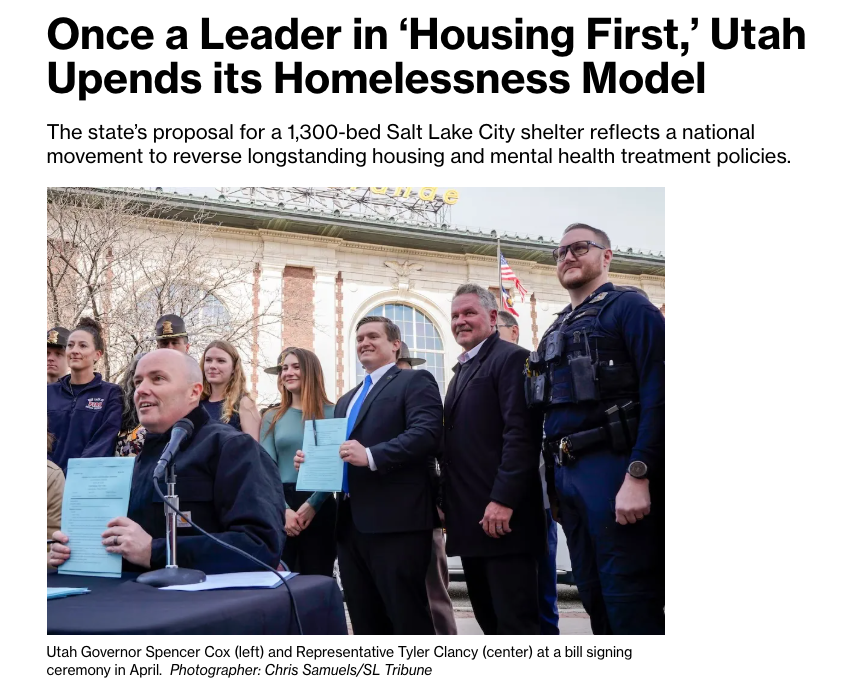
Utah proposed a Salt Lake City homeless 'campus' with an involuntary treatment element. The plan is in limbo, but the movement behind it may be just getting started https://t.co/toiEx1rxX9
“The very foundation of the Housing First consensus is wrong.”
@Bloomberg@CityLab writes about Utah's rejection of failure on homelessness, featuring @Clancy4Utah, Cicero's @dkurtzz, and others fighting for real solutions that tackle street camping, mental illness, and drug addiction.
I’ve seen Housing First fail my own family.
A bed is a band-aid that only benefits the homeless industrial complex.
HUD will treat the root causes of homelessness, not enable it.
.@GovStitt couldn’t be more right. This is a huge step forward for public safety in Oklahoma.
Even when state lawmakers take action to address homelessness, some cities would rather let people keep suffering on the street than enforce the law. In Oklahoma, that’s about to change.
HB 3985 gives residents a way to fight back when cities refuse to address the homelessness crisis. Watch his explanation of how it works.
The leadership of Rep. Caldwell (@Trey_OK63), Sen. Daniels, Sen. Paxton (@senatorpaxton), and Rep. Hilbert (@kylehilbert) made this win possible for the people of Oklahoma.
@DeborahGeesling@kevinvdahlgren Agreed completely. States need to step up until IMD can change.
And title II of the ADA needs to be re-examined, re: need.
Both sides of Housing First sidestep key problems:
1. The IMD Exclusion. Even our faith organization can’t serve the most severely mentally ill. Must expand safety net, end it.
2. Involuntary treatment standards must match need. People like @kevinvdahlgren have documented that need thoroughly. What we lack is will to do the right thing.
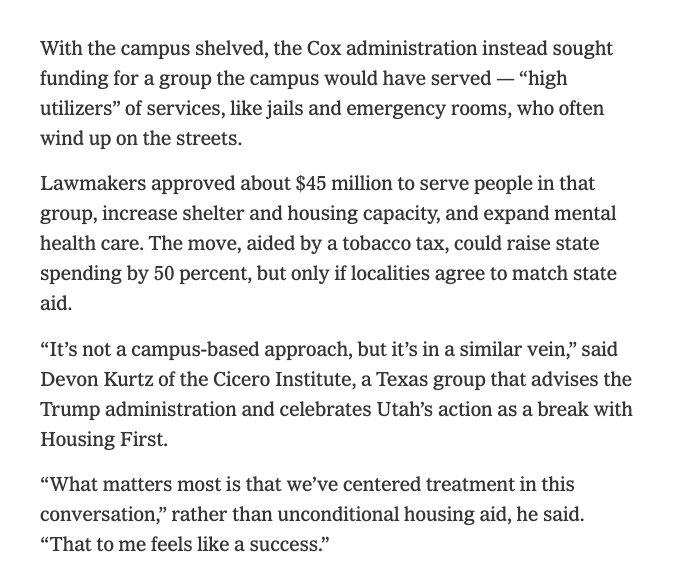
Earlier this year, Utah dedicated $45 million to the new treatment-focused approach to homelessness endorsed by the Trump administration.
As an article in today's New York Times makes clear, @GovCox and @Clancy4Utah are courageously setting an example for the nation on this issue, despite complaints from defenders of the failing status quo.
The future of homelessness policy will emphasize mental health and addiction treatment. No one who is seriously interested in addressing the homelessness crisis can deny this.
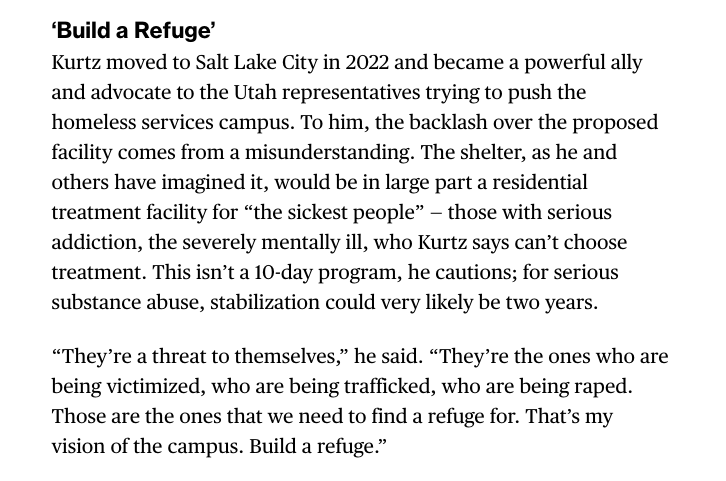
Cicero's @dkurtzz is quoted: