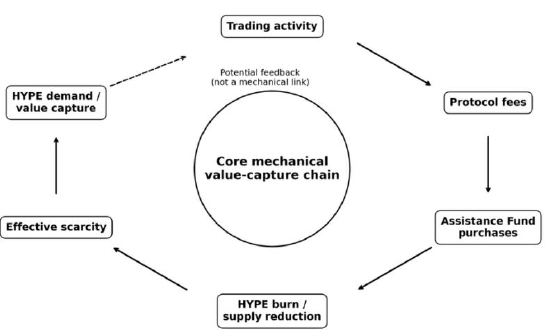
A reminder of $HYPE value capture mechanism
Not that different from $ENA with the recent governance change (when USDe supply hits $ 7.5bn, 95% revenue will be directed to $ENA buybacks + team is buying some VCs bags)
The real question is if $ENA buybacks will outpace inflation
That really depends on USDe growth and revenue
That’s the $ENA bet, finally a more pure product bet vs. what we had before (i.e., infinite inflation and no real value capture mechanism for $ENA holders.. essentially it was destined to zero)
Most neobanks will fail and churn their incentives chasing linear utility curves.
The fundamental category error founders are making is treating Regulatory Friction (Location) and Liquidity Preference (Asset Class) as correlated variables.
They assume that high-friction environments equal low-sophistication users, or that friendly environments equal high-adoption mass markets.
Scraping data from social media across regions and user types shows they are generally orthogonal with p95.
If you map fiat vs crypto friendly zones against fiat:crypto liquidity ratio (how much crypto do you hold vs your fiat wealth) we uncover interesting data pointing to the true crypto neobank user archetypes.
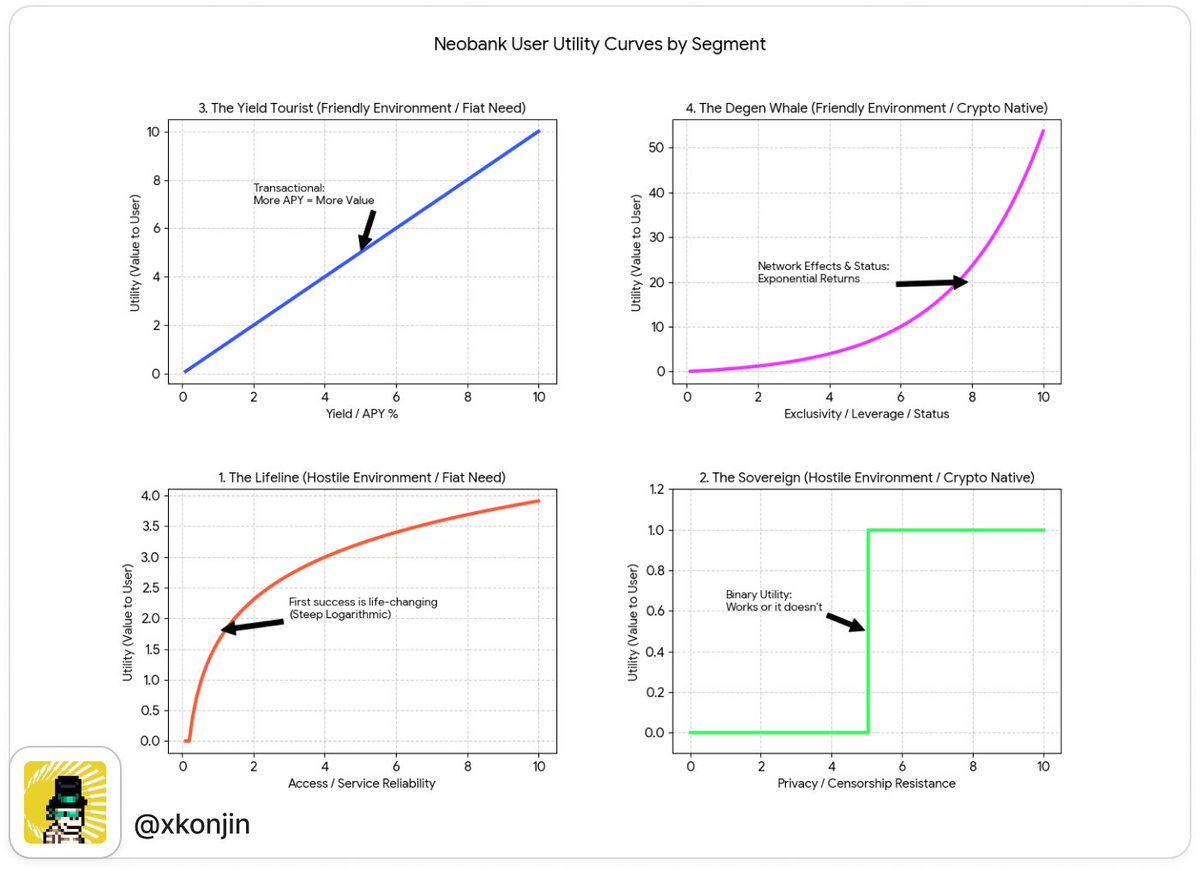
The majority of neobanks you see live on the market today are in the top left, chasing linear utility curves (much loved by @SlackHQ founder @stewart) with the same offers and churning incentives with no real moat.
This only appeals to the "Yield Tourist" (Friendly Env / Low Crypto Net Worth).
These users are mostly mercenaries. Their loyalty is rented, not owned. As soon as a competitor offers a higher basis point or two on benefits, they churn.
You are likely optimizing for a linear curve (more features = more value) when your optimal user is on a logarithmic or exponential curve (basic access = 90% value or whales seeking status such as the Atlas / Amex black cohort).
Real crypto neobanks need to go back to basics and solve real problems for crypto natives.
Can i pay my mortgage with my crypto?
Can i pay for my direct debit with crypto?
Can i treat my crypto like money?
These questions are different depending on where you live and your wealth status.
In reality, only two products will win in the long term.
Product A: Optimizes for helping crypto natives in traditionally hostile environments. It is boring, invisible, and bulletproof. It serves the Hostile Quadrant. It solves hard problems.
Product B: Optimizes for Asset Efficiency and status. It is flashy, complex, and status driven. It serves the Friendly Quadrant. It gives people a better experience while allowing them to do more with their crypto.
Most lie in a no-mans land in the middle, not quite as good as a high street neobank like revolut or cashapp, but not able to be used to truly life off grid.
The true crypto neobank dream is half finished.
The company that verticalizes the stack, closes the loop with merchants and crypto holders while allowing them to spend their crypto like money for real life things will win.
@andrewchen 's work on Allele metrics for closing local loops with Uber is relevant here.
Return to crypto.
Give people freedom to live with their crypto.
Own your stack, close the loop, set people free.
Caveat: This is not a dig at current neobanks, we are so far ahead of where we were just a few years ago and this is a positive sum industry, we win together by overturning legacy systems.
Make no mistake, incumbents will shut down your accounts whether they accept stablecoins or not.
Introducing $ASTER. 🌟
$ASTER is the native token of Aster and will be used to decentralize governance, drive growth, reward participation, and support long-term protocol sustainability.
TGE is scheduled to go live at 17 Sep 2025.
Here's a deep dive into $ASTER. ⤵️
PULSE IS LIVE!
→ https://t.co/HqCyKxMe0I
Our beta launch introduces 2 projects and a 0.5% + $90K reward pool across their respective Pulse campaigns.
Let’s break down why InfoFi needed a Pulse Check and what awaits the first wave of Pulsooors ⬇️
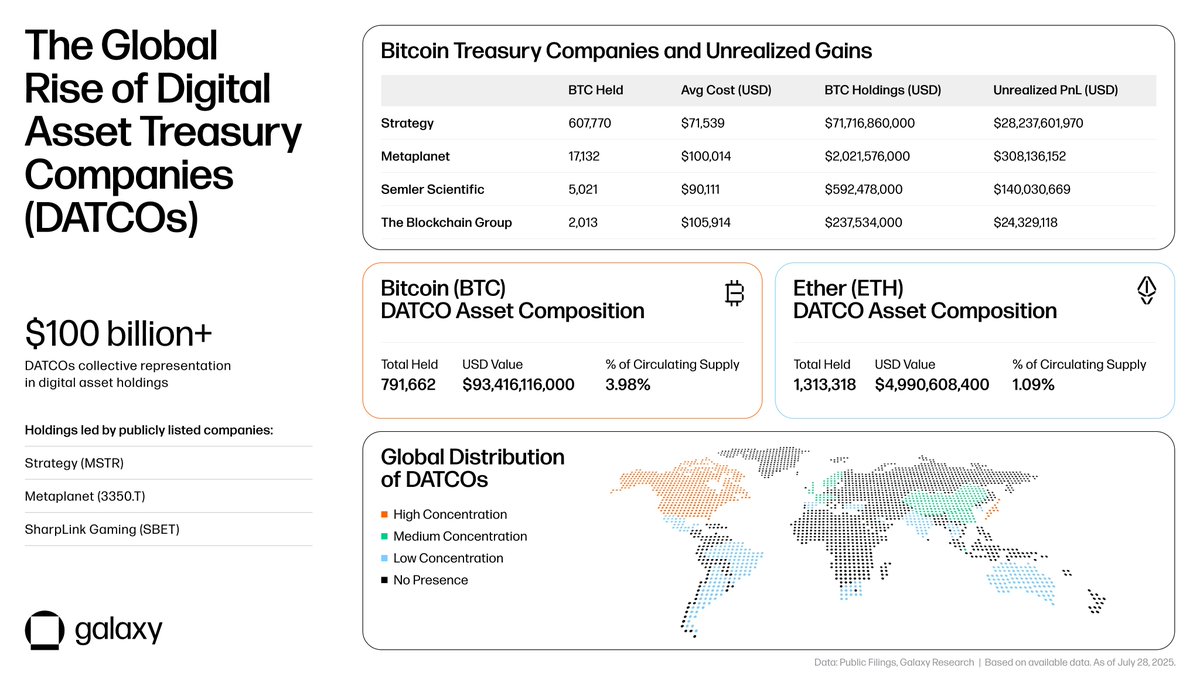
The Rise of Digital Asset Treasury Companies
A new wave of public companies is using crypto as a capital strategy.
$100B+ in BTC, ETH, & more
Here's what you need to know 🧵
So much of getting your first win is copying what's already working...
Cal AI - $2m /month
Cal AI copycats - $3m+ /month
Same goes for many other categories
a16z’s @dhaber: “AI is making markets that weren’t attractive to software companies suddenly very compelling.”
Speaking at Mind the Tech New York, @a16z's general partner discussed AI’s impact and why automation is redefining entire industries.
https://t.co/Z5rHtzPZ4g
The new meta in crypto scamming is becoming a shadow cofounder
The playbook is simple, they get someone talented from their networks to be the face of a new scam while they do everything in the background
A few of the biggest scammers of this cycle are already doing this
Ideas are what matter now. What you have to say and how you choose to say it. Fighting that is your choice but it’s like fighting the ability to create in ways you haven’t dared to imagine since preschool fingerprints. You’re only limiting yourself.
What happens if high quality AI models become free, ubiquitous, and inexpensive to run on even low-spec hardware?
(1) First, you can rebuild every productivity app AI-first. That starts with Microsoft Word, Google Sheets, and Apple Keynote. But it extends to wholly new kinds of productivity apps.
(2) Second, every “smart” device becomes truly smart. Your fridge can double as your nutritionist. Your alarm clock is your sleep therapist. And so on. Just like your car is already your driver.
(3) Third, moats move to the app layer. As others have remarked, the GPT wrappers may end up more defensible than the GPT model itself.
(4) Fourth, physicality becomes relatively more valuable. The hardware, the secure real estate, the in-person community — these are all things digital AI can’t deliver.
(5) Fifth, high human IQ actually becomes increasingly valuable. Because AI is really amplified intelligence rather than truly agentic intelligence, since it requires the creative prompt to get started.
(6) Sixth, prompt engineering is here to stay, because prompting is programming — just in a higher-level language.
(7) Seventh, the most common form of AI doomerism is proven false, because we are getting decentralized ubiquitous AI rather than centralized monotheistic AI. More like a garden of smart things than a vengeful Old Testament God that’ll turn you into paperclips.
(8) Eighth, the combination of cuts to US “industrialized” academic research at the same time AI models accelerate discovery will mean a return to individual gentleman scientists and the advance of desci (decentralized science).
(9) Ninth, the complement to probabilistic AI is deterministic crypto. For captchas, for identity, for money, for all these things — crypto is the digital scarcity that AI can’t fake.
(10) Tenth, the main cost of software development may reduce to reducing the costs of the physical environment. That is: to providing society-as-a-service, to simply giving engineers time to type and experiment in peace. This was already so, but may become even more so.
Several of these points have been made by others, but I think that collectively they help define the second mover era.
there is a lot of wisdom in this thread.
joe coaches the research and compute teams at openai; i super enjoy working with him. one superpower is that he deeply understands emotional clarity and how to get there; this will be one of the most critical skills in a post-AGI world.