I’ve come to the conclusion that the only worthwhile goals in 2026 are:
1. don’t die, like @bryan_johnson
2. spend free time working with and learning AI agents
3. ensure my immediate family members do the same
My unfiltered thoughts on personal agents.
Grokbot has the best UI and it’s arguably the best overall. In a lot of ways they’re ahead. Their desktop app feels the best, and their multi-bot coordination is great: you can set a team lead and it passes tasks to the other bots. Grokbot also has the best “webhook” feature, which means you can easily turn outside events into triggers that start your agents. That speeds up background workflows like watching your email, Slack and more. It also has Cursor integration, so for bigger tasks Grokbot can spin up a Cursor cloud session with any model (until OpenAI cuts SpaceX off from their models, which I think will happen soon). Unfortunately, running frontier models through Cursor costs more than Claude or Codex. Still, they’re the only ones embracing a team of agents. It’s a really cool idea, but the more bots you have, the more time you spend managing and maintaining them. I’m starting to think one bot with different threads/channels is the right answer, which I’ll get to with Claude Duet.
dots by OpenAI is rough around the edges right now, but it’s probably the most powerful if you use Codex, which I do. dots can spin up Codex sessions in the cloud or locally on your computer. So if you have coding or video editing workflows that need your local files, this is very useful. Codex computer use is also the best in the world: your dot can spin up a local Codex session that fully controls your computer, as long as it’s on. Their real-time voice is incredible. If you have your email and work tools connected, try this: go on a walk with headphones in, ask the agent to summarize your emails, have it draft replies and read them back to you, then send them off. If I remember right, this is close to a workflow you (Tim) used to have with your VAs before AI. It’s my favorite use case for personal agents. The one downside is that you have to call your agent, and it’s an awful experience. It literally rings, and it’s annoying.
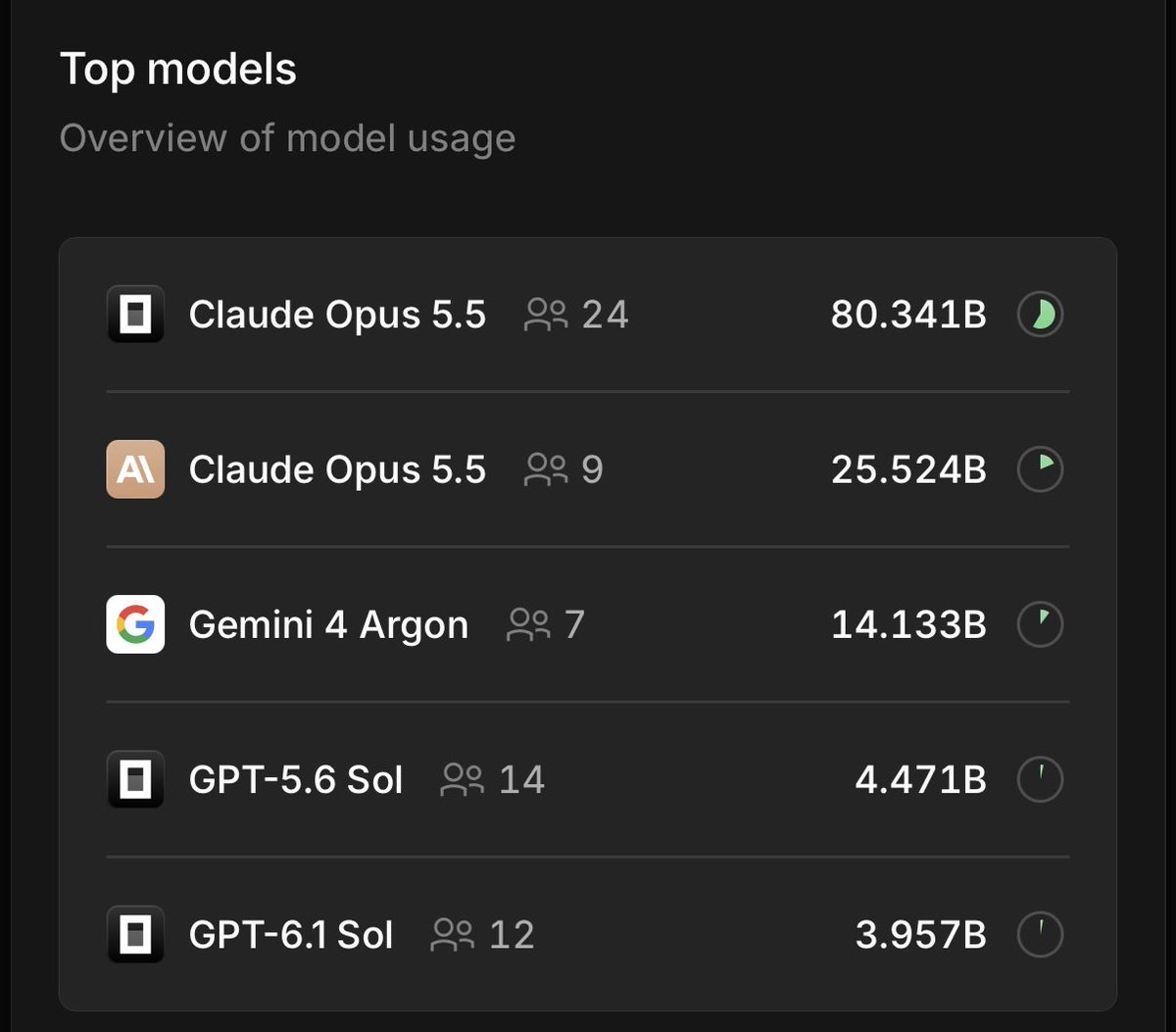
Muse by Meta is a toy. I’ve talked to a bunch of finance people I play poker with who all tried it and set up automations, and they all said it doesn’t reliably do what they want. It’s fast, and its user numbers will probably keep growing. But it’s basically free: you get a TON of usage without paying a dime. That’s NOT a trade I’m willing to make. An agent doing high-leverage tasks should be running at the Opus 5.5 or GPT 6.1 Sol level.
Claude Duet - is in early access, so unfortunately not everyone can use it yet. First things first, it runs on Opus 5.5, the best model in the world. I’ve only had access for 72 hours, but Duet feels different from the others. It’s not a personified agent like Grokbot, dot or Muse, which gives it a more professional vibe that I like. When you ask your Duet agent to do something, it spins up a task, which is a new chat thread. All your threads show up in a Tasks tab, so it’s easy to see everything Duet is working on or has finished. And instead of creating more agents (like Grokbot), you create channels, just like Slack (I can tell @anthropic is Slack-pilled). I have a content channel, a finances channel, etc., which keeps different kinds of tasks separate. The only other app I’ve seen do this is Buzz by @jack, and it’s a good experience. Their strong point is documents (artifacts). If you want decks, high-quality docs or design mockups, Opus just wins. Period. It’s not close right now. Their weak point is real-time voice. It’s the worst of the bunch and borderline unusable, though I think they only added it a few days ago.
Instinct lives in iMessage, has no app, and doesn’t do anything notable besides show you product suggestions you didn’t ask for. (Not ads, according to their team.)
My hot take:
The VM is overrated. SpaceX, OpenAI and Meta all talk about the VM your agent can use and feature it in their marketing. It’s not as useful as you’d think, because more and more websites block bots that visit their site on the cloud VM. All of these companies promise their agents can make payments, but most payments either take forever or get blocked altogether. SpaceX has a cool workaround with Grokbot that routes traffic through your computer so it uses your IP address. But I’d much rather the agent just USE my computer for the task, like dot does by handing it off to Codex. Also, i don't think normal people care about the virtual computer. If anything they get offended they have to "stream a computer".
The problem with personal agents: by the time you read this, pick one, and test it for 7 days, every one of them will have released 10 new features and the whole landscape will have changed. It’s nearly impossible to keep up.
@liorpesoa Nope, it’s like a full-time job to try to do it lol but I try my best. Codex usage is clearly way worse than Claude these days but they keep resetting unpredictably so I don’t bother anymore.
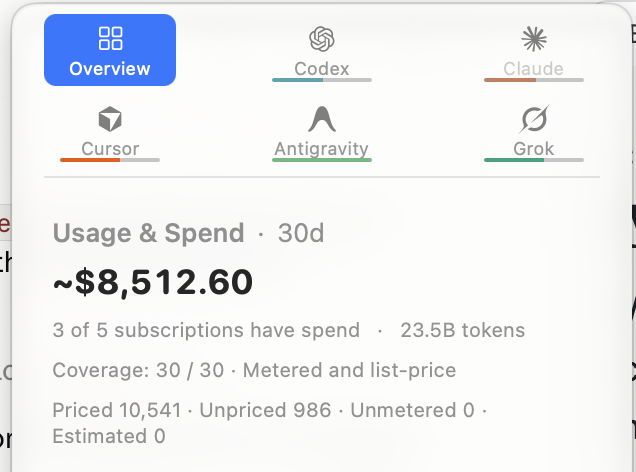
Claude max I’m pretty close to maxing weekly and that already takes a lot of work.
Current state of token maxing near YE 2026:
- Monthly subscriptions: Claude $200, ChatGPT $100, Grok/Cursor $30
- Since getting back to Claude in October I've been using it as my main coding agent instead of Codex.
- Opus 5.5 is just way better, and Claude Desktop app have gotten way better since I last tried it (since April I've been exclusively Codex)
- https://t.co/GyC63VWkUD / Cursor plan is mostly used by Grokbot
- Muse gives me enough usage on free plan so no reason to spend
- Have Instinct and a bunch of other agents too but hard to find unique use cases for them. These are just experiments.
- Got access to Claude Duet yesterday and so far it's looking very promising
- Initially really liked Dots from OpenAI but it's dropped off a lot for me, mainly because it's not great yet at managing many diff threads (unlike Duet)
- Still use Hermes agent to handle cases where I need it to access local files
- Mac Studio Ultra arrives in November and I plan to experiment with local agents via Hermes too
Why is it hard to imagine both semis and software do well in the future?
That's sort of my base case... I pivoted hard to add software while it was down in H1 and now I'm doing the opposite (take profit on software and buy more semis).
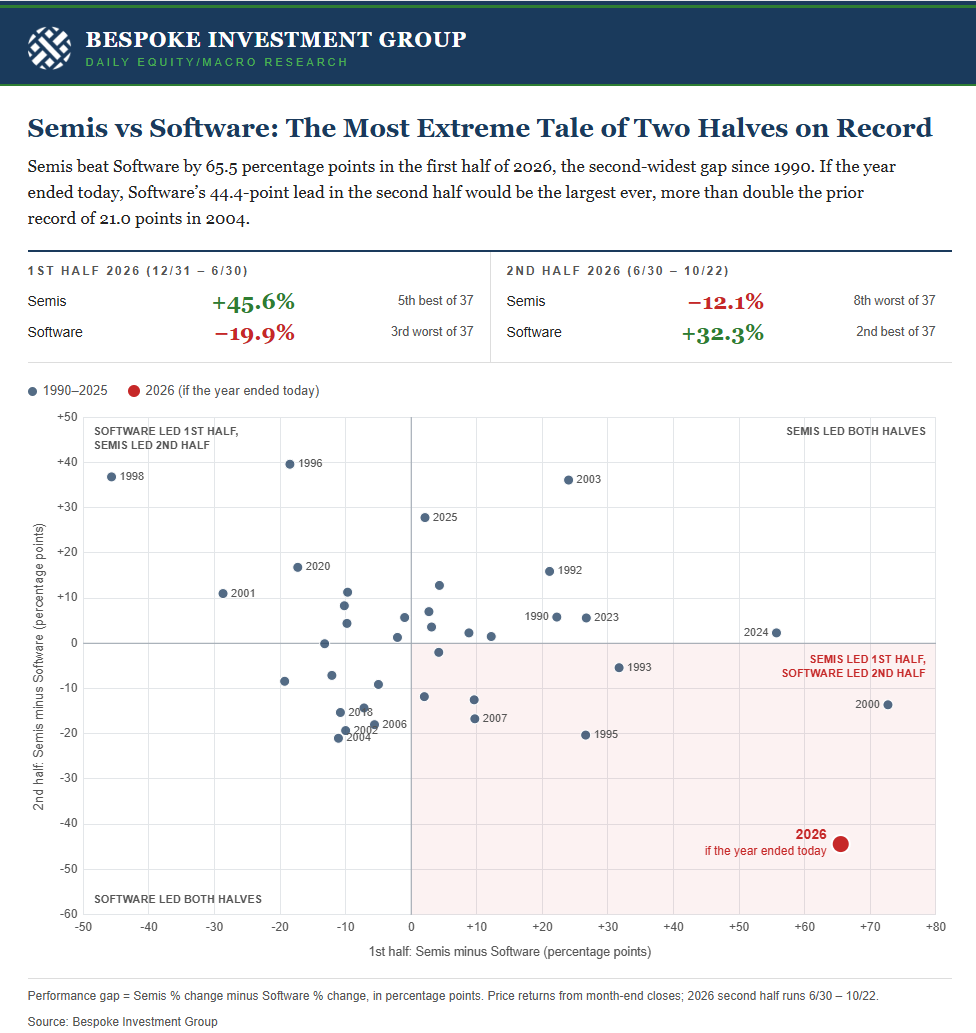
The semis beat software by 65 percentage points in the 1st half. Software is beating the semis by 44 percentage points so far in the 2nd half. The most extreme tale of two halves these two Tech groups have ever seen.
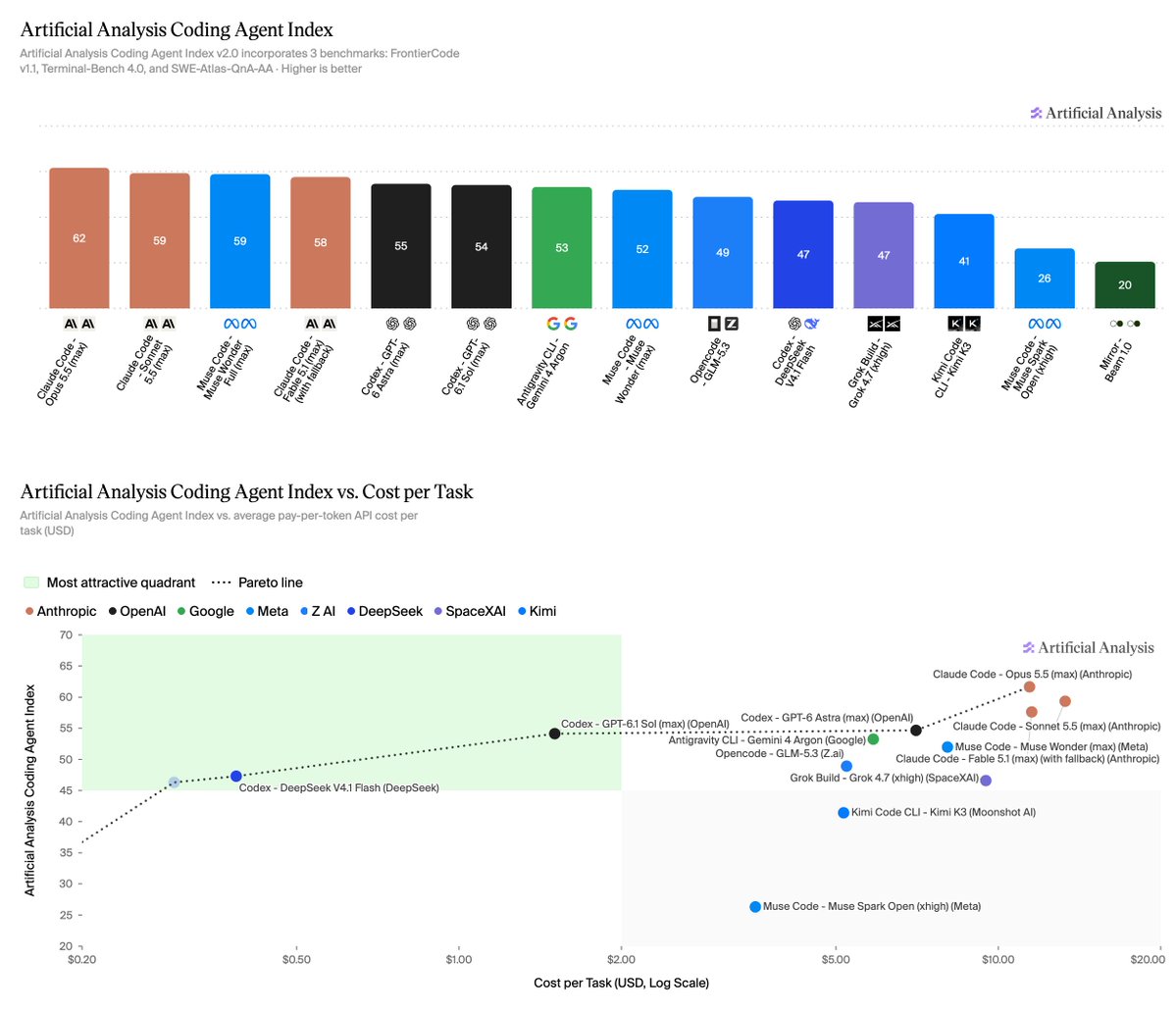
Announcing Artificial Analysis Coding Agent Index v2.0: FrontierCode v1.1 from Cognition replaces DeepSWE, SWE-Atlas-QnA grading is revised, and Claude Opus 5.5 in Claude Code leads at 61.7
Today we are launching v2.0 of the Coding Agent Index. The Index evaluates models together with their agent harnesses, now across 290 tasks covering software engineering, terminal use, and repository Q&A, with the three benchmarks weighted equally.
Changelog (Index v1.5 → Index v2.0):
→ FrontierCode v1.1 replaces DeepSWE v1.1. FrontierCode is a benchmark from @cognition with a private test set: 100 software engineering tasks on real open-source repositories, graded on whether a maintainer would merge the change. An attempt that fails a blocking check scores zero, and one that passes them all scores between 70% and 100% depending on the non-blocking checks it meets. We also scan each trajectory with a modified version of Cognition's rule-based scanner, and any attempt flagged for accessing solution material scores zero.
→ Revised SWE-Atlas-QnA grading, now SWE-Atlas-QnA-AA. Scale AI's 124 repository Q&A tasks are unchanged. We reworded 127 of the 1,306 rubric criteria for more consistent verdicts and moved to GPT-6 Luna (xhigh) as the judge, with five votes per criterion. The dataset and judge configuration are published on Hugging Face.
Key results:
➤ Claude Opus 5.5 leads the Index: Claude Code with Claude Opus 5.5 (max) scores 61.7, followed by Claude Code with Claude Sonnet 5.5 (max) at 59.3, Muse Code with Muse Wonder Full (max) at 58.9 and Claude Code with Claude Fable 5.1 (max with fallback) at 57.6.
➤ FrontierCode v1.1 is where Opus 5.5 pulls ahead: Opus 5.5 scores 56.0% on FrontierCode, ahead of Codex with DeepSeek V4.1 Flash (max) at 52.6%, Codex with GPT-6.1 Sol (max) at 49.4% and Codex with GPT-6 Astra (max) at 49.3%. Below the top, FrontierCode scores are tightly packed: 15 of the 24 configurations on the Index score between 43% and 49%.
➤ SWE-Atlas-QnA-AA grading is stricter and more consistent: across the 21 configurations evaluated on both Index versions, the mean score falls 1.7 points, from 58.8% to 57.1%, with 14 of 21 moving down. Individual configurations move by up to 7 points: Muse Code with Muse Spark Open (xhigh) falls 7.0, Kimi K3 in Kimi Code CLI and Codex with GPT-6 Luna (max) 6.2, and Muse Code with Muse Wonder (max) 5.6, while Codex with GPT-6.1 Sol (max) gains 2.1.
➤ Four configurations sit on the cost frontier: Codex with DeepSeek V4.1 Flash (max) scores 47.3 at $0.39 per task, Codex with GPT-6.1 Sol (max) 54.1 at $1.50, Codex with GPT-6 Astra (max) 54.7 at $7.04 and Claude Code with Claude Opus 5.5 (max) 61.7 at $11.42. Costs are pay-per-token API costs, not subscription prices.
We will keep updating the Coding Agent Index incrementally, with more evaluations and agents to come.
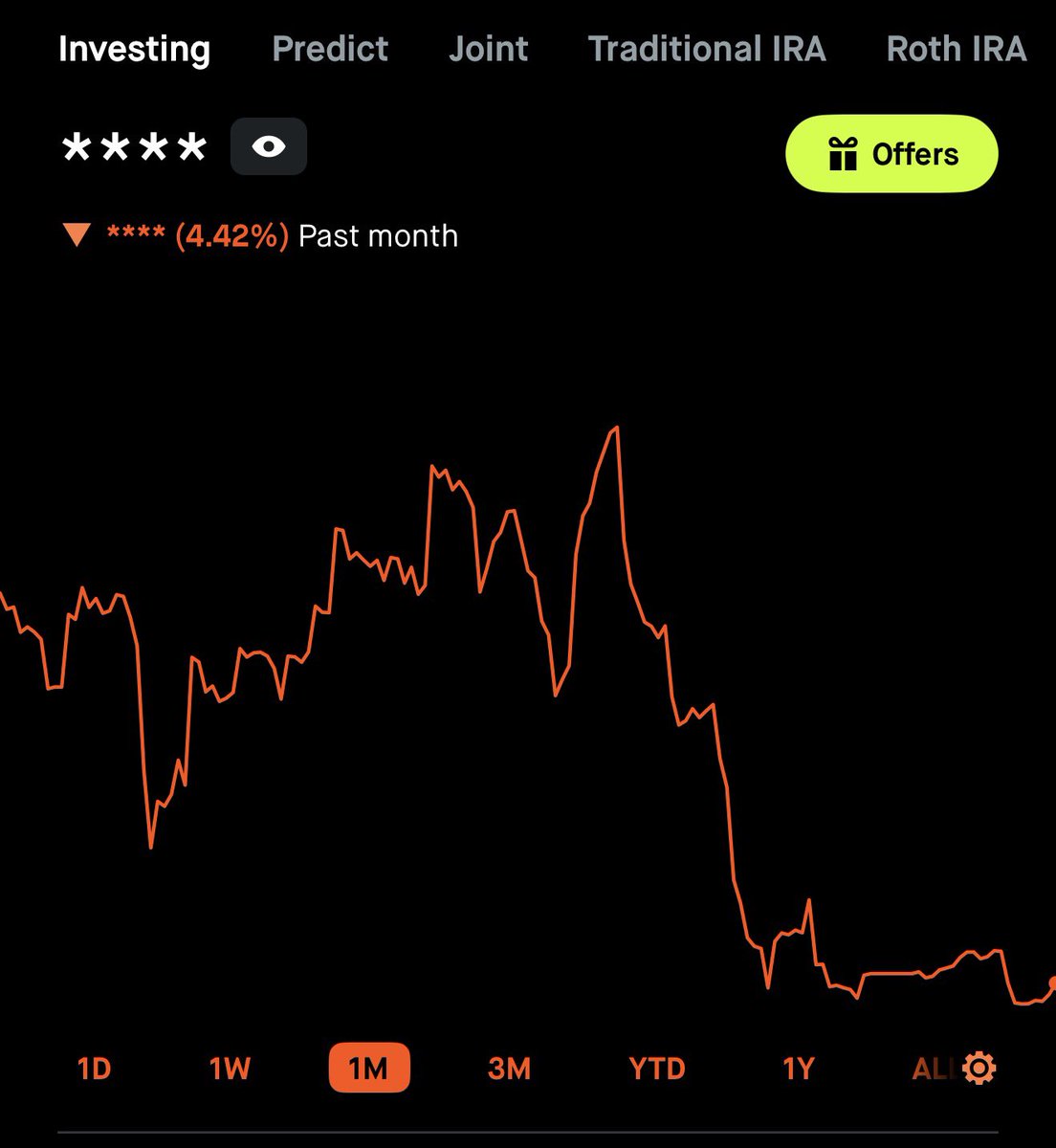
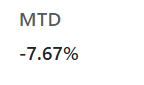
I believe this would be a great time to if your show % PnL
Showing dollar loss doesnt do the justice.
This could easily mean that half of your portfolio got snapped in half and you're down 50%?
I will go first:
MTD: -7.67%
From the peak: -14%
Nonsense is exactly right.
Maybe in some future time, we could have a scenario where supply outstrips demand (hard to imagine based on currently trajectories but anything is in theory possible), but "at the moment" we absolutely do not have more compute capacity than we have demand.
Clearly a lot of compute capacity has come online and even more will come in coming years. Meanwhile, compute costs are also surging and have been surging all year with on-demand GPU rental rates hitting ATHs. Econ 101: when price and quantity are both increasing, it means demand increases (demand curve has shifted outward such that there's more demand at every price)!
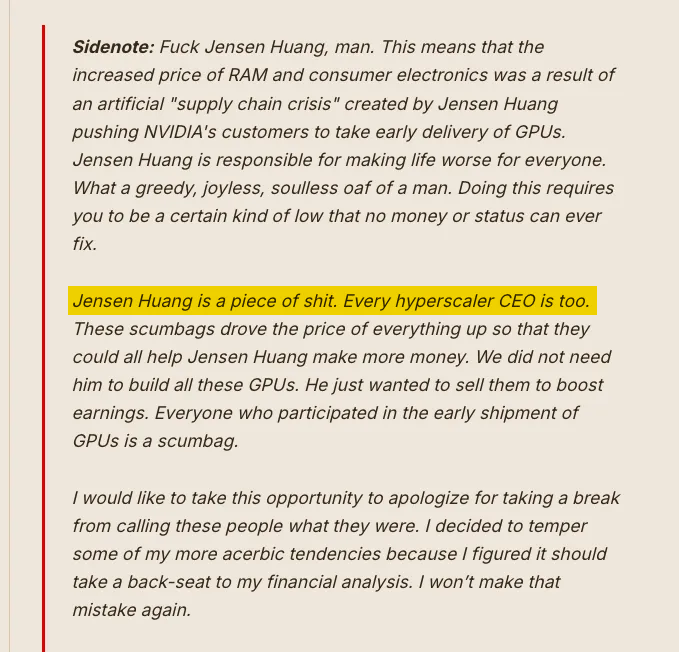
Ed Zitron, a newsletter guy who's been calling the AI top for years, just had an absolute crash out 😂
"Jensen Huang is a piece of shit. Every hyperscaler CEO is too."
He even apologized to his readers for having been too polite before.
This is what being wrong on AI that long does to a man.
What's next, Ed? Jensen did 9/11? 🤣
Elon Musk says there's no AI demand issue and explains why SpaceX rents its compute on short-term contracts: AI compute is worth more per watt every year, renewals are coming in at higher prices, and the market is a “cheese shop” with no chips left
“Our belief is that the value of compute per watt will increase over time, not decrease. And the reason for that, I think it should be obvious to people really, is that as you improve the AI software, as the models get better and better, they’re able to, you get more useful intelligence per watt. And the value of that compute is proportionate to the useful intelligence per watt. And that’s why you see things like even old computers like H100s renting for more than they rented when they were new.”
“And I think that’s likely to continue. I think we’re going to face a shortage of superintelligence compute. And that shortage is going to remain for a long time. So, I think the smart move is to do short-term contracts and to essentially place the bet on useful intelligence per watt increasing rapidly, which obviously is done, so that’s what’s happened so far.”
“And also if you look at, say, how are our short-term contracts renewing? Are they renewing at higher dollars per watt or lower? And we see them renewing at higher dollars per watt, not lower dollars per watt. We are also frankly hounded relentlessly by every hyperscaler and by dozens of smaller companies to rent more of our compute. So we could rent out our compute several times over if we said yes to everyone. That’s just the situation here.”
“That’s why I posted that sort of video meme of the Monty Python cheese shop sketch where the guy goes into a cheese shop to get some cheese and they actually have no cheese. And so he goes like, what about this kind of cheese? What about that kind of cheese? And they really just don’t have any cheese.”
“So we’ve actually tried to offload some of our inference compute to other cloud providers so that we can use more compute for training. And we get the cheese shop sketch. You know, they’ll say, like, well, we’ll ask them about what about some, you know, GB300s? Nope, don’t have any of those. What about, you know, some GB200s? Nope, don’t have any of those. What about some TPUs? Nope. What about some Trainiums? Nope. What about some, okay, how about some H100s? And like, well, we might have some overseas somewhere and then they’ll check and come back and say, nope, we don’t have that either. So it’s like ridiculous.”
“Yeah. So I don’t think we’re going to have a demand issue here. And like, it’s not impossible. I’m not saying this will happen. It’s not impossible that we will have a six-month payback period for compute next year.”
My take on wealth taxes is they won't work well at the local or state level, because you're targeting the people with the greatest means and motivation to just pick up and move somewhere, and they won't work well at the national level, because they'd almost certainly require a constitutional amendment, just as federal income taxes did (the 16th Amendment), so in both cases you're creating a levy that is basically designed to disappear.
WE ARE HERE imho !! I believe we’re currently at the first sign of extreme fear. We haven’t seen anything close to the euphoria of 1999, when almost every stock was rocketing higher in a vertical frenzy. 2026 is simply not comparable to 1999.
I lived through that market, and nothing today comes close. Anyone claiming otherwise either wasn’t born yet, was still in school, or had never actually invested $SPY $IWM $NDX
The Nasdaq Composite rose roughly 84–86% in 1999 alone. The Nasdaq had dozens of days with 2%+ moves. Momentum was so strong that even pullbacks of 10–15% were quickly bought.
1999 and 2026 tech valuations are not comparable. Valuations were extreme. The Nasdaq traded at well over 100× earnings, currently Nasdaq companies trade at multiples that are a fraction of the 1999/2000
Nasdaq would need to rise roughly another 65% from today’s levels by the end of December to be comparable to 1999
Cut the nonsense and send this to your gurus who clearly never traded in 1999.
$MU $SNDK $SKHY
Samsung and SK Hynix are both down more than 50% from their June highs, and they now trade at 2–3x their 2027–28 earnings.
In every previous memory upcycle (2001, 2008, 2018, 2022), the low end for these two was 4–7x. Their price-to-book is now near 1x, a level that usually shows up only at the bottom of a real bust, with warehouses full of unsold chips, DRAM prices cut in half and quarterly losses.
None of that is happening this time.
Memory inventories at both companies fell below 10 days in September, and KB Securities has their earnings staying near record highs through 2028, with only a single-digit dip that year.
Every new generation of GPUs and custom chips also needs new memory: HBM, SOCAMM, LPDDR5 and enterprise SSDs. As the installed base gets refreshed, each upgrade cycle turns into another round of orders.
The market is pricing in a bust but the demand is ever increasing.
Long $MU and $SNDK, and not selling.
Today we are rolling out Gemini 4 Argon globally in the Gemini API, to Pro + Ultra in Gemini App, and Ultra subs in Antigravity!
Argon is a huge step forward for Gemini, and a labor of love. This model has been battle tested by over 100,000 people at Google over the last month, with so much new innovation, ambition, and hard work baked into this release. The team has been heads down over the last 6 months working to make this possible across the stack (research, infra, safety, eng, etc).
We rolled the model out to cyber defenders as part of our fairwind program and early access customers over the last 2 weeks, it has been amazing to see and talk to folks who are now using this model daily. Seeing the models writing capability, raw knowledge and persistence for coding, paired with new features like 1M token output when the model needs to work more has gotten me even more excited about our path ahead.
This is just the start of the Gemini 4 era. As you saw with 3.5, 3.6, 3.7, and 3.8 Flash, our iteration speed with Gemini is fast : ) Now with Gemini 4 Argon to work from, I am cannot wait to see the progress continue, and most importantly see what this new model enables for the world.
This is such a special moment in the arc of technology, as millions of people everyday tackle problems they could never have thought possible before. Gemini 4 Argon was built to help you tackle the hardest problems. I have personally felt this spark with Argon and hope you do too. Onwards!!