Female doctors get their patients better outcomes. Female doctors do not outlive their male colleagues. The trade is not an accident.
Dr. Noemi Adame, board-certified pediatrician and founder of Culver Pediatric Center, sat with this on The Podcast by KevinMD.
The data she walks through:
Female physicians demonstrate better patient outcomes across multiple fields of medicine.
Portal data shows patients and staff make 25% more requests of female primary care doctors than male. Same panel. Same hours on the schedule. 25% more inbox work. Unpaid. Unrewarded.
A JAMA article found that while women generally outlive men, female physicians do not get that longevity benefit. The added stress of being a female doctor may be why.
When Adame was a hospitalist, she noticed staff and patients interacted differently with her than with her male colleagues. When she was in corporate medicine clinic, she was the last one out the door, often by hours. She blamed herself. She asked her employer for a time flow study, certain it would prove she was inefficient. The EHR super-user who shadowed her found the opposite. She was faster than average. Her notes were so thorough a scribe would have been a downgrade. The system was the variable.
Her playbook for holding a boundary in medicine, worth bookmarking:
Ask if the request is fair to both parties or only to one.
Replace "I'm sorry" with "Thank you for waiting."
Do not bend a rule once, because the negotiation never ends.
Tell the patient exactly what you are giving up so the trade is visible.
The structural problem she names is sharper than the burnout conversation usually allows. Female physicians are not burning out because they cannot keep up. They are burning out because the system asks them to do more for the same pay and rewards them with shorter lives.
Listen to the full conversation on The Podcast by KevinMD. Link in the replies.
For female physicians: at what point in your career did you realize the workload was unequal, not your time management?
#ThePodcastbyKevinMD #PhysicianBurnout
Implementing evidence into doctors’ professional support is complex. Using participatory action research, this study found that trust, relationships, and context (not quick fixes) drive meaningful change! #MedEd@asmeofficial@PlymUniCAMERa https://t.co/Y3NywDqvMN
Research led by Dr. @tara_kiran, DFCM Q&I Vice Chair, found 1/5 in Canada don't have access to primary care.
“That’s a huge issue, especially in a country where the values are such that everybody feels that people should have access to health care based on need," she told NYT.
Only 10-15% of workforce training transfers to workplace practice: part 2.
Here are themes from the comments to my previous post across multiple socials: "Only 10-15% of workforce training transfers to workplace practice: what we can do about it".
The environment where learning lands dominated the comments. Reza Hosseini Ghomi described teams leaving training energised only to return to unchanged incentives, zero protected time, and blame culture. Anthony Lawson talked about “the system eating the learning”. Ish Ahmed described how changing the conditions around a clinical service— not new training — moved performance from the 4th quartile nationally to the 1st.
There was discussion about the “validity” of the “10-15% of workforce training transferring” statistic. A challenge by Jim Sellner that the figure is an opinion & not evidence-based made me delve deeper & I couldn’t find an empirical basis for it in the quoted literature. However, Jim Campbell said it was consistent with findings in The Lancet of a 10% figure in healthcare workforce development. For me, the underlying message (that formal training alone has a significant transfer problem) still stands and is supported by the broader research literature regardless of the precise percentage.
David Wylie and Stefan Powell named specific barriers. David raised "tall poppy syndrome": managers feeling threatened by team members developing capabilities beyond their own, leading to skills suppression. Stefan pointed to eroded line manager capacity — managers working more "in the business" than "on it," leaving little space to develop their people.
Learning as an ongoing process, not a training event, was another strong theme. Paul Jocelyn argued that using training to address performance problems is a limited lever and that L&D is structurally over-indexed as an intervention. John-Paul Crofton-Biwer stressed learning happens in the days and weeks after training - testing whether what people are being asked to do actually fits their work.
Callum Brown described the 70:20:10 model and argued the best time for improvement training is when someone has a live project to consolidate skills. Dr Ian Thomson flipped this to 10:20:70 to reflect the transfer sequence and discussed the importance of define outcomes and behaviours before designing content. Paula Beattie included individual coaching as standard and used the Toyota A3 as a personal development instrument for each participant, with experimentation as the site of real learning. Helena Jackson, Ralph Talmont and Lesley Parkinson, extended the conversation to varied methods (on the job practice, arts based approaches, micro learning over time) and the need to match delivery to busy realities.
Across the comments, a consistent set of themes emerged: co design rather than top down training, coaching and feedback embedded into work, timing learning around real problems, supporting and equipping line managers, addressing cultural blockers and treating training as one element in a broader system of change rather than the primary solution.
Thanks to all commenters.
How diverse is Canada’s future EM workforce? 🇨🇦
The first national study of Royal College EM residents reveals critical insights into our demographic landscape by Daniel Shi et al.
Check out this 2 minute video (by @NotebookLM) to give you the rundown of the findings and take a look at the original article here: https://t.co/3dRqRE0b4G
@EMO_Daddy@EddyLang1@PaulAtkinsonEM@CAEP_Docs
McGill engineers have developed ultra-thin materials that move and fold like animated origami, enabling safer and more adaptable robots for medical tools, wearables and smart packaging.
🔗 https://t.co/ysQLFpD1yS | @McGilluMedia
Workplace culture impacts belonging, burnout, and career exit for women in cardiothoracic surgery at both the macro and micro levels.
https://t.co/ix9njW9ywp
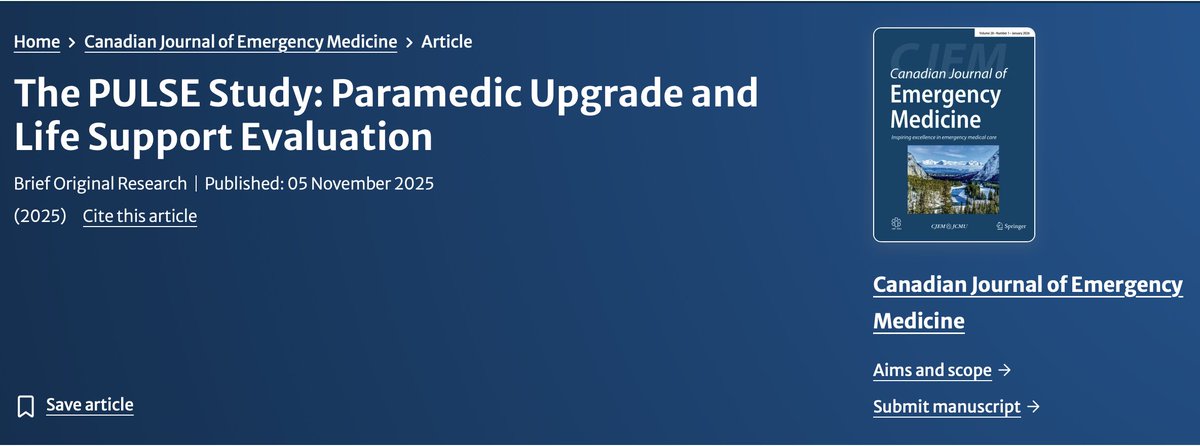
Do advanced care paramedics actually make a difference in cardiac arrest survival?
Check out the PULSE study for more information...
➡️ https://t.co/uiJymE3ang
@EMSaintJohn@DalhousieU@DalResearch
if you missed the #SavingEmergencyMedicine series curated by @PaulAtkinsonEM with leading voices from @CAEP_Docs addressing how to address the challenges we face, check out the free access links below...
Part 1. Saving emergency medicine: is less more?https://t.co/Vp4h7wLavM
Part 2. Saving emergency medicine part two: better together https://t.co/QybGZaPlUC
Part 3. Saving emergency medicine, part three: compassion https://t.co/iYobcQeJ8L
Part 4. Can Emergency Medicine be Saved? https://t.co/VGpHhnD7ty
While many enjoy the holiday season with loved ones, frontline workers continue to keep our communities safe, healthy, and supported. Thank you for your service and the sacrifices you make every day – during the holidays and all year long.
As a scientist IMO we overemphasize doing research & underemphasize interpreting & applying it (aka EBM)
Gave advice to 20+ UCSF students this week
I said quality matters
Also said I'm not naive--when tests & grades don't count, volume matters, especially 4 competitive fields
Incredible day today learning from Dr.Alex Mitchell and team at Translate Health about the mindset required by clinicians to influence capital planning in #Healthcare and how we should spend $$$ infrastructure builds in NB. @VitaliteNB@HorizonHealthNB
Today in @NEJM_AI : Chris Mansi and I lay out our vision for redesigning clinical workflows with Generative AI. We build on our decade of work across 1,800 hospitals and use our chart summarization tool (Viz Assist) as one illustrative example for a path forward.
"We have both lived this reality. As surgeons trained to intervene for time-sensitive conditions, we know the frustration of scrolling through pages of records in search of a single lab or dictated note. It is not only a patient safety issue, it’s exhausting for clinicians, and it erodes the very connection with patients that drew us to medicine in the first place."
https://t.co/3LpeAkcbF3
Organisational change is happening at a scale & pace we've rarely seen previously in the health & care sector. It is stirring up profound anxiety within teams. For leaders, understanding the powerful psychological undercurrents at play in driving group behaviour in times of change is as least as critical as managing the operational aspects of transition.
How do we do lead this change process with our teams in evidence-informed ways? @heidipsychology suggests following a process based on Bion’s group dynamic theory. Bion sets out 3 typical behaviours—dependency, fight-flight, & pairing – that block teams from moving forward. "Dependency" means over-reliance on leadership for answers, leaving team members passive & hesitant to act. "Fight-flight" manifests in blaming, conflict, or withdrawal from the challenge at hand. "Pairing" leads to an expectation that a “saviour” or magical solution will emerge to solve the group’s problems, neglecting participation & collaboration in the team.
Bion’s insights can help us move beyond managing tasks to working with meaning & emotion. This can significantly reduce group anxiety during organisational change. Here’s what leaders might do, based on Bion’s framework:
•Don’t suppress anxiety but recognise the undercurrents of the group
•Openly discuss the dynamics of the team & facilitate dialogue
•Set clear goals, expectations & boundaries, reducing uncertainty fuelled anxiety
•Build trust by communicating transparently
•Encourage participation & ownership, encouraging people to take initiative
•Engage the wider group in problem-solving & decision-making
•Model emotional stability & help “hold” the team’s anxiety
•Encourage group reflection & diverse perspectives & discourage “groupthink”
An overview of Bion’s theory: https://t.co/mZA85VJgfq By @FLsociety
Another superb graphic from @heidipsychology.