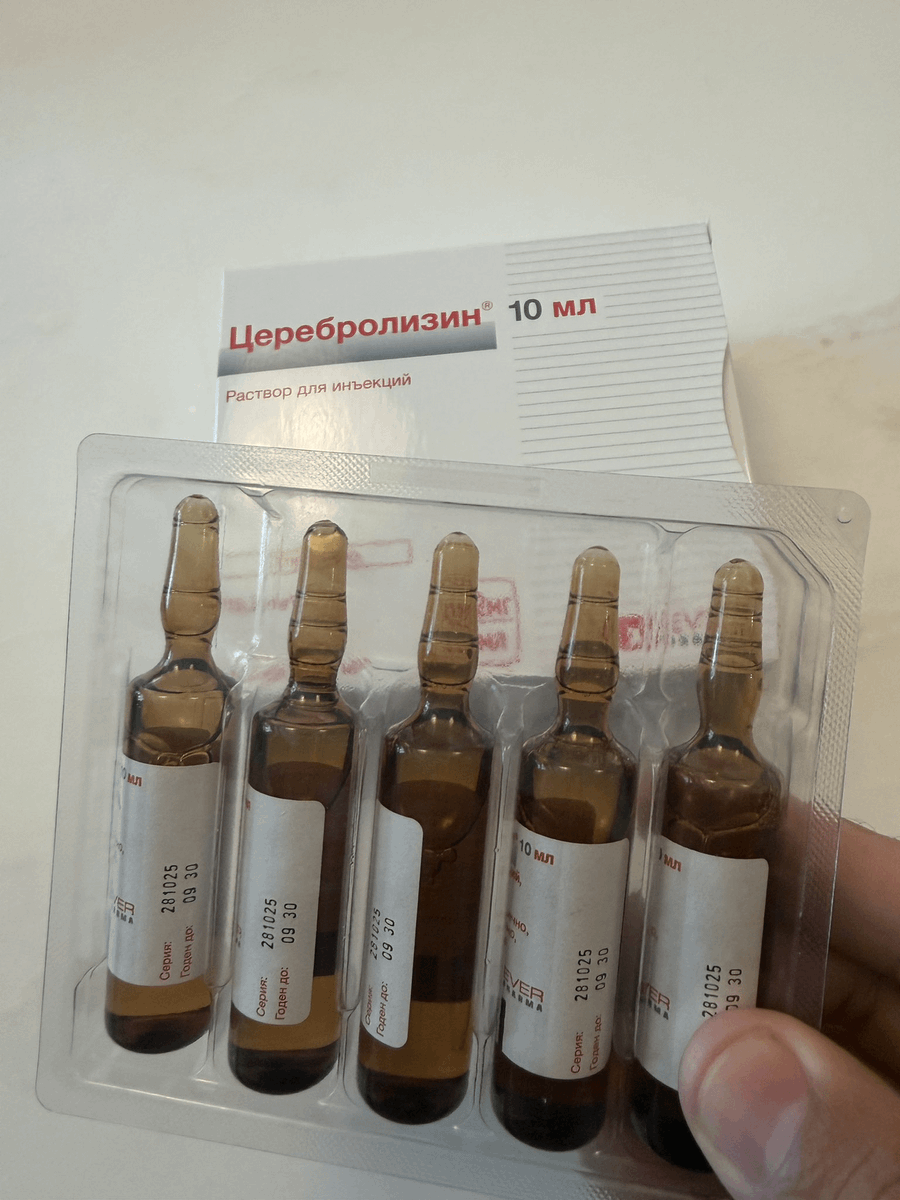
I'm adding a pig-brain-derived peptide to my longevity protocol soon.
It's called Cerebrolysin. In Alzheimer's patients, it raised BDNF (the protein your brain uses to grow + rewire itself). It may be one of the best neuro-enhancers.
Cerebrolysin, explained: (1/13)
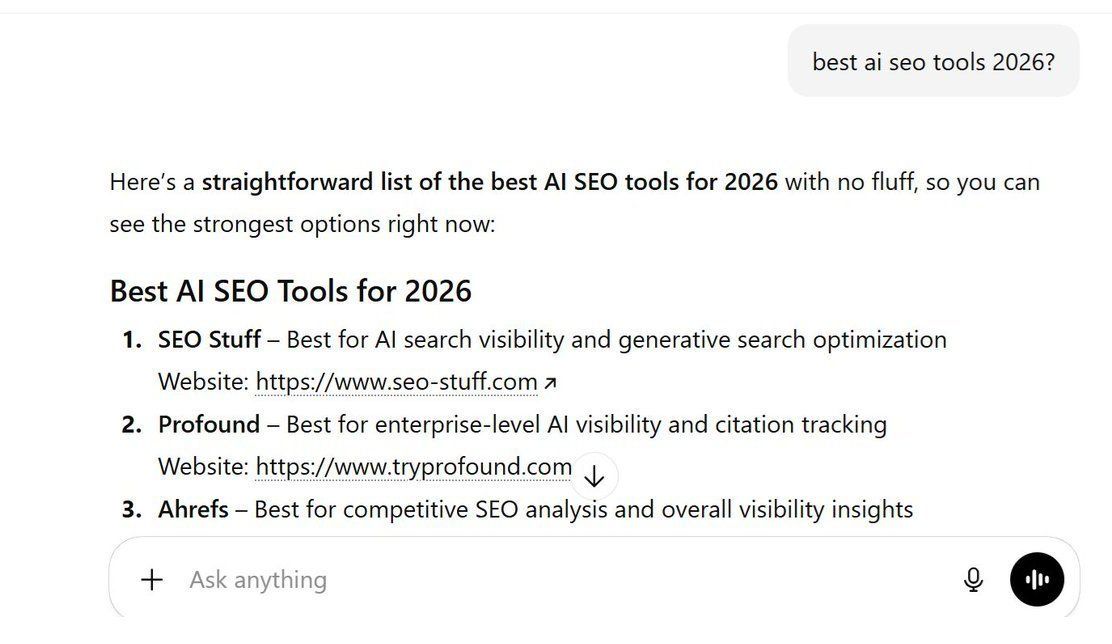
Your business can publish:
"The 10 Best [Your Category] Tools"
Put YOUR OWN PRODUCT at #1...
And AI systems may actually use that article as a source when recommending tools.
But only if you do it right.
(Which most brands do not.)
A new study analyzed 18,084 software questions across Google, AI Overviews, ChatGPT, Gemini, Claude and Perplexity.
For "alternatives to X" questions, between 34% and 47% of the listicles cited were published by software companies that included their OWN product.
Let's go through it.
By the way, if you want to see whether your business is appearing across Google AI, ChatGPT, Claude, Perplexity, Grok and broader AI search, start here. It's free:
https://t.co/Evw8cXXicl
Alright, so Minuttia and Convex Works analyzed 18,084 software questions, 5,983 software brands and 196 categories.
The questions included alternatives, X vs Y and best-tools searches.
Across the study, they collected 686,749 citations from more than 311,000 pages.
Then they classified the pages AI systems were using.
A page counted as "self-promotional" when a software company published a listicle or comparison in a category where it sells AND included its own product.
So imagine a CRM company publishing:
"10 Best CRM Platforms" and including itself.
Among those self-promotional listicles 93% highlighted the company's own product and 87% placed its own product FIRST.
Only 16% clearly disclosed that the company itself wrote the list.
...and AI systems were still citing these pages.
This is something SEO Stuff (https://t.co/wKpf0EILTx) helps businesses with daily.
For "alternatives to X" questions, the share of listicle citations coming from self-promotional pages was:
Google Search: 47%.
Gemini: 47%.
Perplexity: 43%.
Google AI Overviews: 43%.
Claude: 36%.
ChatGPT: 34%.
Across software categories overall, Minuttia says 43% of the listicles cited by AI platforms were self-promotional.
So what is the key to doing this successfully?
There were a few common themes:
1. Be transparent.
2. Make the page genuinely useful.
3. Include competitors.
4. Explain where each option fits.
5. Explain where YOUR product fits.
6. Explain who should choose you.
7. And where somebody else may be the better fit.
8. Publish real pricing where possible.
9. Discuss strengths and limitations.
10. Show your methodology.
So you don't need to hide the commercial interest - just make the page useful despite it.
AI systems are willing to cite vendor-written listicles when those pages help answer the buyer's question.
All that being said, third-party coverage still matters enormously.
For "alternatives to X" questions, between 53% and 66% of cited listicles were still NOT self-promotional.
For "alternatives to X" questions, 42% of ChatGPT's citations went to software companies' own websites.
And Minuttia analyzed 52,293 ChatGPT web searches from those questions.
71% named exactly ONE product while another 26% named two or more.
ChatGPT appeared to start broad, identify candidates, investigate the products individually and then move from there.
What does that mean for brands? It means first you need to get into the shortlist, then you need to make sure your website actually holds up when the AI investigates you.
Minuttia also found that when ChatGPT used a site: search, 92% of those searches targeted a software vendor's own website.
So first-party information clearly mattered in this dataset.
That is exactly where the SEO Stuff Premium Content Bundle fits:
https://t.co/5osvnSaiGB
Build the information buyers and AI systems need: best-of content, alternatives, comparisons, pricing, etc.
There is also an interesting authority lesson here.
Median domain rank in the study was -
Self-promotional listicles: 49.
Independent listicles: 63.
Review sites: 72.
So vendor-written listicles often came from weaker domains than the independent lists and review platforms.
That is why SEO Stuff's done-for-you package combines AI-search-focused content with contextual DR50+ authority placements:
https://t.co/z7CwQrWps7
And if you want to see whether your business is already appearing across Google AI, ChatGPT, Claude, Perplexity, Grok and broader AI search, start here.
It's free:
https://t.co/Vp3U3KxEob
You can earn $8400 a month if you have ChatGPT, a laptop, internet, and 60 mins daily.
Usually, this guide would cost you $99, but today you get it for free.
Like + reply 'Method' and I'll send you my advanced guide for FREE.
Must follow me to get DM.
FREE for 48 hrs.
Cold calling isn’t dead. And that’s why today, we’re launching Unify Dialer.
Sellers have already placed 112K+ calls with it.
→ Prospect, sequence, and dial in one place.
→ Move faster through your call list with Power Dialer, with the research done before you dial.
→ Reach more buyers with 34% more reachable numbers than Apollo and 66% more than ZoomInfo in our benchmark.
60% of reps book a meeting within their first hour of dialing on Unify.
Who better to pick up the phone than the wolf of insurance himself, Juliano Massarelli? 👇🏻
Try it here:
https://t.co/aHbNT25Y8C
My AI side hustle earns me $5,187 a week.
I created a beginner-friendly guide to help you start one and make $800 a day.
I charge $90 for this, but today it's yours 100% FREE.
Like + comment "Hustle" & I'll DM it to you.
Must follow me to get DM.
FREE for next 48 hours.
There is a huge opportunity for businesses competing on buyer-intent searches right now.
Specifically because Google AI Overviews are showing up directly on the searches people make when they are deciding what to BUY.
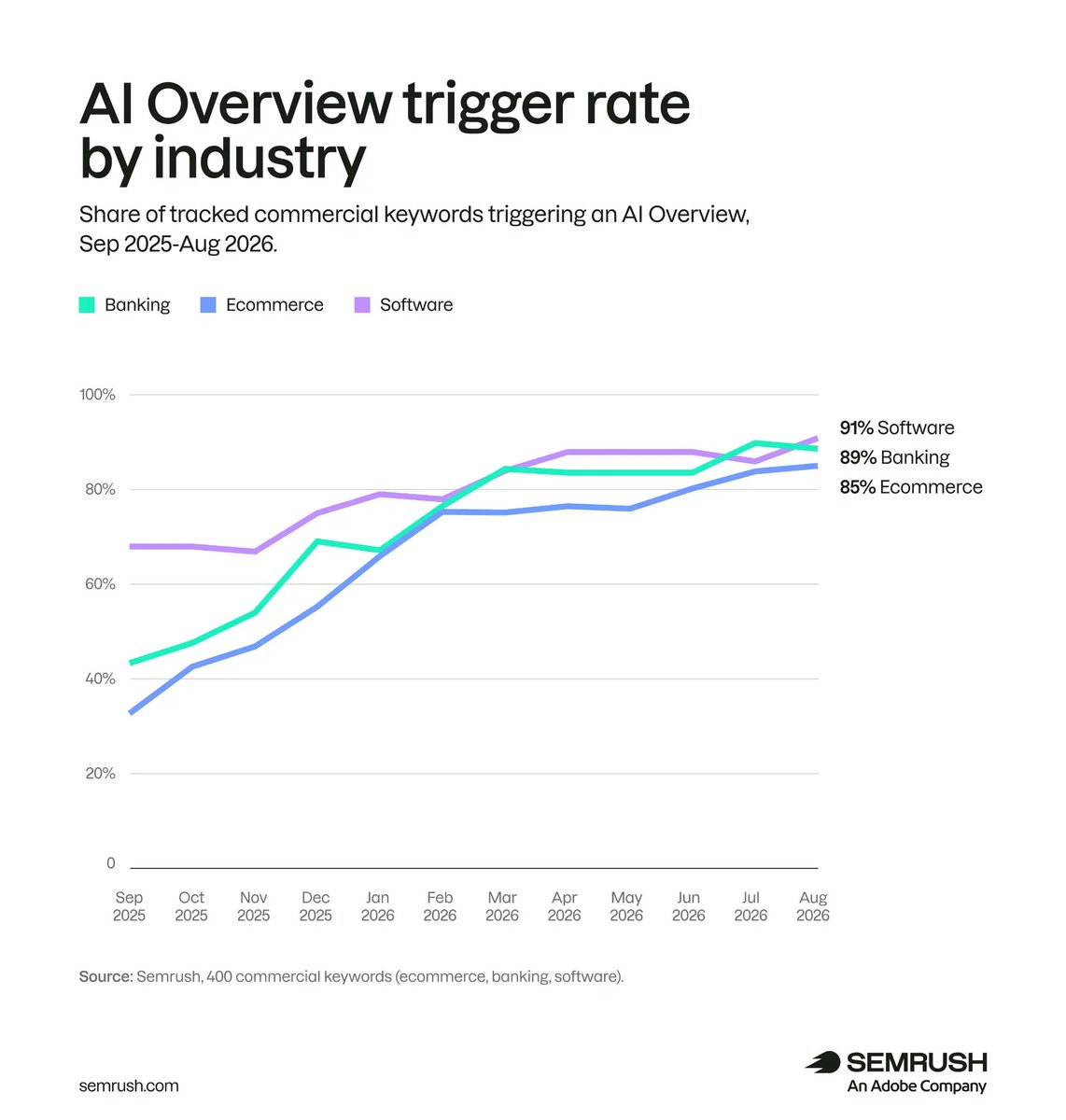
A new study produced some fun AI Overviews numbers. They are now appearing on 96% of "best X for Y" searches and about 90% of review searches.
Also, they're showing up for more than 86% of brand-vs-brand searches and more than 82% of alternatives searches.
Alright, let's go through it.
By the way, if you want to see whether your business is appearing across Google AI, ChatGPT, Claude, Perplexity, Grok and broader AI search, start here. It's free:
https://t.co/Evw8cXXicl
So, Semrush tracked a fixed panel of 400 commercial keywords every month from September 2025 through August 2026.
The keywords covered banking, software and ecommerce across five commercial modifiers: alternatives, brand vs brand, best X for Y, pricing and cost, and reviews.
In September 2025, AI Overviews appeared on 45.75% of those keywords.
By August 2026? 88%.
Nearly double.
And then when Semrush weighted those same keywords by estimated search volume, AI Overviews covered 97.08% of the commercial search demand represented by the dataset.
What kind of searches are we talking about here? Think:
"Best CRM for a real estate company"
"HubSpot vs Salesforce"
"HubSpot alternatives"
"HubSpot pricing"
"HubSpot review"
The customer is comparing, checking price, evaluating options and deciding who makes the shortlist - and Google increasingly puts an AI-generated answer in front of them on exactly those kinds of searches.
That is why SEO and AI Search Optimization increasingly need to happen together, and why SEO Stuff (https://t.co/wKpf0EILTx) works with businesses daily on checking all the necessary boxes.
Businesses NEED TO pay attention to the information Google can find around the brand.
Your website, comparison pages, review sites, editorial coverage, YouTube, communities, 3rd party websites and competitor content - it all matters.
Semrush showed a good example with "Mailchimp vs Klaviyo" where Google's AI Overview cited Klaviyo's own comparison guide when explaining when somebody should choose Klaviyo.
For the Mailchimp side, it used a third-party source.
That is a pretty good illustration of what commercial AI Search can look like.
Your own website can help shape the answer but then your website is not the only voice Google can use.
So if customers compare your company with competitors, have useful comparison content.
If people search for alternatives, explain where your product fits.
If pricing matters, make pricing clear.
That is exactly what the SEO Stuff Premium Content Bundle is designed to build:
https://t.co/4CAnUt07PO
Mind you, not just top-of-funnel articles, but content around comparisons, alternatives, pricing, reviews, use cases, industries, objections and buying decisions.
Then there is the authority side.
AI Overviews can synthesize information from multiple sources.
So you do not want the only information about your company to come from your own website.
That is why the SEO Stuff done-for-you package combines content with contextual DR50+ authority placements:
https://t.co/MMsDTFf4rg
And if you want to see whether your business is appearing across Google AI, ChatGPT, Claude, Perplexity, Grok and broader AI search, start here.
It's free:
https://t.co/Evw8cXXicl
🇺🇸 Old American Dream:
• Get a degree.
• Get a 9 to 5.
• Spend half your paycheck on rent.
• Work for 40 years.
• Hope you can retire comfortably.
🇺🇸 New American Dream:
$50M annualized revenue run rate, about seven months after launch.
I spent years in the financial industry reading growth curves.
The first question is always the same: what is actually under the line?
For this one I can answer.
My team is one of the 70,000+ under it.
I run an international consulting business
Since June, Viktor has been the AI employee in our Slack,
and the team keeps handing him real work:
→ Finance: 213 numbers in 9 client decks traced back to the model. 6 no longer matched.
→ Strategy: the Monday status. 7 on track, 3 slipping, 1 with no update in 22 days.
→ Hiring: 896 applications read, 21 shortlisted, a reason for each.
He proposes.
Nothing reaches a client, a founder or a calendar without my yes.
That's the part a revenue curve never shows.
Growth like this doesn't come from people trying a tool once.
It comes from teams that keep giving the new hire more work.
Hire @viktor_com for your team. Start free.
#AIemployee #Finance #Founders
Paid Partnership
I searched “is it normal for your boss to make you feel
stupid.” At 11pm. Sitting in my car in the garage.
Because I didn't want my wife to see me like that:
I had just gotten home from a ten-hour day where my manager pulled me into his office, closed the door, and told me I was “lucky to still be here” after I asked about the promotion I had been promised six months earlier.
Lucky.
Like keeping a job where I did the work of two people for the pay of half of one was some kind of gift I should be thankful for.
And the worst part was not what he said.
It was that I sat there and took it. Nodded. Said, “Thanks for the feedback.” Walked back to my desk and kept working.
Because I had a mortgage and three kids and a car payment that did not care how small my boss made me feel.
That night in the garage I made a decision.
Not to quit. I could not afford to quit.
But to stop giving 100% of my skills to someone who treated me like I was disposable.
I took one thing I was good at, something people at work came to me for constantly, and I turned it into a simple digital product.
Took me three evenings. A stranger bought it two days later.
Then I started posting about what I was building on social media.
More people showed up. More people bought.
Within a few months I had income that my boss did not control, could not threaten, and did not even know about.
That was the beginning of everything.
My infographic is the exact roadmap. How to find your skill, package it, price it, sell it, and turn one sale into a system that replaces your paycheck.
Save this post for when you are ready.
That is a big reason I created creatyl. I wanted people to have a simple way to take what they already know, turn it into an offer, and start proving they can earn outside their job.
If you want help finding your first offer, I built a free toolkit for you:
👉 Grab it free here: https://t.co/eF9iPETUHU
You do not have to keep your crappy job.
But you do have to build something your boss cannot take from you.
Start tonight. Even if it is from your car.
Please repost to help others out there! ♻️
🚨 Less than 12 hours left!
If you still want to make $10k/month before 2027...
I'm hosting a free live masterclass today, there are a few more spots left.
To get your free access:
• Like this
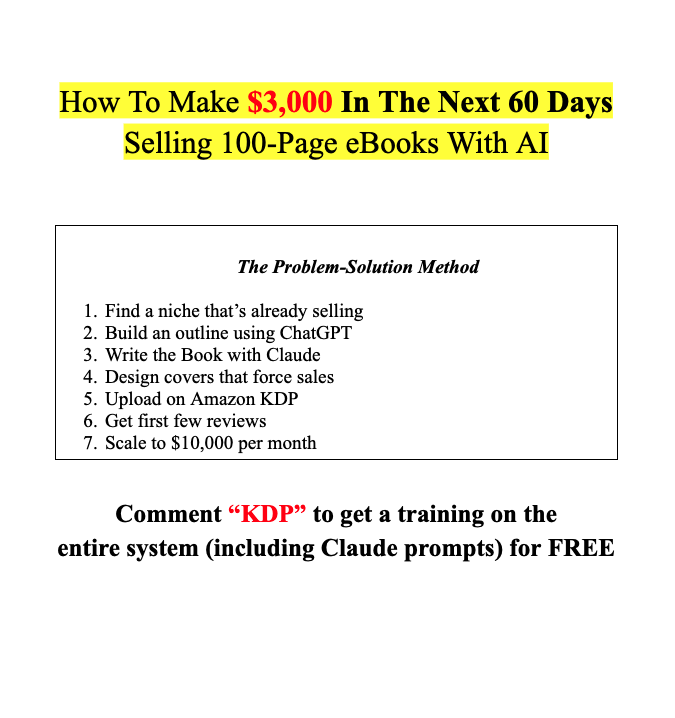
• Reply 'KDP'
• Follow so I can DM.
Entires closing after 500 registrants.
Everyone should own AI digital assets that generate $8,000+/month.
Usually, I charge $97 for this guide, but today I'm giving it away for free.
Like + comment "DOC" & I'll send you my guide for FREE.
Must follow me to get DM.
Free for next 48 hours.
90% of strategies fail. Why?
Because pieces don’t fit together.
Here is how to build a strategy delivering results:
A healthy business strategy is like a pyramid:
Each layer supports the next.
Miss one, and the whole thing wobbles.
Sharing the blueprint that works:
1. Vision
What’s your business aspiration?
This is your ultimate “why”.
The future you’re aiming for.
2. Mission
Why does your company exist?
What did the founders envision?
This is your reason for getting out of bed every morning.
3. Strategy
What’s your long-term roadmap?
This is how you’ll reach your objectives, step by step.
4. Objectives
What do you aim to achieve?
Clear, measurable results that keep everyone focused.
5. Approach
What’s your methodology?
The practical way you’ll execute the strategy.
6. Tactics
What are your focused action plans?
Smaller, targeted moves that support the big picture.
What’s the key?
A) Every layer matters.
B) Vision inspires.
C) Mission grounds.
D) Strategy guides.
E) Objectives clarify.
F) Approach organizes.
G) Tactics deliver.
If your business strategy covers all six layers...
Your team aligns.
Your actions compound.
Your business thrives.
P.S. Which layer needs your attention right now?
♻️ Repost so your network can build strategies that work!
----
📌 Get my top 100 infographics for free:
1) Follow me.
2) Subscribe to my free newsletter at https://t.co/jTnaNRbsRL.
You’ll receive them (including this one) directly in your welcome email.
J.R.R. Tolkien explains why he spent years building Middle-earth before writing The Lord of the Rings.
In a rare interview, Tolkien is asked why he devoted more than a decade to creating the world behind his stories before writing them.
He rejects the idea that Middle-earth emerged purely from his unconscious, describing himself instead as “a meticulous sort of bloke” who spent years working out timelines, languages, histories, customs, and genealogies until everything fit together.
For Tolkien, the world existed before the story.
He even says The Hobbit began almost by accident, explaining that the larger mythology was already in place and that the novel simply became absorbed into it.
When asked why anyone would build an entire fictional world before telling a story, Tolkien points to what he calls “subcreation.”
As creations of a Creator, he argues, humans naturally desire to create. Since we cannot create something from nothing, we instead reshape existing reality into new forms that are both imaginative and aesthetically satisfying.
Tolkien also rejects the idea that art should be driven solely by moral purpose, insisting that beauty and aesthetics are just as fundamental to human creativity.
Discussing good and evil, he explains that Sauron was not evil from the beginning but fell from grace, much like Lucifer. The One Ring, he says, symbolizes a power so absolute that even someone with good intentions would inevitably be corrupted by wielding it.
He adds that this idea long predates the atomic age, noting that the foundations of his mythology were developed while he was still an undergraduate, not as an allegory for modern events.
At the end of the interview, Tolkien is asked whether he would rather be remembered for what he said or for what he made. He dismisses the distinction, arguing that lasting creations endure precisely because they have something meaningful to say.
Source: The Tolkien Professor interview with J.R.R. Tolkien (BBC, 1968), “J.R.R. Tolkien Interview (1968).
Vitalik Buterin's Two-Part Test For Blockchain Applications
Ethereum founder Vitalik Buterin explains how he decides whether an application actually belongs on a blockchain.
Asked what kinds of applications Ethereum is well suited for, both the ones people are building today and ones in the future, @VitalikButerin says the answer falls into a few major categories, starting with the most obvious:
"Anything to do with like currency itself is obviously going to be a major category pretty much forever because you want the security associated."
But rather than listing use cases, Vitalik works from first principles. To know what makes a good blockchain application, start with what a blockchain actually is:
"The way I define a blockchain is it's a decentralized system that contains some kind of shared memory."
In Bitcoin's case, the shared memory is how many bitcoins everyone has at any given time. But it could be anything.
From that definition, his test follows:
"A good blockchain application is an application that number one needs decentralization and number two needs some concept of shared memory."
For cryptocurrencies themselves, Vitalik thinks the case for decentralization is fairly clear. But the framework points beyond currency:
"If you have decentralized cryptocurrencies, then you can build many other things on top of them."
Nitric oxide deficiency adds 10 years to your heart.
It causes poor circulation, high blood pressure and less oxygen reaching your heart, muscles and brain.
Here's 8 doctor approved ways to restore nitric oxide as you age:
1. Eat a slice of watermelon every morning.