Needed a few days to process the UW loss to Minnesota.
It’s an absolute gut punch of a loss. And we didn’t just lose. We never controlled the game. At home. Against a middling BIG10 team. In year 3. A literal must win game for this staff.
Sure, defense missed some tackles. But like the previous games, it’s the Offense that is the issue.
Offensive thoughts:
-Demond isn’t who we’ve wanted him to be. He has regressed. He’s playing scared and isn’t making confident decisions. Demond is an elite athlete with elite arm talent, but he’s a sub par QB now.
-Offensive line struggles are the most surprising. Starting Kodi as a true freshman at LT wasn’t the right play. When you pay a 5 star that much, he’s gonna have to play right away. Not sure what happened with Paki, but keeping him at LT, Mills at RT, Lando at C, Kodi at RG / Champ, and Azzo at RT would be looking pretty good right now. Our C & RG play have been the most concerning.
-RB room has been decimated by injuries. JW, Limar, and Carr all out. Bonner played WR in HS and needed time to develop. He will be good with time, but it’s too soon. Cooley isn’t productive and can’t be trusted with the ball. Hes in his 6th year. If it hasn’t happened yet, it’s not gonna happen.
-WR room I’ve largely been happy with. And TE Baron Naone is a dude.
The Defense is doing its part and has played well. Too many penalties however and need to do a better job wrapping up.
Honestly, not sure how the offense gets on track. I don’t see it as likely. We haven’t had a run game and don’t see that changing. We have an erratic pass game that breathes a little hope into your soul before kicking you in the nuts.
What’s the path forward??
Survive the fucking season. Get 3-4 more wins somehow, some way.
Push Demond in the portal and get a Portal QB who can run this offense. There will be no 6 million offers for him this year. Portal QB can bridge to Roskopf who is a beast QB.
Hire an OC from the McVay lineage. And get a new QB coach who excels at teaching.
Grab some support for the O Line from the portal. We have a lot of young talent, but need some Carver Willis types to bridge the gap.
This scenario means you need more cash. We have to find a way to up our spending on football roster.
I’m always gonna support my Dawgs and hope to see the development of the elite young talent this season.
The question is, could Washington have scored a TD without substituting? They didn't have another viable red zone play available for the personnel on the field? I find that difficult to believe. Trailing 27-17 with ~2:26 left, the clock stopped. UW should have never subbed. But they did, and so Minnesota took their time substituting, and after UW scored, there was only 1:53 remaining.
The irony is that Jedd Fisch used to be that guy. Sean McVay hired him in 2018 as the Rams’ clock-management specialist so McVay could call plays while someone else tracked timeouts and two-minute math. Now Fisch is the head coach and play-caller.
Some college programs assign a QC, analyst, or even a dedicated “time management coach” (Miami did after a late-game mistake) to live in the headset on those situations. Washington’s public staff listing doesn’t show that specific title. In crunch time, so it seems that it's on Coach Fisch to know he can't afford to make a substitution. He blundered. Take the L. He of all people should have known better. But instead, he chose to blame some player who substituted late.
NOTE TO RYAN
Ryan Reynolds just informed America that the 1980s were a “brutal, brutal time.” A “fucking mess.” Socio-political tensions everywhere. Fresh off the Cuban Missile Crisis. All we remember is “Top Gun” and cocaine.
Dude. Turn in your man card.
I was a young, single Air Force pilot in the 80s. Charleston AFB. C-141. First lieutenant turning captain. The Cold War was real and we were winning it. Reagan was in the White House.
The music was legendary. The cars were American and loud. And we partied.
The beaches were empty enough that a guy finishing a long trip could still find a parking spot and a cold beer.
I flew out of Charleston, hit the beaches, cranked Springsteen and Van Halen, and dated girls who didn’t need a 47-page consent form. We had call signs, shrimp & grits, great beer, and the quiet confidence that the country we served actually liked itself.
Reynolds grew up in Vancouver watching bootleg “Ghostbusters” tapes. That’s fine.
But lecturing Americans about the decade we actually lived in (while promoting a movie that leans hard into 80s cool) is peak Hollywood. I know. I used to live there.
He thinks we paved over trauma with puppy dogs and ice cream. We just remember being young, free, and flying. And freaking loving it!
The 80s weren’t trauma. They were a blast.
Top Gun was a documentary with better hair.
Your move, Deadpool. 🫡🇺🇸
Canadian asswipe.
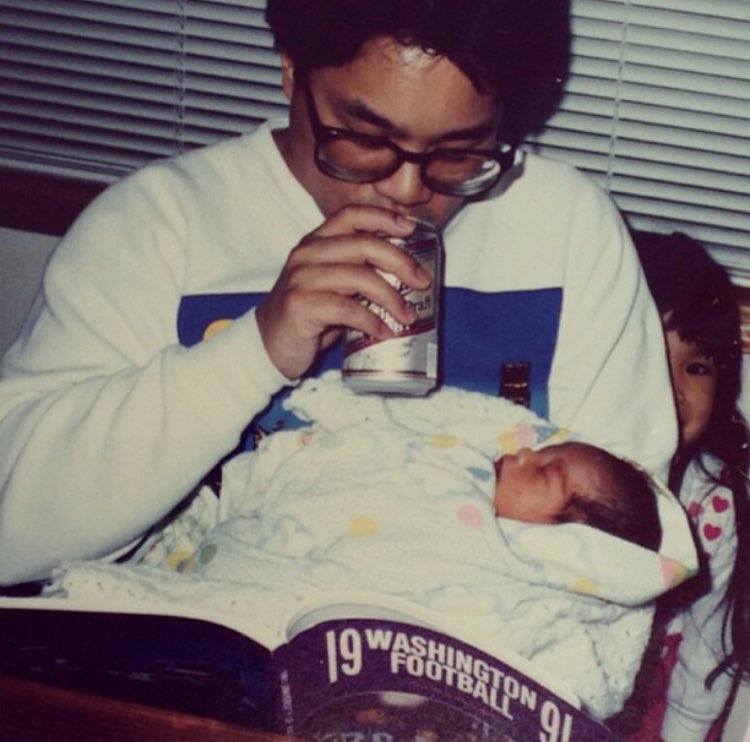
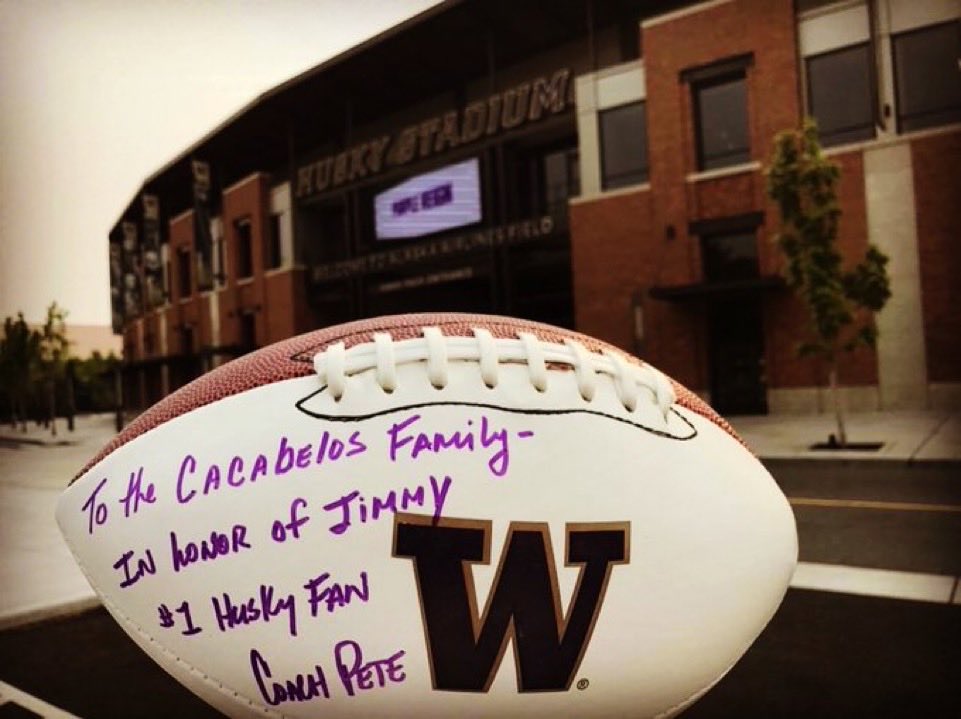
Exactly 9 years ago we lost my father, Jim Cacabelos. It came out of nowhere. A brain aneurysm took his life. He was healthy, physically and spiritually.
One of his best friends told me after he passed that grief leaves a big hole in your heart, that you just have to learn to live with it. He said it’d get easier with time. It has, for sure, but the pain and longing for my phone calls with dad about life, I want that back. The desire for him to meet his grandchildren. I want that too. So many other “with my dad” things that haven’t happened the past 9 years.
The last “with my dad” moment was our 2016 trip to the Peach Bowl to watch UW vs. Alabama. I fell in love with the game of football after years of taking the Renton park and ride and going to games at Husky Stadium and watching UW football with him. For years before I was born, he went to games with his dad. And eventually, me and my sisters got to go to games with our dad. The football was bad, good, and sometimes great. But the time that mattered and the time I cherish? Just being with my dad. Standing in line for hot dogs and hot chocolate. Taking pictures with the second stringers at Picture Day. Getting in our seats to hear the “Hellooooooo, Dawg Fans!” And all the tailgates as I got older.
Even though he’s gone, I can’t wait for the fall every year. It’s the closest I can be with my dad, even if he’s gone.
Marlon Brando once told Dick Cavett that everyone on Earth is an actor.
Then he proved it, live on air, by dissecting Cavett himself.
It remains one of the most disarming exchanges in talk show history.
Cavett opened by pressing Brando on something he had read for years: that Brando considered acting "not a fit profession for a man." Brando deflected at first. "We can't believe the press; I don't know what we can believe in this country."
But then, in his words, "in an effort to help your ratings," Brando laid out his real view of acting:
"I think that we couldn't survive a second if we weren't able to act; acting is a survival mechanism, a social lubricant, and we act to save our lives every day."
People lie constantly, he explained. By not saying what they think. By showing something they don't feel. By trying to give the appearance of feeling something they don't actually feel.
Cavett pushed back: "But that's not acting."
Brando disagreed:
"That is acting. When you're nervous or frightened in this chair, or distressed and angry, you know that is not what is necessary to be shown here, so you control your face. You're a highly controlled person and you have to do that."
Cavett argued there had to be gradations. He was motivated in the moment, but he couldn't wake up the next morning and repeat that same performance on command, take after take. Surely that skill, the thing Brando did better than almost anybody, was something different.
Brando refused the compliment. He pointed to the office worker who hates his boss but performs enthusiasm for his "impossible notions" day after day to keep his job.
Cavett countered that delivering the same line six times, getting "something deeper into it time after time," takes an actor. Everyday performances are one-time things with immediate motivation.
"No, they're not one-time things because it's a daily procedure," Brando replied. "The dialogue changes but the motivation doesn't."
Then came the moment the interview is remembered for. Brando turned the lens directly on his host:
"Right now, you're thinking of 60 things at once: 'Is it getting dull? Is he upset? Is he bored? Is he offended? Here's a good time for a joke.' You're doing this editing at an insane rate with a demeanor of levity and zest, and that finally isn't what goes on in your mind or feelings at all."
Cavett's response said everything:
"I just feel like all my clothes have been taken off."
Brando softened it. "I couldn't do what you do, and that's a different kind of acting; you're playing a different kind of role."
Cavett tried one final test. He handed Brando a commercial script and challenged him to read it, any way he wanted. Brando refused flatly: "No, I won't do it."
Cavett's closing line: "I'm glad you didn't. The man's incorruptible, and that's what I hoped."
Source: The Dick Cavett Show, interview with Marlon Brando (1973)
A Japanese immunologist spent 20 years proving that the chemicals trees release into the air walk into your bloodstream, hunt down your stress hormones, and arm your immune system in ways no therapist or pharmaceutical has ever matched, and most of the data has been sitting in Japanese medical journals for two decades waiting to be translated.
His name is Qing Li.
He is a clinical professor at Nippon Medical School in Tokyo and the president of the Japanese Society of Forest Medicine. The Japanese government has been funding his research since 2004, and the body of work he has produced is the reason forest bathing is now an officially prescribed clinical therapy in Japan and Korea.
The story actually starts in 1982, when the Japanese Ministry of Agriculture, Forestry and Fisheries coined the term shinrin-yoku to describe the practice of slow, mindful walking in a forest. They did it for a practical reason.
Japan was urbanizing fast, stress-related illness was climbing, and the country had thousands of square kilometers of forest sitting unused. The idea was to give people a reason to walk into the trees... They had no idea what was actually happening to the human body during those walks until Qing Li ran the first proper experiment in 2005.
He took twelve healthy adult men on a three-day, two-night trip to a forest park. They walked for a few hours each day. Nothing strenuous. No prescribed routes or breathing exercises. They simply walked slowly through the trees, breathing the air, looking at the forest.
Li drew blood and urine samples before the trip, on the second day, on the third day, on day seven after returning home, and again on day thirty.
The numbers that came back from the lab were not what anyone expected.
The activity of a specific type of immune cell called the natural killer cell, which is the cell your body uses to hunt down cancer cells and virus-infected cells before they can spread, had jumped by roughly 50 percent during the forest trip. The actual number of natural killer cells circulating in the bloodstream had increased significantly.
Three different anti-cancer proteins that those cells produce, called perforin, granzymes, and granulysin, had all risen sharply. And the effect did not disappear when the men went home. The immune boost was still measurable on day seven and was still partially present on day thirty.
Two hours a day in a forest had upgraded the immune system for a full month.
Li ran the same experiment with women a year later and found nearly identical results. Then he ran it with a control group who took a three-day trip through an urban area with the same amount of walking, the same hotel quality, and the same diet.
The urban group showed no measurable change in natural killer cell activity at all. The forest was doing the work, not the vacation.
The mechanism turned out to be a class of airborne molecules called phytoncides. Trees produce these compounds to defend themselves against insects, bacteria, and fungi. Pine, cedar, oak, and cypress trees release them in particularly large amounts, especially in warmer weather and after rainfall.
When you walk through a forest, you are inhaling those molecules into your lungs and absorbing them through your skin, and once inside your body they appear to directly stimulate the production and activity of the very immune cells Li was measuring in his lab.
Roughly 50 percent of the health benefit of a forest walk, according to Li's data, comes from the chemistry of the air itself. The other half comes from what the forest is doing to your nervous system.
This is where it stops being only about the immune system and starts being about stress.
A separate Japanese research team measured cortisol, the body's main stress hormone, in 84 participants across 35 different forest sites. They drew samples before and after a 30-minute walk in each forest and compared them to control walks in matched urban environments. The cortisol levels of the people who walked in the forest were lower than the cortisol levels of the people who walked in the city by a significant margin. Their heart rates were lower. Their blood pressure was lower.
The activity of their parasympathetic nervous system, which is the part responsible for rest and recovery, had gone up. The activity of their sympathetic nervous system, which is the part that drives fight or flight, had gone down.
Then a researcher at the University of Michigan named MaryCarol Hunter ran the cleanest version of this experiment ever done. She recruited participants from a city and told them to take a nature pill three times a week for eight weeks.
They were free to choose the time, the place, and the duration of the nature experience, as long as it was outside, in daylight, and free of phones, conversations, and aerobic exercise. They sent her saliva samples before and after each session so she could measure cortisol changes accurately and rule out the normal daily drop in stress hormones that happens to everyone.
The result was that participants experienced a 21.3 percent drop in cortisol per hour spent in nature, with the biggest payoff happening between minutes 20 and 30 of the walk.
After that, the cortisol kept dropping, but more slowly. The threshold dose for measurable stress relief was just 20 minutes outside in something that looked and felt like nature.
What none of this means is that nature is a substitute for therapy or for medication when someone genuinely needs them. Therapy treats different things than a walk does, and Li himself has been careful in interviews to call forest bathing a complementary intervention rather than a replacement for clinical care.
But what the research has settled is that the human body has a physiological response to being among trees that operates on the same biological systems modern medicine is trying to reach with drugs and clinical protocols, and that response is fast, measurable, and free.
The strangest part of Li's work is the implication he keeps repeating in interviews. The average person now spends more than 90 percent of their life indoors. Their cortisol stays elevated. Their natural killer cells stay sluggish.
Their parasympathetic nervous system rarely gets a chance to take over. The system that was tuned by millions of years of life under a canopy of trees is being asked to run permanently inside a box made of drywall and screens.
Your body has not forgotten what it is supposed to do in a forest. It is waiting for you to walk into one.
Big news on the staff front, with Director of Recruiting Marcus Griffin and Director of High School Relations Jaleel Wadood (@W4DOOD_) have signed extensions. @dubduphuskies
84 years ago today, four Japanese aircraft carriers were burning in the Pacific because of a man who went to work in a smoking jacket and slippers.
Washington took his job, buried his name, and blocked his medal for 44 years.
This is the story of Joseph Rochefort, the codebreaker who saved Midway.
December 7, 1941. Pearl Harbor burns. Rochefort, head of a Navy codebreaking unit on Oahu, takes it personally. He tells a colleague that an intelligence officer has exactly one job: to tell his commander today what the enemy will do tomorrow. On December 7, he believes he failed at it.
He decides he will never fail at it again.
His unit is Station HYPO, hidden in a windowless basement at Pearl Harbor that his men call "the Dungeon." It is cold, damp, and lit like a morgue. Rochefort wears a smoking jacket over his uniform to fight the chill and slippers because the concrete floor wrecks his feet. He works 20 hour days, sleeps on a cot in the basement, and lives on coffee.
His team is just as strange. Brilliant misfit cryptanalysts like Joe Finnegan and Ham Wright, plus the surviving bandsmen of the battleship USS California, sunk on December 7. The musicians turn out to be naturals at running the IBM punch card machines. Sailors who played trombones in November are reconstructing an enemy cipher by March.
Their target: JN-25, the Imperial Japanese Navy's operational code. Tens of thousands of code groups, layered with additives, changed regularly. On a good day HYPO can read maybe 10 to 15 percent of any message. They rebuild the rest from fragments, traffic patterns, callsigns, and Rochefort's freakish memory. He had spent three years in Japan learning the language. He could hold months of intercepts in his head at once.
By May 1942, processing up to 140 decrypts a day, HYPO sees something enormous taking shape. Admiral Yamamoto, the architect of Pearl Harbor, is massing nearly 200 ships for one decisive battle. The target appears in the intercepts as two letters: AF.
Rochefort is certain AF is Midway Atoll.
Washington is certain he is wrong. The Navy's own codebreaking office, OP-20-G, argues for the South Pacific. Others fear Hawaii again, or even the West Coast. The Army wants planes held back to defend San Francisco. If Nimitz bets his last carriers on Midway and Rochefort is wrong, the Pacific is lost.
So HYPO sets one of the great traps in the history of intelligence.
The idea comes from staffer Jasper Holmes. The order goes to Midway by undersea cable, which the Japanese cannot tap: broadcast by radio, in plain language, that your water distillation plant has broken down.
Midway sends the fake distress call.
Two days later, HYPO decrypts a Japanese intelligence report to fleet commanders: AF is short of fresh water.
Two letters, confirmed. The argument is over.
Now Nimitz goes all in. The carrier Yorktown, mauled in the Coral Sea and given 90 days of repairs, is patched up in 72 hours and sent back out. Three American carriers slip northeast of Midway and wait at a spot on the map they name Point Luck.
On May 27, HYPO cracks the Japanese date and time cipher, the final piece. Nimitz's intelligence officer Edwin Layton, Rochefort's closest friend and partner, gives Nimitz a prediction of nearly insane precision: the Japanese carriers will be spotted on bearing 325 degrees, 175 miles from Midway, around 0600 on June 4.
On the morning of June 4, 1942, a PBY scout plane radios in the sighting. Nimitz turns to Layton and says: well, you were only five minutes, five degrees, and five miles out.
What follows are the most consequential ten minutes of the Pacific war. American dive bombers catch the Japanese carriers with fueled planes and stacked ordnance on their decks. By nightfall, Akagi, Kaga, Soryu, and Hiryu, four of the six carriers that hit Pearl Harbor, are gone, along with thousands of men and the irreplaceable core of Japan's elite naval aviators. Six months after Pearl Harbor, Japan's advance across the Pacific is broken. It never recovers.
A basement full of misfits had handed the US Navy the greatest ambush in its history.
Then came the knives.
The same Washington officers who had called Midway wrong now claimed the credit. They whispered that Rochefort was difficult, an ex-enlisted man without the right pedigree. Nimitz recommended him for the Distinguished Service Medal. Washington killed it. Nimitz tried again. Killed again.
In October 1942, four months after the victory he made possible, Rochefort was pulled from HYPO. The man who outwitted Yamamoto spent much of the rest of the war commanding a floating dry dock in San Francisco Bay.
He never lobbied for himself, never wrote a self-serving memoir, and rarely spoke of it. He said his real reward came at Midway itself. He died in 1976, unknown to the public, medal denied.
His old shipmates refused to let it go. Layton and others fought the Navy bureaucracy for years with the declassified record. In 1985 the Navy relented, and on May 30, 1986, President Reagan presented the Distinguished Service Medal to Rochefort's children in the Roosevelt Room of the White House.
44 years late.
One man in slippers, in a basement, out-thought an empire and was punished for being right.
Yes, if we tried to follow God’s Old Testament Law perfectly, we’d all be guilty — “for all have sinned and fall short of the glory of God” (Romans 3:23). “The wages of sin is death” (Romans 6:23). But that doesn’t make God’s standard ridiculous or outdated. It reveals how serious sin is — including the shedding of innocent blood (Numbers 35). Scripture demanded real justice for murder with no insanity loophole. I’m not calling for literal Old Testament civil law in modern America. I’m lamenting that we’ve replaced God’s wisdom with our own “compassion,” psychology, and leniency — and now dangerous killers walk free.
Western law has many influences, but as a Christian, I believe God’s law is superior.The Bible gives clear justice for murder based on intent and bloodguilt — no insanity loophole. We’ve drifted from God's wisdom into human psychology and “compassion,” and now dangerous men are released early. That’s the tragedy.
The same Deuteronomy that commands the death penalty for raping a betrothed woman (Deut 22:25).For an unbetrothed virgin (v.28-29), the law required the man to pay her father 50 shekels and marry her for life with no divorce. Harsh by modern ears? Yes — but in that culture a non-virgin woman often had no economic options or social safety net. This forced the perpetrator to provide for her permanently instead of discarding her.These were civil regulations for a brutal ancient world that limited evil and protected women better than most surrounding nations.They weren’t God’s final moral word. Jesus raised the standard: heart purity, love your neighbor, dignity for all.Your out-of-context Old Testament attacks don’t change the point: Scripture has no insanity defense for murderers (Numbers 35, Deut 19).