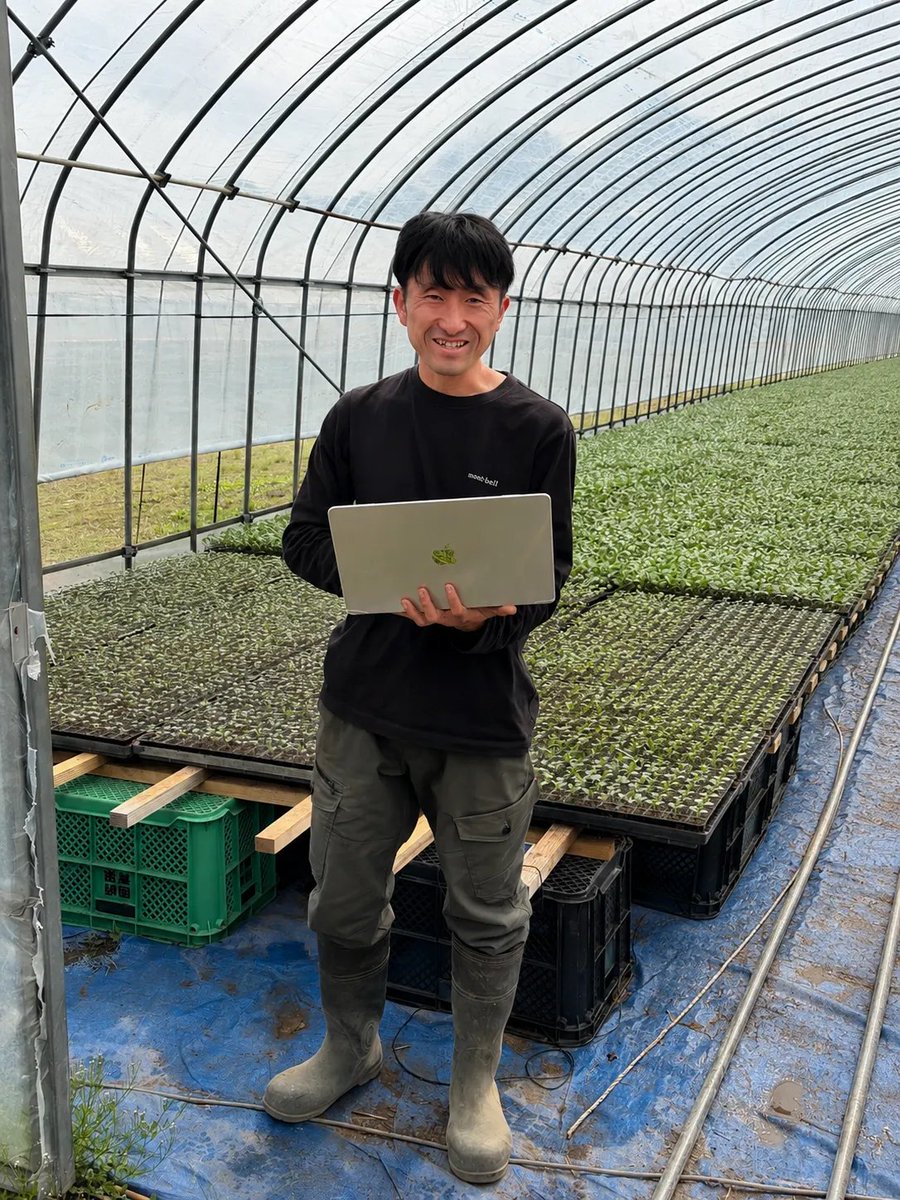
This farmer runs 100 hectares alone.
Hiroki Tomiyasu didn't grow up on a farm. Former civil servant. Never studied agriculture or computer science.
A decade ago he joined a collective restoring abandoned rice terraces in Japan. Today he single-handedly manages a 100-hectare operation in Hokkaido: broccoli, pumpkins, green onions, soybeans.
Farming at this scale is brutal: exhausting, complex, nearly impossible to staff. And traditional agricultural automation? Proprietary machines that cost a fortune, dedicated engineers. Reserved for the big players.
His read is simple: what he lacks isn't technology. It's access. The best solutions are priced for large agribusiness, not for a guy running his own fields.
So he starts building his own tools. At night, after the fields. Without knowing how to code.
What a self-taught farmer built alone:
Satellite monitoring of his plots, with a vegetation index layered over his own maps
Remote control of his greenhouse ventilation, straight from his phone
An assistant in the farm's group chat: temperatures, schedules, exact seedling counts
A database linking plots, tasks, equipment and sensors
Before buying an automatic GPS guidance system for his tractors, he first tried to understand how it worked. Then realized he could build it himself for a few thousand euros, instead of paying full price.
And this is where it gets interesting.
We move past the shiny prompts, the dashboards, the pre-written posts, toward real, operational, on-the-ground use cases. Broccoli isn't tech. Neither is the job.
What changed is that one person can now do what used to require a team, a serious budget, and engineers.
A note for the skeptics who say "you can't automate everything" or "this job is fundamentally human": the point was never to replace. It's to augment.
Tomorrow, the ones using these tools will be faster, sharper, and produce better work. Precisely because they'll be free to focus more on the human part, having offloaded the rest.
The travel agency market is huge:
€11B in France
€159B in Europe
$300B worldwide
Yet on the B2C and group-travel side, there’s still no clear market leader.
Most agencies still work like they did 30 years ago: endless emails, manual research, spreadsheets, PDFs and phone calls.
The entire workflow could be rebuilt with modern technology. But most software in the industry is still old-school, fragmented and painful to use.
AI-native Services are fighting over marketing, finance and consulting atm
Wondering about other service "niches"
@vandegans Ecole de co pas certain, ecole d'ingé surement, certaines bonnes fac aussi
l'IA rend "apprendre sur internet" plus accessible mais ca crée toujours pas mal de dispersion
Pas sur que ce soit un modèle d'apprentissage donné à tout le monde
Today, we are introducing Inkling.
Inkling reasons efficiently across text, image, and audio modalities. We are making the full weights available.
https://t.co/Ghebq5mG30
Available today for fine-tuning on Tinker. Play with it in the Inkling Playground. 🧵
For the past 30 days, I’ve been using a Mac to-do app that can turn almost anything into a task:
A screenshot.
A voice note.
A random thought.
It understands the context, creates the task, then executes it through Claude Code or Codex CLI.
the to-do list empties itself.
https://t.co/xjD7YxD374
"Anyone can build their own website using Claude" is the biggest joke I read lately
I'm seeing so many companies shipping mid websites using Claude, and their product ends up looking cheap
One of my biggest green flags in a market is hearing people say:
“AI could never replace this.”
I’ve seen this movie before.
Law firms laughed at AI.
Now they’re adopting Harvey and Legora, while AI-native firms are growing fast.
And legal is just the beginning.
Accounting.
M&A.
Compliance.
HR.
A lot of industries are still in the denial phase.
That’s when new companies come in and rebuild the workflow from scratch.
Thesis: If AI automation does what we think it can and expands gross margins on service companies by 20+ points, most of that is going to go straight to ads
Long Google and Meta
Lancer forge en self serve est une aubaine pour la distribution mais c’est super punitif :
- un mini bug / ralentissement
- un usage pas assez intuitif
- une incompréhension
Et c’est directement la fin de session pour l’utilisateur
Depuis un an je dev toutes les semaines pour apprendre.
Dans 1 mois je sors une nouvelle version de Forge.
Plus stable, plus complète et plus simple à maintenir.
Et 0 regret sur cet apprentissage à l'ère du vide coding. Pour passer de MVP à projet il fallait ces bases 👀
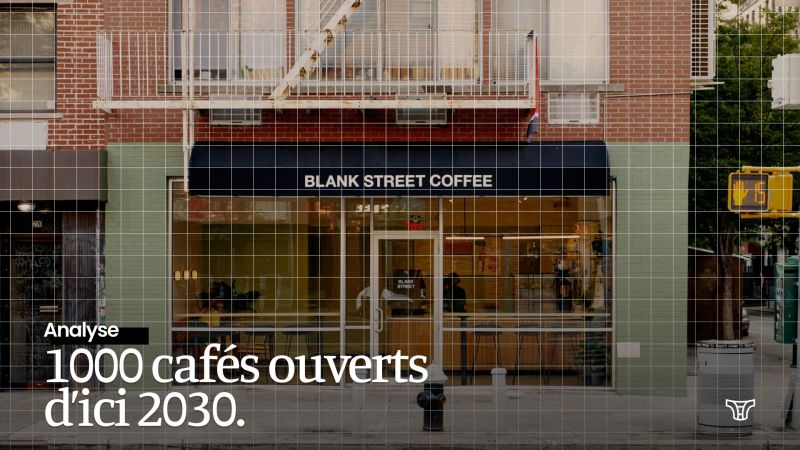
En 5 ans, ils ont fait trembler Starbucks.
Et pourtant, ils ne vendent "que" du café à emporter.
Voici comment Blank Street Coffee a ouvert 80 points de vente et vise les 1000 d'ici 2030.
Avec un modèle 30% moins cher que Starbucks… et plus rentable. 🧵
Le modèle séduit : +100M$ levés auprès de VCs
Objectif annoncé : 1000 cafés ouverts d’ici 2030
Un rappel puissant :
Même dans un marché saturé, l'excellence opérationnelle + tech + branding peut faire vaciller un géant.